
A Lake Houston weekend home can feel like a refuge until divorce turns the keys, mortgage, and repair list into shared decisions. Maybe one spouse used an inheritance for the down payment, while both paid the loan from marital income. Or the house is in one name, and the other spouse assumes that settles who owns it. In Texas, neither the name on the deed nor the fact that you used the house only on weekends necessarily answers the property question.
For families in Atascocita, Humble, and northeast Harris County, the house may also carry flood, insurance, dock, and upkeep concerns that a typical property division overlooks. The practical starting point is to identify what each spouse can prove, then value the house and compare realistic ways to resolve it.
Community or Separate Property on the Lake
A Lake Houston house can have more than one property character. A spouse may have brought the down payment from an inheritance, while marital earnings covered mortgage payments and improvements. Texas law asks what funds acquired the property and whether those funds can be traced. The name on the deed alone does not decide the answer.
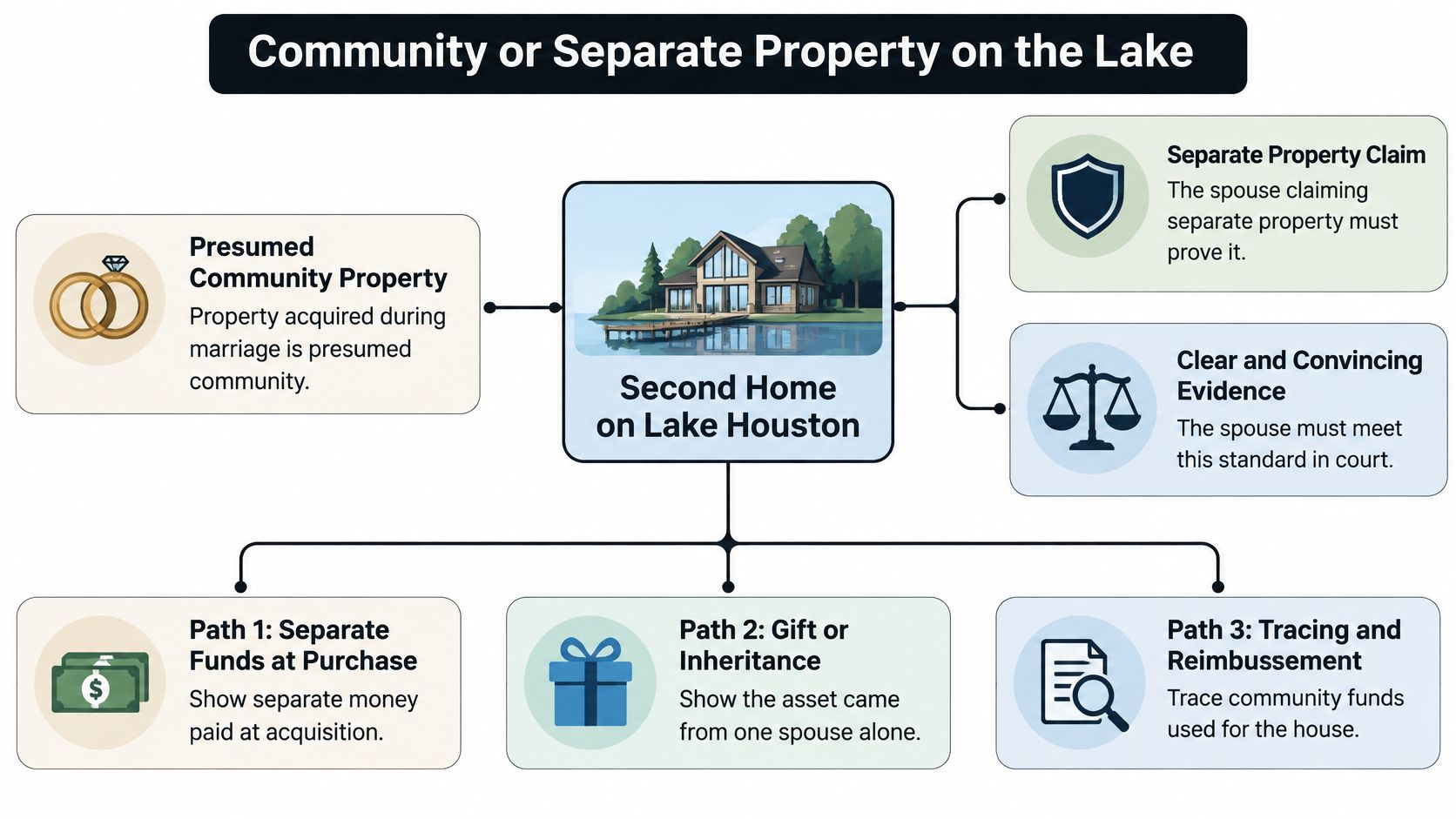
Three patterns to recognize
First, a house bought during marriage with marital earnings. Texas presumes property acquired during marriage is community property. If a couple buys a Lake Houston weekend home with community earnings, it is generally community property even if only one spouse is named on the deed or uses the house on weekends. Each spouse has an undivided half interest in community property, but a court divides the community estate in a just and right manner. That does not mean every asset is automatically split down the middle.
Second, a house owned before marriage or received by gift or inheritance. A home acquired before marriage or received as a gift or inheritance can remain the recipient's separate property. Community money used for mortgage principal, property taxes, or improvements may support a reimbursement claim. Reimbursement seeks repayment for the community estate's contribution, but does not by itself create an ownership share in the house. If the owner added the other spouse to the deed, that spouse may argue the transfer was a gift, making the deed and related records important.
Third, a purchase funded from both separate and community sources. A spouse might use premarital savings for the down payment while the couple pays the mortgage from earnings during marriage. The separate contribution must be traced, and community payments may support a claim related to principal reduction or reimbursement. Closing papers, bank records, and payment history help show where the money came from. Rental income from a separate lake house earned during marriage is generally community property.
Consider a Humble spouse who inherits money in 2014 and uses some of it for a Lake Houston house down payment. The couple then makes mortgage payments with community earnings for years. The inheritance may support a separate-property claim, while the community payments still need to be accounted for. Treating the entire home as solely separate or community property can overlook those distinct contributions.
| Label | What must be shown | Lake Houston example | What the other spouse may still claim |
|---|---|---|---|
| Community | Acquired during marriage, or presumption not overcome | Weekend house bought in 2019 with joint earnings, one name on the deed | Half of the equity, subject to debts |
| Separate | Clear tracing to premarital funds, inheritance, or gift | House owned before the wedding, never retitled | Reimbursement for community mortgage, taxes, or improvements |
| Mixed | Separate down payment plus community debt paydown | Inheritance down payment, then a community mortgage | A traced separate fraction plus a community share of principal reduction |
Ownership labels can be confusing because community property versus joint tenancy describes different legal concepts. This plain-language guide explains why they are not interchangeable: community property versus joint tenancy. For help understanding how Texas rules apply to divorce, see the Atascocita property division service.
The proof standard is demanding. A court needs a clear record, not only a spouse's recollection. Deeds, closing papers, bank statements, inheritance or gift documents, and loan-payment history can help establish tracing and support a defensible accounting.
How to Value and Document the House
A useful property packet starts with public records and builds toward a current market value. Work through the steps in order so you can see both the likely equity and any gaps in the ownership story.
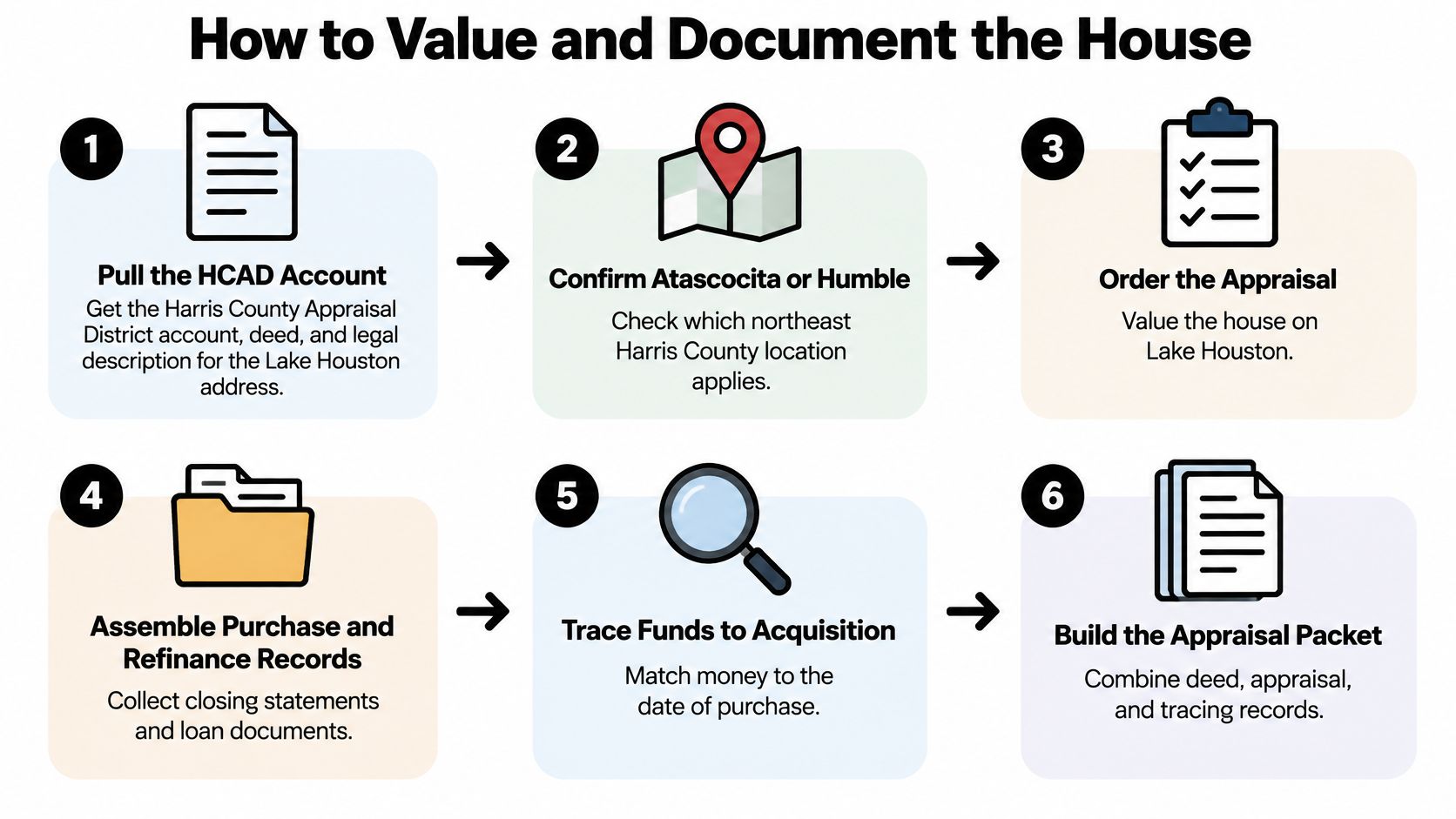
Build the record and find the value
Confirm the property identity. Pull the Harris County Appraisal District account, deed, and legal description for the Lake Houston address. Confirm whether the property is in Atascocita, Humble, or another nearby taxing area. A mistaken address or parcel can lead you to the wrong record.
Get every loan statement. Order the current mortgage, home-equity line of credit, and escrow statements. Check the balances, interest rates, and names of everyone obligated on each loan. A forgotten HELOC can make apparent equity look much higher than the amount the spouses would divide.
Collect the purchase and source-of-funds records. Find the closing file, bank statements for the down payment, inheritance or gift papers, and a payment ledger if one spouse claims a separate contribution. Without a bank trail, a sincere claim about the source of funds may be difficult to prove.
Document the lakefront condition and carrying costs. List flood insurance, wind or hail claims, elevation issues, HOA dues, and repairs that are pending. Note the condition of the dock, pier, and bulkhead. A waterfront property with repair needs shouldn't be treated as though it's in the same condition as a comparable house in good repair.
Get an appraisal suited to the property. Hire a licensed appraiser familiar with Lake Houston comparables. Ask for an as-is value and, if the dock, pier, or bulkhead needs work, an estimate of the cost to cure. A tax appraisal is useful for identifying the parcel, but it isn't a substitute for a current market appraisal.
Calculate equity, then account for characterization. Start with the appraised value and subtract liens. Then apply any traced separate fraction or reimbursement claim. Don't treat the full value, or even the full equity, as the amount either spouse is automatically entitled to receive.
Prepare to exchange the packet. Organize the deed, loan statements, appraisal, insurance records, repair information, and tracing documents for discovery or mediation. Bring a proposal for sale, buyout, or offset, with a clear refinance deadline if one spouse wants to keep the house.
Keep the property stable while the case is open. Don't move money, change title, or stop insurance without legal advice. A sudden change can create new disputes, and a policy lapse can leave both spouses exposed to a serious loss.
A complete packet before the first mediation should let the spouses compare the current value, total secured debt, likely repair costs, insurance and HOA obligations, and any documented separate contribution. If you're assessing a waterfront lot or house for divorce, the Atascocita waterfront valuation guide offers a local point of reference for the valuation issues to consider.
Sale Buyout or Partition for a Lake Houston House
For a couple in Atascocita or Humble who can't both keep the keys, the right option depends on the divisible share, the appraised equity, and whether either spouse can carry the property. Compare the options using the community interest or properly traced mixed-property share, not just the whole amount printed on the deed.
| Option | Who keeps the house | How equity is paid | Best when |
|---|---|---|---|
| Sell and split net proceeds | Neither spouse | Cash at closing after liens, commission, and costs | Neither can afford the note or both want liquidity |
| Buyout with refinance or cash | One spouse | Appraisal equity paid by refinance, savings, or a note | One spouse can qualify for the loan and wants to keep the lake house |
| Offset against other marital assets | One spouse | Other spouse receives more retirement, cash, or the primary home | Equity is real but cash and lending are tight |
| Court-ordered partition | Usually sold by court process | Sale proceeds divided by ownership shares | Spouses cannot agree and one blocks sale or refinance |
What each option asks of you
Sale can give both spouses a clean break, but the bills don't stop just because the property is listed. The mortgage, taxes, insurance, and HOA dues still need to be paid through closing. At the end, the spouses divide net proceeds after liens, any HELOC, commission, and closing costs.
Buyout requires a current value and a workable payment plan. One spouse may refinance or pay cash for the other's share, and mediation may address a selling-cost adjustment in the calculation. Don't sign off on a transfer without resolving how the loan will be handled.
Offset can avoid a large cash payment. The spouse keeping the lake house might give the other spouse more retirement assets, cash, or the primary Atascocita home. Both sides should compare values carefully, especially when different assets carry different tax or liquidity consequences.
Partition is a separate civil lawsuit when the owners can't agree on what to do with jointly owned property. It can take longer, becomes public, and may result in a forced sale. A second home isn't the Texas homestead, so a court can order its sale more readily than it could for a primary residence.
For legal assistance with the division of community property and complex assets in an Atascocita divorce, see the Property Division Lawyer in Atascocita service.
Taxes Mortgage and Insurance After the Split
The net-proceeds surprise is often that a house's apparent equity doesn't equal the cash either spouse takes home. Liens and transaction costs reduce the amount available, and a later sale may have tax consequences that a divorce transfer doesn't.
Tax basis and the loan
A transfer of the house between spouses as part of a divorce is generally not treated like a taxable sale at that moment. A later sale of a second home, however, doesn't receive the primary-residence exclusion, so a large gain may matter if the property's tax basis is low. Ask a tax professional to calculate basis using the original purchase price and qualifying capital improvements, such as a new roof or bulkhead, and to account for depreciation if the property was rented.
A refinance is often the practical gate for a buyout. The spouse keeping the house usually needs to refinance to remove the other spouse from responsibility for the mortgage. Qualifying for the loan on one income can be the point where a proposed buyout fails. If the loan remains joint, a missed payment can hurt both spouses' credit, even if one no longer uses the property.
Ongoing costs and decisions to make
Flood and hazard insurance, property taxes, HOA dues, and utilities continue while the divorce is pending. Temporary orders can set who pays those bills and who may use the house on weekends. Keep renewal dates and tax due dates on a calendar, and don't let a policy lapse on a flood-prone Lake Houston property. The loss could far exceed the equity dispute.
For local considerations around a house's elevation and flood coverage during divorce, review the Atascocita home elevation and flood insurance guide.
Before signing a mediated agreement, ask the lender whether the proposed borrower can qualify and when the other spouse can be released from the loan. Ask the CPA to estimate the tax basis and possible gain on a future sale, including the effect of rental depreciation. Confirm who pays each carrying cost until transfer or sale, and make sure the agreement says what happens if the refinance doesn't close.
Harris County Timeline from Filing to Decree
Say an Atascocita couple agrees that the lake house needs attention but disagrees about whether one spouse can keep it. The divorce follows a sequence, and the house may need temporary ground rules before the spouses finish valuing it or negotiating a permanent outcome.
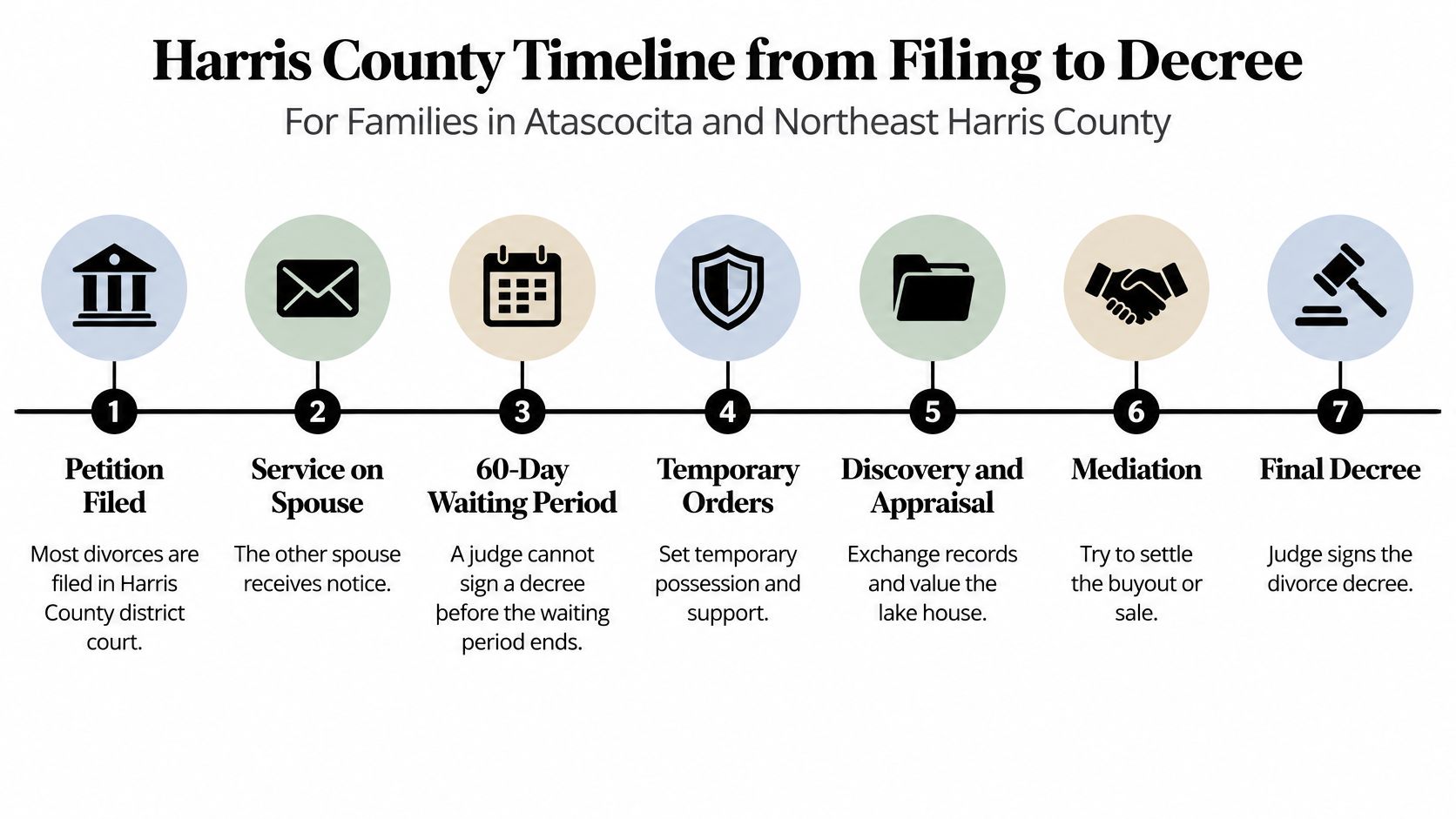
Most divorces for families in this area are filed in Harris County district court. After filing and service, Texas has a 60-day waiting period before a judge can sign a final decree. An uncontested case with a signed agreement may finish in a few months, but a dispute about value or tracing can take much longer.
From filing to a decision
Petition filed. One spouse files the divorce petition, beginning the case. The pleadings put the court on notice that there's a divorce and identify the issues the spouses need to resolve.
Service on the other spouse. The other spouse receives formal notice. If the couple agrees, an appropriate waiver may avoid formal service, but the paperwork still needs to be handled correctly.
Waiting period. The judge can't sign the final decree before the waiting period ends. That doesn't mean the spouses must wait to address bills, access, or protection of the property.
Temporary orders. If the spouses can't agree about the lake house while the case is pending, temporary orders can set who may use it, who pays the note and insurance, and whether it may be listed. For a weekend property, put the rules in writing rather than relying on an informal understanding that can break down.
Discovery and appraisal. Contested cases may involve sworn inventories, document requests, an appraisal, and review of the purchase and payment records. A year or longer can be common when the house's value or separate-property tracing is disputed.
Mediation. Many Harris County courts expect mediation before trial. This is often where the spouses put a sale price, buyout figure, or refinance deadline into a written settlement.
Final decree. If the spouses settle, the decree records their agreement. If they don't, the judge divides community property in a just and right manner. A court may divide it unequally when fault, disparity, or waste is proved, while confirmed separate property remains with its owner.
Local counsel familiar with the courts, judges, and legal environment of Atascocita and surrounding counties can help anticipate inventory deadlines and mediator lists. If a divorce property ruling doesn't resolve co-ownership, partition is a separate lawsuit, not just another step in the divorce. Keep insurance renewals and tax due dates on the calendar while the case moves forward so a missed payment doesn't damage the house or add a new dispute.
Book a Free Atascocita Consultation
Don't wait to get advice if your spouse is about to list or refinance the lake house, your separate-property claim depends on old bank records, flood damage or a lapsed policy is involved, or you can't agree on a sale versus a buyout. Acting before someone signs a listing agreement or moves money out of a house account can help preserve choices and avoid preventable disputes.
A consultation is a planning meeting, not a commitment to take the case to trial. The Law Office of Bryan Fagan serves families in Atascocita and across Harris County from its Humble office at 7702 FM 1960 Rd E, Suite 212, Humble, TX 77346, a short drive for Atascocita and Lake Houston clients. The initial consultation with an Atascocita attorney is free.
Bring the deed, latest mortgage statement, insurance declaration, and any inheritance or gift records you have. The firm's property-division practice addresses community property and complex assets, including a second home. You can call 281-519-3083 or complete the firm's online contact form to schedule.
Schedule your free consultation before signing a listing agreement or moving money out of a house account.
The Law Office of Bryan Fagan – Atascocita TX Lawyers helps Atascocita and Humble families understand property division, document a Lake Houston house, and plan for a practical resolution. Visit Law Office of Bryan Fagan – Atascocita TX Lawyers to take the next step toward a free consultation.