You're sorting out who stays in the house, how to manage the children's routines, and what you can afford after separation. Then an HOA notice arrives at your Atascocita home, perhaps addressed to the spouse who has already moved out. It's understandable to think the balance can wait until the divorce judge decides who gets the property.
An Atascocita HOA foreclosure during a pending divorce needs a coordinated response. The immediate task is to protect the home without giving up objections to improper charges or creating another dispute between spouses. Start with the documents, identify the next deadline, and put the association's collection process and your divorce obligations on the same calendar.
Why an Atascocita HOA Lien Does Not Wait for the Decree
A pending divorce doesn't suspend HOA lien enforcement, and a temporary order assigning payment responsibility doesn't cancel the association's lien. Say a couple in a Harris County subdivision near Lake Houston files for divorce. One spouse moves out, and both assume the unpaid assessment will be handled in the decree. Meanwhile, the association continues collecting.
The distinction between a filing and an actual foreclosure sale matters. The Texas House interim report on property owners' associations explains the difficulty of measuring HOA foreclosure activity, including distinguishing court filings from completed sales.
Current counts show why notices deserve attention. According to Cotality, Texas recorded 36,194 homeowners-association liens in 2025, a 46% increase over three years. Separately, AMI House Buyers' compilation of data attributed to the Harris County Clerk reports 6,586 Harris County foreclosure filings in 2024.
What waiting can cost
Those figures aren't an Atascocita prediction, and they aren't all HOA sales. Your risk comes from your account, notices, governing documents, and procedural stage.
Waiting can leave less equity available for division, threaten credit and housing stability, and reduce the time available to sell or refinance. If neither spouse monitors insurance, a lapsed policy can add another problem. A related issue, an Atascocita MUD tax lien and a divorce decree, also deserves separate attention when reviewing property debts.
Run this same-day self-check:
- Notice status: Have you received a delinquency notice or a recorded lien?
- Balance: Do you have an itemized account ledger?
- Enforcement: Has a lawsuit been filed or a sale date posted?
Use the deadline table to match your documents to the stage that needs action.
Notice and Redemption Deadlines to Track in Harris County
Keep this reference beside your HOA file. Read each row by identifying the triggering event, finding proof of its date, and recording what must happen next. Don't calculate from the day you happened to open an envelope if the governing rule uses the mailing date.
The Texas State Law Library's HOA foreclosure guide explains that an association generally must send two delinquency notices, with the second sent by certified mail, and generally must wait at least 90 days after that notice before filing an assessment lien. The guide also explains that a Chapter 209 assessment lien generally requires an expedited or judicial foreclosure order unless the owner provides a written waiver.
HOA foreclosure notice and redemption timeline
| Stage | What the rule requires | Timing |
|---|---|---|
| Delinquency notices | Association sends two notices before filing a lien; the second is sent by certified mail | Second notice must precede the lien filing |
| Lien filing | Assessment lien may be filed only if the governing documents authorize it | No sooner than 90 days after the second notice |
| Foreclosure authority | Expedited or judicial foreclosure order, or the owner's written waiver | Required before any sale |
| Post-sale notice | Written notice of sale date and redemption rights sent by certified mail to the former owner and recorded lienholders | No later than 30 days after the sale |
| Affidavit recording | Association records an affidavit of notice in the county real-property records | Within 30 days after the notice is sent |
| Redemption period | Former owner may redeem by paying the statutory amounts, including assessments, interest, costs, and attorney fees | Up to 180 days after the post-sale notice |
For the post-sale requirements, Texas Property Code section 209.010 requires certified mail, return receipt requested, to the former owner and each recorded lienholder no later than the 30th day after the sale, followed by recording the affidavit within 30 days after sending that notice. The Texas Legislature's Property Code materials provide the statutory framework for redemption, including the former owner's period of up to 180 days after the association mails the post-sale notice.
The dates that deserve special attention
The early certified notice and the post-sale mailing are easy to mishandle when spouses maintain separate households. The early notice affects when the association may file its lien. The post-sale mailing affects the redemption calculation, so the sale date alone isn't enough.
Pull the recorded affidavit of notice from the Harris County real-property records. Compare its stated mailing date and legal description against the notice, envelope, and association records. Bring discrepancies to counsel rather than assuming an apparent defect automatically restores ownership.
Calendar safeguard: Don't sign an owner's foreclosure waiver simply to make the paperwork disappear. Have counsel explain what protection you're giving up.
Court response deadlines also need separate calculation. MatterAlert's explanation of how court holidays shift filing deadlines is a useful orientation, but counsel should verify the rule governing each particular filing.
This timeline doesn't replace the declaration, actual notices, or court papers. Write every date from the association file onto a shared calendar that both spouses and both attorneys can access, through counsel where direct communication isn't appropriate.
First-Week Steps and the Moves That Help the HOA
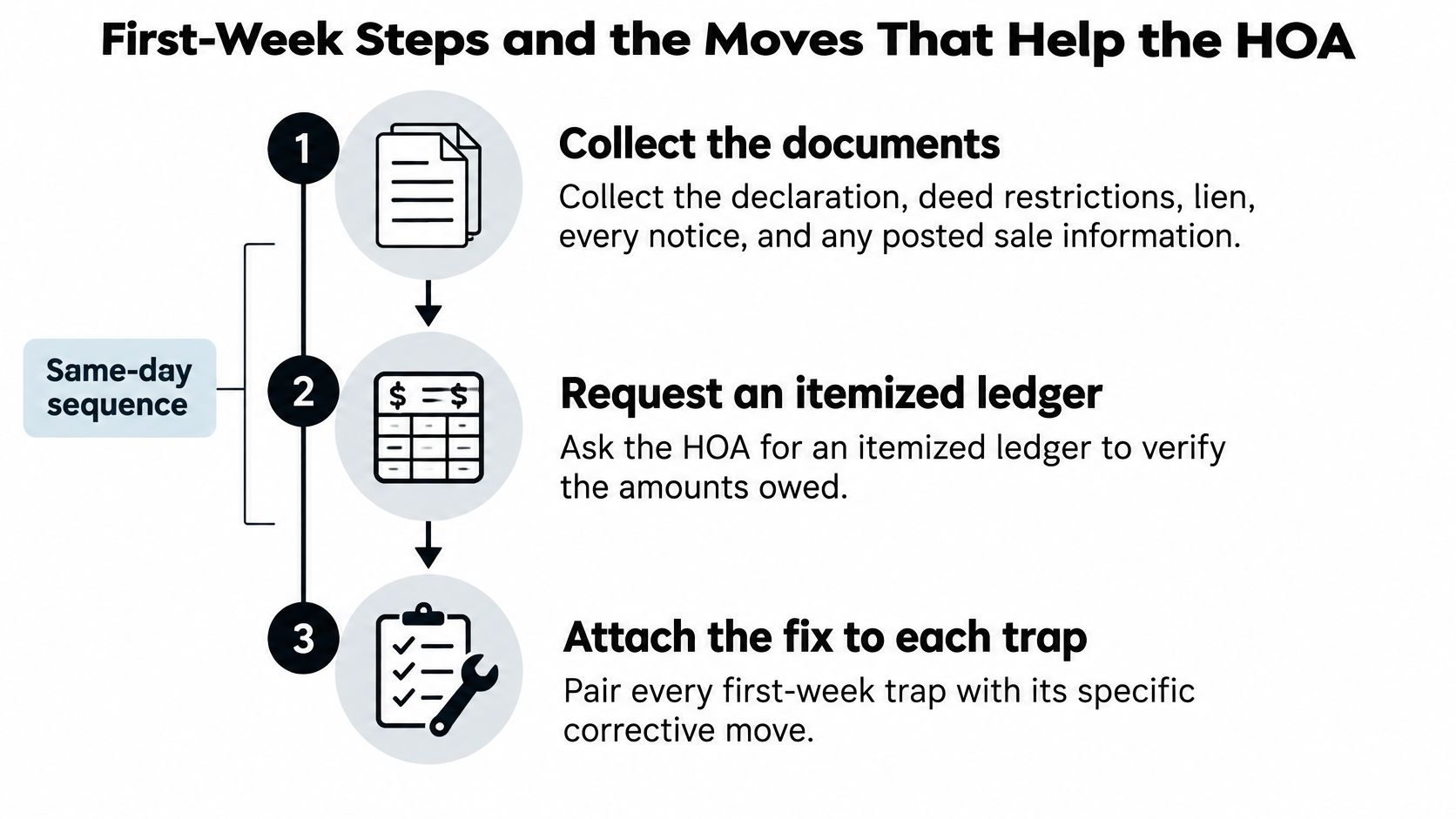
Finish the first week with an organized file, a clear enforcement-stage assessment, and one written response to the association. Missed notices and unclear account balances can make it harder to challenge collection activity or negotiate a workable property decision.
Use the steps below to coordinate the HOA matter with the pending divorce. You can begin checking records before hiring counsel. A posted sale or served lawsuit calls for immediate legal review, so do not wait to complete every step first.
Start with records and verification
Request an itemized account. Ask the association in writing for the current balance and payment history. Keep its response with the notices you have received, and retain the envelopes and certified-mail records. If a spouse has moved out, update the association's mailing information in writing, confirm where future notices will be sent, and check that mail regularly. This gives both spouses and counsel a reliable account of what has arrived and when.
Separate the charges before discussing payment. Sort the claimed balance into assessments, late charges, fines, attorney fees, and other costs. Compare each category with the governing documents and flag charges that need legal review. An amount on the association's ledger is a claim to examine, not proof that every charge is collectible. A Houston Press examination of an HOA collection dispute illustrates why homeowners should review the account rather than treating its total as self-explanatory.
Identify the enforcement stage. Mark whether the matter involves a delinquency notice, a recorded lien, a filed lawsuit, or a posted sale. Save any case number, court information, and sale documents where counsel can locate them quickly. A routine reminder and a sale notice call for different responses. If the documents leave the stage unclear, ask the association's representative to explain it in writing.
Check the other costs of keeping the home. Confirm the mortgage status, property taxes, insurance coverage, and urgent repair needs using current statements and insurer confirmation. A spouse's recollection that bills are current is not a substitute for checking the records. For an Atascocita or Humble household balancing separation expenses, paying the HOA while overlooking another obligation could leave the property exposed.
Move from information to an enforceable plan
Ask counsel about temporary orders. Under Texas Family Code section 6.502, temporary orders may allocate responsibility for the mortgage, HOA, taxes, insurance, and repairs. Make the requested terms specific: identify payment dates, how the spouses will exchange proof of payment, and what happens if the assigned spouse cannot pay. A general instruction to handle household bills gives less direction than a defined list of duties. Law Office of Bryan Fagan attorneys handle divorce steps from jurisdiction and filing through negotiation and finalization. They can also write discovery requests and responses to obtain information about assets and finances when voluntary exchanges do not provide enough detail.
Compare the available resolutions. Consider an agreed payoff or payment plan alongside refinancing, selling, or seeking a court-authorized disposition. A payment arrangement may preserve cash, but it will not solve the problem if the household cannot sustain it. Selling may protect remaining equity, though access, repairs, and closing require cooperation. Before signing a waiver, settlement, or payment plan, get both spouses' written approval and counsel's review, or an appropriate court order.
Assign every follow-up task to a named person and record when that person must report back. Confirm payoff terms, any agreement to pause enforcement, and the association's lien-release arrangements in writing. An order between spouses assigning payment responsibility does not establish that the HOA account has been resolved.
For the divorce inventory, keep payment documentation in one place with the related financial records. Preserve purchase documents and records showing the source of funds, too. Classify the home by when and how it was acquired, not by whose name appears on the deed. That distinction helps counsel assess the proposed resolution and identify each spouse's claims to preserve.
Who Controls the Home and HOA Payments Until the Decree
While a divorce is pending, the association may continue pursuing unpaid assessments even as the spouses dispute ownership, possession, or responsibility for the account. That creates an authority gap: someone must address the lien, but neither spouse should assume they can bind the other to a settlement or new obligation. Counsel should treat this as a civil lien-enforcement matter with its own procedure.
What the association must establish
The Texas State Law Library's property owners' association foreclosure guide explains that assessment-lien authority must appear in the governing documents. If foreclosure is authorized, the association may pursue judicial foreclosure in the county or district court where the property is located. After judgment, a sheriff or constable conducts a public auction under Texas Rule of Civil Procedure 309.
The guide also discusses Inwood North Homeowners' Association v. Harris, the 1987 Texas Supreme Court decision holding that homestead protection under Article XVI, section 50 does not prevent foreclosure for unpaid HOA assessments. Review the declaration, the debt supporting the claim, and the procedure the association is using. The pending divorce does not, by itself, resolve whether the lien is valid or stop its enforcement.

Set limits in the interim agreement
Use the temporary-order step in Section 3 to address immediate responsibilities. The interim agreement should focus on the authority those orders may not settle: who can speak for the household, approve terms, and make decisions affecting the property.
Specify whether either spouse may communicate with the association on behalf of both, and whether an agreement requires both spouses' written approval. Distinguish routine preservation payments from accepting disputed charges, waiving objections, or creating new obligations. State how the spouses will handle a proposed settlement or payment arrangement, and whether either may sign without the other's consent or a court order.
Keep the approval rule workable. A restriction that requires joint consent for every association contact can stall routine administration; a rule that lets one spouse accept any terms can expose the other to obligations they did not approve. Define which decisions need joint approval and which routine steps either spouse may take under the agreement.
Texas family law also limits certain intentionally harmful one-sided dealings. A community-property transfer, or a debt incurred during the pending divorce that exposes the other spouse or community property to liability, can be void as to that spouse if made with intent to injure their rights. The rule is fact-specific. Do not assume every unilateral transaction automatically disappears.
For a Lakeshore household planning an eventual ownership change, review HOA transfer issues after a Lakeshore Atascocita divorce as part of the closing and decree checklist. Identify who will obtain account information, complete association paperwork, and confirm the transfer. A signed decree alone does not complete the association's property-transfer process.
Whether Paying HOA Dues Creates a Reimbursement Claim
Suppose one spouse owned an Atascocita home before marriage, and the other spouse paid recurring HOA dues and a special assessment from a joint account during the marriage. Those payments may support a reimbursement claim, but they do not guarantee a credit to the spouse who made them. The outcome depends on the funds' source, the obligation paid, the property or estate that benefited, and any agreement about the expense.
Texas reimbursement analysis can include community funds used for expenses associated with a spouse's separate property. Characterization, tracing, agreements, and the final division all matter, as explained in this discussion of Texas reimbursement rights and marital-property agreements. The deed alone does not resolve the accounting, and regular dues may be treated differently from an assessment with a distinct purpose.
For example, if the joint-account payment covered ordinary HOA dues, the analysis focuses on the community funds used and the benefit to the property. If a separate charge funded an amenity or improvement, its purpose may affect the analysis. An HOA amenity assessment in a Balmoral Atascocita divorce is a reason to examine the charge itself rather than combine every payment into one total.
Preserve the property without surrendering the accounting
A temporary agreement or court order can state how the spouses intend to treat an HOA payment, such as a preservation expense or a proposed reimbursable advance. In the example above, calling the special assessment a proposed advance records the spouse's position, but the label does not establish entitlement to reimbursement. Counsel should match the wording to the facts and preserve any appropriate objection to the lien or collection procedure.
Homestead status does not resolve the accounting or replace review of the declaration, lien history, property circumstances, and procedural compliance. Redemption after a sale may also require substantial funds while leaving mortgage priority, costs, possession, and marital accounting unresolved.
The decision is practical as well as legal. Compare the immediate cost of preserving the home with the strength of the disputed charge and the household's ability to fund a lasting solution. If an urgent payment includes a contested fee, address the objection in writing rather than assuming payment preserves it automatically.
Schedule Your Free Consultation Before the Next Notice
Schedule a free initial consultation with an Atascocita attorney this week so the HOA file and pending divorce can be reviewed together. You don't need to arrive with every legal question answered. Bring the documents you have and identify any missing records, served papers, or posted sale information immediately.
The purpose is to determine what needs attention first: a response in the civil case, an association negotiation, temporary family-law relief, or a coordinated property decision. A useful consultation connects the next procedural deadline to what you can realistically afford.
Bring a file that shows the whole picture
- Association documents: The declaration, deed restrictions, ledger, notices, recorded lien, and posted sale information.
- Household obligations: Your mortgage statement, tax information, and proof of insurance.
- Divorce papers: The petition, existing orders, and proposed temporary-order language.
- Payment history: Receipts, bank records, and a list of payments either spouse has already made.
Our divorce attorneys have local experience with the courts, judges, and legal system of Atascocita and surrounding counties. They can evaluate temporary-order needs alongside property division, child custody, and spousal support, rather than treating the house as separate from the family's finances.
If you and your spouse agree on most issues, an uncontested divorce may offer a practical route to documenting your agreement. The Divorce Lawyer in Atascocita, TX page provides information about divorce representation for Atascocita and Harris County residents.
Visit the Atascocita office
Our listed office is 7702 FM 1960 Rd E, Suite 212, Humble, TX 77346. You can contact the firm online or visit the Atascocita office to arrange your consultation.
The next notice may be the one that sets an important clock. Scheduling now helps you identify the deadline, assign responsibility, and keep workable options open.
Law Office of Bryan Fagan – Atascocita TX Lawyers offers divorce representation that addresses property division and the family-law decisions surrounding an HOA-threatened home. Visit Law Office of Bryan Fagan – Atascocita TX Lawyers to schedule your free initial consultation at the Atascocita office, and bring your HOA notices and divorce papers so we can help you plan your next steps.