Your tenant in Atascocita is halfway through the lease. Your spouse sees the rent deposits, you're still paying the mortgage, and a repair request arrives just as you're discussing divorce. You need to protect your finances without turning someone else's home into the center of the dispute.
An Atascocita rental home with a tenant in a divorce involves overlapping questions: who owns the property, who manages it while the case is pending, and what the landlord still owes the tenant. The practical answer starts with preserving the lease, documenting the money, and putting management responsibilities in writing.
What to Do First With the Tenant Still in Place
Filing for divorce doesn't cancel a fixed-term lease, change the rent, or erase repair duties. For an owner in Atascocita or Humble, the immediate task is to keep ordinary property operations working while counsel evaluates ownership and division.
Don't start by dividing the latest rent deposit. A Harris County property-division appeal illustrates why current condition and operating evidence matter: flooding made rental properties uninhabitable and materially changed their income. Yesterday's rent history doesn't establish what's available to spend today.
Put the first week in order
- Gather the tenant file. Save the signed lease, renewal documents, rent ledger, deposit receipt, notices, and repair history. Download records from payment platforms before anyone changes account access.
- Pause discretionary transfers. Don't empty the rental account or stop necessary payments. Through an agreed arrangement or counsel, identify who can collect rent and authorize expenses.
- Send a businesslike management note. Give the tenant consistent payment and repair instructions. Don't involve the tenant in allegations about your spouse.
- Leave possession alone. Don't change locks, interrupt utilities, or pressure the tenant to move because you want a simpler divorce.
- Fund the next bills. List the mortgage, taxes, insurance, repairs, and management charges. Put responsibility for them in a written agreement or proposed temporary orders.
First moves for a tenanted Atascocita rental
| Situation | Texas rule | First move |
|---|---|---|
| Fixed-term lease still running | A divorce filing doesn't cancel the lease, change rent, or remove repair duties | Keep the written terms and send consistent rent-and-repair instructions |
| Rent unpaid or tenant holding over | Property Code Chapter 24 generally requires at least three days' written notice to vacate unless the lease sets a different period | Follow the lease and notice process, not a divorce-based eviction shortcut |
| Title may change hands | Property Code §92.105 places deposit responsibility on the new owner and requires a signed acknowledgment | Document the deposit amount and handoff in writing |
| Only one name is on the deed | Family Code §3.003 presumes property possessed by either spouse is community property | Collect the deed, closing file, and rent records before claiming separate ownership |
| Spouses expect a 50/50 split | Family Code §7.001 requires a just and right division, not an automatic half | Calculate equity, debt, and carrying costs |
| Rent is used in support talks | Family Code §8.055 addresses net rental income after operating expenses and mortgage payments, excluding depreciation | Prepare an income-and-expense sheet rather than quoting gross rent |
The tenant needs a functioning landlord now, not just an eventual judgment. Temporary management arrangements often provide the day-to-day stability that the final decree alone can't provide.
Lease Notices and the Security Deposit
Treat the lease as its own contract, not as an attachment your divorce can rewrite. Identify the landlord named in the document, any authorized property manager, and the address or method designated for notices. Preserve messages showing when rent arrived, when repairs were requested, and how anyone responded.
A tenant shouldn't have to decide which spouse is telling the truth. If conflicting instructions have already gone out, have counsel help resolve authority before sending another demand for payment. Keep family accusations out of tenant communications.
A fight between spouses doesn't shrink the tenant's rights.
Follow the lease calendar
Under Texas Property Code Chapter 24, a landlord generally must provide at least three days' written notice to vacate before filing a forcible-detainer action against a defaulting or holdover tenant, unless the written lease sets a different notice period. That notice is part of a legal process, not permission to remove the tenant yourself.
For Humble and Harris County owners, repair and habitability responsibilities continue while property negotiations unfold. Keep a dated repair log, contractor invoices, access communications, and photographs when appropriate. If a tenant reports a problem, respond through the established management channel rather than postponing it until the spouses agree about ownership.
A proposed sale also requires coordination. Review the lease's access and showing provisions before promising a broker unrestricted entry or telling a buyer the home will be vacant. The firm's Atascocita eviction guidance is a relevant resource when possession issues arise alongside divorce.
Make the deposit handoff explicit
The security deposit isn't a rent distribution or a buyout payment. The ownership-transition rule in Property Code §92.105, identified in Affordable Housing Online's Houston housing resource, makes the new owner responsible for the deposit and requires a signed statement acknowledging acquisition and the deposit amount. The former owner can remain liable until responsibility is transferred or assumed.
Don't assume that awarding the house automatically completes every tenant-facing step. Prepare a handoff file containing:
- Deposit accounting. Record the balance and any lawful deductions already documented.
- Custody of funds. Identify where the money is held and how it will move.
- Future rent instructions. State the authorized recipient, payment method, and effective date.
- Repair authority. Name the person who coordinates contractors and lawful entry.
- Insurance status. Confirm who is responsible for maintaining appropriate coverage.
Keep the signed acknowledgment with proof of delivery and the financial transfer record. A decree allocating responsibility between spouses and a statement delivered to the tenant serve different practical purposes.
Get legal advice before an eviction, lease termination, or promise that contradicts the lease. Trying to create vacant possession informally can add a landlord-tenant dispute to an already difficult family-law case.
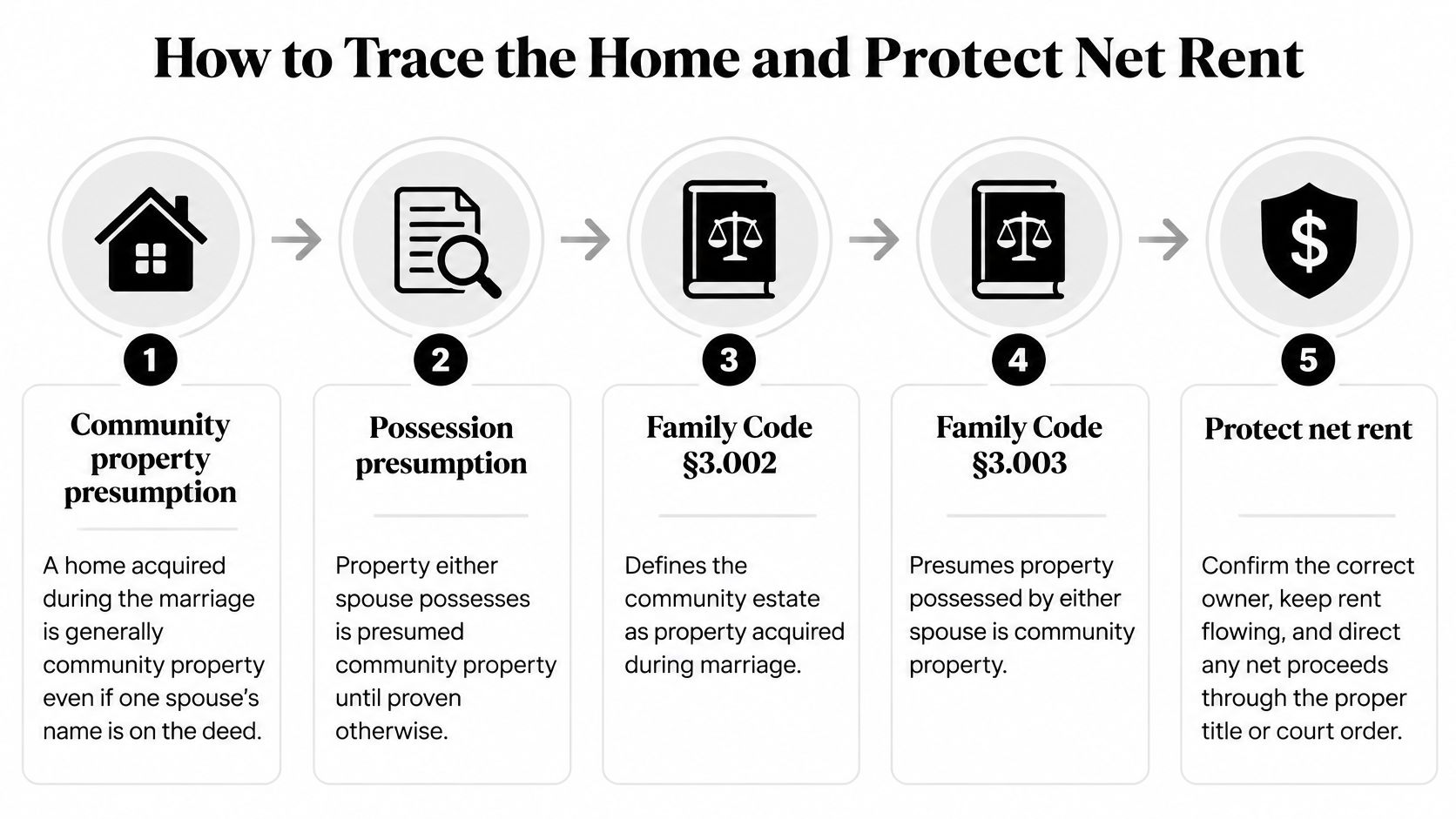
How to Trace the Home and Protect Net Rent
“My name is on the deed” and “I bought it with my inheritance” are starting points, not complete ownership analyses. The acquisition documents and movement of money must support the claim.
Texas Family Code §§3.002 and 3.003 generally classify property acquired during marriage as community property unless it is separate property, presume property possessed by either spouse is community property, and require clear and convincing evidence to establish separate ownership. A deed naming only one spouse doesn't resolve those questions.
Build a traceable ownership file
Start with the purchase, then follow the transactions forward. Don't begin with a conclusion and search only for records that support it.
- Record acquisition details. Identify when the property was acquired, how title was taken, and the claimed source of the purchase funds.
- Collect original documents. Obtain the deed, closing disclosure, mortgage and refinance papers, tax returns, bank statements, invoices, and lease.
- Schedule major transactions. Track the down payment, mortgage principal reductions, capital improvements, and any refinance or sale proceeds.
- Reconcile rental activity. Match gross rent, deposits, operating expenses, owner distributions, and post-separation receipts to account statements.
For example, say an Atascocita owner claims an inheritance funded the purchase. The useful evidence connects the inheritance receipt to the account, the transfer, and the closing payment. A statement that the money “must have come from the inheritance” leaves a gap.
A Texas appellate decision addressing tracing explains why unsupported testimony and commingling can defeat a separate-property claim, and recognizes that rent generated during marriage may be community property even when the property itself is separate. Ownership of the house and characterization of its income aren't necessarily identical.
Keep ordinary repairs separate from capital improvements in your schedule. Replacing a broken component and substantially improving the property may raise different accounting and reimbursement questions. Preserve the invoice and payment source rather than relying on a description in a personal spreadsheet.
For mixed personal and rental accounts, the firm's explanation of commingled bank account tracing in an Atascocita divorce provides relevant context for organizing the records.
Calculate income for the question being asked
Under Texas Family Code §8.055, maintenance calculations include net rental income after operating expenses and mortgage payments, excluding noncash items such as depreciation. That's not the same as the deposit appearing in your banking app.
Consider a hypothetical monthly rent of $1,800, used only as a teaching example. Before calling that amount available income, reconcile the mortgage payment, taxes, insurance, repairs, and management charges. If taxes and insurance are escrowed through the mortgage payment, don't subtract them again.
For forward-looking ownership decisions, also model vacancy and expected maintenance. Keep those planning assumptions separate from actual expenses and the legal maintenance calculation. An allowance for a possible future vacancy isn't automatically a current cash payment.
Accounting safeguard: Label every figure as an actual receipt, an actual expense, or a forecast. Don't present all three as interchangeable.
Mortgage principal creates another common misunderstanding. A payment can reduce current cash while also increasing equity, so the cash-flow worksheet and equity calculation answer different questions. Keep both rather than trying to make a single “profit” figure do every job.
Protect the records and decision-making authority
Use a dedicated rental account with access and spending rules established by agreement or court order. Save monthly statements and attach receipts to transactions so neither spouse has to reconstruct unexplained withdrawals later.
Don't sign a renewal, reduce rent, or refinance without checking authority, existing orders, and the effect on the case. Those decisions can change cash flow or obligations beyond the next payment date. Ask the appraiser to state assumptions about occupancy, condition, and expenses.
Divorce Lawyer in Atascocita, TX describes divorce representation for clients in Atascocita and Harris County. For a tenant-occupied asset, the useful starting point is a file that distinguishes title, reimbursement claims, income, and debt instead of blending them together.

Sell Buy Out or Keep Sharing the Rental
A Harris County court divides the marital estate under the just and right standard, considering both spouses and any children, rather than applying an automatic equal division to every asset, under Texas Family Code §7.001. A workable proposal can award a rental to one spouse and balance the allocation with other assets or debt.
The harder question is what that rental is worth under its actual lease. Don't negotiate from an online rent estimate while ignoring the tenant's remaining term, unpaid repairs, or the cost of keeping the house insured.
Use property-level evidence, not a generic rent
The differing Houston readings associated with Apartment List's Houston rent resource include October 2026 median rent of $1,265, down 2.2% annually, with 8.25% availability versus 6.96% nationally, and a November 2026 reading of $1,436, down 4.1% annually. Those dated indicators aren't a substitute for an appraisal of an Atascocita house.
Separately, Point2Homes' Harris County demographic profile places typical county gross rent at approximately $1,605 per month, including applicable utility payments. Different geography and measures help explain why copying a regional figure into a buyout proposal can mislead both spouses.
Obtain current comparable rentals, the signed lease, an income-and-expense statement, and an appraisal with stated assumptions. Ask how concessions, vacancy, repairs, taxes, insurance, and occupancy affect the opinion.
A reliable tenant can reduce turnover uncertainty. A below-market lease can still limit immediate income, while greater competing availability can make replacement income less certain. Deferred maintenance or flood-related condition changes also need inspection evidence, not guesses.
Ways to divide a tenanted rental
| Option | Fits best when | Numbers to model | Main risk |
|---|---|---|---|
| Buyout and refinance | One spouse can qualify alone and wants to keep the tenant | Net equity after payoff, reimbursement claims, and likely selling costs avoided | A below-market lease or deferred repairs skews the price |
| Sell with the tenant in place | Neither spouse can carry the debt or both need cash | Remaining lease term, showing rules, and possible occupancy discount | Sale timing follows lease obligations, not the divorce calendar |
| Temporary co-ownership | A later sale or refinance is realistic and both accept management rules | Responsibility for rent, mortgage, taxes, insurance, repairs, and management | Mixed accounts and missing orders allow untracked distributions |
| Award the house and offset other assets | Retirement, cash, or debt can balance the allocation | Equity against the rest of the estate, plus net rental income | Missing appraisal and expense evidence undermine the proposal |
A refinance plan needs a fallback if financing fails. A co-ownership arrangement needs an exit mechanism, repair-approval rules, and a way to resolve disagreement. A sale proposal should identify who selects the broker, approves offers, and coordinates tenant access.
For an owner evaluating communication tools during a sale, Sarah, Ansa's real estate receptionist is a resource to consider for real-estate inquiries. Any communication process should keep buyer questions separate from legal notices and tenant repair requests.
Our divorce attorneys have local experience with the courts, judges, and legal environment of Atascocita and surrounding counties. The firm's property-division overview and Atascocita property-division page describe the work involved in shaping a proposal before a judge decides the result.
The decree controls the division between spouses, not an old deed or an informal habit about who pays the mortgage. Proper transfer documents and lender requirements still need attention to carry that result out.
From Temporary Orders to a Decree
A useful rental-property order tells people what to do, not merely who should “handle the house.” Names, responsibilities, deadlines, and records turn a broad agreement into something the parties can follow.
The tenant's repair calendar continues while the court calendar moves. Keep management working throughout negotiation, mediation, and any trial preparation.
Build an enforceable sequence
- Request specific temporary orders. Identify who receives rent and pays the mortgage, taxes, insurance, repairs, and management charges. Ask counsel about restrictions on lock changes, utility interruptions, and unilateral lease or loan changes.
- Exchange the same financial file. Both sides should receive the lease, ledger, deposit receipt, mortgage information, and net-income worksheet. Identify disputed entries instead of circulating competing totals with no supporting documents.
- Negotiate the disposition. Choose a buyout, occupied sale, temporary co-ownership, or award with an offset. Include the transfer paperwork and tenant-facing acknowledgment when ownership will change.
- Prepare evidence if agreement fails. Present current value, debt, condition, income, expenses, tracing claims, and relevant evidence of waste or concealment. The court needs proof, not a request for the rent.
- Complete implementation. Calendar signatures, refinancing requirements, account changes, document delivery, and any sale milestones.
Draft for foreseeable problems
A buyout provision should address what happens if the receiving spouse can't obtain financing. A sale provision should address cooperation with the broker and lawful tenant access. Temporary co-ownership should identify how emergency repairs are funded when the spouses disagree.
Drafting priority: Include the fallback plan while both sides are negotiating, not after the preferred plan fails.
If children are involved, counsel can coordinate the property proposal with custody and support negotiations without confusing the tenant's home with the children's residence. Each issue needs its own evidence and workable terms.
In an agreed divorce, a waiver of service may allow the formal service process to be skipped. It doesn't replace a complete property agreement or supply missing tenant instructions.
Before closing the file, compare the decree with the lease, deposit records, title documents, and management instructions. Resolve contradictions before someone sends the tenant a new demand or assumes a financial obligation has disappeared.
Book a Free Consultation in Atascocita
Call counsel before selling, pursuing eviction, terminating a lease, refinancing, or moving the deposit. Early advice is also useful when separate-property tracing, reimbursement, missing rent, or disagreement over repairs is already creating conflict.
You don't need a perfectly organized file to ask for help. Bring what you have, explain what's missing, and identify any approaching renewal, payment, or notice deadline. That gives the attorney a concrete starting point.
Bring the documents that answer the immediate questions
- Tenant obligations. Bring the signed lease, renewals, notices, ledger, deposit receipt, and outstanding repair requests.
- Property finances. Include the mortgage statement, insurance and tax bills, management statements, and bank records.
- Ownership evidence. Bring the deed, closing papers, refinance documents, and records supporting any gift, inheritance, or premarital-funds claim.
- Current disputes. Save conflicting payment instructions, unexplained withdrawals, proposed agreements, and existing court orders.
A consultation should help distinguish what needs immediate protection from what requires a fuller valuation or tracing review. Tell the attorney whether the tenant has received conflicting messages, whether essential bills are unpaid, and whether either spouse has proposed a new lease or loan.
Plan around the whole divorce
Property decisions rarely stand alone. The firm's divorce representation overview addresses the broader process, while its property-division information focuses on allocating marital assets and obligations.
Our divorce work includes property division, custody, and support, from filing and negotiation through finalization, with mediation or trial when agreement fails. For an uncontested case, our attorneys can help with a waiver of service and an enforceable agreement rather than relying on informal promises.
The initial consultation is free, and clients can contact the firm online or visit the Atascocita office to arrange a meeting. We serve Atascocita, Humble, Harris County, and surrounding communities.
Bring the tenant file so the discussion starts with the lease the occupant is living under. A clear picture of title, cash flow, and management responsibilities helps counsel develop temporary arrangements and a final division that work together.
Law Office of Bryan Fagan – Atascocita TX Lawyers offers divorce guidance for owners who need to protect rental-property interests while honoring an existing tenant's lease. Visit Law Office of Bryan Fagan – Atascocita TX Lawyers to schedule a free consultation at the Atascocita office, and bring your lease, rent ledger, deposit receipt, and mortgage statement.