Skip to content

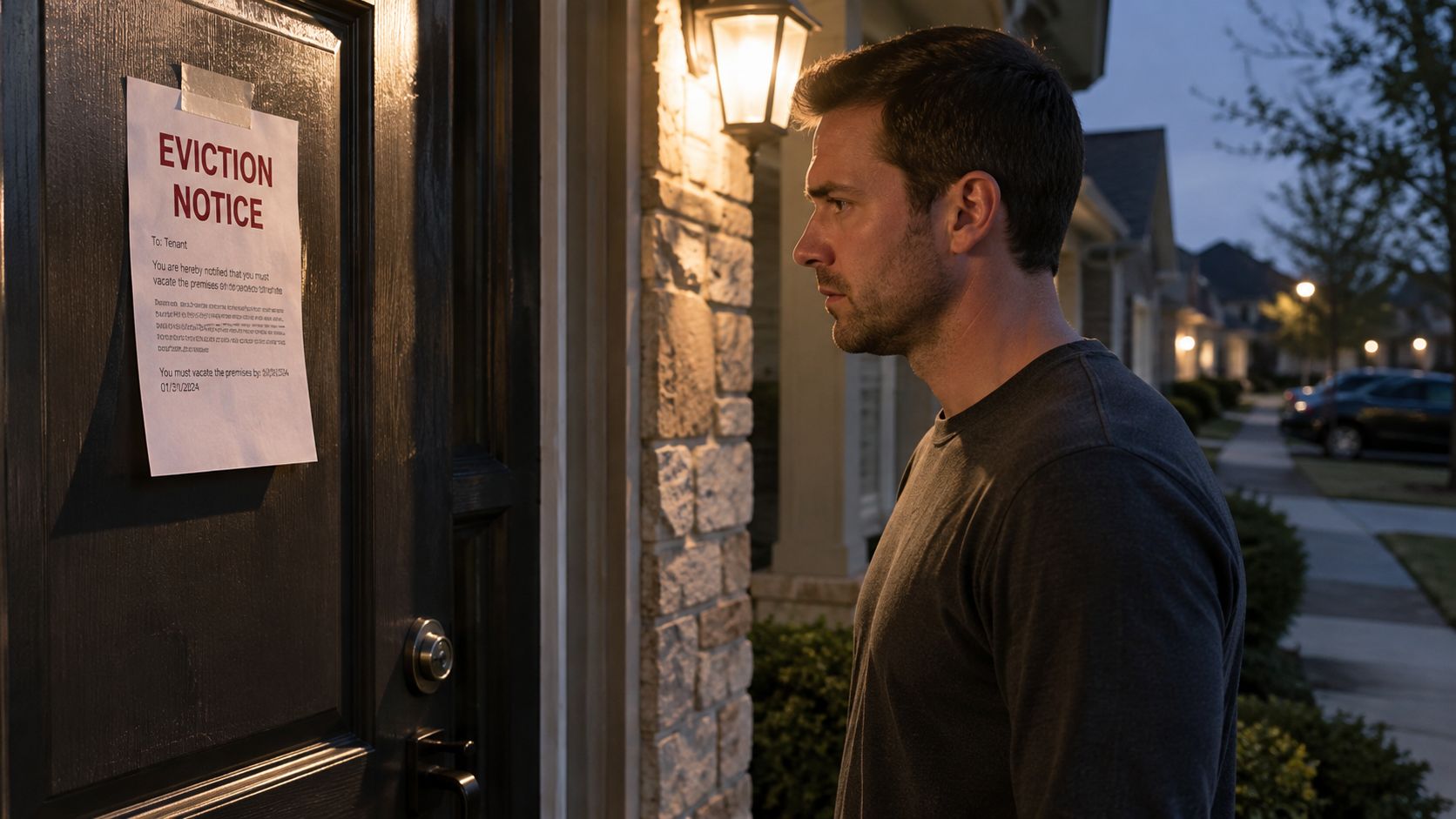
You find a notice taped to your Atascocita front door on a Friday evening. It says you must leave, but it doesn't explain what happens next, whether you can fix the problem, or how much time you have to respond. That uncertainty is frightening, especially when children, work schedules, rent records, and the possibility of finding another home all compete for your attention.
The safest response is action, not silence. A tenant facing eviction in Atascocita, Humble, or northeast Harris County should read every page, preserve every record, identify the correct court, and obtain legal advice as soon as possible. A private attorney isn't the only path. County-funded defense, legal aid, and pro bono organizations may also help, depending on your income, hardship, and case stage.
Understanding the Urgency of Eviction in Harris County
Harris County remains one of the largest eviction markets in the United States. Landlords filed 76,321 eviction cases in 2024, approximately one filing for every 10 renter households, according to Texas Housers' Harris County eviction analysis. The countywide filing rate was 9.7%, and filings remained roughly 20% above pre-pandemic levels, even after declining from 80,110 filings in 2023.
Atascocita sits within the broader northeast Harris County court system. The countywide numbers don't predict the result of your individual case, but they do show why you shouldn't assume the court process will move slowly or give you unlimited time to prepare.
Why the timeline feels so short
The median Harris County eviction case took 24 days from filing to judgment in 2024, as reported by Texas Housers. That period can include service, preparation, a hearing, and a decision. It may pass quickly when you're trying to negotiate with a property manager, locate rental assistance, collect payment receipts, and arrange child care or transportation.
Texas housing disputes also occur in a system where renters have historically appeared without attorneys in most cases. A Harris County fair-housing assessment reported attorney representation for tenants in only 1.96% of cases during a 2022 period, while another countywide snapshot reported representation for only 2.3% of defendants in 2023. The same assessment reported that 43% of eviction cases ended in dismissal, which shows why reviewing the filing, notice, service, payment history, and alleged lease violation matters. See the Harris County fair-housing assessment for those findings.
Practical rule: A notice to vacate isn't the same as a judgment, but it is a warning that your legal clock may already be running.
What to do before panic takes over
Start a single folder, digital or paper. Save the lease, notices, rent receipts, emails, text messages, maintenance requests, photographs, and any benefits or income records. Don't delete angry messages or assume a verbal agreement won't matter. Write down who said what and when while the details remain fresh.
Then call an eviction lawyer in Atascocita, contact Harris County legal services, or ask a qualified housing counselor about available assistance. Early advice can reveal a notice defect, a payment issue, a repair-related defense, or a negotiation option before the dispute reaches judgment.
The Texas Eviction Process and Critical Timelines
Texas eviction cases follow a sequence. Missing one step can affect the next, so treat every document and deadline seriously.
The process from notice to enforcement
Written notice to vacate. In Texas, a landlord generally must provide written notice before filing an eviction case. The standard period is three days, unless the lease provides a different period, according to the Texas State Law Library's landlord-tenant eviction guidance. Read the lease before assuming the statutory period controls.
Justice court filing. If the tenant doesn't leave or resolve the alleged violation, the landlord may file a forcible detainer case in the justice precinct where the rental property is located. Harris County publishes local justice-court eviction filing procedures, and the first stage generally occurs in justice court rather than district court.
Service and hearing. After filing, the tenant must receive the citation and hearing information. Texas guidance states that service must occur at least four days before the hearing. Don't ignore a citation because you're negotiating with the landlord. Negotiations don't automatically cancel a court date.

Hearing and judgment. Bring your lease, payment proof, notices, photographs, communications, and witnesses if appropriate. Explain the facts in an organized way and respond to the specific allegations. A judge may decide possession and related issues based on the pleadings, evidence, and applicable law.
Appeal or writ of possession. A losing party has only five days to appeal the judgment. If the appeal deadline passes, the landlord may pursue a writ of possession. Before a tenant's property is removed, the writ process includes a 24-hour notice. The Texas eviction process deskbook discusses the precinct, filing, and enforcement mechanics relevant to Texas justice courts.
You can also review a screening record when evaluating how an eviction filing might appear in a housing search. Burnt provides a Burnt eviction screening platform that can help people understand eviction-record screening as they plan their next housing steps.
The same urgency applies when a legal problem overlaps with family concerns. For example, the Divorce Lawyer in Atascocita, TX page describes divorce representation for clients in Atascocita and Harris County, but an eviction case itself requires housing-focused advice. Don't assume an attorney handling another legal matter automatically represents you in the eviction.
Navigating the 2026 Texas Property Code Changes
Eviction guidance written before January 1, 2026 may leave out rules that now apply to cases filed on or after that date. Harris County Justice of the Peace guidance explains that the 89th Legislature made major changes to Chapter 24 of the Texas Property Code. Those changes make the exact notice, filing, and defense analysis more important than a generic description of an eviction hearing.
The correct question isn't, “How many days do I have?” It's, “Which rule applies to this lease, this alleged violation, this notice, and this filing date?” A tenant should not rely on an old online form or assume that a prior case followed the same procedure.
What the changes mean in practice
The 2026 framework may affect how parties analyze notice requirements, cure opportunities, pleadings, and defenses. The effect depends on the case facts and the filing date. Landlords need to confirm compliance before filing, while tenants should examine whether the notice accurately identifies the alleged default and gives the time required by the applicable rule or lease.
The changes also make early advice more valuable. A lawyer can compare the notice with the lease, identify whether the landlord followed the required sequence, assess payment and repair records, and determine whether a response should be filed before the hearing.
| Provision | Previous Rule | 2026 Update | Impact on Tenants |
|---|---|---|---|
| Chapter 24 coverage | Older Chapter 24 procedures governed earlier filings | Major legislative changes apply to eviction cases filed on or after January 1, 2026 | The filing date may determine which rules apply |
| Notice analysis | Notice requirements depended on statute, lease language, and the alleged violation | Updated Chapter 24 provisions require current review rather than reliance on older summaries | A tenant should compare the notice with the lease and current law |
| Filing and court procedure | Evictions began in the proper justice precinct | Harris County JP guidance identifies updated Chapter 24 requirements for covered cases | Incorrect filing or incomplete preparation can create procedural problems |
| Defenses and payment issues | The effect of facts depended on the pleadings, lease, payments, and applicable law | Current cases require case-specific analysis under the amended framework | Partial payments, repairs, and alleged retaliation should be documented and reviewed promptly |
For broader Texas legal reading, a resource on reducing property tax in Travis County addresses a different property-law issue and shouldn't be treated as eviction advice. The point is simple: property disputes use different statutes and procedures, so use a source that addresses the specific problem before you act.
Choosing the Right Legal Path for Your Situation
Not every Atascocita tenant needs the same kind of help. The right choice depends on the hearing date, the strength and complexity of the defenses, your financial resources, and whether you need advice, negotiation, courtroom representation, or an appeal.
Compare the available routes
| Option | Typical Cost | Best For | Response Time | Limitations |
|---|---|---|---|---|
| Private eviction lawyer | Varies by attorney and representation scope | Tenants or landlords who need individualized advice, negotiation, or courtroom work | Often arranged directly with the office | Cost may be a barrier, and not every lawyer can accept a case immediately |
| Harris County Eviction Defense Program | Free for eligible residents | Residents at or below 200% of federal poverty guidelines, with priority for unemployment, reduced income, or other hardship | Depends on intake and case urgency | Eligibility and capacity rules apply |
| Pro bono or legal-aid intake | Free or low-cost depending on program | People seeking advice, referral, or representation through organizations such as Lone Star Legal Aid, Houston Volunteer Lawyers, or Houston Eviction Advocacy Center | Depends on screening and available resources | Services may be limited by eligibility, capacity, or case type |
| Self-representation | No attorney fee | People with a straightforward matter who can meet court requirements and prepare evidence | Immediate control over filing and preparation | Procedural mistakes can cost defenses or appeal rights |
The Harris County Eviction Defense Program provides free advice and representation to qualifying residents. The program identifies the 200% federal poverty guideline threshold and prioritizes households facing unemployment, reduced income, or other financial hardship. Contact intake as soon as you receive a notice or citation. Don't wait until the day before court to learn whether you qualify.
Use a simple decision test
If your hearing or appeal deadline is close: Call a private attorney and legal-aid intake at the same time. The first available qualified resource may be the most useful.
If money is the main obstacle: Apply to the county program and contact local legal-aid organizations. Prepare income and hardship documents so intake staff can evaluate your situation.
If the case involves repairs, retaliation, disputed payments, service problems, disability-related concerns, or multiple occupants: Prioritize individualized legal review. These facts can require more than a basic form.
If you're a landlord: A private lawyer may be appropriate when possession, lease enforcement, damages, or repeated procedural issues are involved. County-funded tenant programs generally aren't a substitute for landlord counsel.
Civil disputes can also involve contracts and payment obligations. Readers handling a separate agreement dispute can review breach of contract remedies for general civil-law context, but an eviction deadline still requires immediate, case-specific attention.
Why Local Representation Matters in Atascocita
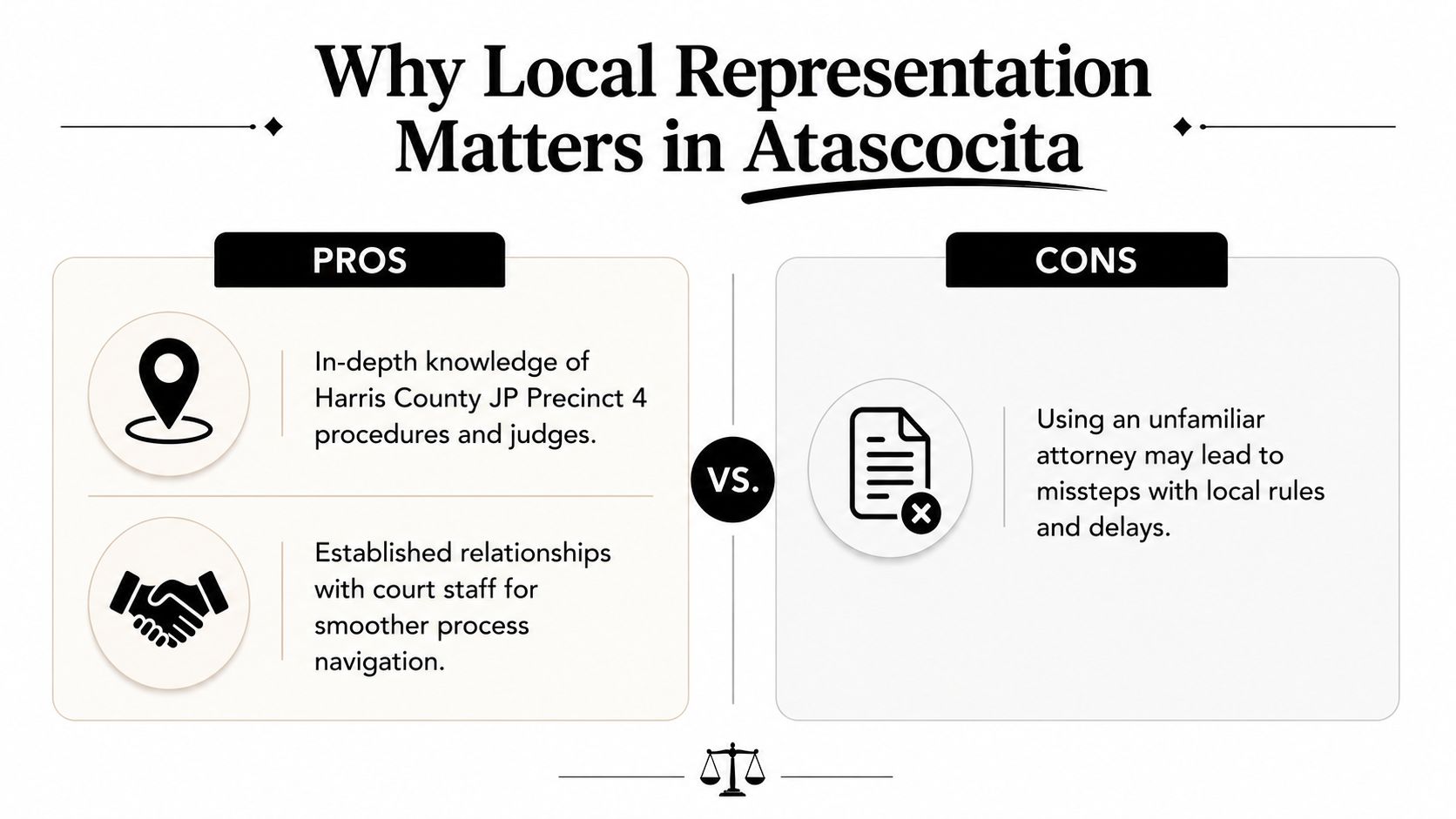
An eviction lawyer who regularly works in Harris County justice courts can do more than recite the statewide process. The lawyer must identify the precinct where the property sits, confirm the correct filing location, monitor the hearing calendar, and prepare documents in the format the court accepts.
Atascocita and northeast Harris County cases move through local JP procedures. Familiarity with those procedures helps counsel spot practical problems early, including a mismatch between the rental address and precinct, incomplete pleadings, service concerns, or a hearing date that requires an immediate response.
Local knowledge improves preparation
A local attorney can also help you decide what matters most for the hearing. That may include a payment ledger, a repair request, photographs, a lease clause, a notice defect, or evidence that the landlord accepted money after issuing a notice. The attorney can organize those facts into a focused position instead of sending you to court with an overloaded file and no clear explanation.
Local access matters during a fast-moving case. A nearby office can make it easier to schedule a prompt consultation, exchange documents, clarify questions, and respond when a court notice or landlord communication arrives. Those practical advantages don't guarantee a result, but they reduce avoidable delay.
Local counsel should know where your case belongs before discussing how to fight it.
Hiring someone unfamiliar with Harris County JP operations creates unnecessary risk. That lawyer may understand Texas law generally but still need time to learn local filing practices, calendars, service procedures, and courtroom expectations. In an eviction case, time spent learning basic logistics is time you don't have.
The firm's civil law practice reflects the broader civil disputes that Atascocita and Humble residents may face. An eviction remains a specialized possession proceeding, so ask directly whether the attorney handles the relevant justice-court work and whether the firm can respond within your deadline.
Preparing for Your Eviction Lawyer Consultation
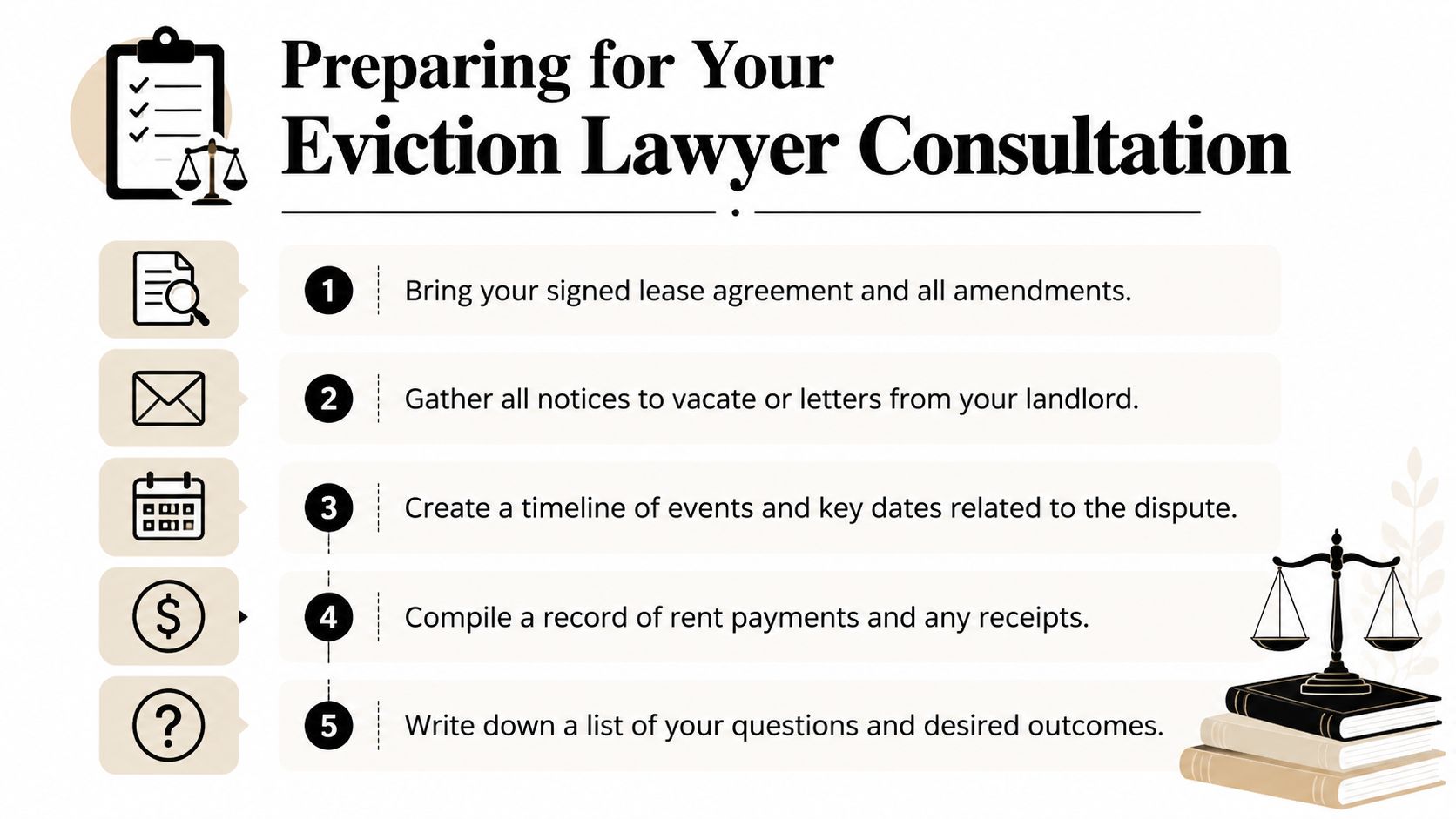
A consultation is more useful when the attorney can see the entire timeline, not just the notice that caused you to call. Put documents in date order and bring copies or clear digital versions.
Build your case file
Lease materials: Bring the signed lease, amendments, renewals, addenda, and any written rules. The lease may change the notice period or explain payment, repair, or termination procedures.
Court papers: Include every notice to vacate, citation, petition, hearing notice, judgment, appeal document, and writ-related paper. Don't leave out a document because you think it looks routine.
Payment evidence: Gather receipts, bank records, money-order information, payment-portal screenshots, and messages about rent. Mark disputed amounts and identify payments made after a notice.
Condition and repair records: Save photographs, videos, maintenance requests, inspection messages, code complaints, and dates when workers entered or failed to respond. Preserve original files when possible.
A written timeline: List the move-in date, rent payments, verbal agreements, repair requests, disputes, notices, service, and court events. Use exact dates when you know them and label estimates accurately.
If you're applying for county-funded assistance, add pay stubs, benefit statements, unemployment records, and other financial information requested during intake. Don't hide unfavorable facts. Your lawyer needs the difficult details to identify risks and choose a realistic strategy.
Expect questions about everyone living in the home, prior eviction history, communications with the landlord, the current rent balance, and whether you have another housing option. Write down your own questions too. If you need help with a separate contract dispute, how to sue for breach of contract is a different civil-law issue and shouldn't replace eviction counsel.
Protecting Your Housing Future in Northeast Harris County
An eviction dispute demands speed, organization, and a current understanding of Texas law. A notice to vacate can lead to a justice-court case, and a judgment can create serious practical problems when you apply for housing in Atascocita, Humble, Kingwood, or the greater Houston area.
The most important deadlines are the ones already in front of you. Review the notice period, respond before the hearing, and treat the five-day appeal period as a hard deadline. Texas guidance explains that the appeal period includes weekends and holidays. If the deadline falls while the court is closed or on a legal holiday, filing moves to the next open court day, as explained by TexasLawHelp's eviction appeal guidance.
Choose action over avoidance
If you qualify for the Harris County Eviction Defense Program, apply. If you need private representation, schedule a consultation. If neither option is immediately available, gather your documents, contact legal-aid organizations, and attend every scheduled court proceeding. Doing nothing gives the other side the clearest path forward.
The Law Office of Bryan Fagan serves individuals and families in Atascocita, Humble, and throughout Harris County. The office handles family law, criminal defense, estate planning, probate, and civil litigation, so a consultation can also help identify related issues involving household members, contracts, or family stability. Ask about current office location, phone contact, and consultation scheduling when you reach out, and bring your complete eviction file.
You don't have to solve the entire case alone tonight. You do need to take the next step before the court's deadline closes.
The Law Office of Bryan Fagan, Atascocita TX Lawyers provides practical legal guidance for residents facing eviction, civil disputes, and related family concerns in Atascocita, Humble, and Harris County. Visit Law Office of Bryan Fagan – Atascocita TX Lawyers to request a free consultation and discuss your notice, court papers, and immediate options with a local legal team.