A protective order is a civil court order that restricts a person's contact with or proximity to someone they have harmed, harassed, or threatened, designed to prevent future harm rather than punish past conduct. Protective orders became a mainstream legal remedy in the United States during the 1970s, and by 1989 all 50 states plus the District of Columbia had statutes offering civil protection-order remedies for battered women. The Journal of the American Academy of Psychiatry and the Law explains this history and the later federal full-faith-and-credit framework strengthened by the Violence Against Women Act in 1994.
If you're in Atascocita, Humble, or northeast Harris County, you may be asking this question after a frightening voicemail, a tense custody exchange, or repeated appearances near your home, work, or child's school. You don't need to know every legal term before asking for help. You do need a clear picture of what an order can do, what it can't do, and what steps may protect you and your family.
When a Protective Order Becomes the Right Next Step
A parent in a Humble-area household may notice the pattern before anyone else does. After a custody exchange, an ex-partner leaves a voicemail that sounds more threatening than the last one. Later, the parent sees the ex-partner's truck idling near an elementary school. The parent blocks the number, changes the locks, asks a friend to handle transportation, and still wonders whether the situation has crossed a legal line.
That question has no single answer, but certain conduct deserves prompt attention. Repeated unwanted contact, threats, stalking, physical harm, access to weapons, and fear for a child's safety can all signal that ordinary boundaries aren't enough. A protective order may give those boundaries the authority of a court, especially when the person continues contacting or watching you after you've clearly asked them to stop.
Practical rule: You don't have to wait for another assault before discussing legal protection. A credible pattern of threats, harassment, or stalking can matter when a court evaluates the risk of future harm.
The order is one part of a larger safety response. Depending on what happened, that response might also include a police report, criminal charges, a custody modification, supervised exchanges, changes to school pickup instructions, technology safeguards, or help from a domestic-violence advocate. A protective order won't automatically resolve a custody dispute, decide a divorce, or guarantee that the other person will obey.
For an Atascocita parent, the most useful early question is practical: What has happened, what proof exists, and what contact or location needs to be restricted immediately? Save voicemails and messages before blocking a number, write down dates and locations, photograph damage or injuries, and tell someone you trust what's happening. If a child may be at risk, include that concern in your safety planning and legal consultation rather than treating it as a separate issue.
Understanding What a Protective Order Actually Is
In plain English, a protective order is a civil court order naming a person whose contact, proximity, harassment, or other conduct is restricted toward a protected person. In family-violence matters, the restrictions can also cover threats or harassment involving children, household members, a workplace, a school, or a vehicle. The order may include firearm restrictions and anti-tracking provisions, not just a simple no-contact command. TexasLawHelp's protective-order fact sheet describes these protections in practical terms.
Think of it as a fence created by a judge. You might build a physical fence around your home, but a protective order creates legal boundaries around contact, distance, and conduct, with court enforcement behind them. The fence doesn't punish the person for what already happened. It tells that person what they must not do going forward.
What the order is not
A protective order isn't a criminal conviction, and obtaining one doesn't automatically mean the respondent will be arrested. It isn't a divorce decree, and it doesn't by itself determine permanent custody, child support, or property division. A judge may include child-related arrangements in temporary relief, but a protective-order case and a broader family-law case remain distinct legal matters.
A civil protective-order case usually begins with the protected person, called the petitioner, asking a civil court for relief. A criminal case can proceed at the same time. After an arrest, a magistrate or criminal court may impose a no-contact condition as part of bond or pretrial release. That condition comes from the criminal case, while the civil protective order comes from a separate court process.
For readers comparing the terms, this explanation of protective order vs restraining order offers useful background on why the remedies aren't interchangeable. In Atascocita, Protective Orders in Atascocita addresses domestic-violence and family-safety matters.
The boundaries you'll see most often
The order may prohibit direct or indirect contact, require the respondent to stay a stated distance away, and identify no-go zones such as a home, workplace, school, or childcare location. Under Texas Family Code chapter 85, a final protective order generally has a standard maximum duration of two years unless the court extends it under applicable circumstances. Read every page carefully because one overlooked provision can create a violation.
Types of Protective Orders in Texas
Texas uses several protective-order vehicles, and the right one depends on the facts, urgency, and procedural posture of the case. The names can sound similar, so focus on four questions: what triggered the order, whether the other person receives notice, which court issues it, and how long it can remain in effect.
| Order Type | Triggering Facts | Hearing Required | Typical Duration |
|---|---|---|---|
| Emergency or ex parte order under chapter 83 | Immediate danger or a need for immediate restrictions based on the application and supporting facts | May be issued without notice before the respondent appears | Up to 91 days under the described emergency framework |
| Temporary ex parte order under chapter 84 | A protective-order application where temporary protection is needed before the full hearing | Issued before the respondent participates, followed by a full hearing | Up to 20 days, sometimes 30 days by written agreement |
| Final protective order under chapter 85 | Evidence presented at a noticed hearing supports protective relief | Yes, the respondent receives notice and may contest the application | Commonly up to two years, with extension possible |
| Criminal no-contact bond condition or pretrial order under chapters 7A or 17 | A criminal arrest or prosecution involving conduct covered by the criminal statutes | Set through the criminal case by a magistrate or other authorized court | Depends on the criminal case and the court's conditions |
A Texas emergency protective order shouldn't be confused with a regular civil protective order. In a qualifying criminal case, a Texas magistrate's emergency order can remain in effect up to the 91st day, but not less than the 61st day, under one set of arrest circumstances. Under another, it can remain up to the 121st day, but not less than the 91st day, as described in Texas Code of Criminal Procedure article 17.292. Texas courts also state that this order can be issued without a hearing before it's entered.
The criminal emergency process is tied to qualifying offenses and case facts. Texas courts' materials identify family violence, sexual assault, aggravated sexual assault, and stalking as triggering offenses. In family-violence assaults, the order becomes mandatory when the accused used or exhibited a deadly weapon or caused serious bodily injury. Texas municipal-court materials discuss those requirements.
Harris County applicants can ask about filing packets at the Harris County Law Library at 1019 Congress and filing procedures at the District Clerk's office at 201 Caroline. Confirm the correct location before traveling, particularly if an Atascocita or Humble address points you toward a nearby precinct court.
Who Qualifies and What Evidence Counts
Eligibility depends on the relationship between the people and the conduct involved. Texas protective-order applicants commonly include spouses and former spouses, current or former dating partners, family members, and household members. Separate protective-order provisions address sexual assault, stalking, and human trafficking, but those categories have their own requirements.
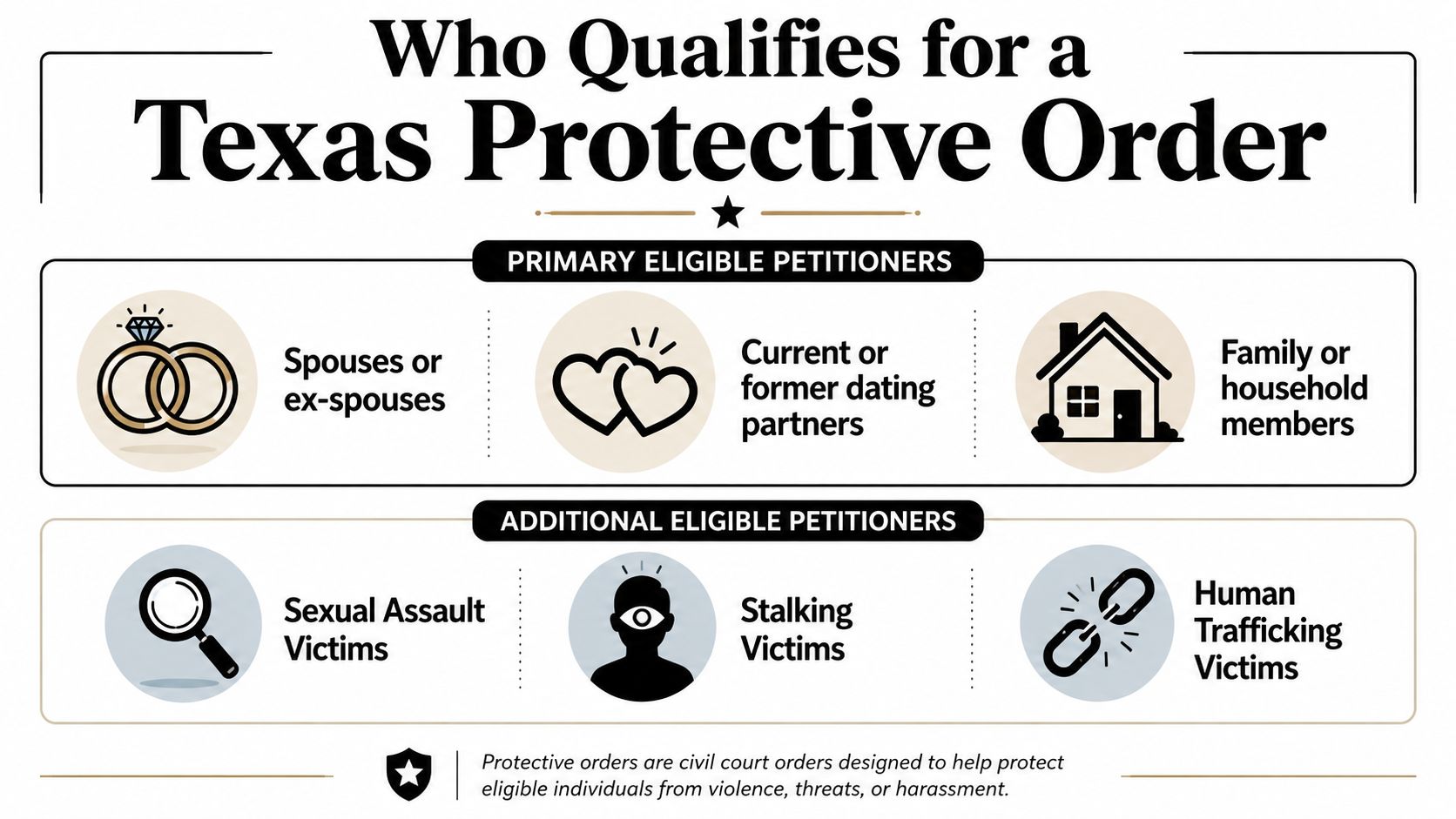
A Humble resident can start with a simple self-check. Ask whether the respondent fits one of the relationship categories, whether the conduct involved family violence, dating violence, stalking, sexual assault, or another covered form of harm, and whether the facts show a need for protection from future conduct. If the answer is unclear, that doesn't mean the claim lacks merit. It means the facts should be reviewed before you decide not to file.
Evidence that helps the judge evaluate risk
The petitioner generally carries the burden of proof in a civil protective-order hearing. The usual civil standard is preponderance of the evidence, meaning the judge decides whether the alleged abuse or harassment was more likely than not to have occurred. That standard is lower than the criminal standard of proof beyond a reasonable doubt, but the petitioner still needs organized, credible evidence. Washington LawHelp's guide to proving a protection-order case explains this distinction and the role of documentation.
Useful evidence may include:
- Photographs: Images of injuries, property damage, damaged doors, or other physical signs.
- Communication records: Threatening texts, emails, voicemails, direct messages, and call logs.
- Official records: 911 records, medical records, therapy notes, and police reports.
- Witness information: Statements from people who saw the conduct, heard threats, or observed injuries.
- Personal documentation: A dated, factual timeline showing what happened, where it happened, and who was present.
Contemporaneous records usually give the court more to evaluate than a general account based only on secondhand information. Don't edit messages, delete embarrassing material, or exaggerate details. Ask the Family Law Facilitator or the Harris County District Clerk's office about organizing exhibits before an ex parte or full hearing. If you're unsure whether you qualify, a free consultation can help you evaluate the claim before you walk away from a potentially available remedy.
Filing and Hearing Process in Harris County
For many Harris County residents, the process begins at the Family Law Center at 1115 Congress. An Atascocita or Humble resident may be directed to a nearby precinct court depending on the filing and hearing arrangements, so confirm the location before appearing. The Harris County court system and clerk's offices can provide procedural information, but they can't give you legal advice about how to present your facts.
Starting the application
You'll generally complete an Application for Protective Order, a sworn petition describing the conduct, and a confidential information sheet. Use clear facts rather than conclusions. Identify dates, locations, threats, injuries, children affected, weapons, stalking behavior, and any existing criminal or family-law cases.
The initial request may be presented to a judge for temporary emergency protection without the respondent participating. If granted, the temporary order can become effective quickly, potentially within hours. The court may address contact, distance, residence access, child exchanges, school locations, and other practical safety concerns.

Preparing for the full hearing
A full hearing is commonly scheduled roughly two weeks later, after the respondent has been served. At that hearing, both sides may present evidence and respond to questions from the bench. The petitioner must show that the alleged conduct occurred and that protective relief is needed to address the likelihood of future harm under the governing civil standard.
The judge may ask what happened, when it happened, whether the respondent has continued contacting you, whether children witnessed or experienced conduct, and what records support your account. Temporary relief can include arrangements for child exchanges, exclusion from a residence, or counseling requirements, depending on the court's authority and the facts.
Harris County filing costs and fee-waiver procedures can depend on the case and the applicant's circumstances. Ask about a waiver if you can't afford filing costs, and request interpreter services if you need them. For courtroom preparation and related family-court context, review what happens at a family court hearing in Harris County, Texas.
Enforcement Firearms and How Well Orders Actually Work
A signed order matters because it creates enforceable rules, but it isn't a physical shield. Local police departments serving Humble and Atascocita, constable offices, and the Harris County Sheriff's Office may respond to reported violations. If the respondent contacts you, appears at a restricted location, threatens you, or violates another provision, preserve the evidence and contact law enforcement when safe.
Violations can lead to criminal charges. A violation is generally treated as a Class A misdemeanor, while a prior conviction or certain aggravating facts can support felony treatment under applicable Texas law. The exact classification depends on the conduct, the order's language, and the respondent's history.
| Type of Violation | Texas Classification | Potential Penalty |
|---|---|---|
| Prohibited contact or another violation covered by the order | Class A misdemeanor in the ordinary circumstance | Criminal prosecution and potential misdemeanor punishment |
| Violation involving a prior conviction or specified aggravating facts | Felony treatment may apply | Criminal prosecution and potential felony punishment |
Firearms and practical safety
Protective-order enforcement can also reach firearms. A U.S. Department of Justice analysis reported about 30,000 protection-order-related firearm background-check denials over fiscal years 2006 to 2015, with roughly 28,000 completed within 3 days and 559 firearm transfers still occurring in those cases. The same DOJ-funded program reported that more than 242,062 protection orders were granted in participating jurisdictions, demonstrating how frequently courts use these orders as a safety tool. The Department of Justice report provides those figures.
A protective order may require firearm surrender under applicable law, and a respondent may have a deadline to transfer or store weapons away from the home. Because firearm restrictions can depend on the order and the person's legal status, read the exact provisions and obtain legal advice rather than guessing.
Research doesn't support treating every order as a guarantee of safety. Findings are mixed, with some studies identifying modest reductions in re-victimization while effectiveness depends heavily on enforcement, offender history, and whether arrest or other interventions accompany the order. Stalking predicts more violations and lower perceived effectiveness, and violent-offense histories can raise concerns about repeat violations. A later meta-analysis found an initial adverse effect that became non-significant after accounting for breaches and judges' tendency to issue orders to higher-risk offenders. The literature summarized by PubMed and the research on violations and perceived effectiveness illustrate why safety planning must accompany the paperwork.
If you need help coordinating civil protection with a criminal case, review the Harris County criminal defense attorney resource and speak with counsel about the particular facts.
What to Do If You Have Been Served
Being served with a protective-order application or order doesn't equal a criminal conviction. It does mean the court process requires your immediate attention. Start by reading every page, identifying restricted people and locations, and preserving the paperwork exactly as you received it.
Do not contact the petitioner to argue, apologize, explain, or ask for another chance. No-contact terms can cover direct and indirect communication, including text messages, social-media messages, emails, phone calls, contact through friends, and messages sent through relatives or children. One violation can trigger arrest and criminal charges under Texas Penal Code section 38.112, depending on the facts and the order's terms.
Your first practical steps
- Mark every deadline. Note the hearing date, response requirements, service date, and any temporary-order expiration language.
- Follow the order exactly. Stay away from listed homes, workplaces, schools, vehicles, and other restricted places, even if you regularly work or live nearby.
- Secure firearms as directed. Don't move weapons casually or ignore surrender or transfer provisions. Ask an attorney how the order applies.
- Preserve your defense evidence. Keep messages, location records, witness information, and documents that support mistaken identity, insufficient evidence, or another defense.
- Request legal help quickly. Counsel may request a hearing, seek modification, ask for dismissal, or discuss an agreed order that avoids a contested hearing.
A respondent can have a legitimate defense, but ignoring the hearing rarely helps. The court may evaluate whether the petitioner has sufficient evidence, whether the allegations identify the correct person, and whether required notice and procedure were followed. You should also assume that living or working near the protected person requires a detailed compliance plan, not informal promises.
If children are involved, don't use them as messengers or arrange unapproved exchanges through them. A family-law attorney can help separate safe parenting logistics from prohibited contact while protecting your position in related custody proceedings.
Local Resources and Your Next Step with the Law Office of Bryan Fagan
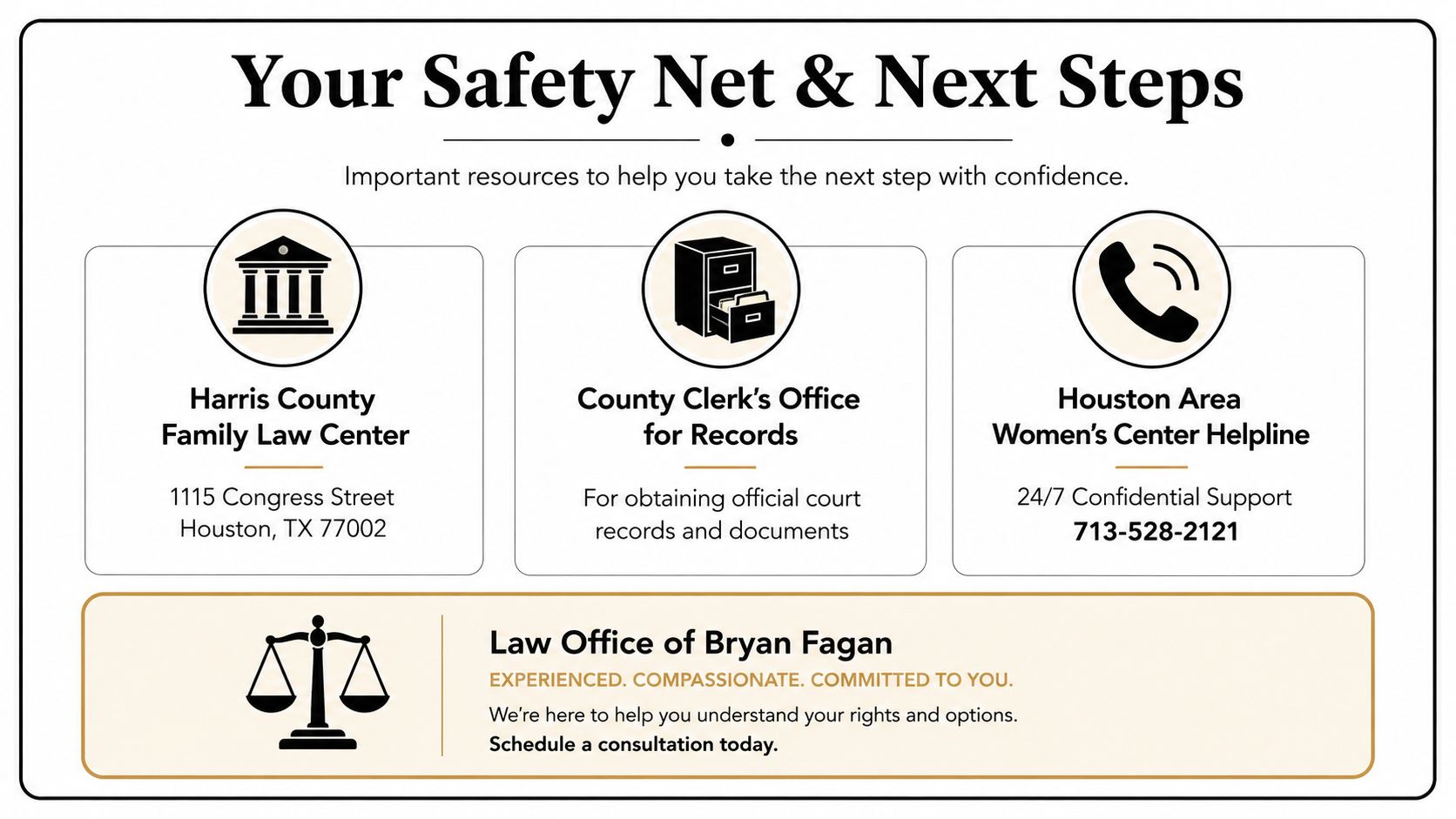
Atascocita and Humble residents can begin with the Harris County Family Law Center at 1115 Congress Street for filing information. The County Clerk's office can help with records, while local law-enforcement and advocacy organizations can help address immediate safety concerns. The Houston Area Women's Center 24-hour hotline, the Texas Domestic Violence Hotline, nearby emergency shelters, and resources in adjacent Fort Bend and Montgomery counties may offer safety planning and support for people who need help outside the courthouse.
A short safety checklist
- Preserve evidence: Save messages, call records, photographs, medical information, and a dated incident log.
- Tell a trusted person: Share your situation with someone who can help with transportation, children, or emergency decisions.
- Review home security: Change locks or access codes if appropriate, and consider how shared accounts or location services expose your movements.
- Document new contact: Don't respond to a violation. Record what happened and contact law enforcement when it's safe.
- Ask about language access: Interpreter services may be available through the court process.
Some firms also use an AI phone agent for law firms to help manage incoming calls and capture initial information. That kind of service isn't a substitute for emergency assistance or legal advice, but accessible communication can matter when a caller is trying to reach the right office.
For local guidance about the distinction between protective and restraining remedies, see the restraining order attorney in Atascocita resource. The Law Office of Bryan Fagan – Atascocita TX Lawyers serves families and individuals in Atascocita, Humble, and Harris County, including clients dealing with family law, criminal defense, and related civil concerns. The office can discuss Harris County procedures, emergency-order filing options, and bilingual communication during a free consultation.
The Law Office of Bryan Fagan – Atascocita TX Lawyers can help you understand protective-order options, prepare for a Harris County hearing, and coordinate related custody or criminal-defense concerns. Visit Law Office of Bryan Fagan – Atascocita TX Lawyers to schedule a free consultation and take the next step with a local legal team.