
A lot of people in Atascocita, Humble, and nearby northeast Harris County first meet the family court system the same way. They open the mail, see a notice with a court date, and feel their stomach drop.
If that's where you are right now, your reaction makes sense. Court notices are formal, the language can feel cold, and it's often hard to tell whether you're walking into a short scheduling matter, a fight over temporary custody, or something much more serious.
The good news is that a Harris County family court hearing usually follows a structured pattern. Once you understand the type of hearing, what paperwork the court expects, and how the judge will likely use the time, the process becomes much less mysterious. That matters because anxiety often comes from not knowing what happens next.
Families in Humble and Atascocita often ask the same questions. Will I have to testify? Can I bring documents with me? Is this hearing the final decision? Why does the court seem so strict about timing and paperwork? Those are the right questions to ask.
What happens at a family court hearing in Harris County, Texas depends on the issue before the judge, but the basic theme is consistent. The court expects preparation, clear paperwork, and focused presentations. If you understand that going in, you're already in a better position than many people who arrive expecting a long open-ended conversation with the judge.
Your Guide to Navigating a Harris County Family Court Hearing
A neighbor in Humble might call after getting served with divorce papers and say, “My hearing is next week. I don't even know what kind of hearing this is.” That's common. The paperwork may refer to temporary orders, enforcement, contempt, entry, submission, or trial settings, and each one means something different.
A parent in Atascocita may be even more worried if children are involved. If you're concerned about temporary possession, child support, or whether the other parent is following an existing order, it's easy to assume the hearing will decide everything at once. In many cases, it won't. A hearing often handles one stage of the case, not the entire case.
A family court hearing is often less like a movie courtroom scene and more like a tightly scheduled problem-solving session with rules.
That's why the smartest approach is to slow down and identify three things first:
What docket are you on
Your notice should tell you whether this is a temporary orders hearing, contempt setting, trial, or another matter.What issue is before the judge
Custody, support, possession, property, enforcement, and procedural motions each require different preparation.What documents or exchanges were required before the hearing
In Harris County, that part can be just as important as what you say in the courtroom.
If you keep those three questions in front of you, the process starts to make more sense. You stop treating the hearing as one giant unknown and start seeing it as a series of concrete steps.
Why Harris County Family Courts Are Unique
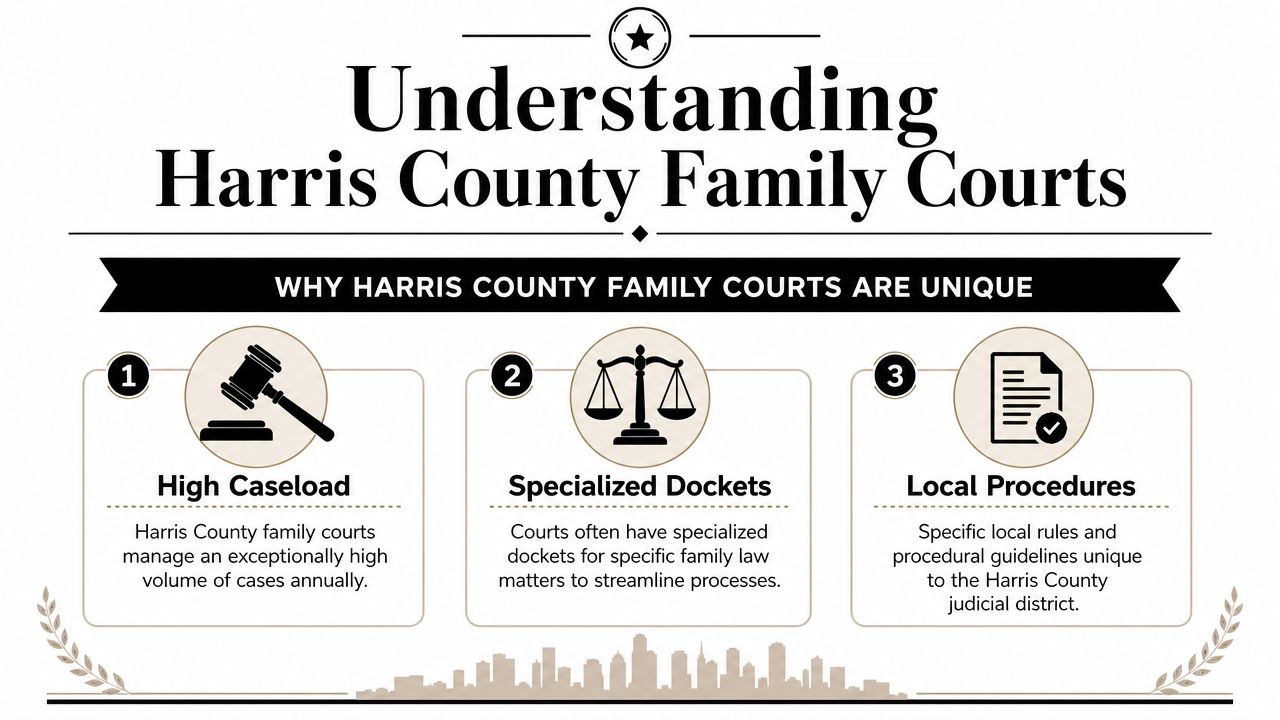
Harris County family court moves the way it does for a reason. The system handles a huge volume of family cases, and that affects everything from scheduling to document exchange to the amount of time a judge can give each matter.
One Harris County court-overload analysis reported that family law cases made up about 40% of all civil cases in the county, and that the county's 11 specialized family court judges were handling as many as 4,000 pending cases each, compared with about 1,500 to 2,000 for a general civil judge. That same report helps explain why judges rely on structure. They have to.
What that means for your hearing
If you're coming from Atascocita or Kingwood, it may feel personal when a judge limits argument or focuses heavily on paperwork. Usually, it isn't personal. It's procedural. The court is designed to move a high number of cases through a specialized system.
That structure shows up in practical ways:
Judges want narrow issues presented clearly
They often need the parties to identify the exact dispute instead of telling the whole history of the relationship.Written materials matter a lot
In support and property disputes, pre-hearing disclosures often carry much of the weight.Hearing time is usually limited
The court often isn't looking for a full retelling of every disagreement between the parties.
Why preparation matters more here
In some settings, a person can show up and hope to explain everything out loud. In Harris County family court, that's risky. A better strategy is to walk in knowing your issue, your requested relief, and the paperwork that supports it.
Practical rule: In a high-volume court, the party who is organized usually has a better chance of being understood.
That doesn't mean the system is unfair. It means the system rewards people who respect its procedures. If you're prepared, concise, and responsive to the judge's questions, you make it easier for the court to act on your request.
The Different Types of Family Court Hearings Explained
Not every hearing does the same job. A useful way to think about it is the difference between urgent care, a routine checkup, and surgery. They're all medical appointments, but you wouldn't expect the same process or outcome from each one. Family court hearings work the same way.
A Harris County family court scheduling overview shows that courts use separate dockets for different matters, including trial docket Mondays at 10:00 a.m., temporary orders hearings Tuesdays and Wednesdays at 10:00 a.m., and contempt hearings Thursdays at 10:00 a.m. Your docket tells you what kind of problem the court expects to address.
Hearing types at a glance
| Hearing Type | Primary Purpose | Key Evidence |
|---|---|---|
| Temporary orders | Set short-term rules while the case is pending | Financial records, parenting facts, school or medical records, concise testimony |
| Enforcement or contempt | Address claimed violations of an existing order | Prior court order, proof of violation, payment history, messages, calendars |
| Motions or submission matters | Handle procedural requests or narrow disputes | Filed motion, response, supporting documents, proposed order |
| Final trial | Resolve remaining disputed issues in the case | Full exhibit set, witness testimony, required disclosures, proposed rulings |
Temporary orders hearings
These hearings often come early in a divorce or custody case. The judge may address where the child will primarily stay, what the temporary possession schedule will be, who pays support, or who has responsibility for certain bills while the case is pending.
For many families in Humble, this is the first major court date. It feels huge because the temporary rulings can shape daily life for months. But it still isn't the final word on every issue.
If you're dealing with an urgent custody issue, this guide on an emergency child custody hearing in Atascocita can help you understand how fast-moving family hearings can differ from standard settings.
Enforcement and contempt hearings
These hearings focus on whether someone failed to follow an existing court order. That could involve missed child support, denied visitation, or other noncompliance.
The key point is precision. The judge usually needs to know what order existed, what part was violated, and what proof supports that claim. General frustration won't carry much weight by itself. Dates, language from the order, and clear records matter.
In enforcement cases, the court often cares less about broad relationship conflict and more about whether a specific order was followed.
Final trial settings
A final trial is where unresolved issues are decided if settlement hasn't happened. That can include conservatorship, possession, support, and property division. Trials are more formal and usually require more extensive preparation than short hearings.
For lawyers and firms trying to explain these differences clearly to the public, there are useful insights on modern legal marketing that show why plain-language education matters. Family law clients rarely need more jargon. They need clarity about what kind of court event they're facing.
How to Prepare for Your Hearing Day
Preparation is where many cases improve or unravel. If you try to figure everything out the night before, the hearing will feel chaotic. If you prepare in stages, the day becomes manageable.
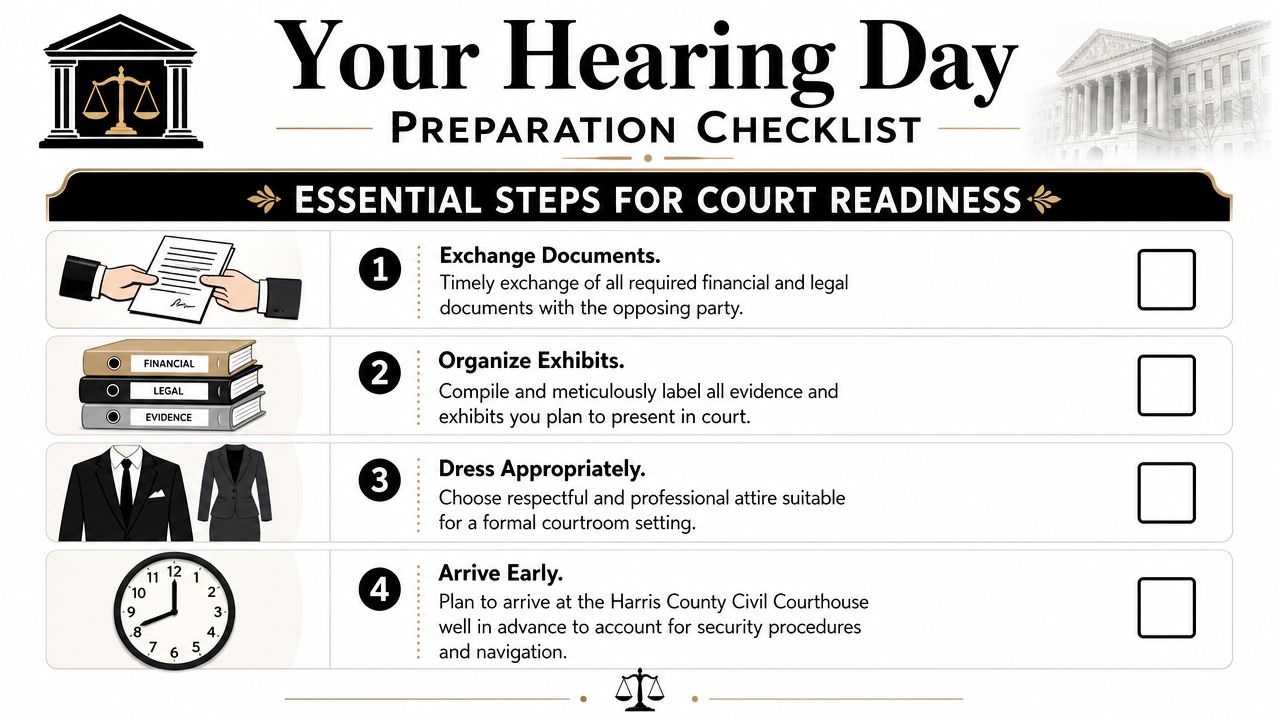
For support-related hearings, Harris County local rules require parties to exchange a Financial Information Statement, the prior two years of tax returns, and two recent pay stubs before the hearing begins, and the local rules note that failure to comply can lead to sanctions under the Harris County family court rules page. That requirement is one of the clearest examples of how the court expects substance before appearance.
A quick visual checklist can help you stay grounded.
Build your hearing file
Start with the documents the court or local rules specifically require. Then build around them with the records that support your position.
Financial materials
If support is at issue, gather the required financial documents early so you're not scrambling.Court papers
Keep your petition, motion, notice of hearing, prior orders, and any responses together in one folder.Exhibits
Organize texts, emails, school records, payment proof, calendars, or photos by issue, not by the order you found them.A short summary
Write down what you want the judge to order and the main facts that support that request.
If custody is the central issue, this article on how to prepare for a custody hearing is a useful next read for parents who want a practical framework.
Confirm logistics before the court date
Many people lose confidence because they focus only on evidence and forget logistics. In Harris County, logistics are part of preparation.
A short video can help you think through the process and hearing mindset before your date arrives.
Check these items in advance:
Your exact hearing type
Make sure you know whether this is temporary orders, contempt, trial, or another setting.Whether the hearing is in person or remote
Don't assume. Verify it.Your exhibit copies
If you plan to offer documents, bring them in a clean, usable format.Your speaking points
Prepare a brief version of your story. Judges usually want the important facts quickly.
Prepare yourself, not just your paperwork
Courtroom preparation also includes behavior. Dress neatly. Arrive early. Turn your phone off. Don't interrupt the judge or the other side, even if something said about you feels unfair.
What helps most: A calm, organized presentation usually lands better than an emotional attempt to say everything at once.
If you have a lawyer, ask for a prep call before the hearing. If you don't, it's still worth practicing how you'll explain your request in plain English. Aim for short, specific answers.
A Step-by-Step Walkthrough of the Hearing Itself
The day of court often feels intimidating because people don't know what the sequence will look like. Once you know the flow, it becomes much easier to manage your nerves.
A Harris County family courts guide explains that many hearing requests go through the District Clerk's E-Hearing Portal, that TRO hearings are handled separately through the Ancillary Clerk, and that trials and evidentiary hearings are generally in person unless both sides agree to Zoom through a Rule 11 Agreement. That means many of the most important hearing decisions happen before you ever walk into the courtroom.
When you arrive
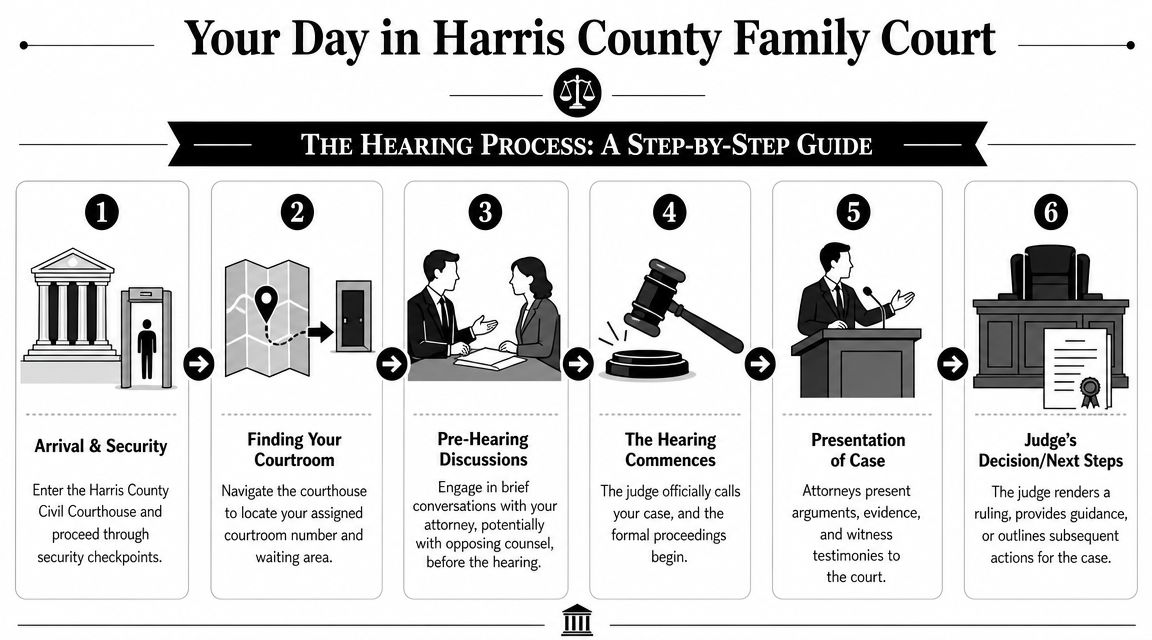
If your hearing is in person, plan for downtown travel, parking, and security screening. Give yourself cushion time. Running late makes everything harder.
Once inside, you'll usually find the correct courtroom, check in as required, and wait for your case to be called. If you have an attorney, this is often when you'll have a final conversation about the judge, the likely order of events, and any last-minute updates.
Before the judge calls your case
A lot can happen in the hallway or courtroom before the hearing begins. Lawyers may exchange documents, discuss possible agreements, or narrow the issues. Even if the case is contested, some points may still be resolved before the judge takes the bench.
If you're self-represented, stay alert and courteous. Listen carefully. Don't assume casual conversation with the other side is private or strategic.
During the hearing
When your case is called, the judge usually wants to know who is present and what issue is before the court. Then the moving party typically presents first.
That presentation may include:
A short argument
What you are asking the court to do.Documents or exhibits
Records offered to support your request.Witness testimony
Sometimes limited, sometimes more detailed, depending on the hearing.Questions from the judge
These can be direct and practical.
The other side then gets a chance to respond. Some hearings are brief. Others involve more evidence and testimony. Either way, the judge is usually focused on the issue set for that docket, not every frustration either party has carried into the courtroom.
Speak to the judge respectfully, answer the question asked, and stop when you've answered it. Rambling usually weakens a point instead of strengthening it.
How the hearing usually ends
At the end, the judge may rule immediately, take the matter under advisement, or direct the parties to prepare an order that reflects the ruling. Sometimes the judge sets another date.
This is one of the biggest surprises for first-time litigants. The hearing itself may be short, but the legal effect comes from the written order that follows.
Understanding Possible Outcomes and Next Steps
Many people assume a hearing means the case will be finished that day. Sometimes it is. Often it isn't.
The Harris County District Clerk's family court information confirms that family cases can involve divorce, custody, support, visitation, protective orders, and related matters, and it also notes that when conservatorship or possession is contested, a court may use a hearing to decide whether a child custody evaluation should be ordered rather than making a final ruling right away, as described on the family case information page from the Harris County District Clerk. That's an important expectation shift. A hearing may move the case forward without ending it.
Common outcomes after a hearing
Some results are immediate and practical. Others are procedural.
Temporary orders entered
The judge sets rules that apply while the case continues.A request granted or denied
This often happens in motion practice or enforcement matters.More fact-gathering ordered
In custody disputes, the judge may decide more information is needed before a final ruling.Another setting scheduled
The court may require the case to come back for a later hearing or trial.
The written order matters most
What controls your case is the signed order, not your memory of what happened in the courtroom. Read it carefully once it's prepared. Make sure it matches the judge's ruling.
If the result isn't what you hoped for, the next step depends on the type of order and the posture of the case. Sometimes the focus should be compliance while preparing for the next stage. In other situations, you may need to discuss whether any legal response is available.
The main point is simple. A hearing is often one chapter in the case, not the whole book.
How a Local Atascocita Attorney Can Guide You
For families in Atascocita, Humble, Kingwood, and nearby areas, the hardest part is often not the courtroom itself. It's trying to decode the process while also dealing with stress at home.
A local attorney can help translate the hearing notice, identify the main issue before the court, organize the evidence, and make sure required exchanges happen on time. That kind of guidance is especially helpful in family cases, where emotions run high but the court still expects a focused, rule-based presentation.
If you're looking for legal help with divorce, custody, support, or enforcement matters in this system, a Harris County family court attorney in Atascocita can assist with hearing preparation, courtroom presentation, and follow-up orders. One option available to local residents is the Law Office of Bryan Fagan – Atascocita TX Lawyers, which handles family law matters in Harris County.

You don't need to know everything before you ask for help. You just need to know enough to take the next step.
If you're facing a family court hearing in Harris County and want clear, local guidance, schedule a free consultation with Law Office of Bryan Fagan – Atascocita TX Lawyers. We help residents of Atascocita, Humble, and northeast Harris County understand what to expect, prepare the right documents, and move into court with a practical plan.