A lot of people in Atascocita don’t call a lawyer the first day something goes wrong. They wait. They hope the argument cools off, the separation stays civil, or the custody disagreement works itself out. Then one spouse moves money, one parent keeps the child an extra night, or an arrest suddenly changes the whole case. That’s usually the moment the problem stops feeling personal and starts feeling legal.
If that’s where you are, take a breath. You’re not the only family in northeast Harris County trying to figure out what happens next, and you don’t need to guess your way through it. The court process is confusing on purpose. The paperwork is dense. The emotions make every deadline feel heavier.
The part many families miss is that family law rarely stays inside one neat box. A divorce can force updates to your will, beneficiary choices, and property planning. A criminal charge can affect a custody case. Under Texas Family Code §153.004, criminal allegations can matter in parenting disputes, and one Atascocita-focused source notes a 22% rise in hybrid family and criminal cases in northeast Harris County in 2025, while unified representation may cut costs by up to 40% for some families navigating overlapping issues, according to Bryan Fagan’s Atascocita family law page.
That’s why a good harris county family court attorney atascocita resident is invaluable. You need someone who understands more than forms and court dates. You need someone who understands how people in Atascocita and Humble live. Commutes matter. School schedules matter. Shift work matters. So do temporary orders, mediation strategy, and whether one legal issue is aggravating another.
An Atascocita Family's Guide to Navigating Legal Challenges
A family near Lake Houston can look fine from the outside and still be under real pressure behind closed doors. One parent is sleeping in the guest room. The kids know something’s wrong. Somebody is worried about the mortgage, somebody else is worried about pickup after school, and both are trying to act normal in front of the children.
Then the practical questions hit all at once. Who stays in the house. Who pays what this month. What happens if one parent leaves with the kids. What if there’s already a police report, or an old DWI, or a protective order request. Those questions don’t wait for you to feel emotionally ready.
Family law problems usually come bundled
In Atascocita, I’ve seen people start by asking about divorce and end up needing guidance on estate planning, temporary parenting arrangements, and how to respond to a criminal allegation that suddenly affects the family case. That overlap is where people get in trouble when they hire too narrowly.
Practical rule: If your family issue touches custody, property, arrest history, or future planning for your children, treat it like a connected legal problem, not a single isolated dispute.
That doesn’t mean every case becomes a courtroom war. It means you should look at the whole picture early. If you wait until a hearing is already set, your options shrink fast.
What local families need first
Individuals don’t need a lecture on legal theory. They need a plan they can follow this week.
- Stabilize the situation: Save texts, emails, account records, and anything that shows parenting patterns or financial activity.
- Protect the children’s routine: School attendance, exchange schedules, medical needs, and calm communication matter.
- Stop making informal side deals: Verbal promises often collapse the moment conflict gets sharper.
- Get legal advice before reacting: Filing first isn’t always the main advantage. Filing smart is.
A local attorney should help you sort out immediate risk, not just open a file. That means identifying whether you need divorce, custody orders, support, a modification, a protective response to allegations, or updated estate documents because your family structure is changing.
Clarity beats panic
The families who handle this process best aren’t the ones who feel the least stress. They’re the ones who get organized early and stop making decisions based only on anger or fear.
You don’t need to know every statute before you act. You do need to know what your next move should be, what not to say, and what paperwork matters first.
How to Choose the Right Family Law Attorney in Atascocita
The wrong lawyer creates extra problems. That’s the truth. If you hire someone who doesn’t regularly handle Harris County family court matters, you may spend more time and money getting caught up to where your case should’ve been from the start.

Local experience matters more than a polished website
A lawyer can look impressive online and still be the wrong fit for your case. What you want is someone who knows the local family court system, understands how contested cases move, and can explain strategy in plain English.
Harris County’s family court process is busy, technical, and often unforgiving to people who come in unprepared. You want counsel who handles these issues routinely, not occasionally.
Board Certification is worth taking seriously
If you’re comparing lawyers, pay attention to Board Certification in Family Law. It’s not a marketing slogan. It’s a meaningful credential. Only 1% of family lawyers in Texas achieve Board Certification in Family Law from the Texas Board of Legal Specialization, according to Cornell’s Harris County family law attorney directory.
That doesn’t mean every non-certified lawyer is unqualified. It does mean certification is a strong signal that the attorney has met rigorous standards in a field where details decide outcomes.
Don’t shop for a family lawyer the way you’d shop for a plumber or tax preparer. Your parenting rights, property division, and future court orders deserve more scrutiny than a quick online comparison.
Ask better questions in the consultation
The first consultation is often spent asking broad questions like, “How much will this cost?” or “Can you win?” Those questions won’t tell you enough. Ask questions that reveal how the attorney thinks.
Try questions like these:
- How often do you handle cases in Harris County family courts?
- What issues in my case need attention first?
- Do you see this as a mediation case, a temporary-orders case, or likely trial preparation?
- How do you communicate with clients when something urgent happens?
- What should I stop doing right now that could hurt my case?
If you’re in the early divorce stage, it also helps to review a focused local resource on divorce representation in Atascocita so you can compare what you learn in a consultation against the actual steps involved in a Harris County case.
Compassion is not optional
A family lawyer doesn’t need to be soft. But they do need to be steady. You’re trusting this person with painful facts, co-parenting conflict, finances, and private family history. If the lawyer can’t explain things calmly when you’re upset, the relationship won’t hold up under pressure.
Here’s a useful way to judge fit. After the meeting, ask yourself:
| What to Evaluate | What a good answer feels like |
|---|---|
| Communication | Clear, direct, not evasive |
| Strategy | Specific to your facts, not generic |
| Court knowledge | Grounded in Harris County practice |
| Temperament | Calm under stress |
| Respect | You felt heard, not rushed |
A strong consultation should leave you more focused than when you walked in. Not falsely reassured. Not scared into hiring. Just clearer.
A short explanation from a family law attorney can also help you hear how legal issues are framed in real life:
Preparing for Your First Meeting with a Family Lawyer
Your first meeting shouldn’t feel like an interrogation. It should feel like organized problem-solving. The easiest way to get there is to stop trying to tell your whole life story from memory and bring the right information.
Start with a timeline, not a rant
Before your appointment, write out a short timeline of the major events. Keep it factual. Dates matter. Who moved out matters. When the children started staying somewhere else matters. When money started disappearing matters.
A clean timeline helps your lawyer spot urgent issues fast. It also keeps the meeting from getting lost in side disputes that don’t move the case.
Bring documents that answer the first legal questions
If you have them, gather the key records in one folder, paper or digital. Don’t panic if you’re missing a few items. Bring what you can and tell the lawyer what exists but isn’t in your possession.
| Document Type | Why It's Important |
|---|---|
| Tax returns | They help show income history and financial patterns |
| Recent pay stubs | They help evaluate support issues and current earnings |
| Bank statements | They can reveal spending, transfers, and available funds |
| Retirement account statements | They matter in property division discussions |
| Mortgage or lease documents | They show housing obligations and property details |
| Existing court orders | They control what’s already legally in place |
| Child’s school or medical records | They may matter in parenting and best-interest issues |
| Screenshots of texts or emails | They can document relevant communication and conflict |
| List of monthly expenses | It helps frame support and budget realities |
If mediation may be part of your case, it’s smart to review practical guidance on how to prepare for divorce mediation in Texas before your meeting. Clients who prepare for negotiation early usually make better decisions later.
Write your questions down
You will forget half of them if you don’t write them down. That’s normal. Stress does that.
Use a short list. The best questions are the ones that help you make decisions, not the ones that invite vague reassurance.
- What should happen in the next few days?
- Do I need temporary orders?
- What documents am I still missing?
- What facts could hurt me if the other side raises them first?
- How should I communicate with my spouse or co-parent right now?
- What outcome is realistic, and what goal is probably not worth chasing?
Bring a notebook. Family law consultations move quickly, and details blur once you walk back to the parking lot.
Don’t hide bad facts
Clients sometimes leave out the exact thing the judge is going to care about most. A recent arrest. A nasty text thread. A drained account. A new relationship. A history of late exchanges. That’s a mistake.
Your lawyer can work with difficult facts. Your lawyer can’t protect you from surprises you chose not to mention.
Use the meeting to judge fit
Pay attention to more than legal advice. Listen for whether the attorney gives you direct answers, whether they can separate urgent issues from background noise, and whether they explain next steps in a way you can repeat later.
A productive first meeting usually does three things:
- Identifies the immediate legal risk
- Outlines the first procedural steps
- Gives you a practical homework list
If you leave with those three things, the meeting did its job.
Your Guide to the Harris County Family Courts from Atascocita
A lot of online family law content skips the part clients live through. It tells you to “go to court” as if that means nothing more than showing up. For Atascocita families, court means planning around a downtown trip, work schedules, child care, parking, security, and the reality that contested cases don’t move as fast as people hope.
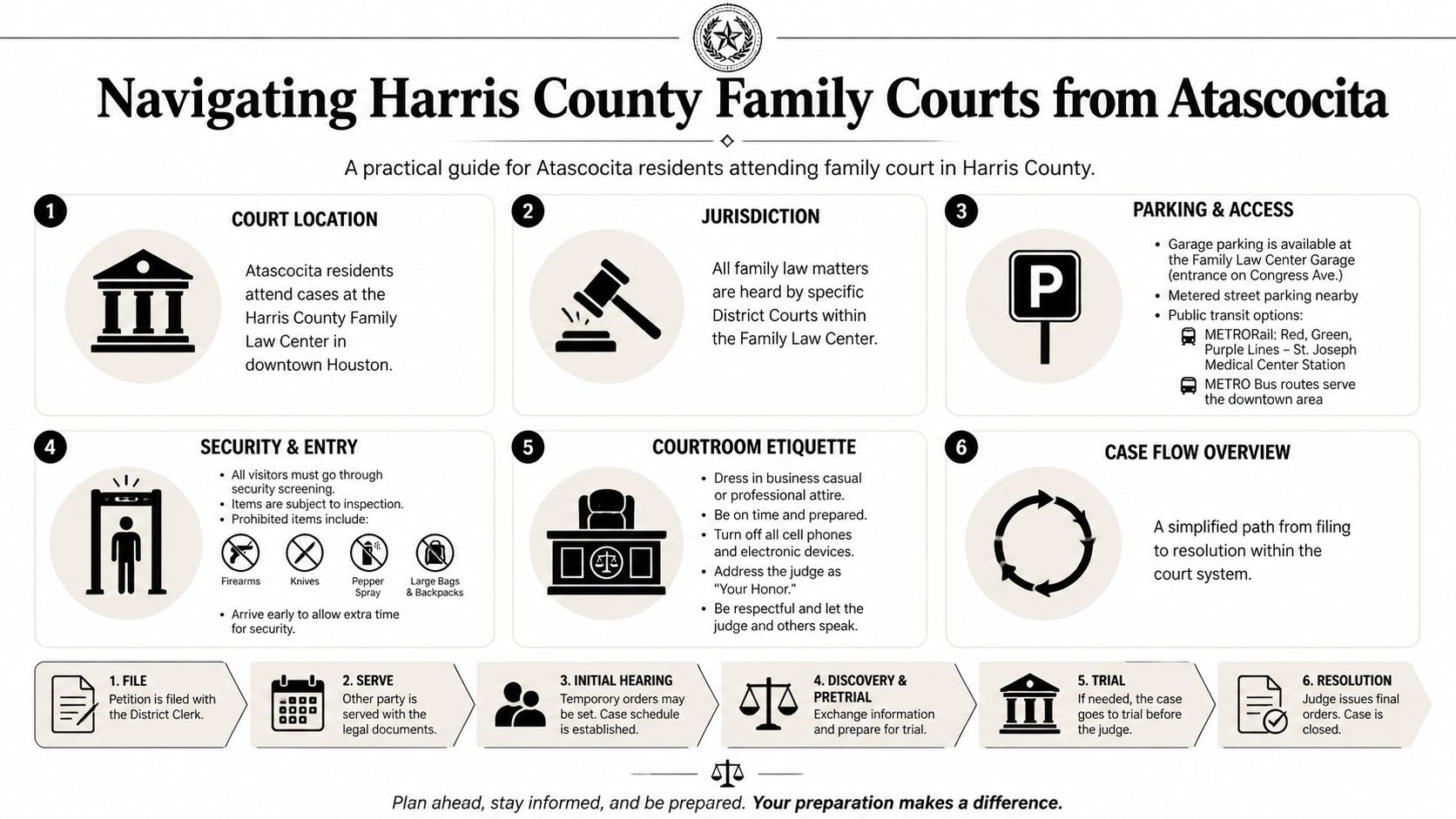
Where your case goes
Harris County’s family court system includes ten district family courts, and the system adopted significant reforms in February 2023 aimed at efficiency, including hybrid hearings, stronger mediation emphasis, and early resolution strategies, as described in this overview of the Harris County district family courts.
That matters because procedure is not static. The county has adjusted how these courts handle volume, scheduling, and case movement. If you’re in Atascocita, your case is still tied to Harris County practice even though your daily life is far from downtown.
The trip from Atascocita is part of the case
One Atascocita-focused source notes that for local residents, a trip to the Harris County Civil Courthouse is often a 35 to 40 minute drive without traffic, and that court filings surged 15% in 2025 with contested case wait times stretching to 8 to 14 months, while virtual hearings were expanded under 2024 rules, according to this Atascocita family court access discussion.
Those details shouldn’t scare you. They should change how you plan.
- Take hearing dates seriously: A missed appearance can create expensive damage fast.
- Build in extra travel time: Downtown delays are real, and arriving rushed never helps.
- Ask about remote appearance options: Some settings may be handled virtually depending on the court and issue.
- Keep your work calendar flexible when possible: Court rarely runs on your preferred timetable.
If you’re starting from square one, this practical guide to filing a divorce in Harris County can help you understand the first procedural step before you’re juggling hearings.
What a court day usually feels like
The first court appearance is often more administrative than dramatic. You may spend more time waiting than talking. Security screening takes time. Court staff move quickly. Lawyers may be handling several matters at once. Judges expect preparation, brevity, and respect for the docket.
That’s why clients should avoid bringing unnecessary items, dress conservatively, and assume that every hallway conversation matters. Even if your hearing is short, your conduct is being observed.
If you have children, line up child care before the hearing unless your lawyer tells you otherwise. Court is not a good place for kids to sit through adult conflict.
Hybrid hearings can be a real advantage
For Atascocita families, remote participation can remove a lot of friction. It can save commute time, reduce missed work, and make short procedural appearances less disruptive. But don’t make the mistake of thinking virtual means casual.
Treat a remote hearing like an in-person hearing. Quiet room. Stable connection. Proper clothing. No driving. No side conversations. No wandering in and out of frame.
Why local guidance matters here
A lawyer who understands the practical burden of getting from northeast Harris County to downtown can help you make smarter choices about scheduling, negotiation, and whether a particular dispute is worth litigating right now. Good legal strategy includes courthouse logistics, not just legal arguments.
Common Family Law Scenarios Timelines and Outcomes
Most clients want one honest answer: what is this likely to look like in real life? The answer depends on conflict level, children, finances, and whether both sides are willing to deal reasonably. Still, most Harris County family cases follow a recognizable pattern.

Scenario one, the uncontested divorce
Two spouses in Humble agree the marriage is over. They’re not fighting over where the children live, and they already have a basic understanding of who keeps which property. That case still requires paperwork, court approval, and attention to detail, but it usually moves with far less friction than a contested matter.
The basic rhythm often looks like this:
- One spouse files the petition
- The other spouse is served or waives service
- The parties exchange needed information
- A final decree is drafted and reviewed
- The court signs the final order
Uncontested doesn’t mean careless. If retirement accounts, a house, or detailed parenting terms are involved, the decree still needs to be precise. Sloppy agreed orders create modification and enforcement problems later.
Scenario two, the contested custody case
Emotions run hottest. One parent believes the children need stability with a different schedule. The other parent feels pushed out. Allegations start. Communication gets ugly. Temporary issues become the whole battlefield.
In Harris County family practice, mediation is required in nearly all contested family law matters, and one local source states that mediation resolves 70% to 80% of cases before trial, according to The Cusic Law Firm’s discussion of child custody in Harris County. That should shape your expectations from the start.
What the custody path often looks like
A contested case usually unfolds in stages rather than one dramatic hearing.
- Filing and notice: One parent asks the court for orders and the other is formally brought into the case.
- Information gathering: Financial records, proposed parenting plans, and communication history start to matter.
- Temporary orders if needed: The court may address where the child stays, who pays support, and how exchanges happen while the case is pending.
- Mediation: The parties attempt structured settlement with a neutral mediator.
- Final trial only if necessary: If major issues remain unresolved, the judge decides.
A custody case is rarely won by the parent who is angriest. It usually turns on consistency, credibility, and the ability to show a stable plan for the child.
Texas courts focus on the best interest of the child. In plain English, that means the judge cares about safety, stability, parental judgment, and whether each parent can support the child’s routine and wellbeing. It is not a contest for the most dramatic accusation.
Scenario three, child support modification
A support case often starts after life has already changed. A parent loses income, gets a new job, takes on different parenting time, or sees expenses shift. People often assume they can just “work it out” informally. That’s risky.
If support needs to change, the smart move is to address it through proper legal channels. Until the court changes an order, the old order usually remains the one that counts. In many cases, support analysis starts with current income information and the Texas guideline framework.
One Harris County-focused source discussing custody methodology references the Texas Child Support Guidelines calculator and notes the familiar guideline example of 20% of net resources for one child in the relevant context of support analysis. The bigger point for most parents is simple: support should be calculated from real financial information, not guesswork.
The mediation advantage is real
People hear “mediation” and think compromise means weakness. That’s the wrong frame. In family court, good mediation is often the strongest move because it lets you keep more control over the outcome.
It also protects children from the fallout of prolonged litigation. If your case touches the family home and a sale or refinance may be part of the solution, practical planning outside the courtroom can matter too. For readers dealing with property issues around a move, sale, or post-divorce housing strategy, this Algomizer guide for real estate agents may help you think through property considerations in a more organized way.
What outcomes usually reward
Judges and mediators tend to respond well to parties who are prepared, realistic, and child-focused. Cases go sideways when one side hides documents, sends reckless messages, or treats the children as a bargaining chip.
The calmest path is not always available. But in a lot of Harris County cases, a disciplined approach produces better outcomes than a theatrical one.
Understanding Legal Fees in Your Harris County Case
Legal fees matter. They matter a lot. Families in Atascocita are often paying for two households, child expenses, and day-to-day life at the same time they’re trying to fund a case. You deserve straight talk on how fees usually work.

The three billing models most people see
Family lawyers commonly use one of a few fee structures.
| Fee model | What it usually means |
|---|---|
| Hourly billing | You pay for time spent on calls, drafting, hearings, negotiation, and preparation |
| Retainer | You deposit funds up front, and work is billed against that amount |
| Flat fee | A set amount may apply to a limited, clearly defined service |
Each model has a place. An agreed, narrow matter may fit a flat fee. A contested custody fight usually doesn’t, because the amount of work depends heavily on the other side’s behavior and court developments.
Some firms and clients also look at alternative structures for limited matters or more predictable services. If you want a plain-English overview of different billing approaches, this guide to alternative legal fees gives a useful outside perspective.
What drives the total cost
Clients often think complexity means only “big assets” or “a lot of hearings.” Those things matter, but they aren’t the whole story. Fees usually rise because of behavior.
Costs tend to increase when:
- Documents are disorganized: Your lawyer spends time sorting what you could’ve sorted.
- Communication is constant but unfocused: Ten scattered emails cost more than one organized message.
- Conflict is performative: Fighting over minor points drains resources needed for major ones.
- The other side delays or hides information: Your lawyer has to spend time forcing the issue.
The cheapest family law case is usually the one with clear records, realistic goals, and a client who responds quickly.
How to control fees without hurting your case
Cost control does not mean doing everything yourself. It means helping your legal team work efficiently.
Try these habits:
- Send one organized update instead of several reactive messages
- Use folders for financial records, court papers, and child-related documents
- Ask strategic questions, not the same emotional question in five different ways
- Save emergencies for actual emergencies
- Prepare for mediation seriously
A lot of families also benefit from choosing a firm that can address overlapping legal needs under one roof when appropriate. For example, the Law Office of Bryan Fagan – Atascocita TX Lawyers handles family law as well as criminal defense and estate planning matters, which can be relevant when a case involves custody, an arrest issue, and the need to update wills or related documents at the same time.
Transparency should be part of the relationship
If a lawyer can’t explain how billing works, that’s a warning sign. You should understand what triggers charges, what support staff can handle, how hearing preparation is billed, and how to raise budget concerns before the bill becomes a shock.
A good fee conversation isn’t awkward. It’s part of responsible case planning.
Your Next Step Toward Peace of Mind and Resolution
If you’re dealing with divorce, custody, support, or a family problem that overlaps with criminal or estate issues, don’t wait for the situation to organize itself. It won’t. The people who do best in these cases usually take one steady step early. They get informed, get their documents together, and get advice that fits Harris County practice and Atascocita reality.
The right attorney should help you think clearly, not just react emotionally. You should understand what matters now, what can wait, and which path gives your family the most stability with the least unnecessary conflict.
Even small details can shape how supported you feel during a case. For example, if you want to see how law firms present themselves online and why clarity matters, this X8 Web Design portfolio entry for a law firm project is a useful reminder that trust often starts with communication.
The path forward may not be easy, but it can be much more manageable than it feels today. Start with a real conversation about your actual facts.
If you’re ready for practical guidance from Law Office of Bryan Fagan – Atascocita TX Lawyers, schedule a free, no-obligation consultation. You can talk through your divorce, custody, support, criminal-defense overlap, or estate-planning concerns with a local team that serves Atascocita, Humble, and northeast Harris County. A clear plan starts with one meeting.