A lot of people in Atascocita don’t start thinking about asset protection because they feel wealthy. They start thinking about it because life gets busy, and the stakes get bigger. Maybe you bought a home near Lake Houston. Maybe your small business is finally growing. Maybe you’re getting ready for retirement and realizing that one lawsuit, one probate problem, or one messy divorce could put years of work at risk.
That worry is normal.
You can be a careful person, pay your bills, work hard, and still end up facing a legal or financial problem you didn’t see coming. In northeast Harris County, that often looks like a business dispute, a family law conflict, a probate issue after a death, or questions about how to keep property in the family without creating stress for your spouse or children.
When people search for an asset protection attorney atascocita tx, they’re usually asking a simple question in plain English: “How do I keep what I’ve built from unraveling later?” The answer usually isn’t one magic document. It’s a plan that fits your life, your family, and Texas law.
Protecting Your Hard-Earned Legacy in Atascocita
Take a common local example. A couple in Atascocita owns a home, has retirement savings, and recently helped an adult child with a down payment on a house in Humble. One spouse runs a small contracting business. The other is thinking about retiring. They’re not trying to create some complicated offshore structure. They just want to know that if something goes wrong, their family won’t lose control of everything.
That’s what asset protection is really about.
For some families, the trigger is divorce. For others, it’s a new business, a rental property, aging parents, or a health issue that forces everyone to get organized fast. In each of those situations, the legal question is the same. How are assets owned, who controls them, and what happens if a creditor, court, or probate process gets involved?
Atascocita residents have access to a substantial legal community. There are 149 asset protection attorneys listed across 51 law firms in Atascocita according to Lawyers.com’s Atascocita asset protection directory. That tells you two things. First, this isn’t a niche issue for only a few families. Second, people in this area are actively looking for ways to protect homes, savings, businesses, and inheritances.
What neighbors usually worry about
Some concerns come up again and again in consultations:
- Family transitions: Marriage, remarriage, divorce, and blended families can change how property should be titled and passed down.
- Business risk: Owners often assume an LLC alone solves everything, then learn their personal and business planning don’t line up.
- Retirement security: Many retirees want to reduce the chance that their family gets stuck in a costly court process later.
- Probate stress: Parents often want a simpler path for children who may already be carrying emotional and financial pressure.
A good asset protection plan should make life simpler for your family, not harder.
In many cases, asset protection overlaps with estate planning. If you’re already thinking about keeping loved ones out of probate, a good place to start is understanding how to avoid probate in Texas. The same planning tools that reduce court involvement can also help protect control, privacy, and stability.
What Asset Protection Really Means for Your Family
Asset protection is the practice of setting up your property, accounts, and legal documents so one problem does not spill into every part of your family’s financial life.
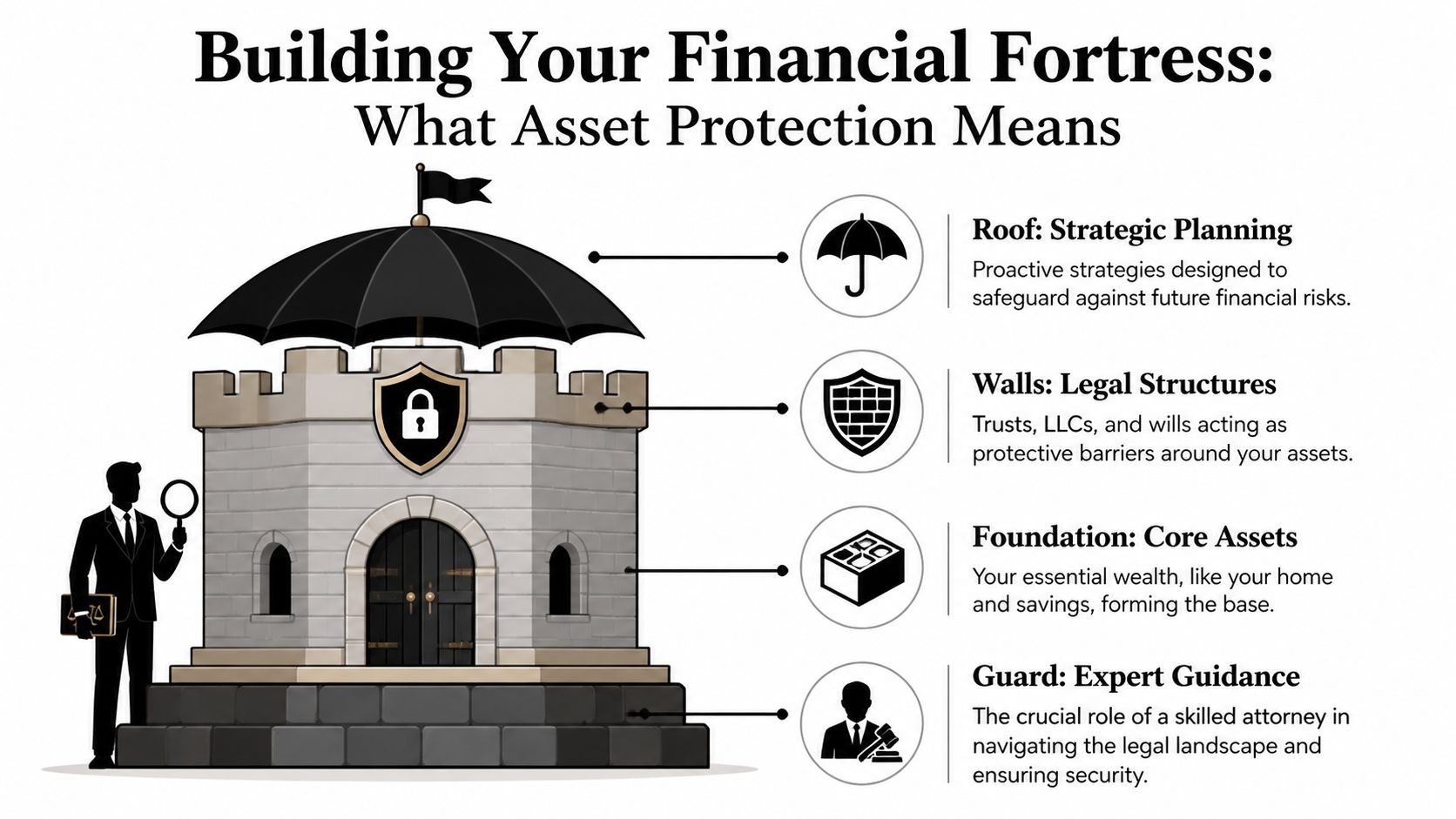
For many families in Atascocita, that conversation starts during ordinary life events, not after a major lawsuit. A couple heading into retirement may want to make sure savings pass smoothly and stay under the right person’s control. A small business owner may need clearer separation between company risk and the family checking account. Someone going through divorce, or remarrying after one, may need to revisit how property is titled and who inherits what.
Asset protection uses legal boundaries created ahead of time. Those boundaries can include trusts, business entities, beneficiary designations, marital property planning, and careful titling of assets. Under Texas law, each tool does a different job. The goal is to make the pieces fit together so your home life, business life, and long-term plans are not working against each other.
What asset protection is
Asset protection means arranging your affairs lawfully and clearly before trouble starts.
That may include:
- Separating risk: Keeping personal assets and business assets from mixing together.
- Clarifying ownership: Titling property in a way that supports your family, marriage, and financial goals.
- Directing transfers: Using wills, trusts, and beneficiary designations so assets go where you want them to go.
- Reducing conflict: Giving the right person authority to act if you die, become ill, or cannot manage things yourself.
A simple example helps. If you own a local business and the business is sued, you want the legal boundary around that business to be real, not just something you assumed existed because you filed paperwork once. If you are planning for retirement, you want account designations, trust terms, and powers of attorney to match. If you are divorcing or entering a second marriage, you want a clear understanding of what is separate property, what may be community property, and how that affects children from a prior relationship.
What asset protection is not
People often confuse asset protection with hiding assets or moving money around after a claim appears. Texas law does not permit fraudulent transfers, and no proper plan is built on secrecy or evasion.
Lawful planning happens early. It follows the rules. It also respects valid debts, court orders, and disclosure requirements.
Practical rule: The earlier you plan, the more choices you usually have.
That timing makes a real difference. Once a divorce is filed, a creditor is pursuing a claim, or a family dispute has already turned into a court matter, your options can narrow fast.
The three goals many families share
Families usually want practical results, not complicated legal theory.
Protect what should stay protected.
If you own a business, rental property, or substantial savings, one dispute should not automatically put unrelated assets in the line of fire.Make hard seasons easier on the people you love.
Death, incapacity, divorce, and retirement all bring paperwork, stress, and decisions. Clear planning gives your spouse, children, or chosen decision-maker a map to follow.Keep control while life changes.
Good planning lets you stay in charge of your affairs now while preparing for the possibility that your health, marriage, business, or income may look different later.
Why plain-English planning matters
Asset protection is not only for wealthy households. In Atascocita, it often matters most for families who have a house, a retirement account, a small business, or children they want to provide for without creating confusion later.
A useful plan should answer ordinary questions in plain English:
| Question | Why it matters |
|---|---|
| Who legally owns this asset today? | Ownership affects control, exposure to claims, and transfer rights |
| Is this separate property, community property, or business property? | Texas rules can change what happens in divorce, death, or a dispute |
| Who can act if I become incapacitated? | Delays and family conflict often start when no one has clear authority |
| Will these choices still make sense if I retire, remarry, or sell a business? | Life events can make an old plan stop fitting your needs |
Once those answers are clear, asset protection feels less intimidating. It becomes a set of manageable decisions that protect your family during the life changes many Atascocita households face.
How Texas Law Uniquely Protects Your Property
A couple in Atascocita may spend twenty years paying off their home, building retirement savings, and growing a small business, then hit a life event such as divorce, retirement, or a health crisis and realize they are not fully sure what Texas law protects and what still needs planning. That is a common place to be. Texas gives families meaningful legal protections, but those protections work more like a sturdy frame than a finished house.

For many families in Atascocita and Humble, the first source of confusion is the family home. Texas is known for strong homestead protection, and that protection is a real advantage. Your primary residence may receive significant protection under Texas law. Still, the answer depends on facts such as whether the property is your homestead, how title is held, and whether a divorce, death, or creditor issue has changed the picture.
The home often sits in the middle of several legal questions at once. A married couple may need to sort out whether the house is separate or community property. A retiring homeowner may want to know whether a refinance, transfer, or trust changes anything. A business owner may worry that a lawsuit tied to the company could reach personal property. Homestead law helps, but paperwork and ownership details still matter.
Title review is a good example. A deed that no longer matches your family goals can create trouble later. The same is true if a parent assumes a will controls everything, but the house, account, or beneficiary designations point in a different direction.
Probate creates another layer. Even with a valid will, Texas probate usually requires court involvement to admit the will and appoint the personal representative. Executors also have deadlines and notice requirements to handle. Small errors, such as missing a filing deadline, failing to gather records, or using unclear valuations, can turn an orderly estate into a slower and more stressful process for the family. That is one reason some households explore trusts before a crisis starts. If you want to understand that option in plain English, this guide on how to create a trust in Texas is a helpful place to start.
Marriage can make asset protection stronger or more complicated, depending on how property has been handled over time. Texas community property rules matter during marriage, in divorce, and after death. If one spouse started a business during the marriage, inherited land from family, or used joint funds to improve separate property, the paper trail matters just as much as the memory of what happened.
That is where Atascocita families often run into preventable disputes.
A spouse may say, "That was my inheritance," while the other spouse points to a shared account, shared expenses, or improvements paid from marital income. A business interest may look simple until someone needs to value it for divorce, sell it during retirement, or transfer it after death. Real estate records can tell a very different story than family assumptions.
Texas also protects certain property beyond the homestead, including many retirement accounts and some insurance-related interests, depending on the facts and the type of claim involved. Those protections are helpful for ordinary families, not just wealthy households. A retired teacher with an IRA, a couple with life insurance, or a local contractor with a paid-off truck and tools may all have assets worth protecting under Texas law.
Still, exemptions do not fix planning mistakes on their own. Problems often begin with mismatched beneficiary designations, an unfunded trust, personal guarantees tied to a business loan, or family members who do not know who has authority to act during incapacity. If you are starting a business, forming the entity correctly also matters, and some owners use services that simplify forming an LLC with OnBiz before working with counsel on the Texas-specific liability and ownership issues that follow.
This short overview may help if you want a visual explanation of common probate and planning issues in Texas.
A local example makes the point. A retired Atascocita couple may own a paid-off home, IRAs, a joint bank account, and inherited land outside Houston. They may also have an adult child going through divorce or a side business that started small and grew over time. On paper, each asset looks manageable. Together, they raise questions about homestead rights, community property, probate, beneficiary designations, and business liability.
Texas law gives that family meaningful protection. The planning job is making sure each piece fits the others so a divorce, business dispute, retirement transition, or death does not pull the plan apart.
Building Your Financial Fortress with Proven Strategies
A common Atascocita scenario looks like this. One spouse is opening a small business. The other is thinking about retirement in a few years. They own a home, have some savings, and maybe one rental property or a side hustle that started as weekend income. Nothing about that family sounds unusually wealthy, but they still have real exposure if the business is sued, if a divorce changes ownership questions, or if retirement accounts and beneficiary choices do not line up with the rest of the plan.
That is why good asset protection usually works in layers. A fence helps, but a locked gate, good lighting, and insurance help too. In legal planning, those layers might include an LLC, one or more trusts, title review, beneficiary updates, and marital property agreements that match Texas law.
LLCs for business and rental risk
An LLC is often one of the first tools people consider because it can separate a business or rental activity from personal ownership. For a local contractor, consultant, online seller, or landlord, that separation matters. It creates a legal bucket for the activity so business obligations are less likely to spill into personal assets.
That protection depends on upkeep. If the owner mixes personal and business money, signs contracts carelessly, or treats the company account like a personal wallet, the separation can weaken. People at the start of the process sometimes simplify forming an LLC with OnBiz to understand the filing steps, then work with counsel to make sure the company structure fits the larger Texas asset protection plan.
An LLC is often worth discussing if you:
- Run a service business: Clear separation can help reduce personal exposure tied to contracts, employees, or customer claims.
- Own rental property: An entity may help contain risk connected to that property.
- Have a partner or investor: Written ownership rules matter more once another person is involved.
Trusts for control, protection, and family clarity
Trusts are not just for large estates. They are tools, and the right tool depends on the problem in front of you.
A revocable trust is often used for management during incapacity, privacy, and smoother transfer after death. It can help a retired couple keep accounts and property organized and may reduce probate problems for assets properly transferred into the trust. During your lifetime, though, it usually does not provide strong creditor protection by itself.
An irrevocable trust can offer stronger protection in some situations because the asset is no longer owned in the same way. The tradeoff is control. That kind of planning may make sense for a family trying to protect property for children from a prior marriage, preserve assets during retirement, or reduce the chance that future disputes pull key assets back into the owner's personal reach.
A special needs trust may help families provide support for a loved one without accidentally disrupting public benefits.
If you want a clearer picture of how these options work, this guide on how to create a trust gives a useful starting point. The key question is usually not, "Do I need a trust?" It is, "What do I need this trust to do for my family under Texas law?"
Family limited partnerships and other layered tools
Some families need more than an LLC or a basic trust. If parents want to keep inherited land, investment property, or a closely held business under coordinated family management, a family limited partnership may be part of the conversation. It can centralize control while allowing gradual transfers over time.
Other pieces are less flashy but just as important. Beneficiary designations need to match the estate plan. Insurance should fit the level of risk. Marital agreements may help define separate and community property before a marriage, during a marriage, or in preparation for a second marriage where children from different relationships are involved.
Small details often decide whether a plan holds together.
Comparing Common Asset Protection Strategies in Texas
| Strategy | Best For | Level of Protection | Complexity & Cost |
|---|---|---|---|
| LLC | Small business owners, landlords, side businesses | Strong for separating business-related liability when maintained properly | Moderate |
| Revocable trust | Families focused on management, privacy, and easier transfer | Limited lifetime creditor protection, useful for probate avoidance and continuity | Moderate |
| Irrevocable trust | Long-term asset preservation and stronger shielding goals | Higher potential protection with less flexibility | Higher |
| Family limited partnership | Families managing shared or generational assets | Can be useful in the right setting, but requires careful structure | Higher |
| Prenuptial or marital property agreement | People entering marriage with separate assets or business interests | Helpful for defining ownership and reducing later disputes | Moderate |
| Direct ownership with basic estate planning | Simpler households with limited exposure | Lowest structural protection, but sometimes a starting point | Lower |
Which strategy fits common life events
The best plan usually starts with the life event causing the concern.
Divorce or remarriage
A second marriage often raises questions about separate property, children from prior relationships, and who should inherit what. Clear agreements and carefully chosen ownership structures can reduce confusion later. If divorce is already underway or likely, any planning has to respect disclosure duties and Texas family law rules.
Starting a business
This is often the cleanest time to set up the right entity, ownership documents, and signing habits. It is much easier to build a good wall at the beginning than to repair one after a dispute.
Planning for retirement
Retirement shifts the focus from building wealth to preserving it. That may mean reviewing titles, updating beneficiaries, deciding whether a trust should hold certain assets, and checking whether an older business structure still fits your current risk.
Key Life Moments That Call for Professional Legal Advice
Calling an attorney about asset protection isn’t a decision typically made spontaneously on a random Tuesday. Usually, something changed. A business became profitable. A marriage is beginning or ending. A parent died. A retirement date is getting closer. You bought property and suddenly realized your paperwork doesn’t answer the important questions.
Those moments are when legal advice becomes practical, not theoretical.

Starting or growing a business
Business owners often wait too long because they’re focused on customers, payroll, taxes, and growth. But early growth is exactly when exposure increases. Contracts get larger. Equipment gets more valuable. Employees or subcontractors come into the picture. A personal guarantee or poorly signed agreement can undermine a lot of careful work.
A lawyer can help review structure, ownership, and risk points before they become expensive problems.
Marriage, divorce, and blended families
Family changes can reshape your financial life overnight. If you’re getting married and bringing a home, savings, or a business into the marriage, it’s wise to think through how those assets will be characterized and managed. If divorce is pending, you need planning that works with Texas family law rather than around it.
For parents in blended families, a core concern is often simple. How do you provide for a spouse while still protecting children from a prior relationship? That usually takes more than a basic will.
Buying property or receiving an inheritance
A new home, rental property, or inherited asset often creates title and transfer questions. If ownership isn’t coordinated with the rest of your plan, one property can become the source of future probate confusion or family disagreement.
This is also a good time to review estate planning documents and civil exposure issues together. If you’re dealing with disputes tied to property, contracts, or personal liability, it can help to review related legal services through Atascocita civil litigation guidance.
People often seek legal help after a conflict starts. The better time is when life just changed and you still have room to plan.
Approaching retirement
Retirement changes the focus from accumulation to preservation. You may be less worried about building wealth and more concerned about keeping it organized, accessible, and protected for the people who depend on you.
Common retirement planning concerns include:
- Control during incapacity: Who can act if you can’t?
- Smooth transfer after death: Will your family face confusion or delay?
- Protection from preventable disputes: Are assets titled and directed clearly?
- Coordination with family realities: Do your documents still fit your marriage, children, and long-term wishes?
If one of those life moments applies to you, that’s usually a sign to sit down with counsel before assumptions turn into problems.
How Our Atascocita Attorneys Guide You Step-by-Step
A lot of people put this off because they think the process will be intimidating. In reality, it should feel organized and calm. Good legal planning starts with a conversation about your life, not a stack of forms.

In the Atascocita area, families have many options for estate planning help. There are 278 top-rated estate planning and probate attorneys available nearby, and trusts can bypass probate, a process that delays asset distribution by 12-18 months on average and costs 4-7% of estate value, according to Super Lawyers’ Atascocita estate planning and probate listings. What matters most is finding an attorney who can explain the plan in plain English and tailor it to your actual risks.
Step one begins with your real concerns
The first meeting is usually about facts and goals. What do you own, how is it titled, who is in your family, and what worries you most? For one person, the main issue may be a business. For another, it’s probate avoidance. For someone else, it’s protecting children during a second marriage.
Bring whatever you have. Deeds, business documents, wills, trust paperwork, divorce decrees, beneficiary designations, or even a handwritten list of assets can all help.
Strategy comes after review
Once the facts are clear, the next step is sorting options. You may need a trust. You may need an LLC review. You may need coordinated estate planning, marital planning, or a cleanup of old documents that no longer match your life.
This is also the point where many families look more closely at living trust planning in Atascocita if avoiding probate and improving continuity are part of the goal.
Implementation should be practical
This stage usually includes drafting, signing, and helping you carry the plan into real life. That can mean preparing trust documents, updating deeds, reviewing business ownership records, and checking whether beneficiary designations support the overall design.
A plan on paper is only part of the job. It has to be carried through correctly.
Reviews matter as life changes
Asset protection isn’t always one-and-done. Marriage, divorce, a new child, retirement, a business sale, or inherited property can all justify a review. The legal structure should change when your life changes.
A good process leaves you with more clarity than when you started. You should know what you own, how it’s protected, and what your family would do if something happened tomorrow.
Common Questions from Your Atascocita Neighbors
Is it too late to protect my assets if a lawsuit has already been filed
Maybe, maybe not. Timing matters a lot. Once a claim exists, your options can become much narrower, and some transfers can create serious legal problems if they appear designed to avoid an existing creditor. That’s why planning works best before a dispute starts.
If a lawsuit is already pending, you still need legal advice. The focus may shift from proactive structuring to defense, compliance, and damage control.
Will an asset protection plan hurt my ability to get a loan
Not necessarily, but lenders care about ownership, collateral, and authority. If assets are held in an LLC or trust, the lender may want additional documentation. That doesn’t mean the plan is bad. It means the plan needs to be coordinated with financing realities.
This is one reason generic online forms often create frustration. They may not match how banks, title companies, or family circumstances work.
What’s the difference between asset protection and estate planning
They overlap, but they aren’t identical.
Estate planning focuses on what happens at death or incapacity. Who inherits, who manages, who makes decisions, and how court involvement can be reduced.
Asset protection focuses more on shielding property from future risk during life. That can include lawsuits, business liability, divorce concerns, or ownership problems. The strongest plans usually combine both perspectives.
How much does a basic asset protection plan cost in Atascocita
There isn’t one fixed answer because the cost depends on what you need. A simple plan for a homeowner with straightforward goals looks different from a plan for a business owner, landlord, or blended family. The core question isn’t “What’s the cheapest document?” It’s “What problem are we solving, and what does it take to solve it correctly?”
Do I need this if I’m not wealthy
Often, yes. Asset protection is especially helpful for people who would feel real harm from losing part of what they’ve built. That includes retirees, parents, small business owners, professionals, and families with a home or savings they want to preserve.
You don’t need extraordinary wealth to need a plan. You need something worth protecting.
If you’re dealing with a divorce, starting a business, planning for retirement, or trying to keep your family out of probate, a personalized conversation can make the next steps much clearer. The Law Office of Bryan Fagan – Atascocita TX Lawyers helps residents of Atascocita, Humble, and northeast Harris County evaluate asset protection, estate planning, probate, and related legal issues with practical guidance and a local perspective. Schedule a free consultation at the Atascocita office to talk through your goals and build a plan that fits your life.