Skip to content
A lot of families in Atascocita put this off for the same reason. Life is full. There’s work, kids, aging parents, mortgage payments, and a hundred smaller decisions that seem more urgent than estate planning.
Then one quiet evening, the question shows up anyway. If something happened to me, what would my family have to deal with?
For many people in Humble and northeast Harris County, that question starts with a house, a bank account, maybe a retirement account, and a strong desire to make things easier for the people they love. That’s where a living trust often enters the conversation. If you’ve searched for living trust attorney atascocita texas, you’re probably not looking for legal theory. You want a clear answer about whether a trust makes sense for your family, your home, and your future.
Securing Your Family’s Future in Atascocita
A common local scenario goes like this. A couple in Atascocita has spent years building a stable life. Their home is paid down, they’ve saved what they can, and they want their children to avoid confusion later. They may already have a will tucked in a drawer, but they’re not sure whether that’s enough.
What worries them usually isn’t just death. It’s delay, court involvement, paperwork, and the possibility that stress turns into conflict.

A living trust speaks to those concerns because it’s designed to keep certain assets out of probate when it’s set up and funded correctly. That matters here. In 2025 surveys, only 13% of U.S. respondents reported having a living trust, compared to 24% who have a will, and Harris County manages over 10,000 probate cases annually. That probate process can last 6 to 18 months and cost families 4% to 7% of the estate’s value, according to Texas probate and living trust data.
Why families feel stuck
Many people assume estate planning is only for wealthy households. It isn’t. If you own a home, want privacy, or want someone you trust to step in if you become unable to manage things, this issue is already relevant.
Other families think a will solves every problem. A will is important, but it works differently. In many cases, a will still sends your estate through court.
Practical rule: If your main goal is to spare your family from a public and court-supervised transfer process, a living trust deserves a serious look.
What peace of mind looks like locally
For Atascocita residents, peace of mind often means practical things:
- Keeping the family home on a smoother path so loved ones aren’t left waiting on court procedures.
- Reducing opportunities for confusion when family members live in different places or don’t agree on next steps.
- Planning for incapacity so someone can manage affairs without a separate court fight.
Families in Humble and Harris County don’t need a complicated legal lecture. They need a plan that works in real life, when emotions are high and time matters. A well-prepared living trust can be that plan.
What is a Living Trust and Why Consider One in Texas
A revocable living trust is a legal arrangement that holds assets under written instructions you create while you’re alive. “Revocable” means you can change it. “Living” means it takes effect during your lifetime, not only after death.
The simplest way to think about it is this. A trust is a financial bucket with rules attached. You place certain assets into that bucket, and the rules say who manages them, who benefits from them, and what happens if you become incapacitated or die.
The three roles people mix up
These terms confuse readers more than almost anything else, so let’s simplify them.
- Settlor means the person who creates the trust. That’s usually you.
- Trustee means the person managing the trust assets. At first, that’s also usually you.
- Beneficiary means the person who benefits from the assets. During your life, that can also be you.
That’s why people often say, “How can I create it, control it, and benefit from it at the same time?” In a revocable living trust, you often do exactly that.
Later, your successor trustee takes over if you can’t act for yourself or after your death. That person follows the instructions already written into the trust.
Why Texas families consider one
For homeowners in Atascocita, a trust often becomes important when the house is the center of the estate. A trust can also help when parents want a smoother transfer for adult children, when second marriages create blended-family concerns, or when someone wants more privacy than a will provides.
A trust can also help avoid rigid default rules. Without planning, Texas law can control who receives property in ways that may not match what you intended.
Here’s where many families get tripped up. They think signing the trust document finishes the job.
It doesn’t.
Funding is the step people miss
For a revocable living trust to avoid probate in Texas, it must be funded. That means assets have to be retitled into the trust’s name. If your house, account, or other property stays in your individual name, the trust may not control it the way you expected.
Data cited from the Texas Board of Legal Specialization shows that unfunded or improperly funded trusts are the leading cause of failure, with up to 70% failing to achieve complete probate avoidance, while attorney-guided funding has a near-perfect success rate, as explained in this resource on Texas living trust requirements and funding.
A signed trust without transferred assets is like labeling moving boxes but never packing them.
What funding looks like in plain English
Funding usually means taking action on real property and accounts, such as:
- Updating the deed to your home so title reflects the trust.
- Retitling eligible financial accounts into the trust’s name.
- Reviewing personal property and business interests to decide what belongs in the trust.
- Coordinating the trust with the rest of your estate plan so nothing important gets left behind.
If you want a broader look at strategies for avoiding probate in Texas, it helps to compare trusts with other planning tools before deciding what fits your family.
Living Trust vs Will Which is Right for Your Atascocita Estate
Most families don’t need a lecture on abstract legal categories. They need to know which tool fits their goals. A living trust and a will can both be useful, but they’re not interchangeable.
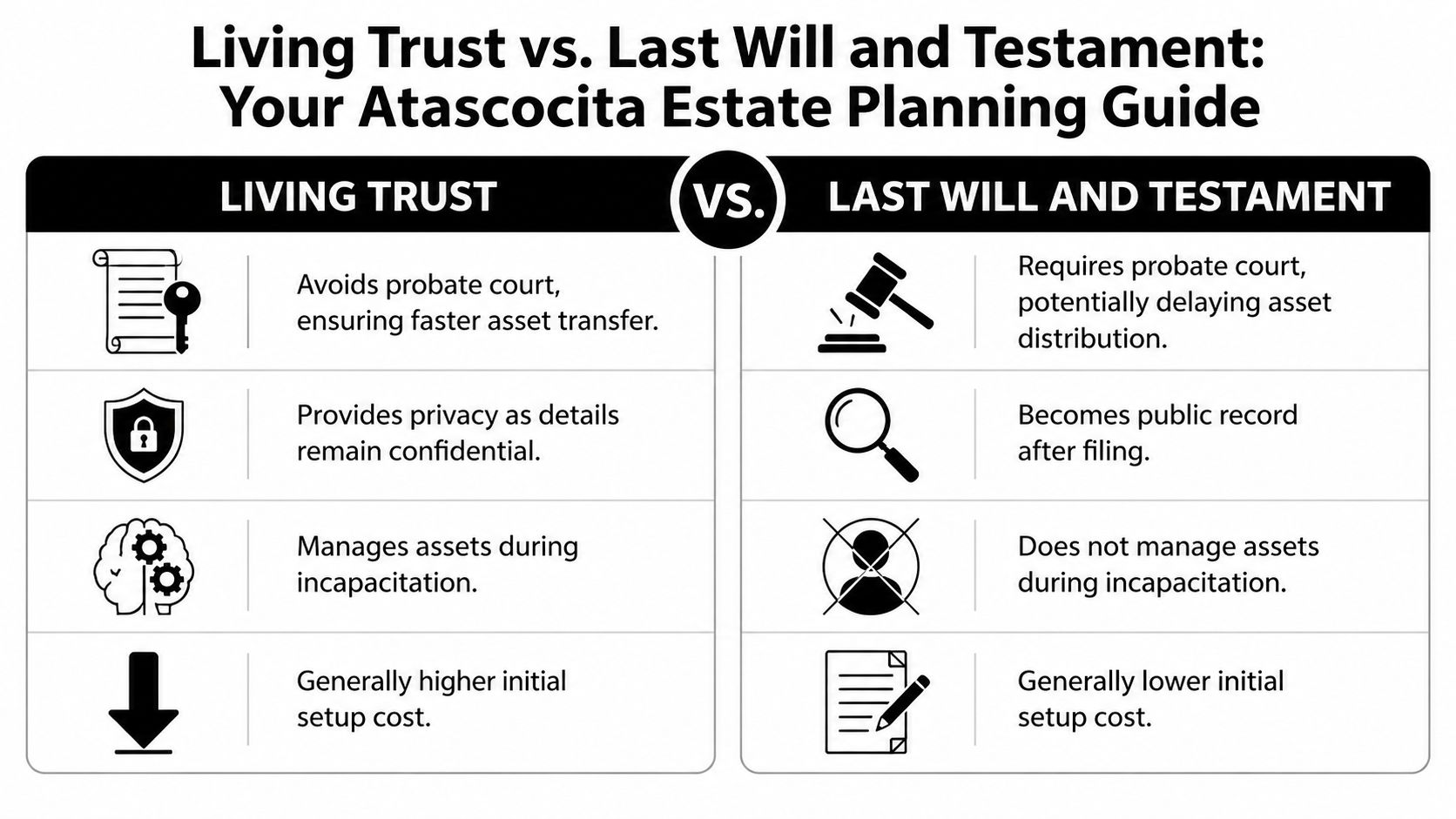
The clearest difference is this. A will gives instructions that are typically carried out through probate. A funded living trust is designed to let covered assets pass outside that court process.
Living Trust vs. Will in Texas Key Differences
| Feature | Living Trust | Will |
|---|---|---|
| Probate | Designed to bypass probate for properly funded assets | Generally goes through probate |
| Privacy | Usually remains private | Becomes part of the court record |
| Incapacity planning | Successor trustee can step in under the trust terms | Doesn’t manage assets during incapacity by itself |
| Setup | More work upfront because drafting and funding both matter | Simpler initial document |
| Asset transfer process | Depends on proper funding before death | Depends on court process after death |
Where a trust has the edge
For many Atascocita families, the strongest reason to consider a trust is control with continuity. If you become incapacitated, your successor trustee can manage trust assets according to the instructions you already put in place.
That matters more than people realize. A will doesn’t do that job during your lifetime.
Privacy is another major point. A trust generally stays private, while a will becomes part of a court file once probate begins. Some families strongly prefer not to make their asset distribution part of a public process.
Where a will still matters
A will is still a core estate planning tool. It can name guardians for minor children, and it often works as a backup even when someone has a trust. Many trust-based plans include a pour-over will to catch assets that weren’t moved into the trust before death.
So this isn’t an all-or-nothing decision between “trust good, will bad.” It’s more accurate to say that each serves a different function.
- Choose a trust-first plan if you want smoother administration, privacy, and built-in incapacity management.
- Choose a will-only plan if your estate is simple and you understand that probate may still be part of the path.
- Use both together if you want a fuller plan with fewer loose ends.
A simple local example
Take a homeowner in Atascocita with adult children. If the home is in a funded trust, the successor trustee can usually follow the trust terms without opening a standard probate case for that property. If the same home is only covered by a will, the family typically starts in probate court.
That difference often shapes the whole experience for surviving relatives.
Families usually don’t regret having clearer paperwork. They regret leaving loved ones with unclear authority.
If you want a plain-language outside resource that compares these tools without a lot of jargon, this Guide to living trusts and wills gives a useful high-level overview.
The Attorney-Led Process Creating Your Trust Step-by-Step
People often expect this process to feel intimidating. In practice, it’s much more manageable when you break it into clear stages and work with someone who handles Texas estate planning regularly.
Attorneys certified by the Texas Board of Legal Specialization in Estate Planning must meet demanding experience and testing standards, and that level of knowledge has been shown to correlate with 40% lower client dispute rates in probate litigation, according to this explanation of Texas estate planning attorney qualifications.
Step one meets real life
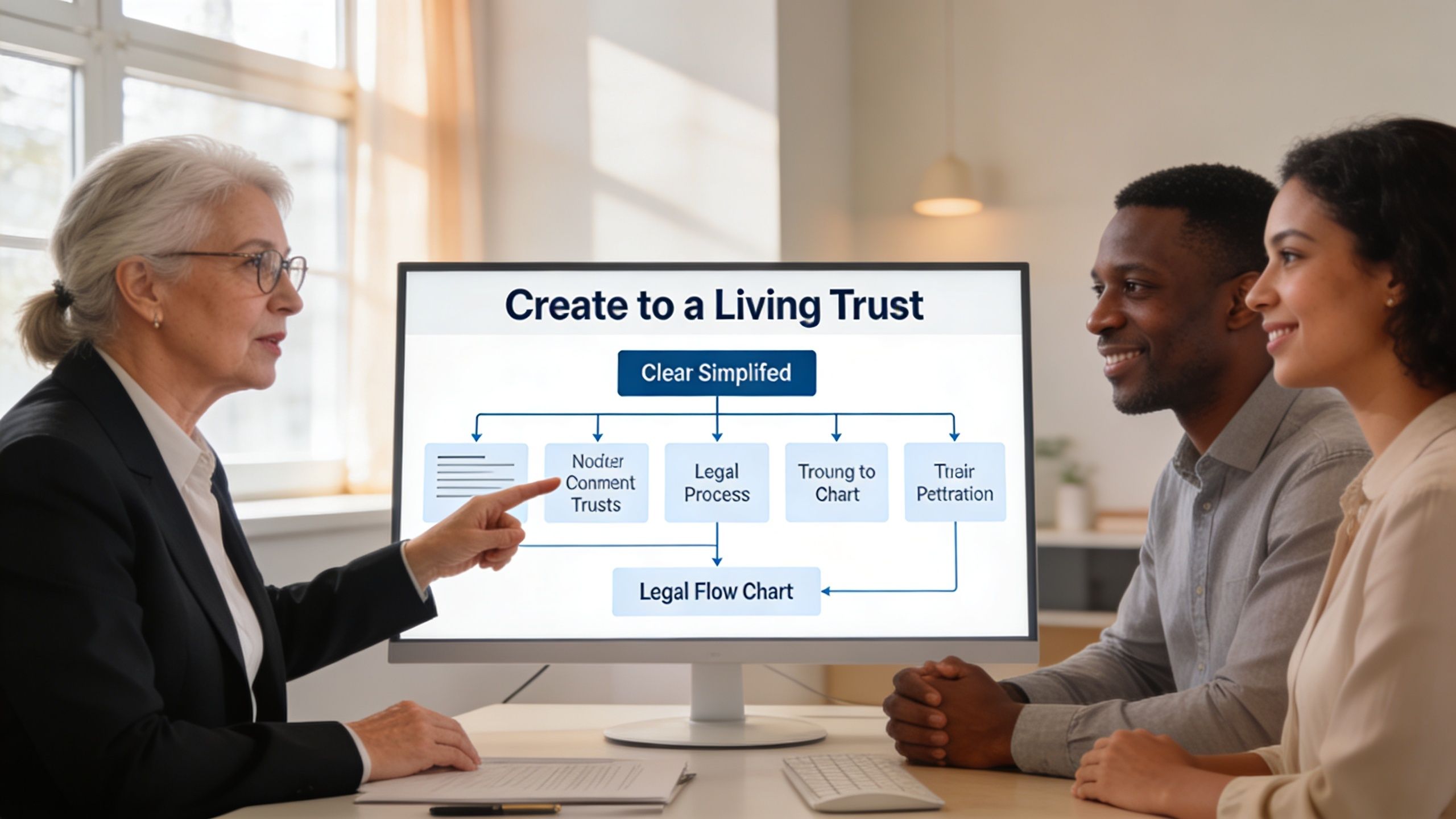
The first meeting usually isn’t about legal jargon. It’s about your family, your property, and what you want to happen if something changes suddenly.
You may talk about your home in Atascocita, children from a prior marriage, a parent who depends on you, or whether you want one child to serve as trustee and another to receive property on different terms. Those details shape the trust more than generic templates ever could.
The process in practical order
Initial consultation
You sit down and identify your goals. Avoid probate. Keep things private. Plan for incapacity. Protect harmony between family members. Those goals determine whether a revocable living trust fits.Asset inventory and strategy session
This step is more important than many people expect. You list what you own and how it’s titled. Homes, bank accounts, investment accounts, business interests, and personal property all need to be reviewed carefully.Drafting the trust and related documents
The documents need to match Texas law and your actual family structure. This is also where you choose the successor trustee and think through practical backup options.
For readers who want a focused overview of the mechanics, this page on how to create a trust offers a useful companion resource.
The review and signing stage
Once the draft is ready, you review it in plain language. Good estate planning conversations often include basic but important questions.
- Who takes over if your first trustee choice can’t serve?
- Should beneficiaries receive assets outright or under conditions?
- Do your documents match your current family reality?
At this juncture, many clients feel the biggest relief. The uncertainty starts turning into a plan.
A short video can also help make the process feel less abstract:
Funding is where attorney guidance matters most
After signing, the focus shifts to implementation. In this phase, deeds, account paperwork, and title details matter. A trust that isn’t funded correctly can leave a family with the same court problems they thought they had solved.
That’s one reason many people prefer structured legal help rather than a do-it-yourself packet. One available option in this area is the Law Office of Bryan Fagan – Atascocita TX Lawyers, which handles trust creation, related documents, and funding coordination as part of estate planning work for local families.
Local insight: The hardest part usually isn’t deciding you want a trust. It’s making sure every important asset actually gets connected to it.
Common Pitfalls and How to Avoid Them
Most trust problems aren’t caused by bad intentions. They happen because people assume a trust is simpler than it is, or because they stop halfway through.
The online form problem
A generic form may look complete because it has signature lines and formal wording. That doesn’t mean it fits Texas property rules, your family structure, or the way your assets are titled.
This shows up when someone owns a house with a spouse, has children from different relationships, or wants specific instructions for a beneficiary who isn’t ready to manage money alone. The form may not be “wrong” in a broad sense. It may just be wrong for your life.
The empty trust problem
This is the mistake that causes the most disappointment. A family thinks the trust will keep everything out of probate, but the key assets were never transferred into it.
Common examples include:
- A homestead still titled individually because no deed was prepared and recorded.
- Bank accounts left untouched because the owner assumed listing them in the trust document was enough.
- A new asset acquired later that never got reviewed after purchase.
When that happens, loved ones can discover that the trust exists on paper but doesn’t control the most important property.
If you remember only one thing from this article, remember this. Creating the trust and funding the trust are two separate jobs.
The set-it-and-forget-it mistake
Life changes. Divorce happens. Children grow up. A chosen trustee moves away, becomes ill, or no longer makes sense for the role. Estate plans need periodic review.
A trust should still match your life years after signing. If it doesn’t, the document may create confusion at exactly the moment it was supposed to prevent it.
The wrong trustee choice
Families often choose a successor trustee based only on closeness. But being trustworthy and being prepared are not always the same thing.
A good successor trustee should be:
- Organized enough to handle paperwork and timelines.
- Calm under pressure when family members ask hard questions.
- Willing to follow instructions rather than personal opinions.
- Responsible with money and able to keep records.
Sometimes the right choice is a relative. Sometimes it’s not. The title carries real responsibility.
Why a Local Atascocita Attorney is Your Best Ally
Estate planning is personal, but it’s also local. The documents may be governed by Texas law, yet the practical work often touches local real estate records, local institutions, and local court realities.
That’s one reason local experience matters in a very concrete way. There are over 278 estate planning attorneys serving the Atascocita area, Harris County handles over 1.2 million probate-related filings annually, and Atascocita’s retiree population is projected to grow 22% by 2030, according to Atascocita estate planning attorney directory data. Those numbers point to two truths. People here need estate planning, and there’s enough complexity in the local system that familiarity matters.
Local knowledge changes the conversation
A local attorney doesn’t need a map to understand the difference between a family in Atascocita Shores, a retiree near Humble, and a business owner balancing personal and business property concerns in northeast Harris County.
That matters because estate planning decisions are rarely generic. A local practice is more likely to hear the same neighborhood concerns repeatedly:
- How should we handle the house?
- What if one child lives out of state?
- What if we’re also helping an aging parent?
- What happens if we become unable to manage our finances?
These aren’t abstract legal puzzles. They’re community patterns.
Why local isn’t the same as convenient
Some people choose a lawyer based only on proximity. Convenience matters, but local value runs deeper than that. You want someone who understands how local procedures, property records, and court expectations affect the details.
You also want someone you can meet with again when life changes. Trust planning isn’t always a one-time event.
If you’re comparing firms, this article on how to choose an estate planning attorney is a practical place to start.
A note on finding community-based professional help
When people search for legal services online, they often rely on how visible a business is in local search results. If you’re curious how firms build that local presence, this overview of local SEO strategies explains the mechanics in plain language.
That visibility matters because families usually look for someone nearby when the issue feels personal. And living trust planning is personal.
A local attorney isn’t just drafting documents. They’re helping a family make decisions in the context of the community where that family actually lives.
Frequently Asked Questions About Texas Living Trusts
Can I change a revocable living trust after I sign it
Usually, yes. A revocable living trust is built to be flexible during your lifetime. If your family changes, your assets change, or your trustee choice no longer fits, the trust can often be updated.
That said, changes should be documented properly. Informal notes in a folder won’t do the job.
Do I still need a will if I have a living trust
In many cases, yes. A will can still serve an important backup role, especially for assets that weren’t transferred into the trust. Parents of minor children also often need a will for guardianship-related planning.
A trust-centered plan and a will often work together, not against each other.
Does a living trust protect assets from Medicaid
A standard revocable living trust usually isn’t the right tool for Medicaid asset protection. Because you retain control, those assets are generally still considered yours for that kind of eligibility analysis.
If long-term care planning is one of your goals, that needs a separate and very careful legal discussion.
How long does it take to create a trust
That depends on how quickly you can gather asset information, review drafts, and complete funding steps. The legal drafting itself is only part of the process. The follow-through matters just as much.
Families who stay organized usually move through the process more smoothly than families who delay the asset and title review.
What should I bring to a first meeting
Bring whatever helps tell the story of your estate and your concerns, such as:
- A list of major assets including real estate and financial accounts
- Any current will or trust documents
- Names of the people you may want as trustee, backup trustee, or beneficiaries
- Questions about family dynamics that may affect the plan
You don’t need perfect paperwork before asking for help. You just need enough information to start the conversation clearly.
A thoughtful trust plan can remove a lot of uncertainty for the people you love. If you’re in Atascocita, Humble, or nearby Harris County communities and want straightforward answers about whether a living trust fits your situation, a one-on-one consultation is the easiest next step.
If you’re ready to talk through your options, schedule a free consultation with Law Office of Bryan Fagan – Atascocita TX Lawyers. We help families in Atascocita, Humble, and northeast Harris County understand living trusts, wills, probate, and related planning in clear, practical terms so you can move forward with confidence.