 Skip to content
You may be reading this because your mom just had a health scare, your dad is slowing down, or you’ve started thinking about what would happen if you couldn’t sign papers, pay bills, or speak with doctors for a while. That’s usually how this starts in Atascocita. It’s not abstract. It’s a real family conversation at the kitchen table, often later than anyone wanted.
A power of attorney can bring a lot of calm to that moment. It lets you choose who can step in if life gets complicated, instead of leaving your family to scramble during a crisis.
Planning for Peace of Mind in Your Atascocita Community
A family in Atascocita might spend months talking around the subject. One adult child notices missed bills. Another worries about doctor visits. A spouse says, “We should probably get paperwork in order,” but nobody knows where to begin. That hesitation is normal.
A power of attorney, or POA, is one of the simplest ways to turn worry into a plan. It doesn’t mean giving up control. It means deciding, while you can, who you trust to help if you ever need them to.

Why local access matters in Atascocita
One practical frustration for many families is finding help close to home. Many Atascocita residents face accessibility challenges, with most listed estate planning lawyers located in Kingwood or Houston, requiring travel. That gap matters for Atascocita’s 88,000+ residents, especially retirees and families who need convenient consultations without dealing with Harris County traffic, as noted by HS Byers Law Firm’s local practice area page.
That’s more important than it may sound. If an older parent has mobility issues, or if you’re fitting legal planning between work, school pickup, and medical appointments, a “nearby” office that’s still a long drive away can become one more reason to delay.
Practical rule: The easier it is to meet with a lawyer, ask follow-up questions, and sign documents correctly, the more likely your family is to finish the process.
What peace of mind really looks like
In plain English, peace of mind means this:
- Bills still get paid: If you’re hospitalized or recovering, someone you trust can handle financial tasks.
- Medical decisions aren’t left in limbo: A trusted person can speak with doctors when needed.
- Your family avoids guessing: Your wishes are written down instead of debated in a hallway.
- You stay in charge now: You choose the person and define the powers.
For many people searching for a power of attorney lawyer Atascocita TX, the true question isn’t legal. It’s emotional. “How do I protect my family without making this harder than it needs to be?”
The answer usually starts with a simple conversation, a clear document, and a lawyer who understands the pace and needs of Atascocita, Humble, and northeast Harris County.
Understanding Your Power of Attorney Options in Texas
Texas uses a few different POA tools, which often confuses people. They hear “power of attorney” and assume one document covers everything. It doesn’t.
The clearest way to think about it is this. A POA is a permission slip, but different permission slips do different jobs.
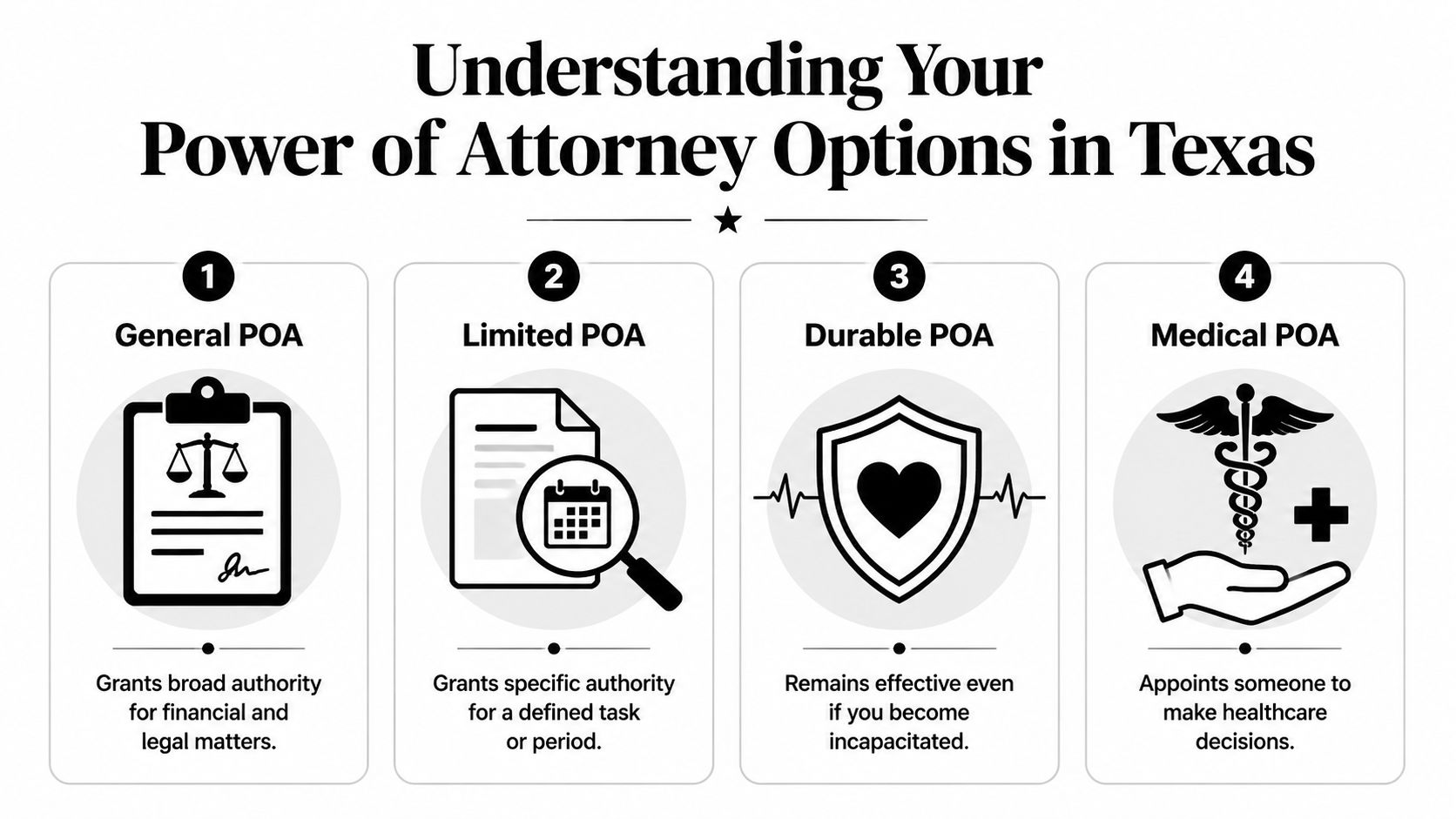
The main POA types most Texas families talk about
| Type | What it generally does | Common use |
|---|---|---|
| General POA | Gives broad authority for legal and financial matters | Short-term help in certain situations |
| Limited POA | Gives authority for one task or a defined time | Signing one real estate document or handling one account |
| Durable POA | Keeps working even if you become incapacitated | Long-term planning for financial affairs |
| Medical POA | Lets an agent make healthcare decisions when you can’t | Hospital stays, treatment decisions, doctor communication |
Why “durable” matters so much
Texas law requires specific durable language for a POA to remain valid after the principal becomes incapacitated. Without that language, the document can fail at the exact time your family needs it most. That durability is a major protection for financial management and can help families avoid court-supervised guardianship, as explained in this discussion of guardianship vs. power of attorney in Texas.
That one word, durable, carries a lot of weight.
If you’re healthy today but want a safety net for tomorrow, this is usually the document people mean when they talk about planning ahead for finances, property, banking, taxes, and similar matters.
Financial POA and Medical POA are not the same
A Durable Power of Attorney usually deals with money and property. A Medical Power of Attorney deals with healthcare choices.
That means the person who can talk with your bank may not automatically have authority to talk with your doctor. Families are often surprised by that. Texas separates these jobs on purpose.
One document helps manage your financial life. Another helps protect your medical wishes.
Immediate vs springing authority
You may also hear lawyers discuss whether a POA is immediate or springing.
- Immediate POA: Your agent’s authority starts when you sign.
- Springing POA: Your agent’s authority starts only after a triggering event, usually proof of incapacity.
Some people like the idea of a springing POA because it feels safer. In practice, it can create delays at the worst possible time because someone has to prove the trigger happened. During a medical event or financial emergency, families often need clarity, not extra hurdles.
If you want a plain-language primer before meeting with counsel, this overview of what is a power of attorney document is a helpful place to start. And if you have family in another state and want to compare how forms differ, this guide to essential Virginia POA forms shows how state-specific these documents can be.
Selecting a Trusted Agent Your Family Can Rely On
The most important part of a POA isn’t the signature line. It’s the person you name.
You’re choosing someone who may one day handle money, paperwork, healthcare communication, or major decisions under stress. That doesn’t automatically have to be your oldest child, your spouse, or the relative who volunteers first. It should be the person who can do the job calmly and with integrity.

What to look for in an agent
A good agent is usually someone with a mix of practical and personal strengths.
- Trustworthiness first: This person must act for your benefit, not their own.
- Steady judgment: Crises make emotional people more emotional. You want someone who can stay level.
- Organization: They should be able to keep records, track deadlines, and follow instructions.
- Availability: Someone nearby in Atascocita, Humble, or the greater Harris County area can often respond faster when documents, meetings, or emergencies come up.
- Willingness to serve: Some people love you very much and still aren’t suited for this role.
Why the choice matters legally
Nationally, 12-15% of POAs face claims of fiduciary breach, and that risk can be reduced by over 60% when the document includes clear limitations and accountability requirements, according to Texas Law Help’s discussion of powers of attorney.
That tells us two things. First, agent misuse is a real risk. Second, careful drafting can reduce it.
A good POA doesn’t just grant power. It builds guardrails around that power.
Questions to ask yourself before naming someone
Instead of asking “Who would be offended if I didn’t choose them?” ask these questions:
- Would I trust this person with my online banking today?
- Can this person handle pressure without freezing up?
- Will this person communicate clearly with siblings, doctors, or banks?
- If they had to explain every action later, would they be comfortable doing that?
Don’t forget backup agents
Life changes. The person you name today may move, become ill, or be unavailable later. Naming an alternate agent is a small step that can prevent big headaches.
A thoughtful lawyer will also talk with you about limiting certain powers, requiring records, and tailoring the document to your family dynamic. That matters a lot more than people think. The right person, backed by the right language, is what makes a POA feel safe.
Your Step-by-Step Guide to Working with an Atascocita Lawyer
Meeting with a lawyer for POA planning doesn’t need to feel formal or intimidating. Most families do best when they show up prepared to talk through real-life details, not legal vocabulary.
Professional drafting can make a meaningful difference. Attorney-drafted POAs are accepted by institutions like banks and hospitals over 95% of the time on first presentation, compared with 70% for DIY forms, according to this Texas POA planning guide.
Before your meeting
Start with the decisions only you can make.
- Choose your decision-makers: Think about who should handle finances and who should handle healthcare.
- Think through your comfort level: Do you want authority to start right away, or only under certain conditions?
- List any special concerns: Real estate, family business interests, blended family issues, or concerns about misuse all matter.
- Consider related planning: A POA works best when it fits with your will, trust planning, and other estate documents.
If you’re still comparing firms, this article on how to choose an estate planning attorney can help you narrow down what matters most in a consultation.
What to bring with you
You don’t need a banker’s box full of paperwork. Bring enough to make the conversation useful.
Bring this if you have it: current IDs, names and contact information for proposed agents, a basic list of assets, information about real property, and copies of any existing wills, trusts, or old POA forms.
You can also bring a short written list of worries. For example:
- “My daughter lives nearby, but my son handles finances better.”
- “I own a home and want to make sure someone can deal with it if I’m in the hospital.”
- “I don’t want family conflict if one child is named and another isn’t.”
That kind of information helps a lawyer draft around real problems instead of generic ones.
Questions worth asking during the consultation
A good consultation should leave you clearer than when you arrived.
- How do you tailor the POA to my family’s situation?
- Should I use an immediate or springing structure?
- Do I need separate documents for medical and financial matters?
- What signing formalities apply in Texas?
- Should anything be filed with the county because I own real estate?
- How do I revoke or update this later if life changes?
One practical note. When families look online for legal help, they often judge a firm first by clarity, not credentials. That’s one reason readable online information matters. If you’re curious how professional service businesses build trust through plain-language content, this article on SEO strategies for service businesses gives a useful outside perspective.
What working with counsel usually looks like
The process is often simpler than people expect:
- Conversation: You explain your goals, family structure, and concerns.
- Recommendation: The lawyer identifies which documents fit your situation.
- Drafting: The terms are customized for your authority, limits, and backups.
- Review: You ask questions and make changes before signing.
- Execution: The documents are signed correctly under Texas rules.
- Distribution: Copies go where they need to go.
For residents who want a nearby option, the Law Office of Bryan Fagan – Atascocita TX Lawyers handles durable power of attorney and related estate planning matters for local families. The key is not the label on the door. It’s finding counsel who will explain the process in plain English and prepare documents institutions are more likely to accept the first time.
Making It Official Texas Rules for Signing and Revoking Your POA
The drafting part matters. The signing part matters just as much.
A strong POA can still cause problems if it isn’t executed correctly, shared with the right people, or updated when life changes.
How signing works in Texas
For a financial POA, notarization is a central step. For a medical POA, Texas also requires the right witness process or notary compliance under the governing rules.
That’s one reason DIY forms often create headaches. People may choose the wrong form, sign it casually at home, or skip the details institutions care about.
A simple checklist after signing
Once the POA is signed, don’t put it in a drawer and forget it.
- Store the original safely: Keep it protected, but make sure your agent can access it when needed.
- Give copies to the right people: Your named agent should have one. Banks, doctors, or other institutions may need one too.
- Address real estate issues: If the POA may be used for real estate matters, ask whether it should be recorded with the Harris County Clerk.
- Review after major life changes: Divorce, death, relocation, or family conflict can all justify an update.
The document only helps if the right people know it exists and can use it when the time comes.
Revoking a POA and preventing misuse
A POA is revocable, but prevention is still better than cleanup. Recent Texas legislative updates have focused heavily on agent accountability. In Harris County, over 1,200 incapacity cases were handled in 2025, with an estimated 15% involving agent misconduct, according to Timothy Webb’s discussion of powers of attorney.
If you ever need to revoke a POA, the practical steps usually include creating a written revocation, notifying the agent, and notifying any bank, healthcare provider, or third party that may rely on the old document. If the POA was used for recorded real estate purposes, local filing issues may also need attention.
For families who speak more than one language or need supporting legal paperwork translated carefully, resources like Translators USA contract translation can help with document clarity, though your lawyer should still guide the Texas legal requirements themselves.
A short video overview
Some people understand this better by hearing it explained. This video can help reinforce the basics before or after your meeting with counsel.
Protecting Your Legacy in Northeast Harris County
A good POA is about more than paperwork. It’s about protecting your household from confusion, delay, and conflict during a hard time.
For many families in Atascocita and Humble, this planning starts with one simple realization. If something happened tomorrow, the people I love might need legal authority right away.
A few common questions
Is a POA the same as guardianship?
No. A POA is something you create voluntarily while you have capacity. Guardianship is court involvement after the fact.
Does a POA replace a will or trust?
No. It works alongside them. A POA helps during your lifetime. A will or trust addresses different parts of your estate plan.
Why not just wait until later?
Because capacity issues often arrive without much warning. Waiting can limit your options.
Why this matters financially too
Without a proper estate plan that includes a POA, Texas law controls asset distribution in ways that may not match your wishes. That statutory process can also be expensive, with probate expenses estimated at 3-7% of an estate’s total value, as described in this guide on power of attorney for aging parents in Texas.
That doesn’t mean every family will face the same outcome. It does mean proactive planning usually gives you more control, more clarity, and fewer avoidable problems.
One more planning thought
Many families who begin with a POA also discover they should review trusts, wills, and beneficiary planning at the same time. If you’re weighing whether a trust belongs in your plan, this discussion of revocable trust pros and cons is a useful next read.
The most reassuring part of this process is simple. You don’t have to solve everything in one afternoon. You just need to take the first step while you still have choices.
If you’re ready to talk through your options with a local team that serves Atascocita, Humble, and northeast Harris County, schedule a free consultation with Law Office of Bryan Fagan – Atascocita TX Lawyers. We’ll help you understand your power of attorney choices in plain English, answer your questions, and make sure your documents reflect your wishes and your family’s real-life needs.


