Skip to content

A lot of families in Atascocita eventually reach the same moment. A parent starts missing bill payments. A grandparent can't explain medication changes after a hospital visit. An adult child is told by a bank or doctor, “We can't talk to you without legal authority.”
That moment feels urgent, but the legal answer isn't always immediate guardianship. In Texas, courts treat guardianship as a serious step because it can remove part of a person's right to make decisions for themselves. A careful lawyer should tell you that plainly.
If you're searching for a guardianship attorney in Atascocita, TX, it helps to start with one basic idea. Guardianship can protect someone vulnerable, but Harris County courts often want families to consider less restrictive options first. That's especially important for families in Atascocita, Humble, and nearby northeast Harris County who are trying to balance safety, dignity, cost, and time.
The same family may also be dealing with related issues at the same time. A guardianship question can overlap with divorce, custody, support, estate planning, or civil disputes involving a loved one's care or finances. That's why clear local guidance matters.
Understanding Guardianship in Texas Law
A daughter in Atascocita may leave a doctor's appointment thinking, “I need legal authority to help my mom.” That reaction is understandable. Under Texas law, though, guardianship is usually treated as a last resort because it can take away part of an adult's right to make personal or financial decisions.
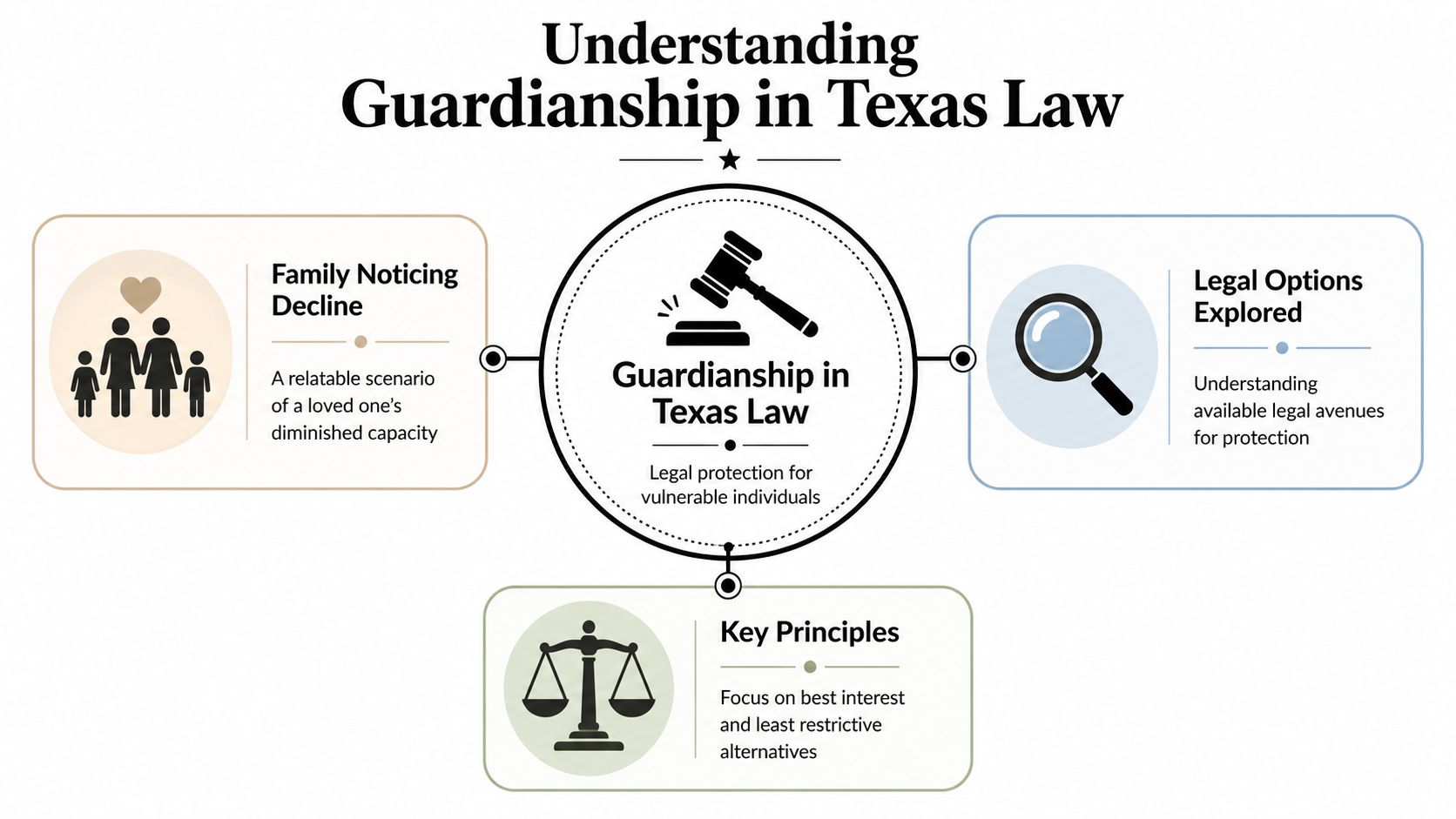
Guardianship works like a court-built safety rail. It exists for people who cannot safely manage certain decisions on their own, but the court is supposed to order only the help that is needed.
In Texas, the person who may need protection is called the ward. The term can feel cold, but it identifies the person at the center of the case. The key legal question is usually incapacity, meaning the person cannot make or communicate some decisions well enough to protect their own health, safety, or property.
What guardianship does
Texas courts do not grant guardianship because a family is overwhelmed, worried, or disagreeing about care. Judges want proof. They also want the proposed ward to keep as many rights as possible.
That point matters more than many online guides admit. Guardianship is not a simple permission slip. It can involve medical evidence, attorney appointments, court filings, hearings, ongoing reporting, and added expense over time. For many families in Harris County, the first question should be whether a narrower solution can solve the actual problem.
A practical way to view it is this: the court should fit the legal remedy to the person, the same way a doctor tries the least invasive treatment that will still work.
For example, a parent in Atascocita may still choose where to live, what to eat, and which family members they trust, yet have no real ability to understand reverse mortgage offers or large withdrawals from a bank account. Another adult may handle daily spending but lack capacity to consent to serious medical treatment after a stroke. In those situations, the court may look at limited authority rather than handing everything to someone else.
Why courts move carefully
Texas law favors least restrictive alternatives. That means the court should consider options that protect the person without removing more rights than necessary. Depending on the facts, that might include a valid power of attorney, medical power of attorney, supported decision-making agreement, trust planning, representative payee arrangement, or another targeted remedy recognized under Texas law and court practice (Texas Estates Code guardianship standards and alternatives).
That is one reason guardianship cases can be more complicated, slower, and more expensive than families expect. If a judge believes a less restrictive option can address the problem, a full guardianship request may face closer scrutiny.
Texas courts also see a significant number of guardianship matters involving older adults. About 60% of those guardianships involve seniors over 65 (Texas Judicial Branch guardianship reporting materials).
If you are sorting through similar legal terms, this guide on guardianship and conservatorship differences in Texas can help clear up a common source of confusion.
A local example
A Humble family may notice their mother is missing meals, giving money to strangers, and signing papers she cannot explain later. Guardianship may turn out to be necessary.
It may not.
If the immediate problem is access to medical information, one document may solve it. If the problem is unpaid bills and a risk of financial exploitation, the answer may be different. If the person can still make some choices but not others, a limited guardianship may make more sense than a broad one. The right legal path depends on what the person can still do, what danger exists now, and whether a smaller tool will protect them without taking away more independence than the court believes is justified.
The Two Primary Types of Guardianship
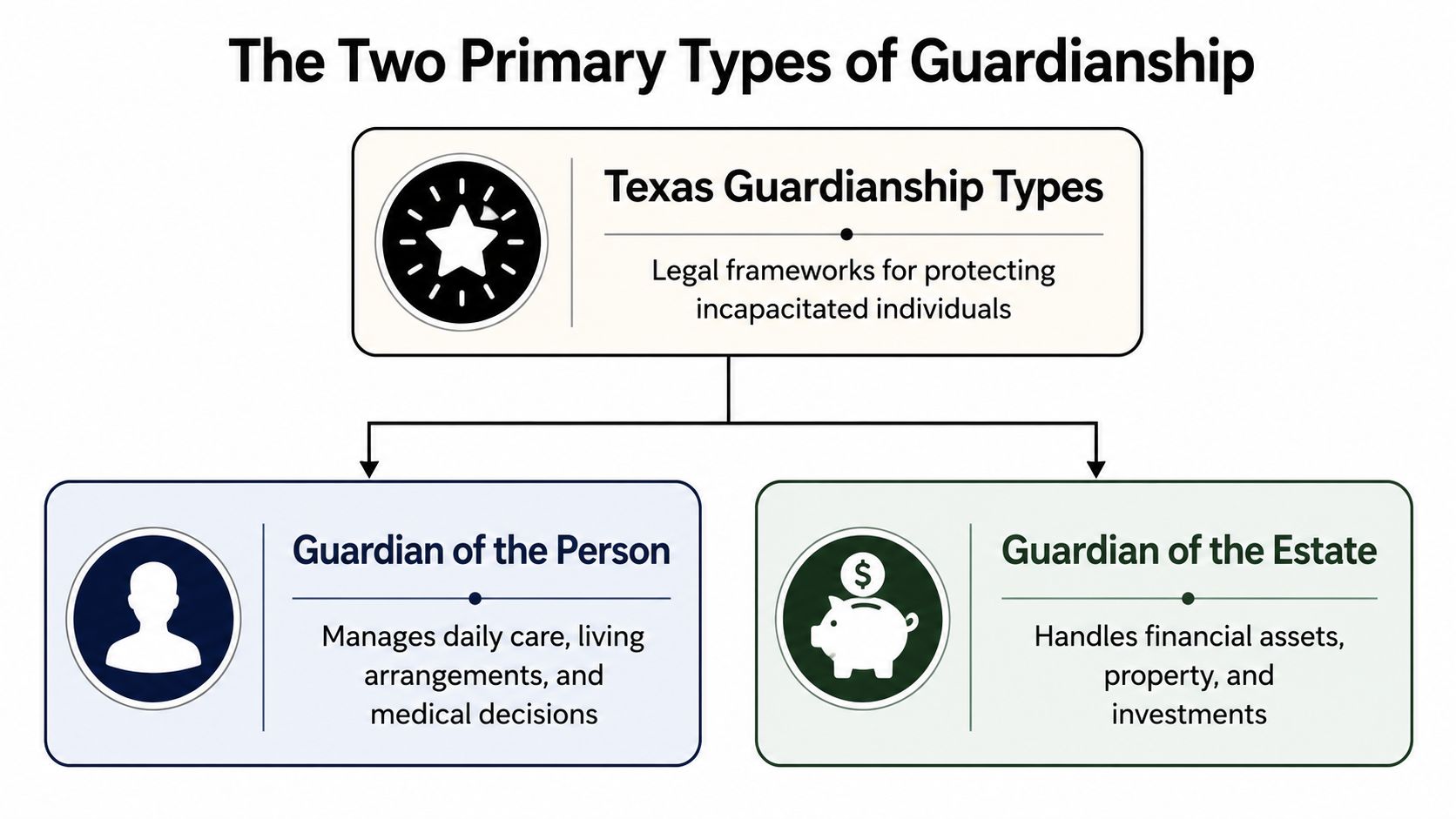
A lot of families in Atascocita come in thinking guardianship is one broad court order that covers everything. Texas law does not work that way. In most cases, the court looks at two separate areas of a person's life: personal decisions and financial decisions. That split matters because judges are supposed to give only the authority that is needed, no more.
That ties directly to the court's preference for the least restrictive option. If someone needs help paying bills but can still make informed medical choices, asking for control over both areas may be too broad. A guardianship case can become more expensive and more contested when the request goes further than the evidence supports.
Guardian of the person
A guardian of the person handles day-to-day welfare and personal care decisions.
That can include decisions about:
- Living arrangements, such as whether someone can safely remain at home in Atascocita or needs a more supervised setting near Lake Houston
- Medical care, including consent for treatment if the person cannot understand the decision well enough to give informed consent
- Basic needs and safety, such as food, clothing, services, and protection from neglect or exploitation
This role is about care. It does not automatically give someone control over bank accounts, retirement income, or property.
Guardian of the estate
A guardian of the estate handles money, property, and financial obligations.
That can include:
- Paying bills, including a mortgage, utilities, insurance, and ongoing household expenses
- Managing assets, such as bank accounts, real estate, or investment property
- Court-required accounting, because anyone managing another person's property must report to the court and follow strict rules
For many families, the hidden weight of guardianship reveals itself. Financial authority usually brings more paperwork, ongoing reporting duties, possible bond requirements, and added cost. That is one reason courts often ask whether a narrower tool could solve the problem before a full estate guardianship is granted.
Why the distinction matters in Harris County
The difference between these two roles is not technical wording. It shapes the entire case. A senior in Atascocita may be fully able to say where she wants to live and which doctor she trusts, but no longer able to understand account statements or spot fraud. In that situation, the court may see a financial problem, not a personal care problem.
Harris County probate courts regularly treat these as separate questions, and about 70% of guardianship petitions in Harris County require separate filings for person and estate (Harris County Probate Courts guardianship resources and filing guidance).
Families often save time, conflict, and expense by asking for only the type of guardianship the facts support. If the concern is long-term planning before a crisis, an Estate Planning Attorney in Atascocita handles wills, trusts, and estate plans for Atascocita families. In many households, that planning helps prevent confusion about who should manage care decisions, financial decisions, or both.
Who Is Eligible to Have a Guardian
Texas sets a high bar before a judge appoints a guardian. The court doesn't make this decision based on a hunch, a family disagreement, or the fact that someone is elderly.
The legal standard is clear and convincing evidence. That's stronger than the lower preponderance of the evidence standard used in many civil cases. In everyday terms, the judge needs solid proof that incapacity exists and that a guardianship is legally necessary (Texas incapacity standard and physician certificate requirement).
What that means for adults
For an adult, medical proof is usually central. The same source explains that a physician's certificate confirming examination and incapacity must be filed with the court within 120 days of the application.
That timing matters. Families sometimes get an older medical letter, assume it's enough, and then discover the court needs a more current certificate tied to the filing. If the certificate is missing, outdated, or too vague, the case can stall.
How minors are different
A proposed ward who is still a minor is treated differently. The physician's certificate requirement described above is waived if the proposed ward is a minor. That doesn't mean the court skips careful review. It means the evidence and legal focus are different.
For example, a family may be planning for a child with significant needs who is approaching adulthood. In another home, a non-parent relative may need legal authority to care for a child because of family instability, custody problems, or other serious circumstances.
Practical signs that often lead families to ask questions
Not every warning sign means guardianship is appropriate, but these situations often prompt a closer look:
- Medical confusion when a loved one can't understand treatment choices or communicate informed decisions
- Financial vulnerability when they're giving away money, ignoring bills, or falling for scams
- Unsafe daily living when medication, food, or hygiene needs are being neglected
- Minor care concerns when a child needs stable legal authority from an adult who is not the parent
The court wants evidence of inability, not just evidence that family members disagree about what should happen.
Navigating the Harris County Guardianship Process
A common Atascocita scenario goes like this. An adult child realizes Mom is missing medications, falling behind on bills, and agreeing to things she does not fully understand. The family assumes the next step is to file for guardianship right away. In Harris County, the court usually starts with a different question. Is guardianship truly necessary, or is there a narrower option that protects the person without taking away more rights than needed?
That point shapes the whole case.
For many families, the hardest part is not filling out forms. It is understanding that guardianship is often treated as a last resort. Judges want to know what problem needs to be solved, what authority is missing, and whether a less restrictive tool could work instead. If a loved one can still sign valid planning documents, or can make decisions with support, the court may view full guardianship as too broad. A plain-language overview of wills, trusts, and POAs explained can help families understand why those options are often reviewed before a court grants guardianship.
The case begins before the filing
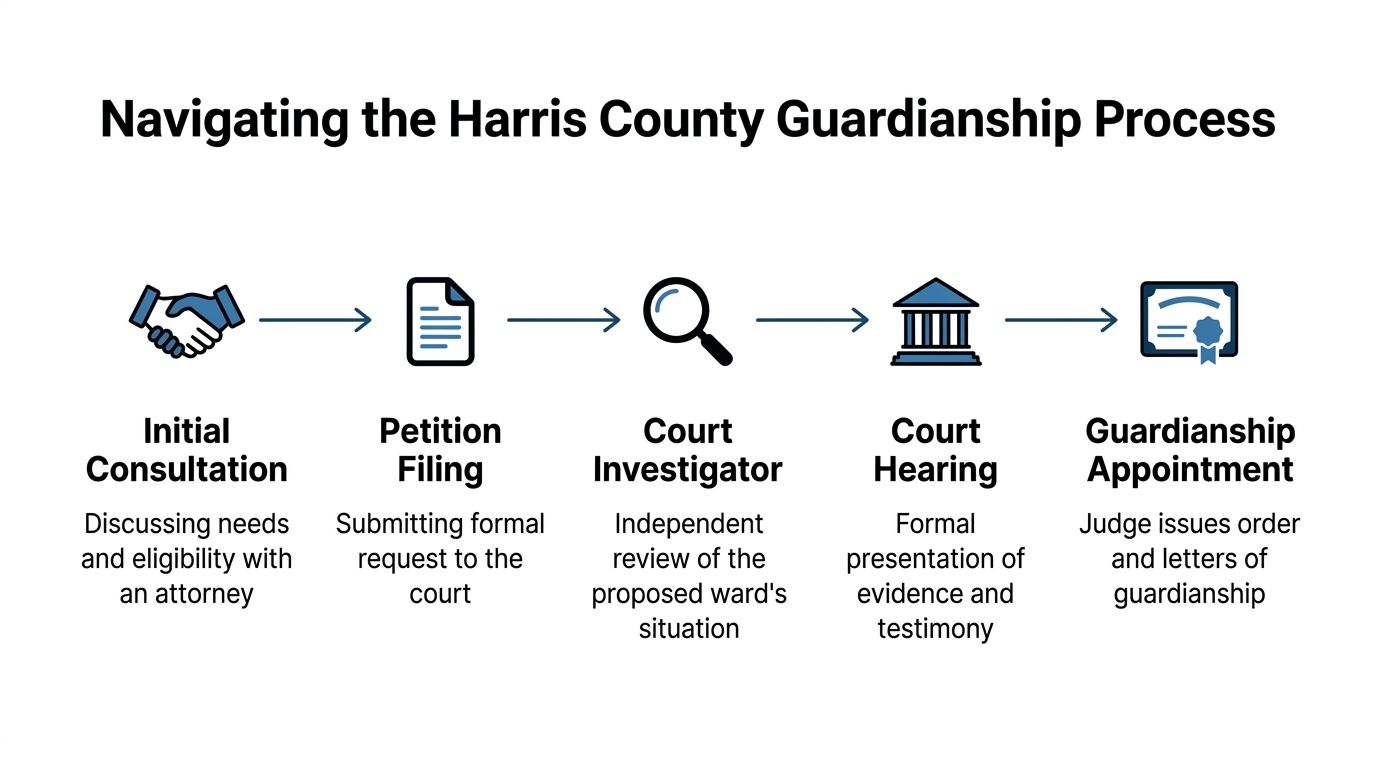
A strong case usually starts at the kitchen table, not the courthouse. Families need to gather the practical facts. What decisions are going unmade? Is the concern medical consent, money management, living arrangements, or day-to-day safety? The more specific the problem, the easier it is to ask for the right level of authority instead of requesting everything.
That matters because broad requests often draw closer scrutiny.
Once an application is filed in Harris County, the court reviews the pleadings and the supporting evidence. Adult cases usually need current medical evidence that addresses capacity in a way the court can use. The proposed ward must also receive the legal protections required by Texas law. In many cases, that includes a court-appointed attorney ad litem whose job is to represent the proposed ward, even if the family members agree among themselves. Families are often surprised by that step, but it makes sense. A guardianship case can limit a person's rights, so the court builds in protections before making that decision. The Texas Judiciary provides a useful overview of guardianship cases and court responsibilities.
What the hearing is really about
Many people expect the hearing to focus only on whether someone is struggling. The judge is usually looking at a narrower and more practical set of questions. Is incapacity proven with proper evidence? What rights, if any, should be removed? Could a limited guardianship solve the problem better than a full one? Have less restrictive alternatives been considered seriously?
A helpful way to picture it is a house key. The court does not want to hand over every key if one key would solve the issue. If the immediate problem is paying bills or consenting to treatment, the judge may question why a broader transfer of authority is being requested.
If the court approves the guardianship, the guardian still cannot start acting on the spot. Institutions usually want to see Letters of Guardianship before they will honor the appointment. Those letters are the court's proof of authority, and they matter in practical dealings with banks, hospitals, care facilities, and government offices.
Emergency cases move faster, but they are still narrow
Some situations need quick action. A loved one may be at immediate risk, may need urgent medical decisions, or may be vulnerable to serious harm. In those cases, temporary relief may be available, but families should not assume "emergency" means informal or automatic. The court still expects a clear explanation of the danger and a request limited to the urgent need.
If you need background on urgent filings, these temporary guardianship forms in Texas can help you understand what families are often trying to accomplish in a crisis.
The work continues after appointment
The court order is not the finish line. Guardianship brings continuing duties, and that is one of the costs many short guides leave out. Depending on the type of guardianship, the guardian may need to file reports, account for money, maintain eligibility to serve, and return to court when problems arise or authority needs to change. That ongoing supervision is one reason courts prefer the least restrictive workable option. Guardianship can protect a vulnerable person, but it also creates a long-term legal relationship with deadlines, paperwork, and the possibility of added expense if compliance slips.
For Atascocita families, that is often the turning point in understanding the process. Guardianship can be the right tool. It is just not the first tool the court wants families to reach for.
Are There Alternatives to Guardianship
A good legal plan starts with the least restrictive tool that still protects the person. In Harris County, courts increasingly expect families to explore alternatives before asking for full guardianship.
That matters because guardianship can be expensive, intrusive, and slow. One local source discussing guardianship alternatives notes that courts prioritize options like trusts and durable powers of attorney to avoid the $30,000+ cost and year-long delay that can come with guardianship in some situations. It also explains that courts require exhaustion of least restrictive alternatives before appointing a guardian (discussion of least restrictive alternatives in Harris County).
Why courts prefer a narrower option
Guardianship can remove rights. A power of attorney or supported decision-making arrangement may preserve more independence while still solving the underlying problem.
That's especially true when a person still understands what they're signing, wants help from a trusted adult, and doesn't need full court supervision. For families trying to sort through planning documents, this plain-language guide on wills, trusts, and POAs explained can be a useful starting point.
Guardianship vs alternatives
| Feature | Guardianship | Power of Attorney | Supported Decision-Making |
|---|---|---|---|
| Court involvement | Requires court filing, review, and continuing oversight | Usually created privately if the person has capacity | Usually built around the person's choice and support network |
| Loss of rights | Can limit the ward's decision-making authority | Can be narrower and based on powers granted in the document | Preserves the person's role in making decisions |
| Flexibility | Less flexible once ordered by the court | Can be tailored to financial or medical needs | Focuses on assistance rather than substitution |
| When it often fits | Serious incapacity with no workable lesser option | Early planning before a crisis | Adults who need help understanding choices, not total replacement |
Common alternatives families should ask about
- Durable power of attorney for financial authority if the person still has legal capacity to sign
- Medical power of attorney for health care decisions
- Trust planning when property management is the main concern
- Supported decision-making when the person can participate but needs structured help
Families dealing with long-term disability planning may also need related tools beyond guardianship. In those cases, a special needs planning attorney in Atascocita can be relevant.
Sometimes these issues overlap with family court matters too. For example, a parent raising a child with special needs may also be handling support issues. A Child Support Attorney in Atascocita addresses establishing, modifying, and enforcing child support in Harris County.
The best legal solution is the one that protects the person without taking more control than necessary.
How an Atascocita Guardianship Attorney Can Help
A guardianship case is rarely just paperwork. It usually involves family dynamics, medical evidence, local court procedure, and a hard emotional question about how much control another adult should have over someone's life.
That's where a local lawyer adds value. The work starts by asking whether guardianship is even the right answer. If a power of attorney, trust, or another limited tool will protect the person, that may be the better path.
Practical help at each stage
A lawyer can help with:
- Evaluating the fit by looking at incapacity, urgency, and alternatives
- Preparing filings so the Harris County paperwork matches the actual needs of the case
- Coordinating evidence including medical records and other proof the court will expect
- Presenting the case at hearings where scope matters just as much as necessity
- Managing disputes when relatives disagree about who should serve or what authority is needed

The local context matters too. Harris County is one of the busiest family law jurisdictions in Texas, with more than 15,000 divorce cases filed annually, and those family matters can intersect with guardianship, custody, and planning for minors. The same local source states that The Law Office of Bryan Fagan, serving Atascocita, has over 20 years of combined experience guiding clients through guardianship cases, divorce, custody battles, and CPS investigations (Atascocita family law and guardianship background).
Why local experience helps
A guardianship petition in northeast Harris County doesn't happen in a vacuum. The same family may also be dealing with a custody conflict, an adoption question, a civil property issue, or estate planning gaps that should have been addressed earlier.
When your lawyer understands those overlapping areas, the advice is usually more practical. You're not just filing a case. You're trying to protect a person and stabilize a family.
Atascocita Guardianship FAQs
What does a guardian have to do after appointment
Guardians usually have continuing duties to the court. Those may include reports about the ward's condition or financial management, depending on the type of guardianship. Missing deadlines can create trouble, so families should treat post-appointment compliance as part of the case, not an afterthought.
What if two family members both want to serve
The court looks at the ward's best interests, the scope of the need, and whether the proposed guardian is suitable. A judge may also look closely at conflict within the family if that conflict could affect care or financial protection.
Can a guardianship end
Yes. If the ward's condition improves or the legal need changes, the guardianship may be modified or terminated. The court won't do that automatically. Someone usually has to return to court and present updated evidence.
What if the ward moves away from Atascocita or Texas
Relocation can create added legal steps. The guardianship may need court approval, transfer procedures, or coordination with another state's court system. Families should get legal advice before moving a ward or moving assets tied to the guardianship.
Is guardianship only for older adults
No. Guardianship can involve minors, adults with disabilities, or adults whose medical condition prevents safe decision-making. The right legal approach depends on the person's age, capacity, and what decisions need protection.
When should I talk to a lawyer
As soon as you see repeated signs that a loved one can't manage health, safety, or finances. Early advice can help you avoid filing for a remedy that is broader, slower, or more expensive than necessary.
If your family is weighing guardianship, custody, divorce, estate planning, criminal charges, or another legal problem in northeast Harris County, schedule a free consultation with Law Office of Bryan Fagan – Atascocita TX Lawyers. We help Atascocita and Humble residents understand their options, prepare the right filings, and move forward with a clear plan.