Skip to content
When you realize a loved one in your Atascocita family can no longer manage their own affairs, the legal terminology can feel overwhelming. You might hear terms like "guardianship" and "conservatorship" and wonder what the difference is, especially here in Texas. Let's clear up a common point of confusion right away.
In many states, these are two separate legal actions. But in Texas, things are a bit different. Our state uses the single term guardianship to cover the protection of both an individual's well-being and their finances. Navigating this process is a deeply personal journey, and our goal is to provide you with the clear, compassionate guidance you deserve.
Understanding Guardianship and Conservatorship in Texas

If you've seen national news stories about high-profile legal battles, you've likely heard the word "conservatorship" used to describe someone managing another person's money. That’s the common use in states like California. In Texas, however, what they call a conservator, we call a Guardian of the Estate.
This isn't just a matter of semantics; it reflects how our Texas legal system is structured to help local families. Instead of creating a separate "conservatorship" process, the Texas Estates Code establishes different types of guardians to handle specific needs. For families in Atascocita, Humble, and northeast Harris County, knowing this distinction is the first step toward finding the right legal protection for a loved one.
The Two Pillars of Texas Guardianship
When a Harris County court determines a person is "incapacitated" and needs protection, it will appoint a guardian. This incapacitated person is legally known as the "ward." Depending on the ward's specific needs, the court can appoint one person to handle everything, or split the duties between two different people.
Here's how the roles break down in plain English:
Guardian of the Person: This guardian's focus is entirely on the ward's personal and physical well-being. They become the primary decision-maker for things like healthcare choices, where the ward will live, and arranging daily care and social activities. Think of them as the person responsible for the ward's quality of life.
Guardian of the Estate: This is the role that mirrors what other states call a "conservator." The Guardian of the Estate is put in charge of the ward's financial life, including all property, income, and assets. Their job involves everything from paying bills and filing taxes to managing investments and real estate, all under the strict supervision of a Harris County probate court.
Pursuing guardianship is a significant step. It involves a court stripping an individual of their right to self-determination, which is a decision no family takes lightly. At the Law Office of Bryan Fagan, we’ve walked countless families through this difficult process with compassion and legal precision.
A key takeaway for Texas families is this: while other states separate guardianship and conservatorship, Texas law consolidates these duties under the umbrella of guardianship, offering tailored protection for both the person and their assets.
Texas Guardianship Roles Guardian of Person vs Guardian of Estate
To help Atascocita families distinguish between the two primary types of guardianship roles under Texas law, this quick reference table breaks down their core responsibilities.
| Area of Authority | Guardian of the Person | Guardian of the Estate |
|---|---|---|
| Primary Focus | The ward's personal health, safety, and daily life. | The ward's financial assets, property, and income. |
| Key Decisions | Consenting to medical treatments, choosing a living facility, and arranging in-home care. | Paying bills, managing bank accounts, selling property, and filing tax returns. |
| Legal Duty | To provide for the ward's physical care and comfort, and make healthcare decisions. | To prudently manage, protect, and invest the ward's assets. |
| Court Reporting | Files an "Annual Report on the Condition and Well-Being of the Ward." | Files a detailed "Annual Account" of every financial transaction. |
Ultimately, understanding these roles is the foundation for protecting a vulnerable loved one, whether it's an aging parent with dementia in Atascocita or a special needs child in Humble turning 18.
Our team is here to help you navigate these sensitive issues and determine the best path forward for your family. If you're in Atascocita, Humble, or the surrounding communities, schedule a free consultation with us today to talk through your unique situation.
Who Needs a Guardian in Our Atascocita Community
It's one thing to read the legal definition of guardianship, but it's another thing entirely to see how it applies to real families in Atascocita, Humble, and our surrounding neighborhoods. In our experience, the need for a guardian almost always arises at two key points in life: for children whose parents can't care for them, or for adults who can no longer care for themselves.
Making the choice to pursue guardianship is never simple. You're asking a court to remove a person's fundamental rights to make their own decisions. But it’s crucial to remember that the ultimate goal isn't control—it's protection for the most vulnerable people among us when they have no other way to stay safe.
Protecting Minors in Northeast Harris County
When a child’s parents are deceased, unavailable, or unable to provide care, a guardianship becomes essential. This isn't an informal arrangement with a relative; it’s a formal court order from a Harris County judge that grants an adult the legal right to make crucial decisions for that child.
For example, think of grandparents in Kingwood whose own child is battling a long-term illness and simply can't raise their young son. For the grandparents to enroll him in school, consent to medical treatment, and provide a stable home, they would need to petition the court for guardianship.
We often see the need for a minor guardianship in situations like:
- The death of both parents.
- A court has terminated the parents' legal rights.
- A parent is incapacitated for the long term due to severe injury, illness, or incarceration.
- The child has been abandoned by a parent.
For many Atascocita families, understanding the process of how to get guardianship of a minor is a critical first step. It is a structured legal path that ensures the child's best interests are the court's top priority, providing them with the stability and care they deserve.
When Adults Become Incapacitated
The need for an adult guardianship can arise suddenly or creep in over time. In either case, it becomes necessary when an adult can no longer make sound decisions about their own health, safety, or finances. Before a Texas court will appoint a guardian, the adult must first be legally declared "incapacitated."
This can happen in a few common scenarios in our community.
Gradual Cognitive Decline
Picture an adult daughter in Atascocita whose elderly mother has dementia. She's started forgetting her medication and has become an easy target for phone scams. A guardianship would give her daughter the authority to manage her healthcare, pay her bills, and shield her finances from fraud.
Developmental Disabilities
Many dedicated parents in the Humble area care for a child with a significant developmental disability. What many don't realize is that their natural authority as parents ends the moment their child turns 18. To continue making legal, financial, and medical decisions for their adult child, they must go to court to establish a legal guardianship.
Sudden Incapacity
A tragic accident can change everything in an instant. A serious car wreck on Lake Houston Parkway or a sudden stroke could leave someone completely unable to communicate or make their own choices. In these heartbreaking situations, a spouse or family member must often seek guardianship just to manage medical care and handle financial responsibilities during recovery.
A court won't grant a guardianship lightly. It demands clear and convincing proof that the person is truly incapacitated and that there are no less restrictive options, like a power of attorney, that could work instead. This is why having a compassionate attorney who knows the ins and outs of the Harris County probate courts is so important.
If your family is facing one of these challenges, you don't have to navigate it alone. The Law Office of Bryan Fagan – Atascocita TX Lawyers is here to offer the support and legal clarity you need. We invite you to schedule a free, confidential consultation to talk through your family’s unique situation.
Guardian Authority Versus Conservator Responsibilities
When you're trying to understand the difference between a guardianship and a conservatorship, it really all comes down to one question: What can the appointed person actually do? It's a source of a lot of confusion, especially since Texas law is designed for our communities and handles things a bit differently than other states.
Here, the term "guardianship" is a broad umbrella. This gives our Harris County probate courts the flexibility to give a guardian only the specific powers a person truly needs. These powers are split into two distinct roles: the Guardian of the Person and the Guardian of the Estate. One person can hold both titles, but the jobs themselves are completely separate.
The Guardian of the Person: Personal Care Decisions
The Guardian of the Person is solely focused on the individual’s physical and emotional well-being. Think of them as the primary decision-maker for all of life’s personal matters, with no control over finances.
A Guardian of the Person has the power and the duty to:
- Decide on a Place to Live: They make the tough call on whether the person (the "ward") can continue living at home with support, moves in with a relative, or transitions to a place like an assisted living community in the Atascocita area.
- Consent to Medical Treatment: This person is responsible for all healthcare choices. From routine doctor's visits to authorizing major surgery, they ensure the ward gets the medical care they need.
- Provide Daily Care: This includes managing everything from meals and clothing to social activities, all with the goal of maintaining the ward's quality of life.
The flowchart below gives a clear picture of who might need a guardian to step in and handle these kinds of personal decisions.
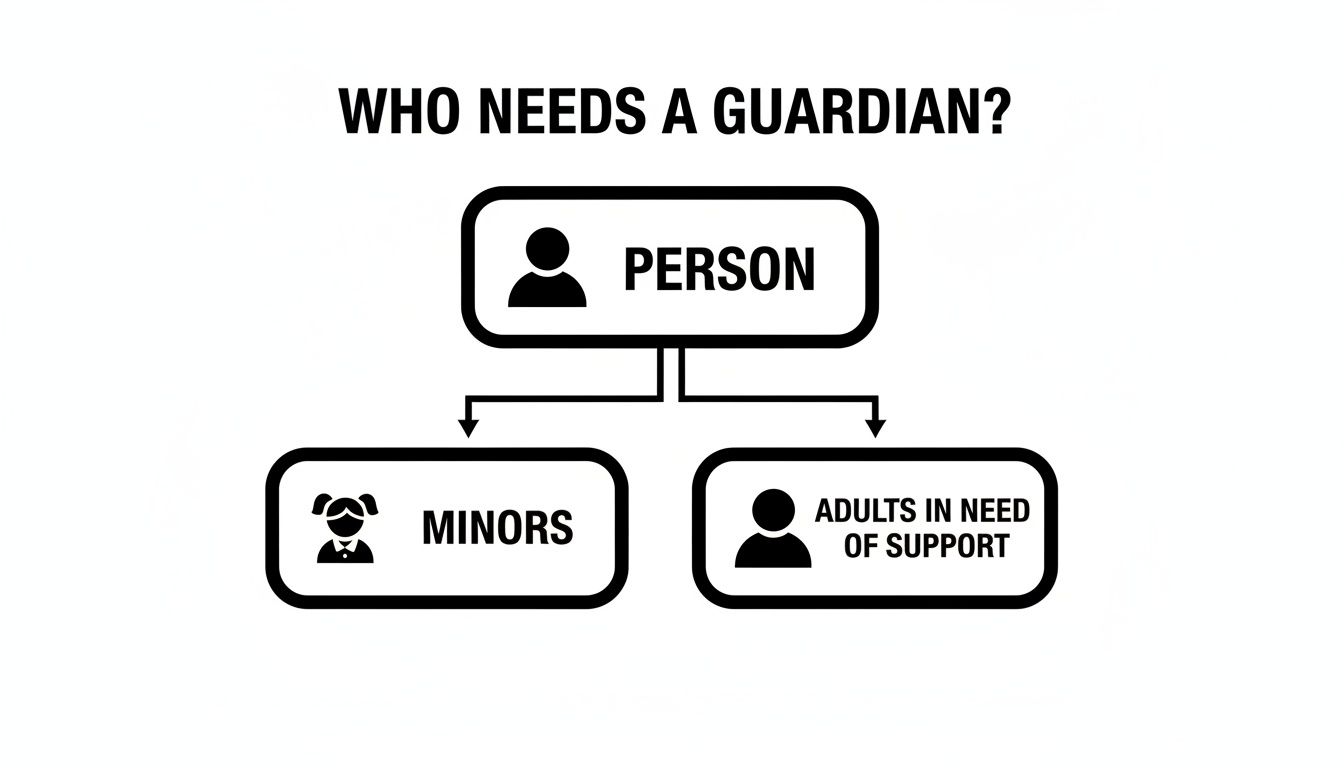
As you can see, guardianship serves a protective purpose for both minors and adults who are no longer able to make these critical decisions for themselves.
The Guardian of the Estate: Financial Management
Now, let's talk about the money. The Guardian of the Estate handles a job that mirrors what many other states call a conservatorship. This person is entrusted with managing the ward’s property and financial assets, but they operate under the strict supervision of the court. They have zero authority over the ward's personal or medical life.
Some key responsibilities of a Guardian of the Estate include:
- Managing bank accounts, investments, and retirement funds.
- Paying the ward's bills, from the mortgage and utilities to medical expenses and taxes.
- Collecting any income the ward is entitled to, like Social Security benefits or a pension.
- Overseeing real estate and other property, which can only be sold with explicit court permission.
Nationally, there are an estimated 1.3 million adults under active guardianship or conservatorship, with these arrangements managing at least $50 billion in assets. The main difference you see across the country is that a guardian typically handles personal needs, while a conservator manages the estate. In Texas, our "Guardian of the Estate" simply fills that financial role.
A guardian is a fiduciary. This is a critical legal concept. It means they owe the person they are protecting the absolute highest duty of loyalty and good faith. Every decision must be in the ward’s best interest—never their own—and the court holds them accountable for it.
This fiduciary duty isn’t just a suggestion; it’s a rule the Harris County probate courts enforce with an iron fist. A Guardian of the Person must file an "Annual Report" on the ward’s physical and mental condition. A Guardian of the Estate has an even higher bar, needing to submit a detailed "Annual Accounting" of every single dollar that came in and went out. This intense oversight is the system’s best defense against neglect or financial abuse, giving Atascocita families peace of mind.
To get a better handle on the financial side of things, you can learn more about how conservatorship works in Texas and see how closely it aligns with the Guardian of the Estate's duties.
Figuring out these distinct responsibilities can feel overwhelming. The Law Office of Bryan Fagan – Atascocita TX Lawyers is here to help you determine which path is right for your family. Schedule a free consultation with our team to get clear, compassionate guidance today.
When a loved one can no longer make decisions for themselves, the court system can feel like another overwhelming burden. We get it. At the Law Office of Bryan Fagan, our goal is to demystify this process for our Atascocita neighbors, giving you a clear roadmap so you can move forward with confidence.
Establishing a guardianship in Texas isn't a casual family agreement; it’s a formal court proceeding with strict rules designed to protect the person in question, known as the "proposed ward." Let's walk through what you can expect in the Harris County probate courts.
Step 1: Filing the Application for Guardianship
The entire journey starts when you file an Application for Appointment of a Permanent Guardian with the Harris County Clerk. This is a highly specific legal document, not just a simple form you fill out.
It needs to detail who you are (the applicant), the person you believe needs a guardian (the proposed ward), and their close family members. Critically, it must lay out exactly why a guardianship is necessary and which specific powers you’re asking the court to grant. Having an Atascocita guardianship attorney draft this for you is crucial to prevent rookie mistakes that can cause delays or even an outright rejection from the clerk.
Step 2: Getting the Physician's Certificate of Medical Examination
This is probably the single most important piece of evidence you'll need. A licensed Texas physician has to perform a detailed examination of the proposed ward within 120 days before you file the application.
Based on that exam, the doctor completes a formal document known as the Certificate of Medical Examination (CME). This isn't just a doctor's note; it's a legal certification outlining the nature and severity of the person's incapacity. It specifically addresses their ability (or inability) to manage their own food, clothing, shelter, health, and finances. This CME provides the court with the objective medical proof it needs to even consider taking away someone's legal rights.
Step 3: The Court Appoints an Attorney Ad Litem
As soon as your application hits the court's docket, a judge in Harris County will appoint an independent lawyer called an attorney ad litem. This attorney has one job and one job only: to be the eyes and ears of the court and represent the best interests of the proposed ward.
The attorney ad litem's investigation is thorough. They will:
- Meet face-to-face with the proposed ward to explain what's happening.
- Interview you, the doctor who completed the CME, and other relevant family members.
- Review all the medical records and legal paperwork filed in the case.
Once finished, the ad litem files a formal report with the judge. This report gives their professional opinion on whether the person is truly incapacitated and if guardianship is the least restrictive, most appropriate solution. They also help the court decide if a Guardian of the Person, a Guardian of the Estate (which is Texas's version of a conservatorship), or both are truly needed.
The role of the attorney ad litem is a crucial safeguard. Their independent investigation ensures that every guardianship is thoroughly vetted and truly necessary, protecting vulnerable adults in our community from having their rights unnecessarily removed.
Step 4: The Guardianship Hearing in Harris County
The final step is the hearing itself, held in one of Harris County's statutory probate courts. This is where the judge hears all the evidence and makes the final call. You'll need to be there to provide testimony.
Your attorney will present your case, submitting the application and the physician's certificate as evidence. The attorney ad litem will also present their findings to the judge. To approve the guardianship, the judge must be persuaded by clear and convincing evidence that the proposed ward is incapacitated and that appointing you as their guardian is in their best interest.
Step 5: Issuance of Letters of Guardianship
If the judge grants the guardianship, you're almost done. You'll have to take a legal oath and post a bond, which is a type of insurance policy that protects the ward's assets.
After you've met these final requirements, the court issues Letters of Guardianship. This official court document is your legal proof of authority, allowing you to make decisions on the ward's behalf. With this in hand, you can finally begin your role as guardian, knowing you have the legal standing to protect your loved one.
Powerful Alternatives to Guardianship in Texas

While a guardianship can be a necessary safety net, our attorneys always advise clients that it should be the absolute last resort. When a court steps in, it means stripping away a person's fundamental rights to make their own choices. For families here in Atascocita, Humble, and the surrounding Harris County communities, that process is not just legally complex—it's incredibly emotional.
The good news is that with some thoughtful planning, you can often avoid it entirely. By putting the right estate planning documents in place now, you keep control in your hands and spare your loved ones from the cost, public scrutiny, and heartache of a future court battle. This is one of the most powerful things you can do for your family.
Durable Power of Attorney
One of the most effective ways to avoid a financial guardianship (what many other states call a conservatorship) is with a Durable Power of Attorney (DPOA). This is a legal document where you appoint someone you trust—known as your "agent"—to handle your finances and legal matters if you become incapacitated and can't do it yourself.
With a DPOA, your agent can seamlessly step in to manage critical tasks, such as:
- Paying your bills and mortgage to keep things running.
- Managing your bank accounts and investments.
- Filing your income taxes.
- Overseeing real estate matters.
The "durable" part is what makes it work. It means the document stays valid even if you become mentally unable to make decisions. Without a DPOA, your family’s only option would be to ask a Harris County court to appoint a Guardian of the Estate. As we explain in our guide, a Durable Power of Attorney in Texas is a private and efficient way to keep the courts out of your financial life.
Medical Power of Attorney and Living Will
A Medical Power of Attorney (MPOA) does for your health what a DPOA does for your finances. It lets you name a trusted agent to make medical decisions on your behalf if you're unable to communicate your wishes. Your agent can then talk with doctors, approve treatments, and advocate for the care you would want.
This document works hand-in-hand with a Directive to Physicians, more commonly known as a Living Will. This is where you state your preferences on end-of-life care, such as the use of life support. Together, these documents ensure your voice is heard, preventing your family from having to make agonizing choices and avoiding the need for a court-appointed Guardian of the Person.
Planning ahead is about more than just legal strategy; it's an act of care. You get to choose your own decision-makers, keeping private family matters out of a public courtroom and protecting your independence.
Revocable Living Trusts
Another fantastic tool for managing your property without court oversight is a Revocable Living Trust. You create a trust and transfer your major assets into it—your home, bank accounts, and investments. You then name a "successor trustee" who can take over and manage these assets for your benefit if you become incapacitated. This creates a smooth transition of control with no court involvement needed.
A key difference between guardianship and conservatorship is that both involve a court taking away a person's control over their life and finances. A guardianship typically covers personal and medical decisions, while a conservatorship is about the money and property. These alternatives—Powers of Attorney and Trusts—let you stay in charge by naming the people you want in these roles ahead of time. You get to pick your own protectors.
Don't wait for an emergency to force your family into a difficult situation. The attorneys at the Law Office of Bryan Fagan – Atascocita TX Lawyers can help you build a solid plan that secures your legacy and gives everyone peace of mind. Schedule a free, no-obligation consultation with our Atascocita office to take control of your future today.
Common Questions About Guardianship in Atascocita
When you realize a loved one can no longer care for themselves, your mind is probably racing with questions. We get it. As a law firm that works with families right here in the Atascocita and Humble areas, we hear these concerns every single day. Here are some straightforward answers to the questions our neighbors ask us most often.
How Long Does the Guardianship Process Take in Harris County?
This is often the first thing people want to know, and the honest answer is: it depends. In a perfect world, where all the paperwork is in order and no one objects, you might be looking at a timeline of two to four months in Harris County.
But reality often throws a few curveballs. The probate court’s own schedule, getting the required doctor’s evaluation for your loved one, or disagreements among family members can all add time. If someone formally objects to the guardianship, the case becomes "contested," and that simple timeline goes out the window. An experienced attorney can help you anticipate these hurdles and keep the process moving as smoothly as possible.
Can I Be Paid for Serving as a Guardian in Texas?
Yes, Texas law allows guardians to be paid for their work, but it’s not automatic. You have to formally request compensation, and a Harris County probate judge must approve it.
The judge will look at what’s fair and “reasonable” based on a few key things:
- The size and complexity of your loved one's finances (the "estate").
- The actual tasks you are performing as guardian.
- The time and effort your duties demand.
Compensation is most common for a Guardian of the Estate, since managing money, property, and investments is a significant responsibility that often requires professional-level skill. It's important to remember that any approved payment comes from the ward’s estate, not out of your own pocket.
What Happens If Someone Objects to My Appointment as Guardian?
If a relative or another interested party formally objects to you becoming the guardian, the case becomes a contested guardianship. This instantly changes everything, turning what could have been a cooperative process into a legal battle that has to be decided by a judge.
The court will set a hearing where both sides present their case with evidence and witness testimony. The judge’s only goal is to determine what is in the best interest of the proposed ward. They will weigh all the facts to decide who is the most suitable person for the job. In these situations, having a skilled Atascocita probate lawyer isn't just a good idea—it's essential to make your case effectively.
A contested guardianship is emotionally exhausting. The court isn't focused on family drama; its primary concern is protecting the vulnerable person. Strong legal representation is crucial to show the judge why you are the right choice for that responsibility.
Do I Need a Lawyer to File for Guardianship in Texas?
Legally, you are allowed to file for guardianship on your own (this is called filing pro se). In practice, this is strongly advised against. A guardianship case is not a simple form-filling exercise; it’s a lawsuit that permanently takes away a person’s basic civil rights. The Texas legal system is complex and built for lawyers.
The procedural rules, evidence standards, and required paperwork in Harris County are incredibly strict. One small mistake can cause months of delays—leaving your loved one vulnerable—or result in the judge flat-out denying your request. The court will also appoint its own attorney (an attorney ad litem) to investigate, and going up against them without your own counsel puts you at a significant disadvantage.
Hiring an experienced lawyer ensures everything is done right from the start. It protects you from mistakes and, more importantly, protects the person you’re trying to help. While you can learn the difference between guardianship and conservatorship online, actually navigating the court process is something you should not do alone.
When you're faced with the difficult choice of seeking guardianship for someone you love, you don’t have to go through it alone. At The Law Office of Bryan Fagan – Atascocita TX Lawyers, we offer clear, compassionate, and skilled legal support to families throughout our community. Let us worry about the legal details so you can focus on your family.
Schedule a free, confidential consultation to discuss your situation. Visit us online today at https://www.atascocitaattorneys.com.