Skip to content
Facing a divorce brings a tidal wave of questions, and for many of our neighbors here in the Atascocita community, one of the most pressing is about financial stability. So, let's get right to it: yes, you can get spousal support in Texas, but it's crucial to understand that it is not guaranteed. Texas law provides pathways for a spouse to receive temporary financial help, but you must meet specific qualifications.
Understanding Spousal Support in Atascocita and Harris County

The emotional stress of a divorce is enormous on its own. When you add the fear of suddenly managing your life on a single income—a reality for many in Atascocita, Humble, and across northeast Harris County—it can feel completely overwhelming. This is exactly why the topic of spousal support, which Texas law officially calls spousal maintenance, is so important to our community.
It’s helpful to think of spousal maintenance not as a permanent payment, but as a temporary bridge. The purpose is to provide a spouse who lacks sufficient property or income with a short-term financial cushion. It’s designed to offer the breathing room needed to find a job, get new skills, and transition toward supporting yourself. This support recognizes the very real, non-financial contributions you may have made to the marriage, like pausing your career to raise a family or supporting your spouse as they built their career.
Spousal Support Is Not an Automatic Right
One of the biggest myths our attorneys have to address is the idea that spousal support is automatic if you earned less or were a stay-at-home parent. That's simply not how it works in Texas. The law is actually quite strict. To have a judge order spousal maintenance, you first have to prove you are eligible by meeting very specific criteria laid out in the Texas Family Code.
A Harris County family court judge is prohibited from ordering spousal maintenance unless you can clearly show that you meet the specific legal requirements. This means that building a strong case and gathering the right evidence from the very beginning is absolutely essential.
For example, the most common way to qualify requires proving the marriage lasted at least 10 years and that, despite your diligent efforts to find work, you still cannot cover your basic, reasonable needs. There are, however, critical exceptions for situations involving family violence or a disabling condition, which we will explain in more detail.
Here's a quick look at the main scenarios where a resident of Atascocita or Humble might be eligible for court-ordered support.
Quick Guide to Spousal Support Eligibility in Texas
This table summarizes the main pathways to qualify for court-ordered spousal maintenance in Texas.
| Eligibility Path | Key Requirement | Potential Support Duration |
|---|---|---|
| 10-Year Marriage | Marriage lasted 10+ years AND you lack the ability to provide for your minimum reasonable needs. | Up to 5, 7, or 10 years, depending on marriage length. |
| Family Violence | Your spouse was convicted of or received deferred adjudication for an act of family violence within 2 years of the divorce filing. | Up to 5 years. |
| Disability (Self) | You have an incapacitating physical or mental disability that prevents you from earning sufficient income. | As long as the disability persists. |
| Disability (Child) | You are the primary caregiver for a child of the marriage who has a physical or mental disability requiring substantial care. | As long as the child's needs prevent you from working. |
Keep in mind, meeting one of these initial tests is just the first step. You still have to provide detailed evidence of your financial needs and your efforts to become self-sufficient.
At The Law Office of Bryan Fagan, we know how scary financial uncertainty can be during a divorce. We created this guide to give our Atascocita neighbors a clear, practical roadmap to the rules, helping you understand your rights and options. Our goal is to provide the knowledge you need to make the best decisions for your future.
If you’re worried about how you’ll make ends meet after your divorce, you don't have to figure it all out alone. A compassionate local attorney can help you evaluate your situation and determine if you can get spousal support in Texas. We invite you to schedule a free, confidential consultation at our Atascocita office to discuss your specific case.
The 3 Types of Spousal Support in Texas
When people in our community talk about “alimony,” they often imagine one single type of payment. But here in Texas, financial support after a divorce isn't a one-size-fits-all solution. The law actually offers three different routes, each designed for a specific purpose.
Think of it this way: one is a temporary bridge to get you through the divorce process itself, another is a custom agreement you build with your spouse, and the third is a more regulated path overseen by a judge. Knowing the difference is the first step in figuring out what might work for your family’s future in Atascocita or Humble.
1. Temporary Spousal Support
Divorces take time. From the day you file the petition in a Harris County court to the moment the judge signs the final decree, months can pass. But your bills won't wait.
That’s where Temporary Spousal Support comes in. It’s a court-ordered payment designed to cover necessary living expenses while the divorce is still pending. The goal is to maintain financial stability, ensuring the lower-earning spouse can still pay for housing, utilities, and other essentials. These orders are temporary and end automatically once your divorce is finalized.
2. Contractual Alimony
Not every part of a divorce has to be a fight in a courtroom. Contractual Alimony is a form of spousal support that you and your spouse agree to on your own terms, completely outside of what a judge might order. It's something you negotiate, often with the help of your attorneys or during mediation, and include in your final divorce settlement. We walk our clients through what to expect in our guide on how to prepare for divorce mediation.
The biggest advantage of contractual alimony is its flexibility. You and your spouse have the freedom to design a plan that truly fits your family's unique financial situation—something a court simply can't do.
Because it’s a private agreement, you can decide on payment amounts and durations that go beyond the state's strict limits. For example, a Humble couple could agree to a lump-sum payout or extend payments for longer than a judge could legally order. Once this agreement is part of your final divorce decree, it becomes a binding contract and is enforceable just like any other legal agreement.
3. Court-Ordered Spousal Maintenance
This is the type of support most people are thinking of when they ask, "can you get spousal support in Texas?" It’s also the most challenging to obtain. Unlike contractual alimony, Court-Ordered Spousal Maintenance isn't based on a mutual agreement. It's a legal remedy a judge can impose, but only if you meet a very strict set of requirements outlined in the Texas Family Code.
The most common path to qualify is by having been married for at least 10 years. But that's just the first hurdle. You must also prove that you don't have enough property from the divorce to meet your "minimum reasonable needs" and that you're unable to earn enough income to support yourself, despite your diligent efforts.
Even if you qualify, the law puts tight limits on it. For a marriage lasting 10 to 20 years, for example, a judge cannot order payments for more than five years. The amount is also capped—it cannot exceed $5,000 or 20% of the paying spouse's average monthly gross income, whichever is less. These rules are in place to provide a temporary safety net, not a permanent solution.
Qualifying for Court-Ordered Spousal Maintenance
When our neighbors in Atascocita ask, "can you get spousal support in Texas," they're usually thinking about payments ordered by a judge. This is where the law gets very specific and, frankly, quite strict. Unlike support you and your spouse might agree on yourselves, a Harris County judge simply cannot order spousal maintenance unless you clear a demanding, two-part legal test.
Let's walk through what a Texas judge actually looks for so you can get a realistic sense of where you stand.
First, you have to pass an initial eligibility test. The most common way to do this is by meeting the 10-Year Rule. This is exactly what it sounds like: you must have been married for at least 10 years before the divorce was filed. But if your marriage was shorter, don't stop reading; the law provides a few critical exceptions for specific, serious situations.
If you meet that first requirement, you then face a second, financial hurdle. You have to prove to the court that you lack sufficient property—even counting the assets you'll receive in the divorce—to provide for your minimum reasonable needs. On top of that, you must also show that you have been diligently trying to earn an income or develop job skills but still can't make ends meet.
This chart helps put court-ordered maintenance into context with the other types of support available.
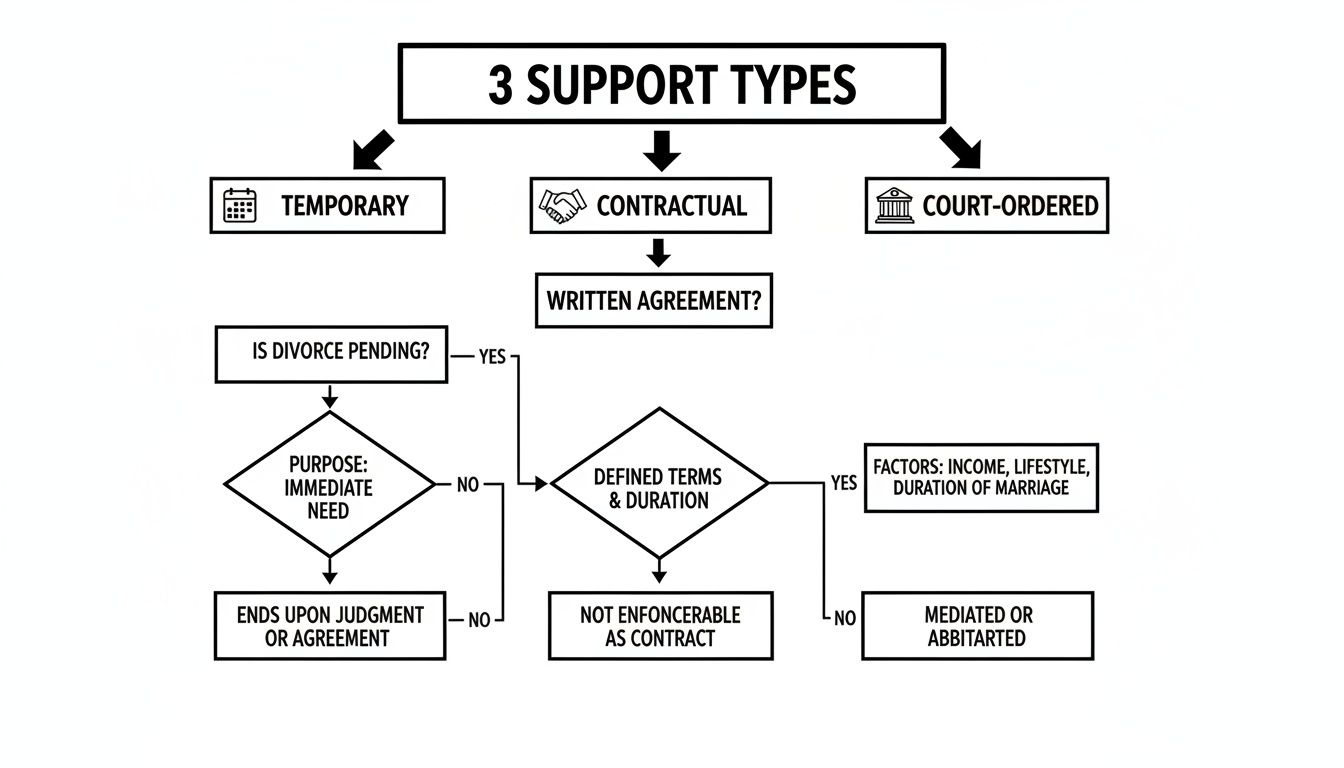
As you can see, temporary support and contractual alimony offer more flexibility. Court-ordered maintenance is a different animal altogether, with a much narrower path to qualification.
What Are Minimum Reasonable Needs?
The phrase "minimum reasonable needs" might sound a bit vague, but in a Harris County courtroom, it boils down to your actual, itemized monthly budget. This isn't about funding the same lifestyle you enjoyed during the marriage. It’s about covering the core necessities of life.
A judge will look at real-world expenses, keeping in mind the cost of living in communities like Atascocita and Humble. These needs typically include essentials like:
- Housing: Your rent or mortgage payment.
- Utilities: The basics like electricity, water, and gas.
- Food: A practical grocery budget.
- Transportation: A car payment, insurance, gas, and routine maintenance for your commute.
- Healthcare: Health insurance premiums and necessary out-of-pocket medical costs.
So, for example, if you live in Atascocita and put your career on hold for 15 years to raise your children, a judge will expect to see a detailed budget. This budget must clearly demonstrate that your potential income and your share of the property from the divorce will not be enough to cover these fundamental monthly bills.
Exceptions to the 10-Year Marriage Rule
The Texas legislature understood that some circumstances are so difficult that they justify support even if a marriage hasn't lasted a decade. You can get around the 10-year rule if you can prove one of these three situations applies to your family:
- You have an incapacitating disability: If you suffer from a physical or mental disability that prevents you from earning enough to support yourself, you might qualify for maintenance regardless of the length of your marriage.
- You are caring for a disabled child: If you are the primary caregiver for a child of the marriage who has a disability requiring substantial, around-the-clock care, a judge can award support. The law recognizes this role prevents you from holding a traditional full-time job.
- You are a victim of family violence: If your spouse was convicted of (or received deferred adjudication for) an act of family violence against you or your child, you could be eligible. The violent act must have occurred within two years of filing for divorce or while the divorce is ongoing.
Just meeting one of these conditions doesn't automatically mean you will get support. It just means the judge can consider it. You still have to present clear and convincing evidence to back up your claim.
At The Law Office of Bryan Fagan, we know that proving your case can feel like an uphill battle. You aren't just showing a judge some numbers; you are telling the story of your life and your contributions to the marriage. We work with clients across Humble, Atascocita, and the greater Houston area to gather the financial records and personal testimony needed to build a powerful and persuasive case for support.
If you think you might qualify, the next step is to understand how courts decide how much to award and for how long. It's not a simple calculation—it’s a balancing act where a judge weighs numerous factors specific to your family's life.
How Courts Calculate Support Payments and Duration
So, you've shown a Harris County judge that you qualify for spousal maintenance. That's a huge step, but it immediately brings up two big questions: How much will you receive, and for how long?
Contrary to what you see in movies, Texas judges do not pull numbers out of thin air. They operate under a strict set of rules from the Texas Family Code, which lays out specific formulas and guidelines to ensure the process is as predictable and fair as possible. Think of it less as a lottery and more as a structured calculation designed to provide a temporary safety net, not a permanent lifestyle.
The Financial Cap on Spousal Maintenance
First, Texas law puts a hard cap on the amount of spousal maintenance anyone can receive. This is to prevent the payments from becoming an impossible financial burden on the paying spouse.
A judge can only order payments that are the lesser of two figures:
- $5,000 per month, or
- 20% of the paying spouse's average monthly gross income.
It's important to understand that "gross income" means all earnings—wages, salary, bonuses, dividends—before a single tax or deduction is taken out. This "lesser of" rule is a concrete ceiling; a judge cannot legally order more, no matter the circumstances.
Let's walk through a practical example for a family in our community. Say a couple in Humble is divorcing, and the higher-earning spouse makes an average gross monthly income of $12,000. The 20% cap would be calculated like this:
$12,000 x 0.20 = $2,400
Because $2,400 is less than the $5,000 statutory maximum, the absolute most a judge could award in this case is $2,400 per month.
Now, if that same spouse earned $30,000 a month, 20% would be $6,000. In that scenario, the award would be capped at the $5,000 limit, since that is the lesser amount. For a deeper dive into this topic, you can learn more about how much alimony costs in Texas in our detailed article.
How Marriage Length Determines Payment Duration
Just as the law limits the dollar amount, it also puts strict time limits on how long you can receive payments. The primary factor here is the length of the marriage—the longer you were married, the longer you might be able to receive support.
It's crucial to understand these are the maximum timeframes allowed by law. A judge always has the discretion to order support for a shorter period, but they cannot legally go beyond these statutory limits.
Here’s a clear breakdown of the maximum duration a Texas court can order spousal maintenance based on how long you were married.
| Texas Spousal Maintenance Duration Limits |
| :— | :— |
| Length of Marriage | Maximum Duration of Support Payments |
| 10 to 20 years | 5 years |
| 20 to 30 years | 7 years |
| Over 30 years | 10 years |
These limits are designed to provide a reasonable runway for the receiving spouse to get back on their feet and become self-supporting.
What about those special cases that don't require a 10-year marriage? If maintenance is awarded because of a family violence conviction, the maximum duration is 5 years. If the award is based on a spouse’s disability, the payments can continue for as long as they remain eligible and unable to support themselves due to that disability.
The Human Factors a Judge Must Consider
The calculation doesn't stop with a simple formula. A Harris County judge is legally required to look beyond the numbers and weigh a whole list of factors that are unique to your family's story. This is where a judge’s discretion really comes into play as they work to find a fair and just outcome for your family.
These aren't just suggestions; they are mandatory considerations for the court, including:
- Each spouse's ability to provide for their own minimum reasonable needs
- The education, job skills, and employment prospects of both spouses
- How long the marriage lasted
- The age, work history, earning potential, and physical and emotional health of the spouse seeking maintenance
- Whether one spouse contributed to the other's education or career advancement
- The value of a spouse's contributions as a homemaker
- Any marital misconduct, like adultery or cruelty, by either spouse
- Any history or pattern of family violence
A judge in a local Harris County court will carefully balance your proven financial need against every one of these factors to craft an order that truly fits the specific circumstances of your life and your divorce.
Preparing a Strong Case for Spousal Support

When it comes to spousal maintenance, walking into a Harris County courtroom and simply asking for it is not enough. A judge won’t take your word for it that you need financial help. You have to prove it, and that means building a case with clear, organized evidence that tells the story of your financial reality.
Think of it like presenting a business case. You need to show the judge the numbers, your plan for the future, and why an "investment" of spousal support is necessary and justified. It requires a powerful and professional presentation of the facts.
Step 1: Gather Your Financial Documentation
The foundation of any request for spousal support is paperwork. A judge needs to see the real numbers behind your day-to-day life, and that means digging in and gathering specific financial records. This isn't just about showing you have little income; it's about painting a complete picture of your financial situation from every angle.
While your attorney will provide you with a specific checklist, you can get a head start by collecting these essential documents:
- Financial Information Statement: This is a crucial, comprehensive form used in Texas divorces that details all your income, assets, debts, and monthly expenses. It’s the cornerstone of your financial case.
- Bank Statements: Pull together at least the last 12 months of statements for every checking and savings account in your name.
- Pay Stubs: If you’re currently working, gather all your recent pay stubs.
- Tax Returns: You'll typically need the last three to five years of your joint tax returns.
- Retirement and Investment Account Statements: These statements show the court the full scope of assets available to both you and your spouse.
It might feel like a mountain of paperwork, but each document is a building block in your case. For families in local communities like Atascocita and Humble, having this organized from the outset is a huge first step toward a successful outcome.
Step 2: Create a Detailed Monthly Budget
One of the most persuasive pieces of evidence you can present is a detailed monthly budget. This is where you demonstrate your "minimum reasonable needs" in a concrete, line-by-line format. A vague claim that you "can't pay the bills" is easy for a court to dismiss. A spreadsheet that clearly shows your income falling short of your necessary expenses is much harder to ignore.
Your budget needs to be realistic and reflect your actual cost of living. Be prepared to itemize everything, including:
- Rent or mortgage for your home in Humble or Atascocita
- Monthly utilities (electricity, water, gas, internet)
- Groceries and household necessities
- Car payments, insurance, and fuel
- Health insurance premiums and average medical co-pays
- Childcare costs, if applicable
A meticulously prepared budget does more than just list your bills. It translates the reality of your life into the language of the court, proving your request for support is based on genuine need, not just desire.
This step is absolutely critical when determining if you can get spousal support in Texas. It shows the judge you’ve done your homework and are approaching this process with the seriousness it deserves.
Step 3: Document Your Good-Faith Efforts
This might be the most overlooked—and most important—part of your case: proving that you are actively trying to become self-sufficient. A Texas judge is required by law to see that you are making a good-faith effort to find a job or get the training needed to support yourself. You can't just sit back and expect a check.
This means you must document every action you take to find employment. We advise our clients to keep a detailed log.
- Job Applications: Track every job you apply for. Note the date, the company, the position, and save any confirmation emails or responses you receive.
- Interviews: Log the dates, times, and contact information for any interviews you land.
- Training or Education: Keep records of any steps you take to improve your skills, whether it's enrolling in a certification course at Lone Star College-Kingwood or attending online workshops.
- Networking: Make a note of industry events you attend or informational interviews you set up in the Atascocita area.
When you present this log to the court, you’re showing the judge that you see spousal support for what it is—a temporary bridge to get you back on your feet, not a permanent destination. It proves you're taking ownership of your future, which is exactly what the law is designed to encourage. An experienced Atascocita family law attorney can help you weave this evidence into a compelling narrative that gives your request the best possible chance of succeeding.
Take Your Next Steps with a Local Atascocita Attorney
Understanding the complexities of spousal support in Texas is one thing, but actually securing it for your family is another. You’ve taken the time to learn the rules, and now it’s time to put that knowledge to work for your future.
Our law firm is part of the fabric of the Atascocita, Humble, and northeast Harris County communities. We live and work here, just like you. We’ve seen firsthand the stress and uncertainty that divorce can bring, and we firmly believe you should never have to face this challenge on your own. Our goal is to empower you to move forward with confidence.
Partner with a Compassionate Advocate
You aren't just looking for any lawyer; you need an advocate who sees the person behind the case file. It's a reality that some firms get caught up in flashy advertising and winning strategies for modern family law marketing, but our focus has always been on building real trust with the people we serve right here in our community.
Your story matters. A compassionate attorney won’t just look at your financial documents; they will listen to understand the full context of your marriage and your contributions, crafting a strategy that reflects your unique situation.
Choosing the right legal partner is one of the most critical decisions you'll make during this process. To help you feel confident in your choice, we’ve put together a guide on how to choose a divorce attorney that fits your specific needs.
We invite you to schedule a free, no-obligation consultation at our Atascocita office. A caring and knowledgeable attorney is ready to listen, answer your questions, and start building a personalized strategy to protect your financial future.
Frequently Asked Questions About Texas Spousal Support
Once you get past the legal rules, the real-world questions start popping up. We see this every day with our clients in Atascocita and Humble. It’s one thing to understand the law, but it's another thing entirely to live with a spousal support order day in and day out.
Here are some of the most common concerns we hear from people just like you. Getting straight answers can give you a much clearer picture of what life will look like after your divorce is final.
What Happens if My Ex Is Late on Spousal Support Payments?
This is a scary and unfortunately common concern. When you’re counting on those court-ordered spousal maintenance payments to make ends meet, a late or missed payment can throw your life into chaos. The good news is that a court order isn't just a suggestion—it's legally binding.
If your ex-spouse stops paying, you have powerful legal recourse. We can file an enforcement action in the same Harris County court that handled your divorce. A judge can then step in and enforce the order by:
- Garnishing your ex-spouse's wages with a wage withholding order, so the money comes directly out of their paycheck.
- Holding your ex-spouse in contempt of court, which could lead to fines or even jail time.
- Ordering them to reimburse you for the attorney's fees you had to spend pursuing the missed payments.
The key is to act quickly. If a payment is missed, don't wait and hope for the best. Contact your lawyer immediately to get the enforcement process started.
Can We Change the Spousal Support Order Later?
Yes, but it’s not automatic. A court-ordered spousal maintenance order can be modified if—and only if—there has been a material and substantial change in the circumstances of either person. Life happens, and Texas law recognizes that an order that was fair on the day of your divorce might become unfair years down the road.
Common reasons for a modification include:
- The person paying support involuntarily loses their job or takes a major, long-term pay cut.
- The person receiving support remarries or gets a new job that significantly increases their income.
A word of caution: this flexibility usually applies only to court-ordered spousal maintenance. If you agreed to contractual alimony as part of your settlement, you often cannot change it unless your original agreement specifically says you can. That's a critical distinction our clients need to understand.
Does Adultery Affect Spousal Support?
It absolutely can. While Texas is a "no-fault" divorce state, meaning you don't need to prove wrongdoing to get divorced, a judge can consider bad behavior when dividing property and awarding spousal support. Marital misconduct like adultery is fair game.
If your spouse’s affair was a major reason the marriage ended, a judge may be more inclined to award you spousal support. On the other hand, if the person asking for support is the one who was unfaithful, a judge might award less support, shorten the duration, or deny it altogether. It's not an automatic disqualifier, but it is definitely a factor the judge will weigh.
How Is Spousal Support Treated for Taxes?
This is a huge financial question, and the answer changed significantly a few years ago. For any divorce finalized after December 31, 2018, the tax treatment is very straightforward:
- Payments are not tax-deductible for the spouse who pays them.
- Payments are not considered taxable income for the spouse who receives them.
In simple terms, the paying spouse gets no tax break, and the receiving spouse gets the full amount tax-free. This is a massive shift from the old rules and has a direct impact on the true financial value of any support agreement. It's a crucial factor that must be considered during negotiations.
When you’re trying to navigate the complex aftermath of a divorce, you need clear, practical advice from someone who understands the ins and outs of the Harris County courts. The Law Office of Bryan Fagan – Atascocita TX Lawyers is here to provide that guidance. If you're wrestling with these questions, schedule a free, no-pressure consultation with our team. Visit www.atascocitaattorneys.com or call us to get started.