 Skip to content
When you’re facing a divorce in Atascocita or Humble, financial questions can feel overwhelming. One of the first that usually comes to mind is, "How much is alimony in Texas?"
The short answer is that Texas law puts a firm ceiling on what a court can order. These payments, which are legally called spousal maintenance, are capped at the lesser of two amounts: $5,000 per month or 20% of the paying spouse's average monthly gross income.
What Texas Law Says About Spousal Maintenance
Forget the dramatic, lifelong alimony payments you see in the movies. The reality for families here in Harris County is a world apart.
Texas treats spousal maintenance as a temporary and rehabilitative tool, not a permanent paycheck. The entire goal is to provide short-term financial support to a spouse who can't meet their "minimum reasonable needs" right after the divorce.
Think of it as a bridge. This support gives the receiving spouse a crucial window of time to get the skills, education, or job training they need to stand on their own two feet. It's a legal recognition that one partner may have put their career on hold for the family's benefit, leaving them in a tough spot financially when the marriage ends. As a law firm dedicated to serving the Atascocita community, we want to ensure you feel supported and understand how these laws apply to your life.
The Legal Limits on Payments
It’s critical to understand that this formula only sets the maximum possible award. A judge isn't required to order the full amount and will weigh many other factors before deciding on a final number. The law is carefully designed to be fair and avoid placing an impossible burden on the paying spouse.
This cap is a cornerstone of Texas divorce law. The Texas Family Code makes it clear that maintenance awards must be reasonable and tied directly to the payer's actual income. It’s a detail that surprises a lot of people when they first start the divorce process.
Getting a handle on this framework is the first step toward planning your financial future. It’s not about winning or losing; it's about finding a stable path forward for everyone. For a deeper look at the fundamentals, our guide on what spousal support is in Texas provides a solid foundation.
Here is a quick overview of the key statutory guidelines.
Texas Spousal Maintenance At a Glance
| Factor | Texas Law Guideline |
|---|---|
| Maximum Monthly Payment | The lesser of $5,000 or 20% of the paying spouse's average monthly gross income. |
| Duration (General Rule) | Payments can last for 5, 7, or 10 years depending on the length of the marriage. |
| Duration (Disability) | Payments can continue as long as the receiving spouse's disability persists. |
| Duration (Family Violence) | 5 years for marriages under 10 years if family violence is proven. |
These statutory limits provide the basic rules of the road, but a judge will always look at the unique circumstances of your case to make a final determination.
Meeting the Eligibility Rules for Alimony
Before a Harris County court even considers the question of "how much is alimony in Texas," the spouse asking for support has a big hill to climb: proving they are legally eligible. Unlike some states, Texas law doesn't make spousal maintenance an automatic part of divorce, no matter how long you were married or how different your incomes are.
First, you have to show the judge that even after the community property is divided, you will still lack enough assets to meet your "minimum reasonable needs." This is a critical legal standard. It means you don't have enough property—think savings, investments, or home equity—or the earning capacity to cover your basic living expenses on your own.
Proving Your Need for Support
Once you've established that initial need, you then have to satisfy one of several specific conditions. For many folks in communities like Atascocita and Humble, the most common route is the 10-year marriage rule.
- The 10-Year Marriage Rule: To qualify under this rule, you must have been married for at least 10 years and show that you’ve made a real effort to earn an income or develop skills but still can't provide for your minimum reasonable needs. For instance, a Humble parent who left the workforce for 15 years to raise children likely needs time and financial help to get the training required to find a decent job today.
Once a spouse is found eligible, the court then moves on to calculating the amount, which is subject to strict statutory caps.
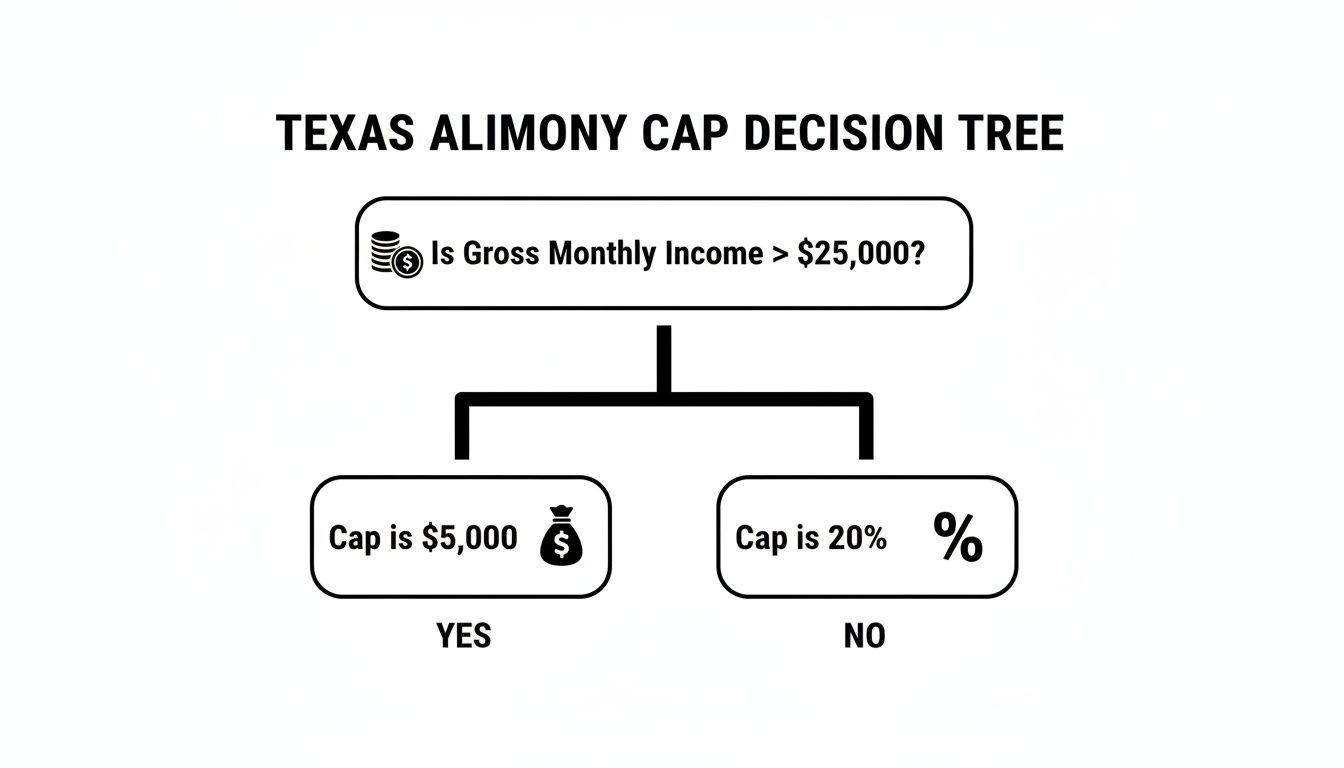
This visual breaks down how the state's formula puts a ceiling on what can be ordered. The court can award the lesser of $5,000 per month or 20% of the paying spouse's average gross monthly income.
Important Exceptions to the 10-Year Rule
The law recognizes that some circumstances are so severe they warrant support even in shorter marriages. These exceptions create other paths to eligibility, sidestepping the decade-long requirement entirely.
Family Violence: The 10-year rule is waived if the paying spouse was convicted of (or received deferred adjudication for) an act of family violence against you or your child. This must have occurred within two years of filing for divorce or while the divorce is pending.
Disability of a Spouse: You may qualify if you can't earn enough to support yourself because of a significant physical or mental disability.
Caring for a Disabled Child: You can also be eligible if you're the primary caregiver for a child of the marriage (of any age) who has a disability requiring substantial care and supervision, which in turn prevents you from working.
Clearing these strict hurdles is the very first step in any spousal maintenance case. If you think your situation fits one of these scenarios, it’s crucial to understand how the details of your life align with these legal standards. The team at The Law Office of Bryan Fagan is here to help. Schedule a free consultation at our local Atascocita office to discuss your case and figure out your next steps.
How Texas Courts Calculate Alimony Payments

Once you've established eligibility for spousal maintenance, the big question on everyone's mind is: "So, how much will the payments actually be?" The starting point for that answer is a very specific, statutory formula.
Think of this formula as a hard ceiling. Texas law sets a clear maximum on what a judge can order, which helps create a degree of predictability for both the person paying and the person receiving support.
The maximum spousal maintenance a court can order is the lesser of two figures: $5,000 per month or 20% of the paying spouse's average monthly gross income.
This means that no matter how much someone earns, the payment can never top $5,000 a month. For most families in the Atascocita and Humble areas, however, it’s the 20% rule that usually comes into play as the limiting factor.
Breaking Down the 20 Percent Rule
To apply this formula, a Harris County judge first has to figure out the paying spouse's "average monthly gross income." This isn't just their salary or what they see on a pay stub; it’s a much more comprehensive figure.
"Gross income" under Texas law includes nearly every dollar coming in from any source:
- Wages, salary, commissions, overtime, and tips
- Bonuses
- Income from a business or self-employment
- Interest, dividends, and royalties
- Rental income from investment properties
- Retirement benefits, pensions, and annuity payments
The court will look at all of these sources to land on a fair monthly average. This is especially important when income isn't consistent—think of a small business owner in Humble whose profits change month to month, or a professional in Atascocita who gets a large annual bonus. The judge’s job is to smooth out those fluctuations to determine a reliable monthly income before applying the 20% cap.
Practical Examples of the Calculation
Here is a step-by-step look at how this works. Let's walk through a couple of real-world scenarios to see how this plays out for families in our community.
Example 1: The Atascocita Professional
Imagine an engineer in Atascocita earns an average monthly gross income of $12,000.
- Step 1: Calculate 20% of $12,000, which is $2,400.
- Step 2: Compare that number to the $5,000 statutory cap.
- Result: Because $2,400 is the lesser amount, the absolute maximum a judge could order for spousal maintenance is $2,400 per month.
Example 2: The Humble Business Owner
Now consider a successful entrepreneur in Humble with a more variable income that averages out to $30,000 a month.
- Step 1: Calculate 20% of $30,000, which comes out to $6,000.
- Step 2: Compare that to the $5,000 statutory cap.
- Result: In this case, $5,000 is the lesser amount. The maintenance award is capped at $5,000 per month, even though 20% of their income is higher.
It's critical to understand that this formula only sets the maximum possible payment. The final amount a judge actually awards could be less, because they must then weigh a whole host of other factors to decide what's truly fair and just for your specific situation.
What Factors Really Influence the Final Alimony Amount?

Just because you qualify for spousal maintenance doesn't mean you'll automatically get the maximum amount. Far from it. That statutory formula—the lesser of $5,000 or 20% of the paying spouse's gross monthly income—is simply the starting line. It's the absolute ceiling, not the guaranteed floor.
Think of it this way: the law sets the maximum height of the room, but a Harris County judge decides where, between the floor and that ceiling, the final award will actually land. This is where the specific details of your marriage, your finances, and your lives come into play. It's not a math problem; it's a judgment call based on a whole host of factors.
The Court's Deep Dive into Your Marriage
The Texas Family Code gives judges a specific list of things they must consider when making this decision. For families here in Atascocita and Humble, knowing what the court is looking for is critical. It helps you build a solid case and have realistic expectations.
A judge will meticulously comb through:
- Each Spouse’s Post-Divorce Financial Reality: This isn't just about income. It's about the entire financial picture for each person once the divorce is final, including the specific assets and property they walk away with. For a deeper look at this, our guide on what is community property in Texas in Atascocita families is a great resource.
- Education and Earning Potential: The court assesses the skills, training, and employment history of both spouses. They'll ask practical questions, like how long would it genuinely take the requesting spouse to acquire the education or skills needed to earn a living wage?
- The Length of the Marriage: A 20-year marriage where one spouse stayed home to raise the family is viewed very differently than a 10-year marriage where both spouses worked full-time. The duration often tells a story about sacrifice and dependency.
- Age and Health: The court takes a hard look at the age, physical health, and emotional condition of the spouse seeking support. A chronic illness or disability that prevents someone from working is a powerful factor in the court’s decision.
A judge isn't just going down a checklist. They're piecing together the financial story of your marriage to determine what kind of support, if any, is truly fair and just under your unique circumstances.
Your Actions and Conduct Can Tip the Scales
It’s not all about the numbers. A judge also has the discretion to look at how both spouses have behaved.
Have you been actively seeking a job? Are you enrolled in a training program to update your skills? Demonstrating these good-faith efforts can significantly bolster your case for maintenance. On the flip side, things like intentionally hiding assets or squandering community funds during the divorce process can seriously damage the other party's position.
Finally, while Texas is a "no-fault" state, marital misconduct like adultery or cruel treatment can absolutely be considered. It won't be the only factor, but it can certainly influence a judge’s view on what is "just and right" when it comes to ordering spousal maintenance. Your best strategy is always to present a clear, honest, and well-documented picture of your situation.
How Long Do Alimony Payments Last in Texas?

When people ask, "how much is alimony in Texas," they're only getting half the picture. The other critical question is, "for how long?" The duration of the payments can have just as big an impact on your financial future as the monthly amount.
Think of Texas spousal maintenance as a temporary bridge, not a permanent destination. The law is designed to give a spouse the time and resources to get back on their feet, not to create a lifelong financial arrangement. This approach gives everyone involved a clearer timeline for moving forward.
For families in Humble and Atascocita, this means you can plan for the future with more certainty, knowing there's a clear end date for the support payments in most situations.
The Official Timelines for Spousal Maintenance
The Texas Family Code lays out specific rules that tie the maximum length of maintenance directly to how long you were married. These aren't just suggestions for the judge; they're firm limits.
When a Harris County judge is deciding on the duration, they'll be looking at this framework. Here’s a quick breakdown of the maximum timeframes allowed by law:
Maximum Duration of Spousal Maintenance in Texas
The length of your marriage is the primary factor in determining the absolute longest a judge can order maintenance payments to continue.
| Length of Marriage | Maximum Duration of Maintenance Payments |
|---|---|
| 10 to 20 years | 5 years |
| 20 to 30 years | 7 years |
| More than 30 years | 10 years |
It’s really important to see these as a ceiling, not a guarantee. A judge can, and often will, order maintenance for a shorter period if they feel it’s a reasonable amount of time for the receiving spouse to find work or complete training. The goal is always to provide the shortest reasonable period for self-sufficiency.
Are There Exceptions for Indefinite Payments?
So, are these time limits set in stone? For the most part, yes. But Texas law does carve out a few very specific exceptions for situations where a spouse truly cannot become self-supporting.
These exceptions are rare and reserved for circumstances where a significant, ongoing issue makes it impossible for a spouse to provide for their own basic needs.
A judge might order maintenance to last indefinitely in two primary scenarios:
- A Disabling Condition: The receiving spouse has a serious physical or mental disability that prevents them from earning a sufficient income.
- Caring for a Disabled Child: The receiving spouse is the primary caretaker for a child of the marriage (of any age) who has a substantial physical or mental disability, and these caregiving duties prevent them from working.
In these specific cases, payments can continue for as long as the disabling condition exists. For the vast majority of Atascocita and Harris County divorces, however, the standard timelines based on the length of the marriage are what you can expect.
Changing or Enforcing Your Alimony Order
Life in Atascocita and Humble doesn’t stand still just because a divorce is finalized. People get new jobs, face unexpected health issues, or start new relationships. Because real life is always changing, a spousal maintenance order isn't always set in stone forever.
Under Texas law, you can ask a court to modify or even terminate spousal maintenance, but there’s a catch. You have to prove there has been a "material and substantial change in circumstances" since the original order was signed by the judge.
When Can You Modify an Alimony Order?
That legal phrase—"material and substantial change"—sets a high bar. The courts do this intentionally to prevent ex-spouses from running back to court for every minor financial hiccup. A small raise or a temporary dip in overtime pay probably won't cut it. The change needs to be significant and likely permanent.
So, what kind of situations might a Harris County judge consider significant enough?
- Job Loss or Demotion: The spouse making payments loses their job (and not on purpose) or is forced into a role with a major pay cut.
- Major Promotion or Pay Increase: The spouse receiving support gets a great new job or a huge raise that allows them to become self-sufficient.
- Disability or Illness: A serious, long-term health problem affects either person's ability to earn a living.
- Remarriage or Cohabitation: The recipient remarries or moves in and begins living with a new romantic partner.
If you think your circumstances have changed enough to warrant a modification, you can’t just stop paying or demand more. You have to file a formal motion with the court. This process is all about documentation and making a persuasive legal argument, which is why it’s so important to understand how to choose a divorce attorney who can build a strong case for you.
What Happens When Payments Stop?
Now, let's flip the script. What if your ex-spouse just decides to stop making their court-ordered maintenance payments? You have powerful legal tools on your side. You should never be in a position where you have to beg for money you are legally entitled to.
An enforcement action is when you ask the court to step in and force your ex-spouse to follow the rules of the divorce decree. It’s a serious legal move designed to protect your financial security.
A Harris County judge has several ways to enforce an alimony order. They can order wage garnishment, which means the payments are taken directly out of your ex's paycheck. They can also place liens on property or, in serious cases, find the non-paying spouse in contempt of court. That can lead to hefty fines or even jail time.
Whether you’re trying to change an order or force someone to follow one, protecting your rights is crucial for building your new future after divorce.
Answering Your Top Alimony Questions in Texas
Even after you get the basics down, spousal maintenance can leave you with a lot of "what if" questions. Let's tackle some of the most frequent ones we hear from our clients in the Atascocita and Humble communities.
Can We Just Agree on an Alimony Amount Ourselves?
Yes, you absolutely can, and frankly, it's often the better way to go. Spouses can create what’s known as a "contractual alimony" agreement. This is a private contract that lets you sidestep the court's rigid eligibility rules and statutory caps.
This route gives you and your spouse the freedom to decide on an amount and a payment schedule that actually works for your family's unique situation. For many people in Atascocita, keeping these decisions out of a judge's hands is a huge relief. Just make sure you have a skilled attorney draft the agreement—you need it to be ironclad to prevent problems later.
Are Alimony Payments Taxable?
This is a big one, and the rules have changed. For any divorce finalized after 2018, the answer is no. Spousal maintenance payments are no longer tax-deductible for the paying spouse, and they aren't considered taxable income for the receiving spouse.
This was a major shift from the old system. It directly impacts the real-world value of every dollar exchanged, so it's something we make sure all our Harris County clients account for during negotiations.
The tax rules are a game-changer. You have to look at the net financial impact, not just the gross dollar amount. Ignoring this can lead to some nasty financial surprises down the line.
How Does Adultery Play into an Alimony Decision?
It can play a surprisingly big role. While Texas is a "no-fault" state—meaning you don't have to prove someone did something wrong to get divorced—a judge can absolutely consider marital misconduct when it comes to alimony.
Here’s how it typically works in a Harris County courtroom: If the spouse asking for support was unfaithful, a judge might be less inclined to award it, or might award less. On the flip side, if the higher-earning spouse's affair led to the marriage's breakdown, the judge could see that as a reason to be more generous with the maintenance award.
The ins and outs of spousal maintenance are tricky, and the final decision will impact your financial stability for years. At The Law Office of Bryan Fagan – Atascocita TX Lawyers, we're dedicated to helping our neighbors understand their options and chart a clear course. If you're facing these questions, let's talk about your specific situation.


