Skip to content
A lot of people in Atascocita start this process the same way. They sit at the kitchen table with a stack of forms, a cup of coffee gone cold, and one big question: “Why does something this personal have to feel this bureaucratic?”
Maybe you're newly divorced and ready to stop carrying a name that no longer fits your life. Maybe you're changing your name to reflect who you are. Maybe you want your child's name to match the household they're growing up in. All of those reasons are real, and all of them matter.
The hard part isn't usually deciding you want the change. The hard part is figuring out how Harris County expects you to do it without making a mistake that delays everything. That's where local guidance matters. A lawyer who understands the courthouse process for northeast Harris County can save you time, frustration, and unnecessary stress. If you're still deciding who should help, this guide on how to choose a family lawyer in Atascocita, Texas is a good place to start.
Embarking on Your Name Change Journey in Atascocita
I've talked with plenty of neighbors from Atascocita, Humble, and Kingwood who thought a name change would be simple, then got overwhelmed as soon as they saw the court paperwork. That reaction is normal. Courts want detailed information, and they want it in the right format.
For some people, the name change is tied to a family law issue. A divorce wraps up, and they want their old name back. A custody matter settles, and a parent starts asking whether a child's last name should change too. Others come in with concerns that overlap with criminal history or personal safety. Texas law doesn't treat those situations casually, and neither should you.
A name change is personal, but in Texas it's also a court case. Treat it that way from day one.
What I tell people is simple. Don't guess your way through it. If you live in Atascocita or Humble, your case is part of the Harris County court system, and local practice matters. Filing the wrong form, missing a required notice, or showing up unprepared for a hearing can turn a manageable process into a drawn-out one.
A good plan starts with two questions. Are you legally eligible to file, and do you have the right paperwork ready? Once those are clear, the process becomes a lot more manageable.
Confirming Your Eligibility for a Name Change in Texas
You do not want to learn you were in the wrong court after paying a filing fee and taking time off work. I see that happen with Atascocita and Humble residents who assume any Texas court can handle a name change. Harris County will not overlook basic eligibility mistakes.
For an adult name change, the first question is residency. Texas courts generally require you to have lived in Texas for at least six months and in the county where you file for at least ninety days, as outlined in this Texas name change residency overview. If you live in Atascocita or Humble and plan to file in Harris County, make sure your address history supports that filing before you prepare anything else.
Jurisdiction matters because the judge must have legal authority over your case. If your timing is off, the fix is simple. Wait until you meet the residency requirement, then file once.
What judges are actually looking for
A court is not grading your life story. It is deciding whether your request is lawful, clear, and made in good faith.
Use this checklist:
- You meet the residency rules: Six months in Texas and ninety days in Harris County for a standard adult filing.
- You are filing in the correct county: For Atascocita area residents, that usually means Harris County, not wherever you used to live or where a relative lives.
- You can explain the reason plainly: Personal, family, religious, or professional reasons can be valid if you state them clearly.
- You are not trying to avoid a problem: Courts reject requests tied to debt evasion, criminal avoidance, or other improper motives.
That last point matters more than people expect. If a judge thinks the request is designed to hide from creditors, dodge legal obligations, or create confusion, the case can stop right there.
Child name changes follow different rules
If a parent wants to change a child's name, treat that as a separate category. Texas places child name changes under Chapter 45 of the Family Code, and the case must be filed in the county where the child lives. The petition needs the child's current name, the proposed name, and a specific reason the change serves the child's interest. You can review the statute directly through the Texas Legislature's Family Code, Chapter 45.
In Harris County, child cases often get more scrutiny because they can overlap with custody orders, parental rights, or support disputes. If the other parent disagrees, expect a more contested process.
If your paperwork includes records from older court files, school files, or identity documents, keep them organized from the start. A comprehensive resource on PDF data handling can help you pull text from scanned records before you file or before your lawyer reviews them.
If your name change issue connects to a broader family law case, that matters too. For example, support disputes often run alongside family identity issues, and Child Support Attorney in Atascocita work involves establishing, modifying, and enforcing child support in Harris County.
My advice is simple. If there is any question about residency, a criminal record, an active family case, or a disputed child name change, get legal advice before you file. In Harris County, the cleanest cases move fastest.
Gathering the Necessary Documents and Forms
A lot of Atascocita and Humble residents hit the same wall. They have the right reason for a name change, but the paperwork is incomplete, names do not match across records, or the proposed order is missing. Harris County clerks do not fix those problems for you. They reject bad packets, and that costs time.
Build the packet before you file
For an adult case, your packet should be clean, consistent, and ready for the judge to sign. For a child case, the court will expect more detail and closer review, especially if family records are involved. Either way, sloppiness creates delay.
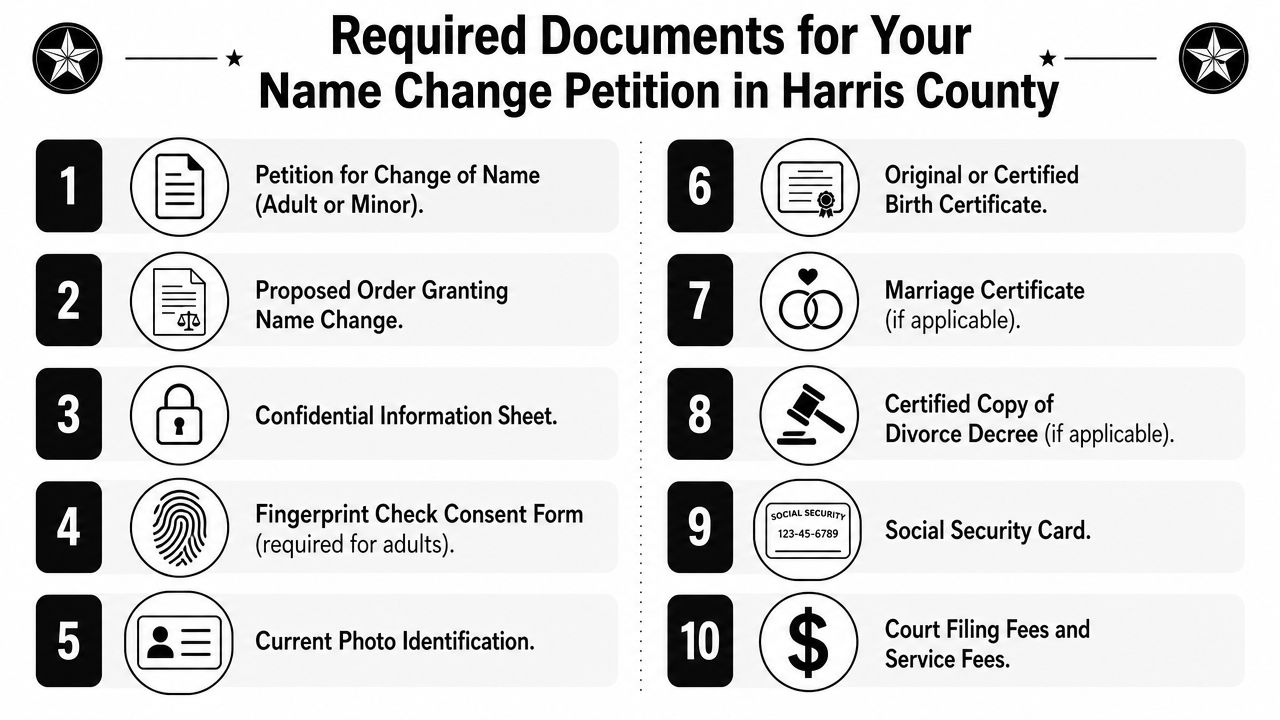
Use this order. It works well in Harris County:
- Original petition: Your formal request to the court. It needs to match your ID and supporting records exactly.
- Proposed order: Bring a clean draft for the judge. If you do not prepare it, the court will not do it for you.
- Proof of identity: A current photo ID is standard. Supporting identity records such as a birth certificate or Social Security record are often helpful when names differ across documents.
- Supporting family records: If the request connects to marriage, divorce, or a prior court order, include certified copies where appropriate.
- Fingerprint materials for adults: Adult cases usually require fingerprints and a background check. Handle that early so it does not hold up your hearing.
That last point matters more in Harris County than many statewide guides admit. Local judges and clerks see enough avoidable mistakes that they expect you to arrive organized.
Local records and filing details matter
If you need older court paperwork, certified copies, or help figuring out where a record sits in the local system, review the Harris County probate clerk records and filing guide before you file. People often waste a week chasing the wrong office.
Fees also deserve attention. Filing costs, copy costs, certification charges, and fingerprint-related expenses can add up fast. Check the current Harris County district clerk and agency requirements before you submit anything, and if cost is a real barrier, ask about filing a Statement of Inability to Afford Payment of Court Costs.
Organize your documents like a lawyer would
Do not dump scanned PDFs, phone photos, and email attachments into one folder and hope for the best. Sort everything by document type, label each file clearly, and compare every name, date of birth, and signature before filing.
If your records are spread across scanned PDFs, old court files, and email attachments, get them organized before filing. A comprehensive resource on PDF data handling can help when you need to pull names, dates, or document details from court paperwork without retyping everything by hand.
Here is the standard I recommend:
| Document type | Why it matters |
|---|---|
| Petition and proposed order | These are the core court papers |
| Identity records | They show the court who you are now |
| Marriage, divorce, or prior court records | They explain the history behind the request |
| Fingerprint materials | They support the adult background review |
| Fee waiver papers, if needed | They affect whether the clerk accepts filing without advance payment |
If your documents do not match each other, fix that before you file. In Harris County, inconsistent names, dates, and signatures are one of the fastest ways to turn a simple case into a delayed one.
Navigating the Harris County Court Process Step by Step
The court process feels less intimidating once you see it as a sequence instead of one big unknown. Texas name changes follow a defined path, and that's good news because predictable procedure is easier to manage.
A helpful visual summary is below.
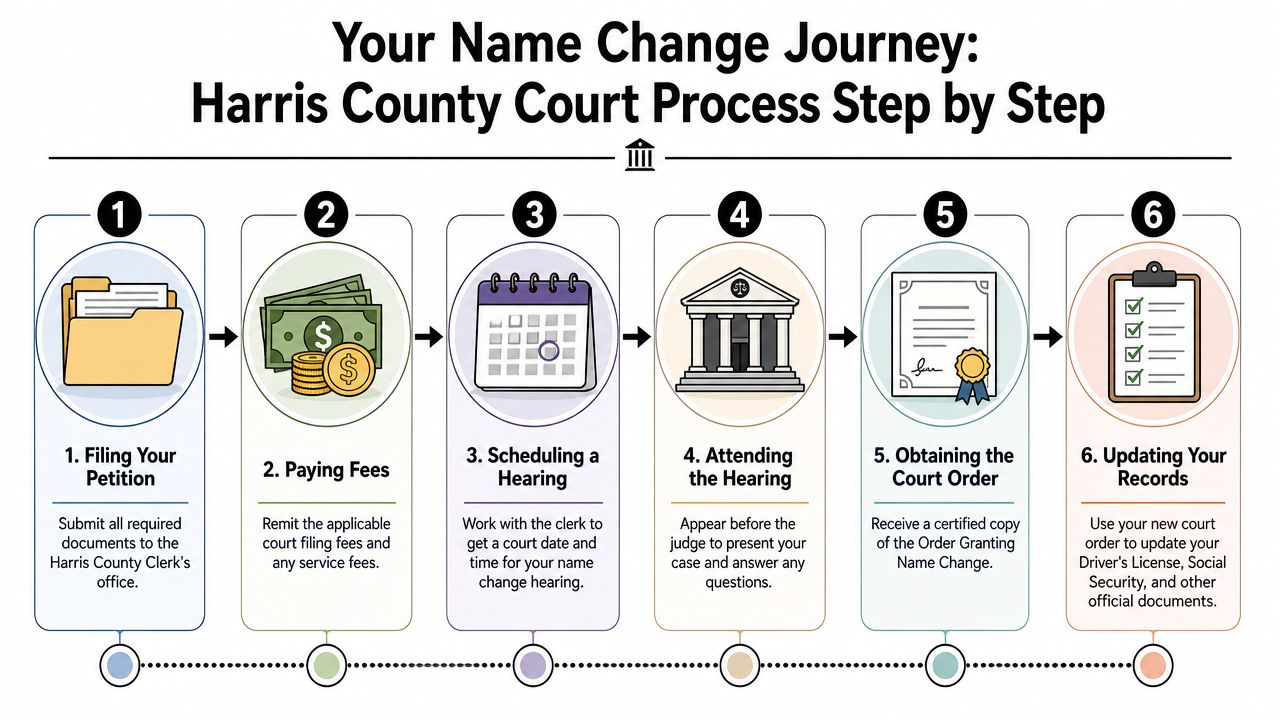
What filing actually starts
The legal process for changing a name in Texas involves 8 distinct procedural steps, beginning with filing an Original Petition for Name Change with the district clerk, which then assigns a unique cause number and designates a specific court for the case, according to this Texas name change procedure overview.
That cause number matters. It's how the court tracks your case, your hearing, and your final order. Once your petition is filed, your case is no longer an idea. It's an active court matter.
For many Harris County filings, people also end up dealing with related clerk and records questions. If you're trying to understand how local recordkeeping works, this page on the Harris County probate clerk helps explain part of the local court system.
The sequence in plain English
The practical flow usually looks like this:
- File the petition with the district clerk. The clerk assigns the case number and court.
- Complete the fingerprint requirement. Adults need to handle this promptly so the background portion doesn't hold up the case.
- Handle notice issues if a child is involved. The other parent or managing conservator may need formal notice, unless there's a valid waiver.
- Prepare for the hearing. In an uncontested case, this is often a prove-up. In a contested case, expect more questions and a more formal presentation.
- Get the final order signed. No signed order, no legal name change.
- Order certified copies. You'll need them to update records after court.
Here's a short explainer that gives a general visual walkthrough of the process:
What happens at the hearing
People often worry most about standing in front of a judge. In a straightforward case, the hearing is usually about confirming the facts in your petition and making sure your request is lawful.
A judge may want to know your reason for the change, whether the request is being made for any improper purpose, and whether all procedural requirements were met. If this is a child case, the court will pay close attention to notice, consent, and the child's best interests.
Go to court with a clean file, a clear explanation, and certified paperwork ready. That's how you make a routine hearing stay routine.
Why legal help changes the experience
A lawyer doesn't magically change the law. A lawyer changes the odds that your paperwork is complete, your hearing is properly set, your order is drafted correctly, and your case doesn't get derailed by a preventable issue.
That's especially true when the name change overlaps with divorce, custody, criminal defense, or estate records. The Law Office of Bryan Fagan – Atascocita TX Lawyers handles family law, criminal defense, civil litigation, probate, and estate planning matters for clients in Atascocita, Humble, and Harris County, which matters when a “simple” name change is attached to a larger legal problem.
Handling Special Cases and Common Complications
A parent in Atascocita files what looks like a simple name change for a child, then learns the other parent was not properly notified, the child is old enough to have a say, or an old Harris County order changes the whole strategy. That is how routine cases turn into expensive delays.
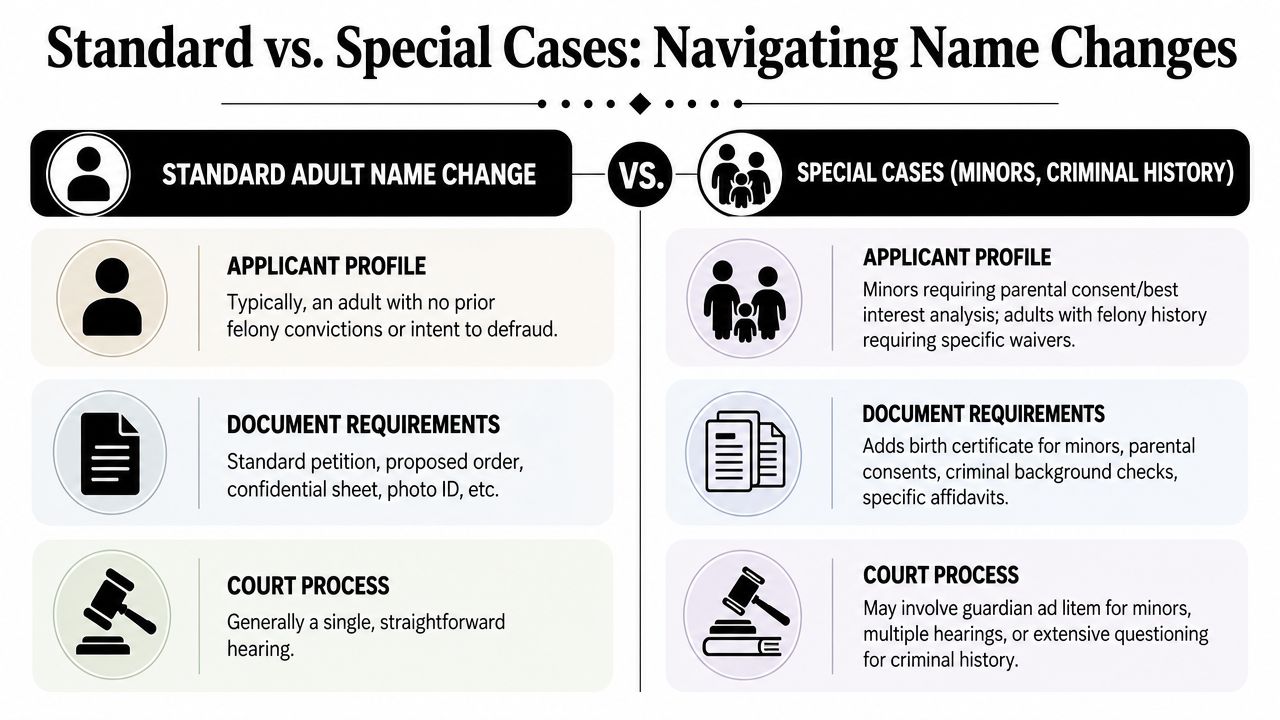
Minor name changes
Child cases get more scrutiny in Harris County because the court has to protect the child, not just approve what the adults want. If the child lives in Atascocita or Humble, the case still goes through the Harris County process, and the judge will focus hard on notice, consent, and whether the change serves the child's best interests.
If the child is 10 or older, the court expects the child's written consent. As noted earlier, that is not a technical detail. It is a requirement that can stop the case if you ignore it.
The other common problem is the other parent. If parental rights are still intact, the court usually wants proper notice, and sometimes active participation, before it will sign anything. Parents often tell me, “We both agree in principle.” That is not enough. The file has to show the court exactly what happened, who was served, and why the requested change is appropriate.
If the name issue is tied to adoption, SAPCR orders, or a custody fight, treat it as part of the larger family law matter. Filing a stand-alone petition without reviewing existing orders is a mistake.
Post-divorce changes
Divorce decrees solve some name problems and leave others behind. Read the signed decree line by line.
If the decree clearly restores a prior name, that order is usually the document you use to update records. If the decree is silent, vague, or never signed with that language, you may need a separate adult name change case in Harris County. That happens more often than people expect, especially after contested divorces or cases that were resolved under pressure at the end.
For Atascocita and Humble residents, the practical issue is simple. Do not assume the family court already handled it just because the divorce is over. Confirm what the order says before you spend time trying to update a driver license, Social Security record, or bank account.
If the divorce is still feeding disputes over possession, support, or enforcement, the name issue may overlap with broader family law matters such as Contested Divorce Attorney in Atascocita work involving advocacy in Harris County courts.
Cases involving felony history
Harris County judges look closely at petitions filed by people with a felony record. They should. A court-ordered name change cannot be used to hide from creditors, avoid law enforcement, or sidestep past obligations.
TexasLawHelp explains that an adult with a felony conviction generally must show either a pardon or enough time has passed after completing the sentence and any community supervision before the court can grant the request, as outlined in this Texas name change eligibility guide for felony cases. If your paperwork does not prove that point cleanly, expect the case to stall or fail.
My advice is straightforward. Do not file first and hope the details work themselves out later. Get the discharge papers, sentencing records, and any other required proof in order before you ask the court for relief.
Procedural mistakes that create avoidable delays
Special cases usually break down over paperwork and procedure, not dramatic courtroom fights. In Harris County, I see the same errors over and over:
- Notice was never completed correctly: In child cases, that can delay the hearing or lead to dismissal.
- The filing ignores an older family court order: Prior custody, support, or termination orders may control what has to happen next.
- Criminal history records are incomplete: The court will not fill those gaps for you.
- The hearing date gets missed: That creates extra cost, extra waiting, and sometimes a reset of the scheduling process. If that risk is on your mind, read what happens if you miss a court date in Harris County family court.
The fix is preparation. For Atascocita families, that means checking the Harris County filing requirements, reviewing every existing order tied to the person whose name will change, and making sure the court gets a clean, complete record the first time.
Life After the Name Change What to Do Next
The judge signs the order, and people feel relieved. They should. But the court order is only half the job. Your name doesn't become useful in daily life until your records match it.
Start with government identification. For minors, the process described in the earlier court-process discussion includes amending the birth certificate after the order is signed. For adults, the same process summary explains that you'll need proof such as a certified court order or marriage license to update a driver license and then work through other agencies and institutions.
Your post-order checklist
Handle the updates in a sensible order:
- Get certified copies first: Don't rely on a plain copy. Many agencies want a certified court order.
- Update identification records: Driver license and Social Security updates usually drive the rest of the process.
- Notify your employer and bank: Payroll, tax reporting, direct deposit, and account verification need to match.
- Update schools and medical providers: If a child is involved, records need to be consistent.
- Review legal and financial documents: Wills, trusts, beneficiary designations, property records, and insurance should all reflect the correct name.
Don't ignore related legal planning
A name change often exposes other documents that need attention. A divorced parent may need to revisit custody paperwork. A person with a prior criminal case may want to make sure all records are handled consistently. A retiree in Humble who changes a name after marriage, divorce, or personal choice may also need to review wills, trusts, and probate planning.
That's why this process reaches beyond family law. It can touch criminal history disclosures, estate planning, and civil documentation all at once. When your records don't line up across systems, simple tasks become a headache.
The court order opens the door. Your follow-through is what makes the new name work everywhere else.
If you want the process handled carefully from start to finish, don't piece it together on your own. Get help before the filing, not after the mistake.
If you're looking for a name change attorney in Atascocita, Texas, schedule a free consultation with Law Office of Bryan Fagan – Atascocita TX Lawyers. We help residents of Atascocita, Humble, and northeast Harris County sort out the filing, prepare for court, and address the related family, criminal, civil, and estate issues that often come with a name change.