Skip to content
Your phone lights up with a text that changes the whole week. The child's mother says she's keeping the kids a little longer. Then “a little longer” turns into missed pickups, arguments over school decisions, and a fear that if you say the wrong thing, you'll lose time with your children. A lot of fathers in Atascocita and Humble arrive at this point feeling two things at once. They love their kids immensely, and they aren't sure what the court will determine about that fact.
That uncertainty is real, but it's also where good legal strategy starts. A custody case in Harris County isn't won by repeating that you're a good dad. It's built by showing the court how you parent, how you communicate, how you support your child's routine, and how you handle conflict when things get tense. Those details matter in a way many fathers don't realize until the case is already moving.
Families in northeast Harris County also face related legal issues that often overlap with custody disputes. Divorce can affect housing, finances, and possession schedules. A protective order or criminal allegation can change what happens in a family courtroom. Estate planning matters too, especially if you want clear guardianship planning and decision-making documents in place for your child. Texas family, criminal, and civil law often meet in one stressful season of life, which is why practical local guidance matters.
A Father's First Step in an Atascocita Custody Case
A father in Atascocita may start this process sitting in his truck outside a school, wondering whether he should go in, whether he should text again, or whether one angry exchange will be used against him later. Another father in Humble may already be out of the home and worried that the new routine is becoming the permanent routine. Both situations feel urgent because they are urgent. Time starts creating a pattern, and patterns matter in custody cases.
The first step usually isn't a dramatic courtroom move. It's getting clear about your legal position, your immediate risks, and your goal. Are you trying to protect your regular parenting time? Are you trying to become the parent who determines the child's primary residence? Are you an unmarried father who hasn't yet secured legal rights? Those are different problems, and they need different responses.
Start with facts, not panic
Most fathers hurt their case when they react emotionally before they understand the legal terrain. Text arguments, social media posts, showing up unannounced, or withholding support out of frustration can create problems fast. A calm, documented, child-focused response works better.
Practical rule: In the first days of a custody dispute, act like every message could be read by a judge.
That doesn't mean you have to be passive. It means your next steps should be deliberate. Save communications. Keep a calendar. Write down missed exchanges, school involvement, doctor visits, and overnight stays. If there's already a court order, follow it as closely as possible while you seek legal advice.
What local fathers need most
In Atascocita and Humble, many fathers want the same thing. They want steady time with their children, a voice in important decisions, and a process that doesn't reduce them to “visitor” status. That's possible, but the path depends on your status as a married or unmarried father, the current living arrangement, and what evidence you can present.
If you're looking for a custody lawyer for fathers in Atascocita TX, the useful question isn't “Do fathers have rights?” The useful question is, “What do I need to prove, and what should I stop doing today?”
Myths vs Reality Fathers Rights in Texas Law
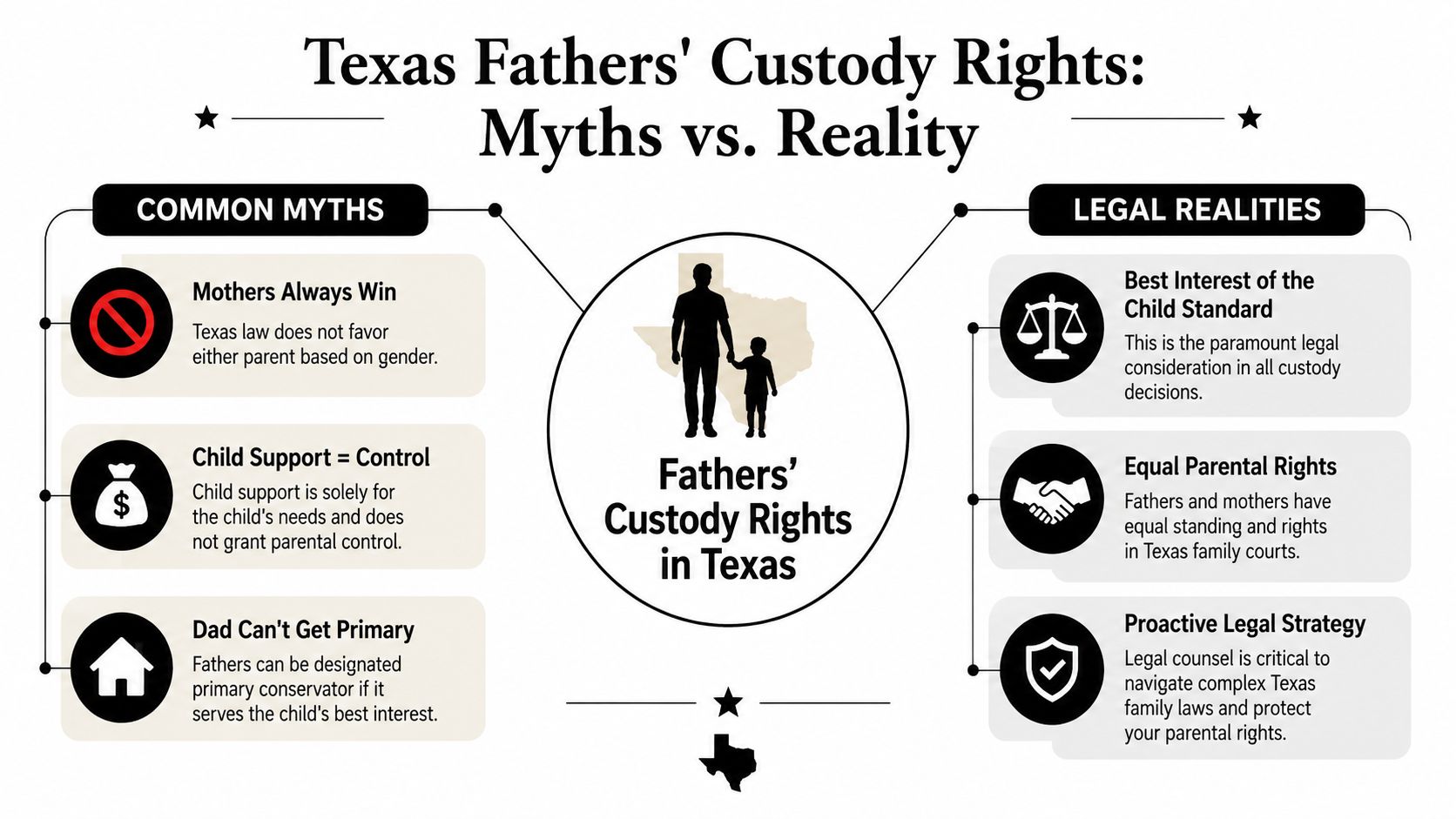
A lot of fathers walk into a custody dispute assuming the result is already tilted against them. That belief usually comes from old stories, bad advice, or a general sense that mothers always end up with the child. Texas law doesn't work that way.
Under the Texas Family Code, there is no legal preference for mothers over fathers, and judges must decide custody based on the best interest of the child without regard to gender, as summarized by McNamara Lawyers on Texas fathers' rights. That point matters for married fathers and for unmarried fathers who have taken the legal steps needed to be recognized by the court.
What the court is actually deciding
In Texas, the words can sound technical, so it helps to translate them into plain English.
| Legal term | What it usually means in real life |
|---|---|
| Conservatorship | Who has the rights and duties to make important decisions for the child |
| Possession and access | The parenting schedule and when each parent has time with the child |
| Primary conservator | The parent who usually has the right to determine the child's primary residence |
| Standard possession order | A common schedule the court may use, depending on the facts of the case |
The court isn't grading which parent feels more hurt. The court looks for stability, involvement, judgment, and a parenting plan that serves the child's day-to-day life.
Three myths that hold fathers back
Myth one. Mothers automatically win.
That's not the legal standard in Texas. The court is supposed to focus on the child's best interest, not the parent's gender.
Myth two. If I pay child support, I control the outcome.
Child support and custody are related family law issues, but one doesn't buy the other. Support is about the child's needs. Custody is about parenting rights, duties, and the child's best interest.
Myth three. Dad can't be the primary parent.
A father can be named the parent with primary rights if the evidence supports that result. The issue is proof, not labels.
For local families needing formal guidance on conservatorship and possession, Child Custody Lawyer in Atascocita, TX provides custody and conservatorship representation for Atascocita families.
The numbers tell a more complicated story
The law is neutral, but outcomes still show a gap. In Texas, fathers receive about 33% of total parenting time, compared with a nationwide average of 35% for custodial fathers, according to Texas divorce and custody statistics discussed here. The same source explains that U.S. Census Bureau data shows about 80% of custodial parents are mothers, while fathers account for 20% of sole custodial status nationally. Texas is listed as number 22 nationally on child custody statistics by gender in that discussion.
That doesn't prove fathers can't succeed. It shows that many fathers still end up with less time than they hoped, often because they enter the process late, without documentation, or without a plan built around the child's actual needs.
The fathers who do best usually stop arguing in general terms and start proving specific parenting conduct.
The Critical First Step for Unmarried Fathers in Atascocita
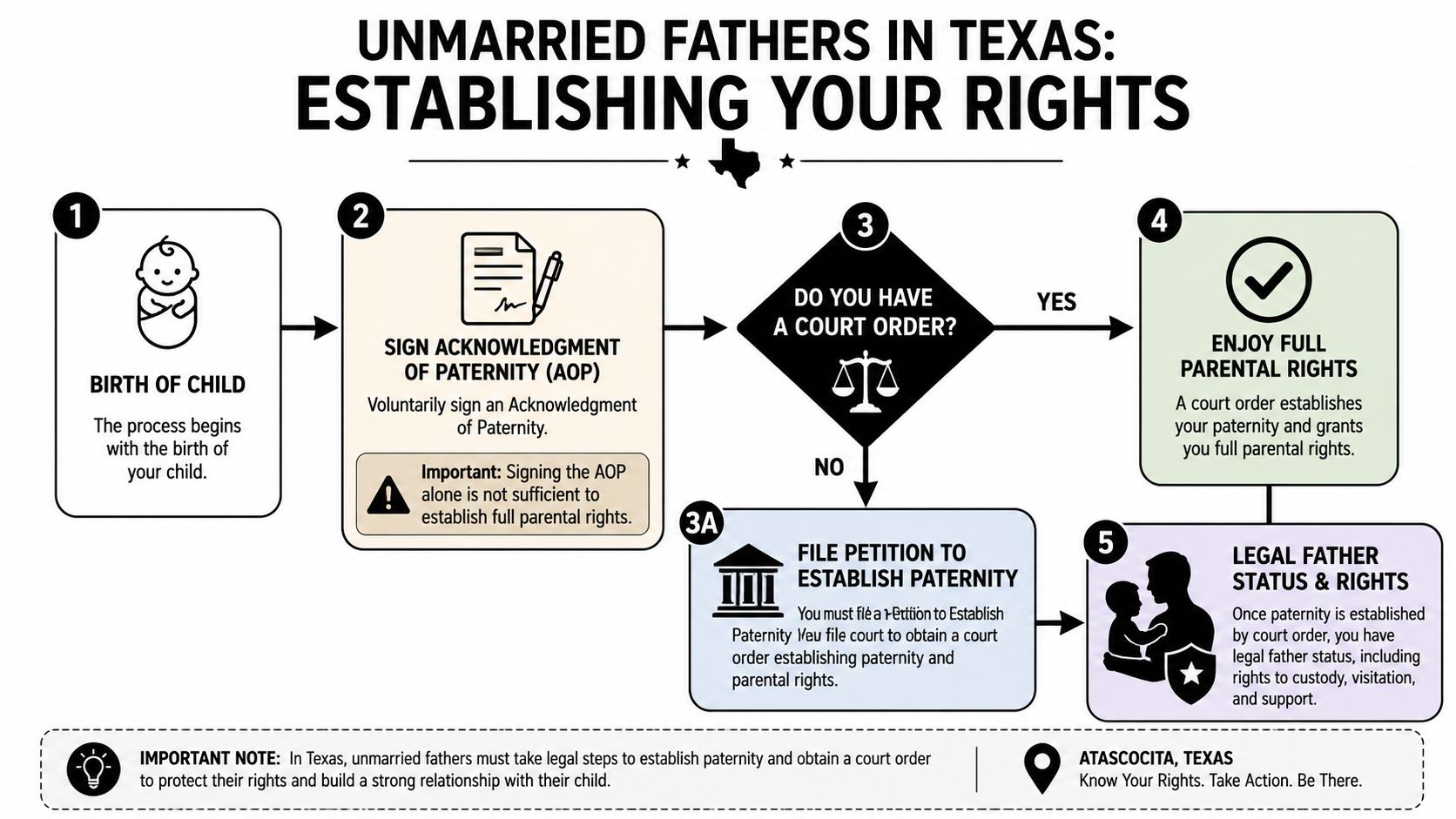
This is the issue many fathers in Atascocita and Humble don't hear soon enough. If you were not married to the child's mother when the child was born, biology by itself doesn't give you enforceable custody or visitation rights in Texas.
An unmarried biological father must legally establish paternity before he can claim rights such as custody, visitation, or decision-making over education and healthcare, and that can be done through a voluntary acknowledgment of paternity or by asking the court for DNA testing, as explained by Cordell & Cordell on Texas child custody and paternity.
Why this distinction matters so much
A married father and an unmarried father can love their children in the exact same way, but the legal starting point is different. For unmarried fathers, the court needs legal paternity in place before it can give enforceable orders about custody, visitation, or parental decision-making.
That's why some fathers get blindsided. They've been caring for the child, helping financially, attending birthdays, maybe even seeing the child every week. Then conflict starts, access is cut off, and they learn that informal parenting isn't the same as legal rights.
The two main paths to establish paternity
Here's a practical breakdown:
Acknowledgment of Paternity
If both parents agree, they can sign an Acknowledgment of Paternity. This can be an important step, but you still need to confirm what court orders are in place regarding custody, visitation, and decision-making.Court case to adjudicate parentage
If there's disagreement, uncertainty, or no signed acknowledgment, a father can file a case asking the court to establish paternity. DNA testing may be part of that process.Orders for rights and duties
Once paternity is established, the court can address conservatorship, possession, access, support, and the rights to receive school and medical information.
For a closer look at the process, this guide on how to establish paternity in Texas is a useful starting point.
A short overview can help clarify the issue before you act:
What works and what doesn't
What works: moving quickly, filing the right case, preserving proof of your relationship with the child, and asking for clear court orders.
What doesn't: assuming the mother has to let you see the child because you're the biological father, relying on verbal agreements, or waiting until months of separation make your involvement look limited.
If you're unmarried, paternity is not paperwork to deal with later. It is the gateway to every other custody right you want to protect.
Navigating the Harris County Custody Process Step by Step
Once the case starts, most fathers feel better when they know what's coming next. Harris County custody litigation has a sequence. Even when the facts are messy, the process itself is usually recognizable.
Research discussed in this summary states that only about 5% of custody cases are ultimately resolved in court, while over 90% of fathers who actively pursue custody receive some form of custody, typically through negotiated settlements, according to this referenced discussion of custody outcomes. The larger point is practical. Most cases don't end in a final trial. They move through negotiation, temporary orders, and mediation first.
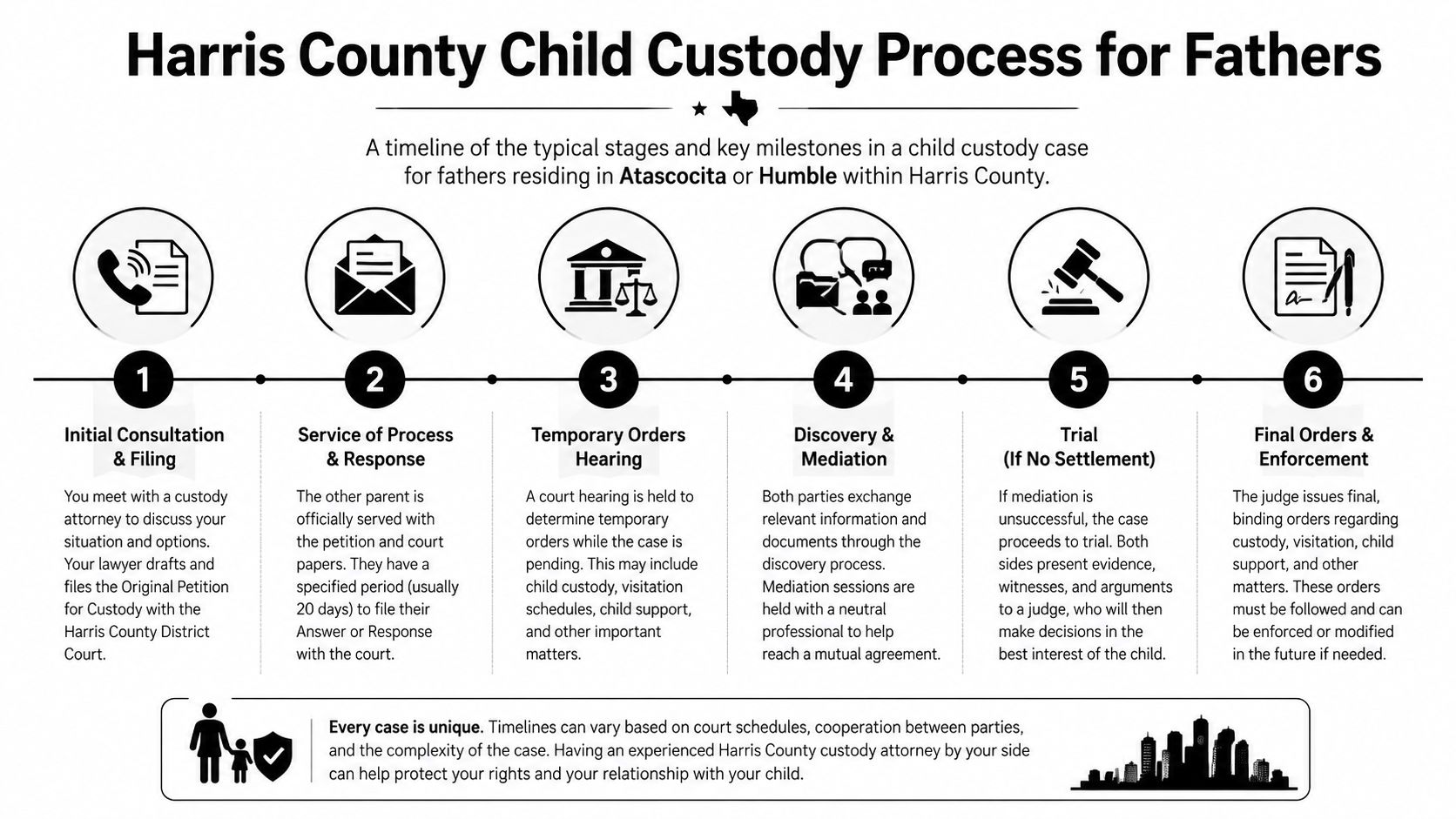
The usual sequence in a Harris County case
Filing the petition
One parent files the initial pleading that asks the court to make custody orders. That filing frames the dispute and starts deadlines.
Service and response
The other parent must be formally served or must waive service if appropriate. Then a response is filed.
Temporary orders
This stage often matters more than fathers expect. Temporary orders can address who has the child now, the immediate parenting schedule, support, and rules of conduct while the case is pending.
Where preparation starts shaping the outcome
After temporary orders, the case usually moves into evidence gathering. That can include school records, medical records, calendars, messages, photographs, and witness information. If one parent makes broad accusations, the other parent needs specific proof in response.
Mediation is also a major part of the process in Harris County. A neutral mediator works with both sides to see whether an agreement can be reached without asking the judge to decide every detail. Fathers who enter mediation with organized evidence and realistic goals often do better than fathers who treat mediation like an informal conversation.
For a more focused discussion of local decision-making, this article on how judges decide custody in Harris County Texas can help you understand the lens the court uses.
Step by step mindset
A useful way to think about the process is this:
- Early stage: protect your immediate contact with the child.
- Middle stage: build the record with real evidence.
- Settlement stage: negotiate from documented facts, not frustration.
- Trial stage: present a clear, child-centered story the court can trust.
A good case file is often quieter than people expect. It's made of calendars, school emails, medical records, pickup logs, and calm communication.
Fathers from Atascocita or Humble sometimes assume they need one dramatic piece of evidence. Usually they need something different. They need consistent proof across time.
How a Custody Lawyer Specifically Helps Fathers
A father can know he's significantly involved and still struggle to present that involvement in a way the court can use. That gap is where legal counsel matters. A custody case isn't just about telling your story. It's about selecting the right legal claims, asking for the right temporary relief, meeting deadlines, preparing evidence, and avoiding strategic mistakes.
Turning fatherhood into admissible proof
Courts don't award conservatorship based on good intentions. They act on evidence. A lawyer helps organize your parenting history into something the judge can evaluate. That may include school participation, medical involvement, exchanges, housing arrangements, communication records, and proof that you can support the child's routine.
A lawyer also helps separate facts that matter from facts that only inflame conflict. For example, many parents spend hours collecting texts that show mutual anger. That rarely helps. The better evidence often shows who handled homework, who attended appointments, who coordinated child care, and who encouraged the child's relationship with the other parent.
Strategy, procedure, and local judgment
The legal system has rules that don't bend just because someone is stressed. Filing mistakes, weak temporary orders, missed deadlines, and vague settlement language can hurt a case long after the first hearing. A lawyer tracks those procedural points while keeping the larger strategy in view.
That strategy is different for different fathers. One man may need emergency temporary orders after parenting time is cut off. Another may need to focus on disproving a “he wasn't involved” narrative. An unmarried father may need to secure legal standing before anything else. Someone facing a related criminal allegation may need family law strategy that accounts for what's happening in the criminal court as well. That overlap is one reason families often need guidance that reaches beyond family law alone. Criminal defense issues can affect temporary possession. Civil disputes over property or housing can affect stability arguments. Estate planning can become part of a broader conversation about protecting a child's future.
Negotiation is part of the job too
Most custody cases are not won by loud courtroom moments. They are shaped in negotiation rooms, mediation sessions, and drafting tables where language becomes enforceable orders. A lawyer helps fathers avoid vague deals that sound fine in the hallway but create conflict later.
If you're comparing options for a custody lawyer for fathers in Atascocita TX, a useful place to start is a lawyer who regularly handles these issues, such as the father rights attorney in Atascocita Texas. The Law Office of Bryan Fagan – Atascocita TX Lawyers handles family law matters including custody, divorce, and related disputes for families in Atascocita, Humble, and Harris County.
A lawyer doesn't replace your role as a father. He or she helps translate your role into a case strategy the court can recognize.
Preparing Your Case Proving You Are the Best Parent
The strongest thing a father can do during a custody case is build a record that shows how he parents in ordinary life. Not once. Repeatedly. Harris County judges weigh specific best-interest factors, and courts are increasingly paying attention to a parent's willingness to co-parent over historical primary caregiver status. Fathers need to document ongoing involvement in school and medical care with calendars and communication logs to answer a primary-caregiver argument, as summarized by Rudy Santos on fathers' rights and best-interest evidence.

Build a record that looks like real parenting
A judge is more persuaded by a steady pattern than by a single speech about love. Start collecting and organizing the parts of your parenting life that can be shown clearly.
- Keep a detailed calendar. Track overnight stays, pickups, drop-offs, school events, sports, tutoring, doctor visits, and day-to-day caregiving.
- Save school records and messages. Parent portal screenshots, report card notices, school emails, and teacher communication can show consistent involvement.
- Track medical participation. Keep appointment summaries, insurance explanations, prescriptions, and notes showing your attendance or follow-up.
- Preserve helpful communications. Save messages where you coordinate schedules, ask about homework, discuss treatment, or support the child's needs.
- Take ordinary photos. You don't need staged pictures. Normal life matters. Homework at the kitchen table, school events, and routine parenting can help show involvement.
Show the court what stability looks like
Stability doesn't mean perfection. It means the child has a safe, predictable environment with you.
Consider whether your home setup answers practical questions. Does the child have a place to sleep? Do you know the school schedule? Can you get the child to activities on time? Are you prepared to handle homework, meals, hygiene, and bedtime without relying on vague promises that “family will help”?
A short checklist can help:
| Area | What to review |
|---|---|
| Housing | Clean, safe, age-appropriate sleeping space |
| Schedule | Work hours that allow reliable exchanges and supervision |
| Transportation | Ability to get the child to school, activities, and appointments |
| Supplies | Clothing, school items, medications, and basic routine needs |
Communication can win or lose ground
Many fathers underestimate how much their messages matter. Judges don't expect warm friendship between separated parents, but they do notice which parent stays child-focused and which parent escalates.
Use written communication carefully. Keep it brief. Stick to logistics, health, education, and the child's needs. If a co-parenting app is in use, use it consistently. If text is the main method, write as if your message will be printed and handed to the court.
Courtroom reality: The parent who stays organized and respectful often looks more credible than the parent who sends the most emotional message.
That also means avoiding bad habits that can damage a case:
- Don't badmouth the other parent to the child.
- Don't use the child as a messenger.
- Don't post about the case on social media.
- Don't skip parenting time unless there's a serious reason and you've documented it.
- Don't make threats you can't or shouldn't carry out.
Countering the primary caregiver argument
A common argument in custody cases is that the mother has historically done more of the daily care, so the schedule should stay mostly the same. Sometimes that history is accurate. Sometimes it's exaggerated. Either way, fathers need a response grounded in evidence.
That response isn't “I love my kids too.” It's more concrete.
You want to show things like:
Current involvement
You attend school events, handle pickups, help with homework, and know the child's teachers, doctor, and routine.Decision-making ability
You can make sound choices about education, healthcare, discipline, and activities.Support for co-parenting
You aren't trying to erase the other parent. You are willing to work within a schedule and encourage the child's relationship with both parents.Consistency under pressure
When conflict rises, you stay focused on the child instead of turning the case into a personal war.
A practical weekly routine for fathers in active cases
This is a simple structure many fathers can follow right now:
Monday: update your parenting calendar and save any important school messages.
Midweek: confirm upcoming exchanges and activities in writing.
Appointment days: keep records of attendance and any follow-up.
Weekend: take part in the child's normal routine, not just entertainment.
Every week: review your messages before sending. Ask whether each one sounds child-focused and reasonable.
If you're serious about improving your position, think less about proving the other parent is bad and more about proving you are reliable, informed, and cooperative. That is often the stronger case.
Take Control of Your Future Your Atascocita Legal Partner
Fathers in Atascocita and Humble often start this process with the same fear. They worry the court will overlook what they do for their children. Texas law doesn't require that result. But the system does require action. If you're unmarried, legal paternity has to be addressed. If your parenting time is being squeezed, you need a documented response. If your case is already in Harris County, you need a plan that fits the facts, not a collection of assumptions.
The fathers who put themselves in the strongest position usually do three things well. They get clear on their legal footing. They document their real parenting role. And they stay focused on what the court can evaluate. That approach is useful whether you're dealing with divorce, custody, enforcement, or related issues that touch criminal defense, civil disputes, or long-term planning for your family.
You don't have to figure out every step alone. A custody dispute feels personal because it is personal, but the response should still be disciplined and strategic. If you're looking for a custody lawyer for fathers in Atascocita TX, choose counsel who understands Harris County practice and the realities fathers face when they're trying to protect meaningful time with their children.
If you're dealing with a custody dispute in Atascocita, Humble, or northeast Harris County, schedule a free consultation with Law Office of Bryan Fagan – Atascocita TX Lawyers. You can discuss your situation confidentially, get clear on your next legal step, and build a practical plan for protecting your parental rights and your child's future.