Skip to content
A lot of families in Atascocita and Humble reach this point the same way. A parent passes away, everyone is still trying to process the loss, and then practical questions start piling up fast. Who has access to the bank account. What happens to the house. Where do you file the will. Who do you even call at the courthouse.
That's usually when people first hear about the Harris County Probate Clerk. To a grieving family, it can sound like one more government office standing between them and closure. In reality, the clerk's office is part of the formal path for honoring a loved one's wishes, protecting heirs, and getting authority to handle property the right way.
For many northeast Harris County families, the confusion isn't about whether they want to do things correctly. It's about not knowing where to start. A son in Humble may have his mother's original will in a desk drawer. A surviving spouse in Atascocita Shores may still be living in the home but can't update title issues or access certain accounts without court paperwork. Those are common situations, and they're exactly why a clear filing plan matters.
Probate in Texas can feel technical, but the steps become much more manageable when you break them down. Some estates need formal court involvement. Some qualify for simpler options. Some problems come from the family dynamic, while others come from paperwork, timing, or a missed filing detail.
Navigating a Difficult Time with a Clear Path Forward
When someone dies, legal tasks don't wait for grief to settle down. Mail keeps arriving. Mortgage payments are still due. Insurance companies, banks, and title offices still want documents. Families in Atascocita often find themselves trying to mourn and organize an estate at the same time.
A common example is a family member who knows there's a will but has no idea what comes next. They may assume the will alone gives them authority to act. It usually doesn't. In many cases, the court process is what gives an executor the legal power to gather assets, deal with creditors, and transfer property.
That's where the Harris County probate clerk fits in. The clerk maintains probate filings and records for the county's probate courts, which handle estate administration, guardianship matters, and related proceedings. The clerk's office isn't there to create extra stress. It's there because estates need a formal record, a filing process, and an official chain of authority.
Grief often makes ordinary paperwork feel overwhelming. Probate feels easier once you know which documents matter first and which ones can wait.
Families in Humble and Atascocita also bring a local layer of concern to probate. They're not only worried about legal forms. They're worried about keeping peace among siblings, protecting a family home, and avoiding mistakes that could slow everything down for months.
That's why a calm, practical approach works best.
What helps early on
- Find the core documents: Start with the original will if there is one, the death certificate, property information, and a rough list of accounts and debts.
- Identify the decision-maker: If the will names an executor, that matters. If there's no will, the court may need to appoint someone else.
- Avoid informal shortcuts: Banks, title companies, and courts usually want formal authority, not family consensus.
Texas probate law connects to estate planning, guardianship, and sometimes family law issues involving minor children or dependent adults. In some households, a death also exposes older legal problems that were never cleaned up, such as remarriage issues, inherited property disputes, or a need for future planning. Those same families often benefit from updating their own wills and powers of attorney after the estate is handled.
When You Must Interact with the Probate Clerk
Probate becomes necessary when a deceased person leaves behind assets that can't pass automatically to someone else. That often includes a house titled only in the decedent's name, certain bank accounts, or property that needs a court order before anyone can sell, transfer, or manage it.
For a family in Atascocita, that might mean a home in a single parent's name. For a family in Humble, it may be a checking account that the children can't access even though everyone agrees who should receive it. If there's no automatic transfer mechanism in place, the estate often has to go through the probate system.
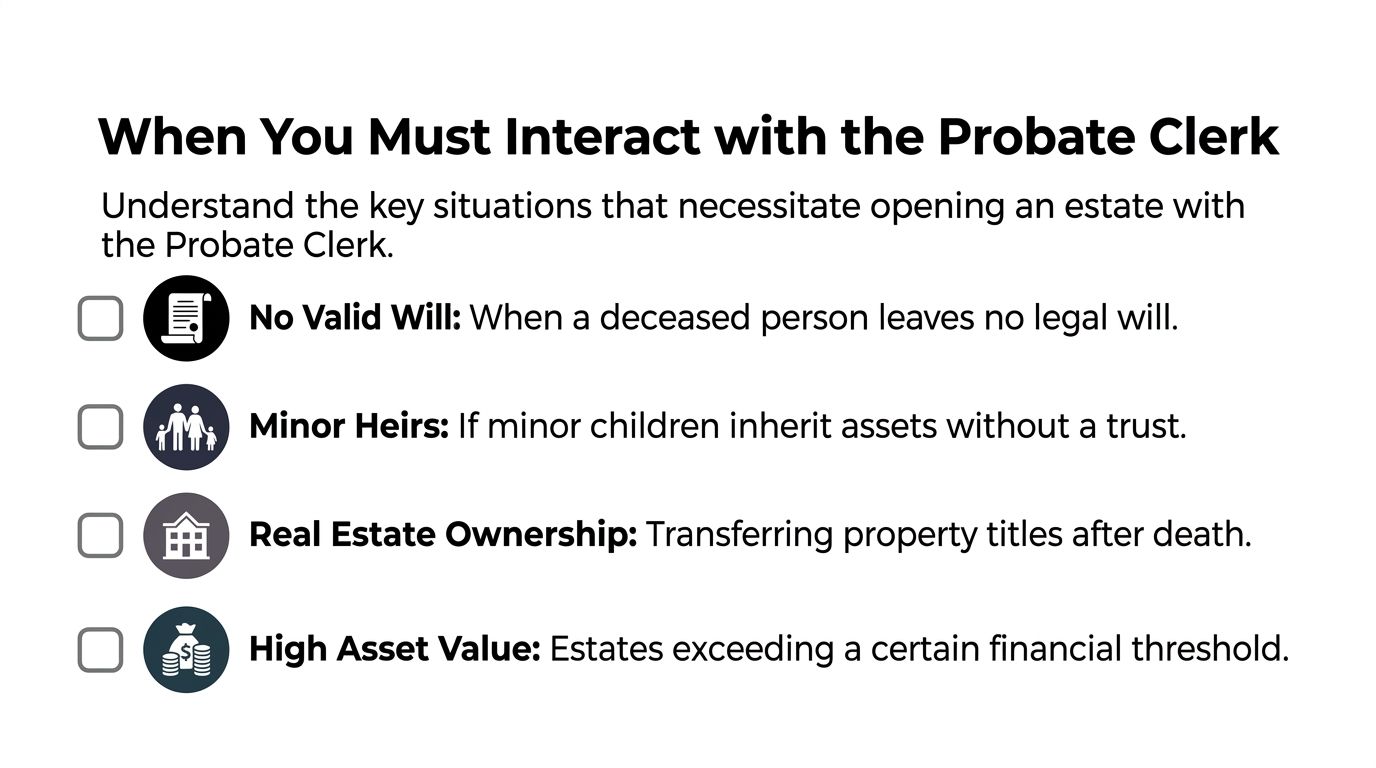
Common probate triggers
- A will exists, but court authority is still needed: The will names an executor, but that executor still needs court recognition before acting for the estate.
- No will exists: The estate may need an administration under Texas intestacy law so the court can identify heirs and appoint someone to act.
- Real property must be transferred: If title to a home or other real estate can't be updated informally, probate is often the path.
- A minor heir is involved: Extra care is needed when a child inherits property directly.
- Third parties demand formal documents: Banks, brokerage firms, and title companies often require official probate paperwork.
A helpful starting point is understanding what assets go through probate in Texas. That question usually determines whether you need a court filing at all.
The deadline families should not miss
Texas gives families time to act, but not unlimited time. Under Texas Estate Code Section 256.003, an application to probate a will must be filed within four years of the decedent's death, and missing that deadline generally makes issuance of Letters Testamentary legally impossible in standard jurisdictions, as summarized in this Texas probate limitations reference).
That rule matters more than many people realize. Families sometimes delay because everyone gets along, no one is in a hurry to sell the house, or the original will was tucked away and forgotten. Then a title problem appears years later, and the easiest probate route may no longer be available.
Practical rule: If you've found a will, don't store it away and assume it can be handled later. The clock runs from the date of death, not from the day the family feels ready.
If your situation clearly calls for estate administration, Probate Lawyer in Atascocita, TX addresses probate administration and estate settlement in Harris County.
The Harris County Probate Filing Process and Fees
Most families expect probate filing to be either fully online or fully in person. Harris County probate practice is neither. The process is a hybrid, and that's one of the first places people run into trouble.
The clerk requires the application to be filed electronically, but the original signed will still has to be physically delivered. If that second step doesn't happen on time, the case can stall before it really begins.
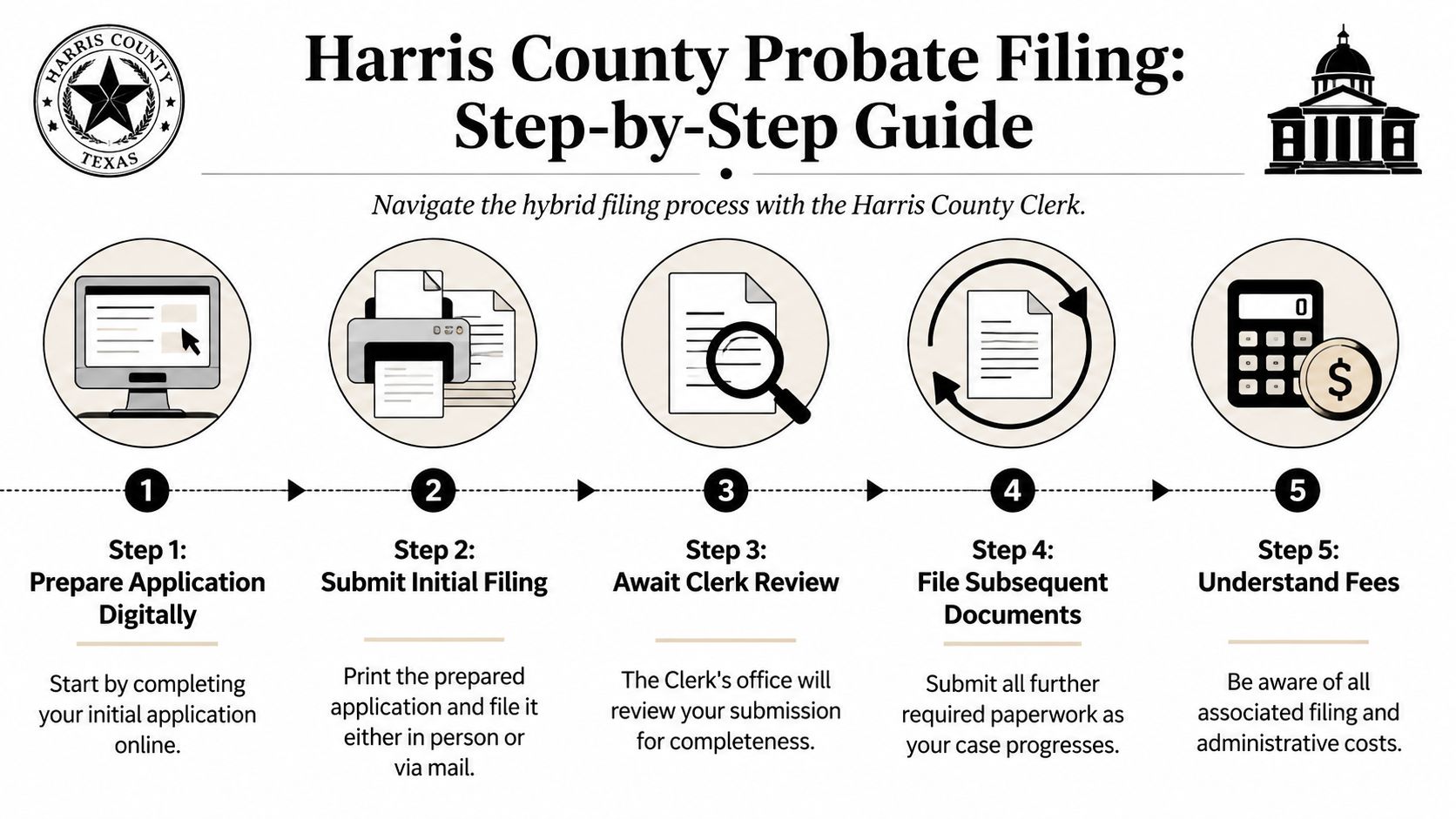
The filing sequence that works
- Prepare the probate application carefully. The initial application has to match the estate facts, the decedent's information, and the relief being requested.
- E-file the application with the clerk. Harris County uses an electronic filing process for this first step.
- Deliver the original will quickly. The original signed will must be filed with the county clerk within three business days after e-filing, according to this summary of the Harris County hybrid probate filing rules).
- Track follow-up documents. Probate isn't one filing. It's a sequence of required filings, notices, and court actions.
- Request the right certified papers. After appointment, certified copies of Letters are often what banks and other institutions specifically ask to see.
Many people get tripped up at step three. They assume uploading a scanned will is enough. It isn't.
A scanned copy may help your lawyer prepare the case, but it doesn't replace the original will when the clerk requires physical delivery.
A separate but related issue is organization. The families who move through this process more smoothly usually gather names, addresses, property descriptions, and account information before filing. That same planning mindset helps in other legal matters too. A structured checklist is one reason people find value in resources like The Divorce Process in Atascocita: What to Expect, which also breaks a court process into practical steps.
Here's a short overview of the required media and process:
Fees families should expect
The filing costs aren't mysterious, but they do need to be budgeted for.
| Filing item | What it covers | Cost |
|---|---|---|
| New estate filing | Base filing fee for most new estate cases | $360 |
| Certified copies of Letters | Often needed for banks and similar institutions | $2 each |
| Citation fee | Notice to interested parties | $8 |
Those fees come from the Harris County probate filing summary in the same hybrid filing rules reference).
Mistakes that cause avoidable delay
- Missing the original will deadline: This is one of the most common reasons a filing slows down.
- Underestimating small fees: Certified copies and citations are minor line items, but they matter.
- Forgetting post-appointment obligations: The Inventory, Appraisement, and List of Claims is a common trouble spot if it isn't filed on time after appointment.
- Treating probate like one hearing instead of a process: Most delays happen after filing, not before filing.
Texas civil and family law often overlap with probate in practical ways. If an estate includes a claim involving property rights, a former spouse, or a minor child's interests, the filings become more sensitive. The same is true when criminal issues affect an heir or proposed administrator's ability to participate. Probate may be its own court process, but real families rarely fit into one neat legal category.
Understanding Probate Timelines and Common Hurdles
The question families ask most is simple. How long is this going to take.
The honest answer is that probate timelines depend partly on the estate and partly on the court's workload. Harris County courts are moving cases, but they're also carrying a heavy docket. In one reporting period, Probate Court No. 1 processed 2,401 new and reopened cases and closed 3,092 cases, for a clearance rate of 128.8%, yet 85% of pending cases had been pending more than 180 days, according to Harris County Probate Court No. 1 reporting discussed here.

That combination tells families something important. Cases are getting resolved, but a large share of the pending docket is older. So when someone says probate should be quick, that's not a safe assumption.
Why delays happen
Some causes are inside the family's control. Others aren't.
- Incomplete filings: Missing names, outdated addresses, or inconsistent information can slow clerk review and court scheduling.
- Family disputes: If heirs disagree about the will, the administrator, or the property, progress usually slows.
- Hard-to-find assets or heirs: Estates get stuck when no one has a clean picture of what exists or who must receive notice.
- Court congestion: Even a clean case moves within the pace of the local docket.
A more detailed discussion of local expectations can help if you're trying to gauge next steps. This guide on how long probate takes in Texas is useful when you're comparing a straightforward estate with a more complicated one.
What families can control
The biggest timeline gains usually come from preparation, not from rushing.
| Common hurdle | What helps |
|---|---|
| Missing documents | Gather the original will, death certificate, and asset list early |
| Notice problems | Confirm correct names and addresses for heirs and interested parties |
| Property confusion | Pull deeds, account statements, and beneficiary information before filing |
| Family tension | Decide early who will communicate with relatives and professionals |
Local reality: The court can only move as fast as the paperwork and notice process allow. A well-prepared case usually avoids the kind of delay that starts with one small omission.
Families in Atascocita often feel this pressure when they're handling both an estate and their own household obligations. A surviving spouse may still be working, helping with grandchildren, and trying to keep up with mortgage and insurance issues. Probate delays become more stressful when no one has a clear job list.
That's why the practical side matters. Keep one file. Keep one point of contact. Write down what has been filed and what still needs to happen. Probate is emotional, but the part that moves a case forward is usually careful administration.
Simpler Alternatives to Formal Probate in Texas
Not every estate needs full formal probate. Sometimes the best answer is a shorter, narrower procedure that gets the family where it needs to go with less cost and less court involvement.
That matters for families in Humble and Atascocita because many estates are modest, straightforward, and mainly centered on a home, a vehicle, and a few accounts. If the estate fits the legal requirements, a simplified option may be more practical than opening a full administration.
The main alternatives families ask about
Small Estate Affidavit is often discussed when someone dies without a will and the estate is limited enough to qualify under Texas law. It can be a useful tool, but it isn't a universal shortcut. Whether it works depends on the estate makeup, the type of property involved, and the family structure.
Muniment of Title is another option in some cases where there is a will and a full administration may not be necessary. It's often considered when the estate's main need is proving title rather than running a long administration.
Informal transfers outside probate may also exist if assets already have beneficiary designations, survivorship features, or trust-based ownership. In those situations, some property may never need to be part of the court case.
Formal probate versus alternatives in Harris County
| Procedure | Best For | Typical Timeline | Requires a Will? |
|---|---|---|---|
| Formal Probate | Estates needing court appointment, creditor handling, or broad authority | Varies with the estate and court docket | Sometimes yes, sometimes no |
| Small Estate Affidavit | Limited estates that may qualify under Texas law | Often shorter than formal probate | No |
| Muniment of Title | Estates with a will where limited court action may be enough | Often simpler than full administration | Yes |
| Non-probate transfer | Assets with valid beneficiary or survivorship setup | Depends on the institution involved | Not necessarily |
The chart helps with initial screening, but it doesn't replace legal review. The same estate can contain both probate and non-probate assets. A family home may require one solution while a retirement account passes a different way.
Trade-offs that matter in real life
A simpler procedure can save time and reduce friction. It can also leave families without the broader authority that a formally appointed executor or administrator would have. That difference becomes important if someone needs to deal with creditors, sell multiple assets, or resolve disputes between heirs.
For example, a family may think they only need to transfer title to a home. Later, they discover an old account, a refund check, or a debt issue that the simpler procedure doesn't address well. That doesn't mean the first idea was wrong. It means estate planning and estate administration are both about fit.
If you're evaluating whether a simplified approach might work, this resource on how to avoid probate in Texas is a useful companion to a case-specific review.
Why planning ahead still matters
Probate alternatives usually work best when the person who died had done some planning before death. A clear will, trust-based planning, beneficiary designations, and coordinated property titles can all reduce the burden on loved ones later.
That's one reason estate planning belongs in the same conversation. Families who have recently gone through probate often decide to update their own documents right away so their children won't face the same uncertainty. In Texas, those planning steps can also intersect with family law concerns, such as blended families, children from prior marriages, or a need to name trusted people for minors. Civil disputes over ownership can often be prevented by better planning on the front end.
When You Need a Local Atascocita Probate Attorney
Some probate matters are manageable with strong organization and a straightforward estate. Others stop being a paperwork project and become a legal judgment call. That's the point when a local lawyer usually saves more stress than they add.
One obvious sign is disagreement. If siblings don't trust each other, if someone questions the will, or if one relative is already using the decedent's property as if it belongs only to them, it's time to get legal guidance before the conflict hardens. Probate disputes rarely get simpler once money, real estate, or old family grievances are involved.

Situations where legal help usually makes sense
- A will might be contested: Questions about capacity, undue influence, or execution formalities need careful handling.
- No one is sure who the heirs are: Intestate estates can become complicated quickly, especially with blended families.
- The estate includes a business or difficult property: Those assets often require more than standard probate paperwork.
- A minor or incapacitated adult is involved: Guardianship and probate issues can overlap.
- You feel overwhelmed by the process: That is a legitimate reason to get help.
The local court structure itself is also a factor. Probate filings in Harris County are handled through the county's probate court system, and the clerk's office operates from the Harris County Civil Courthouse at 201 Caroline, Houston, TX 77002, Monday through Friday from 8:00 AM to 4:30 PM, with dedicated clerks for each of the five probate courts, including Christine Salazar for Probate Court No. 1, as described in this overview of the Harris County probate clerk structure and location.
That formal structure is one reason local familiarity matters. A lawyer who regularly handles probate administration understands how to prepare the file, anticipate court expectations, and keep communication organized.
Legal help is also about family stability
Probate isn't only a transfer process. It's often the first legal event after a death that forces a family to deal with unfinished business. Sometimes that's estate-related. Sometimes it spills into questions about guardianship, old property disputes, or whether surviving family members need updated estate plans of their own. In other households, unrelated legal stress is happening at the same time, such as divorce, custody issues, or even criminal charges affecting a relative who expected to play a role in the estate.
In those moments, counsel helps people make decisions in the right order.
The right probate strategy isn't always the most complicated one. It's the one that fits the estate, the family, and the risks you actually face.
For readers looking at local options, Law Office of Bryan Fagan – Atascocita TX Lawyers handles family law, criminal defense, civil matters, estate planning, and probate-related issues for people in Atascocita, Humble, and surrounding Harris County communities. If your immediate need is estate administration and settlement, Probate Lawyer in Atascocita, TX is the most direct place to review that service.
If you're dealing with the Harris County probate clerk after the loss of a loved one, you don't have to sort through the process alone. The Law Office of Bryan Fagan – Atascocita TX Lawyers offers free consultations for families in Atascocita, Humble, and northeast Harris County who need guidance on probate, estate administration, wills, and related legal concerns. If you're unsure whether you need formal probate, a simpler alternative, or immediate legal help with a contested matter, schedule a consultation with the Atascocita office and get clear, compassionate direction for your next step.