 Skip to content
When you lose a loved one, the last thing your family needs is to be thrown into a confusing and drawn-out legal process. Here in Atascocita and Humble, one of the first questions we hear is, “How long does probate actually take?” While every family's situation is different, a typical, straightforward probate case in Texas can often be wrapped up in six months to a year.
That's a lot faster than you’d find in many other states, which is a small bit of good news during a difficult time.
Decoding the Texas Probate Timeline
Grieving is hard enough without the added stress of a court process you’ve never dealt with before. In simple terms, probate is the official, court-supervised process of validating a will, settling any of the deceased's debts, and making sure their property gets to the right people. It sounds simple, but for anyone new to the Harris County court system, the timeline can feel like a total mystery.
Our goal is to take that mystery out of the equation. When you understand the steps involved and what to expect at each turn, you and your family can feel more prepared and in control.
Why Texas Probate Can Be Faster
It’s always a surprise to people when they learn how much probate timelines can differ from state to state. Nationally, it’s not uncommon for the process to drag on for nearly two years. You can learn more about how probate timelines differ across the United States, but the key takeaway is that Texas has a much more efficient system.
This streamlined approach is a huge benefit for local families in Atascocita and northeast Harris County, making the whole ordeal a little less burdensome. There are two big reasons why Texas gets it right:
-
Independent Administration: This is the game-changer. Texas law often allows for "independent administration," which means the executor can handle most of the estate’s business—like paying bills, managing accounts, and selling property—without having to ask for a judge's permission for every little thing. This freedom cuts down on delays and legal fees in a major way.
-
Clearer Statutes: The Texas Estates Code lays out a pretty clear roadmap. When you follow the rules, the process moves along predictably without unnecessary hold-ups.
For many Atascocita families, this means the probate journey is a manageable one. With the right guidance, you can honor your loved one’s wishes without getting stuck in a cycle of endless court dates and paperwork.
Thinking about the process in distinct phases helps make it feel less overwhelming. Each stage has its own general timeframe, so you can see what’s coming next. Understanding this from the start helps set realistic expectations and lets you focus on what really matters—taking care of your family. At The Law Office of Bryan Fagan, we're here to guide you with compassion and the local expertise you need every step of the way.
A Step-by-Step Walkthrough of The Probate Process
To get a real handle on how long probate can take, it helps to see the entire journey from start to finish. Think of this as your roadmap through the Harris County probate court system, showing you exactly what to expect. By breaking it down into clear stages, we can help families in Atascocita and Humble know what’s coming next and feel a lot more in control.
Here’s a simple visual that lays out the basic flow, from filing the first piece of paper to officially closing the estate.
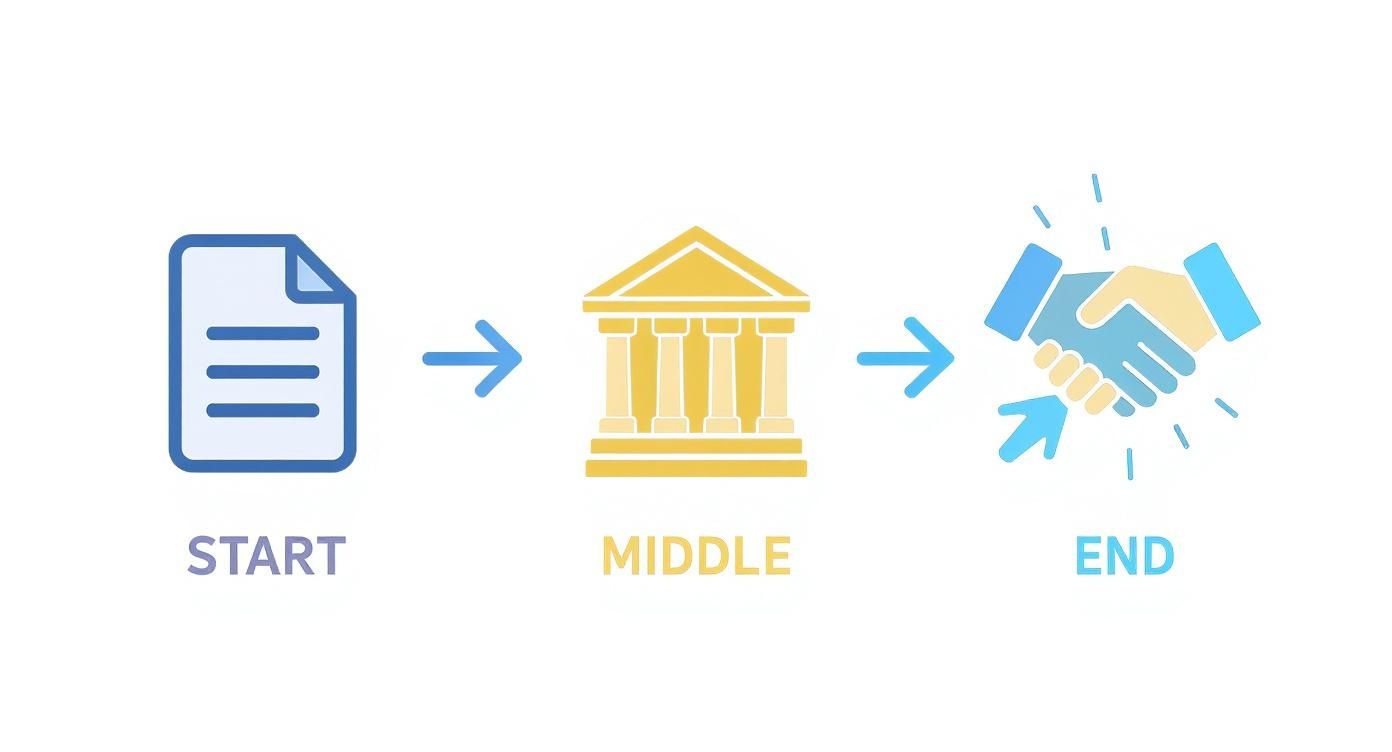
As you can see, the process moves through a few key milestones: the initial court filings, the administrative heavy lifting, and finally, the distribution and closure. Each of these steps has its own timeline and demands specific responsibilities.
Stage 1: Filing the Will and Kicking Things Off
Typical Duration: 1 to 2 months
The entire probate process officially starts when the person named as the executor in the will—or sometimes another interested party—files the original will along with an "Application for Probate" with the Harris County Clerk. This application is essentially a formal request asking the court to confirm the will is legitimate and to appoint the executor.
Once that application is filed, the clock starts on a mandatory waiting period here in Texas. A hearing can’t be scheduled until at least 10 days have passed. During this time, a notice gets posted at the courthouse, letting the public know that a probate case has been opened.
Stage 2: The First Court Hearing and Getting Appointed
Typical Duration: 2 to 4 weeks after filing
The first court hearing is a major milestone. Here, the judge will review the will, listen to some brief testimony to confirm who passed away and that the will is valid, and make sure everything is in order. Assuming it is, the judge will officially admit the will to probate and appoint the executor.
This is when the executor receives "Letters Testamentary." This isn't just a letter; it's a powerful legal document giving the executor the authority to act for the estate. With it, they can access bank accounts, talk to creditors, and manage property. It's a huge step forward. We go into much more detail about what this involves if you want to learn more about how to probate a will in Texas.
Stage 3: Notifying Creditors and Taking Inventory
Typical Duration: 3 to 6 months
This is often where the most work happens. The executor has two big jobs during this phase:
- Notify Creditors: You are required to publish a notice in a local newspaper to let any potential creditors know about the death. For any known, secured creditors (like a mortgage company), you have to send a direct, formal notice. Creditors then have a set amount of time to make a claim against the estate.
- Inventory the Assets: Within 90 days of being appointed, the executor must create and file a detailed "Inventory, Appraisement, and List of Claims." This is a formal, itemized list of everything the estate owns and what it was worth on the date of death. For families in Humble with a mix of assets, getting this right takes careful organization.
This stage demands meticulous attention to detail. A precise and complete inventory is crucial for getting the court's approval for the final distribution and for giving heirs a clear picture of what the estate actually holds.
Stage 4: Paying Debts and Distributing the Assets
Typical Duration: 1 to 3 months
Once the inventory is approved and the time for creditors to make claims has passed, the executor can start tying up loose ends. This means paying all the valid debts, bills, and any final taxes out of the estate’s funds.
After all obligations are settled, the executor can finally prepare to distribute the remaining assets to the beneficiaries, following the instructions laid out in the will. If you're looking for a good overview of an executor's full duties, you can find helpful tips on how to settle an estate. With distribution complete, the executor can take the final steps to formally close the estate, bringing the probate process to an end.
Common Roadblocks That Can Delay Probate
While most probate cases in Texas follow a predictable path, some situations can throw a wrench in the works, turning a six-month process into a year-long ordeal. Knowing what these potential hurdles are ahead of time can help your family in Atascocita or Humble prepare for the journey. These roadblocks usually boil down to family disagreements, messy assets, or plain old human error.
Think of probate as a clear highway. When everything’s in order, traffic flows smoothly. But when something unexpected pops up, it’s like a five-car pile-up—everything grinds to a halt, and clearing the wreckage takes time. Just being aware of these common roadblocks is the first step in learning how to navigate around them.
Disputes Among Family Members
The Will Contest
By far, one of the biggest reasons for a probate delay is a will contest. This is when an heir, often a child or spouse, files a formal objection with the court, arguing that the will is invalid.
In Texas, a will contest is typically based on one of these claims:
- Lack of Testamentary Capacity: The person challenging the will insists the deceased wasn't mentally competent or "of sound mind" when they signed it.
- Undue Influence: The argument is that someone pressured or manipulated the deceased into creating or changing the will to benefit them.
- Improper Execution: The will wasn't signed and witnessed according to the strict formalities required by Texas law.
When a will is contested, the administrative part of probate stops cold. The case shifts into litigation mode, which can mean depositions, court hearings, and even a full-blown trial. This legal battle can easily add many months or even years to the timeline, creating a huge emotional and financial burden for everyone.
Issues with Locating People and Assets
Another surprisingly common delay is the simple act of tracking down every person and every asset connected to the estate. This happens more often than you'd think, especially in a sprawling area like northeast Harris County.
Difficulty Finding Heirs
If someone passes away without a will, the court must legally identify all the heirs in what’s called an "heirship proceeding." This requires finding every relative who stands to inherit under Texas law. Sometimes, that means hunting down a distant cousin you’ve never met or an estranged family member who moved away decades ago. It can be a long and frustrating search.
Missing or Disorganized Assets
It's a similar story if the deceased wasn't a great record-keeper. The executor might have to spend months playing detective, searching for hidden bank accounts, forgotten 401(k)s, or deeds to property tucked away in a safe deposit box. Every undiscovered asset holds up the filing of the final inventory, which in turn pushes back the entire probate schedule. A recent survey found that 68% of Americans do not have a will, a fact that almost always complicates the process of distributing assets. You can read more about how probate timelines and expenses are affected by common issues across the U.S.
An executor’s job is to be a detective for the estate. When the clues are scattered or missing, the investigation takes much longer, and the entire case is delayed until a full picture can be presented to the court.
The Complexity of the Estate
Not all estates are created equal. An estate with just a house and a bank account can be fairly simple. Others, however, have built-in complexities that will naturally stretch out the probate timeline.
Here are a few examples you might see right here in our Humble and Atascocita communities:
- Owning a Business: If the deceased owned a local business, the executor has to keep it running, get it properly valued, and then figure out whether to sell it or transfer ownership. This involves specialized appraisals and tough financial decisions.
- Extensive Debts or Creditor Claims: An estate with a lot of debt requires the executor to carefully manage and pay off creditors. If a creditor’s claim is questionable and the executor disputes it, that can trigger its own mini-court case and cause delays.
- Out-of-State Property: Owning a vacation home in Florida or a plot of land in another state means you have to open a second probate case there. This is called ancillary probate, and it forces you to navigate two different court systems at the same time, each with its own rules.
These roadblocks can seem intimidating, but they don’t have to derail everything. With proactive communication, careful organization, and guidance from an experienced probate attorney, you can steer the estate through these challenges as efficiently as possible.
Practical Ways to Help Speed Up the Process
While the Harris County probate courts operate on their own official timelines, you and your family aren't just along for the ride. There are several proactive steps you can take to keep things moving efficiently and honor your loved one’s final wishes without getting bogged down in delays. It really all comes down to organization, communication, and having the right expert guidance from the start.
Taking charge of these areas can dramatically cut down the time your family spends tangled up in the probate system. Instead of just reacting to problems, you can get ahead of them, making the entire journey smoother for everyone involved.
Foster Clear and Open Communication
One of the biggest things that can grind a probate case to a halt is conflict between beneficiaries. When family members in Atascocita or Humble are left wondering what's going on, suspicion and confusion can quickly spiral into legal disputes that stop all progress.
As the executor, one of the most effective things you can do is simply keep everyone in the loop. This doesn't have to be complicated. It just means:
- Holding an initial family meeting to explain what your role is and what they can expect.
- Sending out brief, regular updates on your progress, even if it's just a quick email saying you've filed a certain document or paid a bill.
- Being transparent about the estate's finances and the decisions you're making on its behalf.
When people feel included and informed, the chances of a costly and time-consuming will contest plummet.
Get Organized from Day One
A messy estate is a slow estate. You'll give yourself a massive head start if you can gather all the essential documents before you even file the probate application. Every minute spent hunting for paperwork later is a minute wasted.
Get a folder or a binder and start collecting these key items:
- The Original Will: The court will not accept a copy; they need the original, signed document.
- The Official Death Certificate: You'll need several certified copies to deal with banks, government agencies, and other institutions.
- Financial Records: This means recent bank statements, investment summaries, property deeds, car titles, and life insurance policies.
- List of Debts: Gather up all the known bills, like the mortgage, credit card statements, and any outstanding medical expenses.
Doing this legwork upfront makes filling out the court's required inventory much faster and more accurate, which helps you avoid the delays that come with having to file amendments. If the estate includes a home, knowing the steps for selling a house in probate quickly can also make a huge difference in the overall timeline.
Work with a Knowledgeable Local Attorney
Trying to handle the Harris County probate system on your own can lead to a lot of frustration. Simple clerical mistakes—like missing a filing deadline or failing to notify a creditor correctly—can easily set you back weeks or even months. Bringing an experienced Atascocita probate lawyer on board from day one is one of the best ways to steer clear of these common traps.
Think of an attorney as your professional guide. They make sure every form is filled out correctly, every deadline is met, and every legal box is ticked. This not only makes the process faster but also gives you incredible peace of mind during an already stressful time.
For some families, the most effective way to speed up the process is to bypass it entirely through smart estate planning. Looking into alternatives, like learning how to create a trust, can be a powerful strategy for the future.
Exploring Simpler Alternatives to Traditional Probate
For many families here in Atascocita and the surrounding communities, the idea of a formal, months-long probate process is just overwhelming. The good news is that it isn't always the only way. Texas law actually provides several effective—and often much faster—ways to transfer a loved one's assets, saving families precious time, money, and emotional energy.
These alternatives are powerful tools that can either simplify the court process or help you sidestep it entirely. Understanding these options is the key to making informed decisions that honor your loved one's memory without the stress of a drawn-out legal battle.

The Small Estate Affidavit: A Simpler Path
One of the most valuable tools we have for smaller estates in Texas is the Small Estate Affidavit (SEA). This is a sworn legal document that lets you collect and distribute a person’s assets without having to go through a formal probate hearing. It's often the perfect solution for families in our community dealing with a more modest estate.
Of course, not everyone qualifies. To use an SEA in Texas, the estate has to meet some specific criteria:
- The total value of the assets (not counting the homestead and other exempt property) must be $75,000 or less.
- The person must have passed away without a will (intestate).
- The value of the assets has to be greater than any known debts.
If you meet these conditions, the heirs can file the affidavit with the Harris County court. Once a judge signs off on it, the SEA works just like a court order, giving banks and other institutions the green light to release assets directly to the heirs. This whole process can often be wrapped up in a matter of weeks, not months.
Bypassing Probate with Smart Estate Planning
The most effective way to deal with probate is to plan ahead and avoid it altogether. A few key estate planning strategies can ensure your assets pass directly to your loved ones, keeping everything out of the courthouse and securely in the hands of your family. Many people are surprised to learn just how to avoid probate in Texas with a handful of straightforward tools.
Living Trusts
Think of a revocable living trust as a powerful vehicle for avoiding probate. During your lifetime, you transfer your assets—like your home, investments, and bank accounts—into the trust. You don't lose control; you manage everything just like before. But when you pass away, the successor trustee you've chosen simply distributes the assets according to your instructions. No court involvement is needed.
Transfer on Death Deeds (TODDs)
For homeowners in Humble and Atascocita, the TODD is an incredibly useful tool. It’s a simple deed that lets you name a beneficiary who will automatically inherit your real estate the moment you die. The property transfer happens outside of the probate system, saving a huge amount of time and money.
Beneficiary Designations
This might be the simplest probate-avoidance trick in the book. By naming beneficiaries directly on the following types of accounts, the funds pass straight to them upon your death:
- Life insurance policies
- Retirement accounts (like 401(k)s and IRAs)
- Bank accounts (Payable-on-Death or POD)
- Investment accounts (Transfer-on-Death or TOD)
Proper beneficiary designations are a cornerstone of effective estate planning. They ensure a swift, private, and seamless transfer of wealth, completely bypassing the probate process for those specific assets.
Comparing Your Options
Seeing how these methods stack up against the traditional court process can make the choice much clearer.
Probate vs. Probate Alternatives in Texas
| Method | Typical Timeframe | Common Use Case | Court Involvement |
|---|---|---|---|
| Traditional Probate | 4-12+ months | Estates with a valid will or complex assets. | High (required for entire process). |
| Small Estate Affidavit | 4-8 weeks | Modest estates under $75,000 without a will. | Minimal (judge's approval of the affidavit). |
| Living Trust | Weeks to a few months | Individuals seeking to avoid probate and maintain privacy. | None (assets are distributed privately). |
| Beneficiary Designations | Days to a few weeks | Transferring financial accounts and insurance proceeds. | None (direct transfer to the named person). |
Choosing the right path really comes down to your family's unique situation. A Small Estate Affidavit is a fantastic solution after a death for a qualifying estate, while trusts and TODDs are proactive measures you can take now to protect your family in the future. Understanding these alternatives is the first step toward a smoother, less stressful transition for your loved ones.
When You Should Speak with a Probate Lawyer
Trying to manage the probate process on your own can feel like navigating a maze, especially when you're also dealing with the loss of a loved one. It's easy to get overwhelmed. Knowing when it’s time to call in a professional is the first step toward protecting your family’s interests and making sure everything is handled correctly.
While some very straightforward estates might not require legal help, many situations definitely do. An experienced hand can make all the difference, saving you from costly mistakes and unnecessary stress.
Clear Signs You Need an Attorney
You should seriously consider talking to a probate lawyer if you find yourself in any of these common scenarios:
- Family Disagreements: Do you see arguments brewing among family members? If there's any tension over who gets what or how the will should be interpreted, it's wise to get a lawyer involved early to mediate and prevent a full-blown dispute.
- A Contested Will: This is a major red flag. If someone in the family formally challenges the will, claiming it's invalid due to things like coercion or the deceased not being of sound mind, you absolutely need legal representation.
- Complex Assets: The estate isn't just a simple bank account. If it involves a family business, commercial real estate, properties in other states, or complex investments, you'll need an expert to manage the valuation and distribution properly.
- Significant Debts: When the deceased left behind a lot of debt, you have to deal with creditors. A lawyer can help you navigate this minefield, ensuring legitimate claims are paid and the estate is protected.
Handling these complexities without legal guidance can turn a difficult situation into a nightmare, dragging out the process and creating financial risks. An attorney is more than just a legal advisor; they are your advocate, making sure every detail is handled by the book.
As a local law firm right here in your community, The Law Office of Bryan Fagan is committed to helping families navigate these tough times with compassion and clarity. We serve clients across Atascocita, Humble, and the surrounding areas of northeast Harris County.
Let us help you find the best path forward. Schedule a free, no-obligation consultation at our Atascocita office to discuss your specific situation.
Common Questions About the Texas Probate Process
When you're dealing with the loss of a loved one in Atascocita or Humble, the last thing you want is more confusion. The probate process can feel overwhelming, but getting straight answers to your questions can make a world of difference. Here are some of the most common questions we hear from families just like yours.
What Happens if Someone Dies Without a Will in Texas?
When someone passes away without a will, the law says they died "intestate." Their estate still has to go through the court system to get assets to the right people, but the process looks a little different. Instead of following the instructions in a will, the court has to step in and figure out who the legal heirs are based on Texas law.
This is done through a formal court action called an “heirship proceeding.” It’s often more complicated and can take longer than probating a standard will. The biggest downside is that the state’s formula for who gets what might not match what your loved one actually wanted. This is one of those situations where having an experienced attorney can save you a lot of headaches.
Do All Assets Have to Go Through Probate?
Thankfully, no. Not everything a person owns is subject to the probate process. Many common assets can be set up to pass directly to a specific person, bypassing the courts entirely.
These are often called "non-probate" assets and usually include things like:
- Life insurance policies that have a named beneficiary.
- Retirement accounts like 401(k)s and IRAs.
- Bank accounts set up as 'Payable-on-Death' (POD).
- Real estate that has a Transfer on Death Deed (TODD) filed.
- Any property held inside a living trust.
Using these estate planning tools can make transferring assets much faster and keeps the process private.
How Much Does Probate Cost in Harris County?
There's no single price tag for probate; the cost really depends on how complex the estate is. For a simple, straightforward estate where everyone is in agreement, the costs in the Atascocita area are usually quite predictable and manageable.
You can generally expect expenses like court filing fees, the cost to publish a notice in a local newspaper, and attorney's fees. An executor can also be paid, though many family members choose not to take a fee. However, if disagreements pop up or if the estate has complex debts or business assets, the costs can definitely go up. The best way to get a realistic idea of the cost is to discuss your specific situation with an attorney.
At The Law Office of Bryan Fagan – Atascocita TX Lawyers, we know you have questions, and we're here to give you clear answers. If you’re facing the probate process and need compassionate, local legal help, give us a call today for a free consultation. https://www.atascocitaattorneys.com


