Skip to content
Losing a loved one is incredibly difficult. On top of the grief, you’re suddenly faced with legal duties that can feel overwhelming. Probating a will in Texas really boils down to a few key stages: filing an application with the proper county court, attending a short hearing to validate the will, and then managing the estate’s assets and debts. It’s the official process that makes sure your loved one’s final wishes are carried out exactly as they wanted. For families here in Atascocita, Humble, and northeast Harris County, understanding this process can provide a clear path forward during a challenging time.
Starting the Texas Probate Process After a Loss

When a family member passes away, the last thing you want to think about is paperwork and court dates. For many families we work with in Atascocita and Humble, the word “probate” sounds intimidating. But its purpose is actually quite straightforward—it’s the formal legal process that gives the named executor the authority to act on behalf of the estate.
Think of it as the court giving its official stamp of approval. Probate validates the will and then oversees the steps needed to settle the deceased’s affairs, from paying final bills to distributing property to your family.
What is the Goal of Probate?
At its heart, the probate process is designed to protect everyone involved—the family, beneficiaries, and even creditors. It has a few very specific goals:
- Validate the Will: First and foremost, the court officially recognizes the will as the final, legally binding instructions of the person who passed away.
- Appoint an Executor: The person named in the will to handle things (the executor) is formally granted legal authority. The court issues a document called “Letters Testamentary” that proves they are in charge.
- Settle Debts: It creates an orderly system for identifying and paying off any outstanding bills—like final medical expenses or credit card balances—using the estate’s funds.
- Transfer Assets: Once the debts are cleared, the executor can legally transfer what’s left. This means the house in Atascocita, the car, or the savings accounts can finally go to the beneficiaries named in the will.
The core purpose of probate is to provide a clear, court-supervised path for winding up a person’s affairs. It prevents confusion and disputes by ensuring every step is handled according to Texas law and the specific wishes outlined in the will.
Getting started means understanding you don’t have to figure this all out by yourself. The legal requirements can be tricky, especially since they’re specific to the local courts. For instance, the initial application has to be filed in the county where the deceased lived. For our neighbors in Atascocita and Humble, that means filing with the Harris County Clerk.
Having a local attorney who knows the ins and outs of the Harris County probate courts can make a world of difference. We can make sure the paperwork is filed correctly and that you feel supported and prepared for each step. Of course, the best way to make this process smoother for your loved ones is by creating a solid estate plan ahead of time, including clear wills and trusts. Our goal is to give you the right information during this challenging time, making the path forward as clear as possible.
Choosing the Right Path for Probate in Texas
When it comes to settling a loved one’s estate, Texas law thankfully doesn’t force everyone down the same rigid path. Your family’s situation in Atascocita is unique, and the legal process should reflect that. Picking the right approach from the start can make a world of difference, saving you an incredible amount of time, money, and stress. It really comes down to matching the legal framework to your family’s specific needs.
For most folks in our community, the main goal is to get through probate as efficiently as possible, with the least amount of court meddling. That’s why getting a handle on the different types of probate is so important. The two big ones are Independent Administration and Dependent Administration, and they are worlds apart.
Independent Administration: The Go-To Method in Texas
If you’ve heard stories from friends or neighbors in Humble about a probate process that was surprisingly straightforward, they were almost certainly talking about Independent Administration. There’s a good reason this is the most common and preferred method in Texas. When a well-drafted will specifically calls for it, the court essentially gives the executor the keys and lets them manage the estate with minimal supervision.
Once the executor is appointed and files an inventory of the estate’s assets, they’re free to handle most of their duties—paying off debts, selling property, and distributing assets to the heirs—without having to run back to the judge for permission every single time. That freedom is what makes the process so much faster and less costly.
Let’s say an Atascocita resident passes away with a clear will naming their daughter as executor. The estate includes a house, a car, and a couple of bank accounts. Under an Independent Administration, the daughter can pay the final bills, list the house for sale, and transfer the assets to the beneficiaries without the delay and expense of constant court hearings.
Dependent Administration: When Court Oversight is Necessary
On the other end of the spectrum is Dependent Administration, which is exactly what it sounds like—a much more hands-on, court-supervised process. In this scenario, the administrator has to get the judge’s green light for almost every move they make, from paying a simple credit card bill to selling a piece of real estate. This means more paperwork, more hearings, and, you guessed it, higher legal fees and a much longer timeline.
So, why would anyone ever go this route? Dependent Administration becomes essential in a few key situations:
- When there’s no will and the heirs can’t agree on who should be in charge.
- When major conflicts exist among the beneficiaries who are likely to challenge the administrator’s decisions.
- To protect the interests of a minor or an incapacitated heir who can’t speak for themselves.
Imagine a family where siblings are already at odds over their parent’s estate in Humble. A Dependent Administration creates a controlled environment where a judge oversees every transaction, ensuring everything is transparent and by the book, which can prevent mismanagement and further family disputes.
Simpler Alternatives for Straightforward Estates
For many families, even an Independent Administration can feel like more than they need. The good news is that Texas law offers some streamlined options for smaller or less complex situations. While data shows that Independent Administration is used in about 80% of Texas probate cases, making it the clear favorite, simpler alternatives are becoming more common.
For instance, the Small Estate Affidavit is a great tool for estates valued at $75,000 or less (not counting the homestead). This process often bypasses the need for a formal court hearing altogether. Another popular option is a Muniment of Title, which is a quick way to transfer property when there’s a valid will and no outstanding debts to worry about. These options are part of a larger effort to make the probate process more accessible. You can dig into more specifics about the various state of Texas probate laws and their timelines to see what might fit your family’s needs.
The key takeaway is that you have options. The structure of your loved one’s estate and the dynamics of your family will point toward the most logical and compassionate path forward.
Ultimately, understanding these different routes helps you prepare for the journey ahead. Whether it’s the autonomy of an Independent Administration, the safety net of a Dependent Administration, or the simplicity of an alternative, making an informed choice is your first step toward settling your loved one’s affairs with confidence and peace of mind.
Step-by-Step Guide to Filing for Probate in Harris County
Once you and your family have a clear plan for handling your loved one’s estate, the next step is to get the legal process started with the court. If you live in Atascocita, Humble, or anywhere in our corner of northeast Harris County, you’ll be working with the Harris County Clerk’s office. This is the point where the will transitions from a personal family document to a public legal instrument.
The journey begins by filing a formal document called an Application to Probate Will and for Issuance of Letters Testamentary. It sounds complicated, but it’s essentially a formal request asking the Harris County court to do two things: legally recognize the will as valid and officially appoint the executor named in it.
Preparing and Filing the Initial Application
Think of the application as the foundation of your entire probate case. Every detail matters. Getting it right the first time is crucial because mistakes or missing information can easily cause frustrating delays. I’ve seen simple omissions set a case back by weeks for local families.
Here’s what you absolutely must include in the application:
- The Decedent’s Details: Their full legal name, the date and location of their death, and their primary residence at the time (e.g., their home in Atascocita).
- Proof of Venue: A simple statement confirming Harris County is the correct place to file because this is where the person lived.
- The Will Itself: You need to state that the decedent left a valid will, mention the date it was signed, and confirm you’re filing the original will along with the application.
- The Applicant’s Information: The name and contact details for the person asking to be appointed as the executor.
- List of Heirs and Beneficiaries: A complete list of all legal heirs (those who would inherit if no will existed) and the specific beneficiaries named in the will, including how they are related to the deceased.
Filing this application and paying the required court fees with the Harris County Clerk officially opens the probate case.
The Waiting Period and Notice Posting
After you file, don’t expect immediate action. The law requires a mandatory waiting period. The Harris County Clerk will post a public notice, called a “citation,” at the courthouse. This announces that a will has been submitted for probate.
This isn’t just bureaucratic red tape. It’s a crucial transparency step. The notice gives anyone who might have an interest in the estate a chance to come forward and contest the will if they have a valid reason. This public notice must be posted for a minimum of 10 days before any court hearing can be scheduled.
The First Court Hearing
The initial hearing often sounds more intimidating than it really is. For a straightforward, uncontested will in Harris County, this is usually a short and routine appearance before a judge. The primary goal is simple: get the will officially admitted to probate and have the executor formally appointed.
During the hearing, the person applying to be executor will have to give some brief testimony. We call this “proving up” the will. It involves answering a standard set of questions to confirm the facts—that the person has passed away, that the document presented is their true last will, and that it was signed correctly according to Texas law.
This hearing is the pivotal moment where the will is legally validated. Once the judge signs the order admitting the will to probate, the executor can take their oath and officially receive the authority to manage the estate.
Once the judge signs the order, the executor can obtain Letters Testamentary. These are the official court documents that give the executor legal power to act for the estate. With these letters, you can access bank accounts, talk to financial institutions, and manage or sell property. They are your official credentials to act on behalf of your loved one.
To give you a clearer picture, this table breaks down the key stages you can expect in an uncontested probate case.
Key Stages of the Harris County Probate Process
This table outlines the typical sequence of events and estimated timelines for an uncontested probate case in Harris County, helping families understand the journey ahead.
| Stage | Key Action | Typical Timeframe |
|---|---|---|
| Initial Filing | File Application to Probate Will with the Harris County Clerk. | Day 1 |
| Citation Posting | The clerk posts public notice of the filing at the courthouse. | 10-day minimum waiting period |
| Court Hearing | Testify before a probate judge to “prove up” the will. | 2-4 weeks after filing |
| Executor Appointment | Judge signs the order; executor takes an oath and receives Letters Testamentary. | Same day as the hearing |
| Notice to Creditors | Publish a notice in a local newspaper for potential creditors. | Within 1 month of appointment |
| Inventory Filing | File a detailed Inventory, Appraisement, and List of Claims with the court. | Within 90 days of appointment |
| Estate Administration | Pay debts, manage assets, and prepare for distribution to beneficiaries. | 6 months to 1+ year |
| Distribution & Closing | Distribute remaining assets to beneficiaries as directed by the will. | Varies based on estate complexity |
Keep in mind that these timeframes are estimates. Any complications, like a will contest or difficulty locating assets, can extend the process.
This infographic illustrates the common paths your probate journey might take, from the widely used Independent Administration to more specialized alternatives.
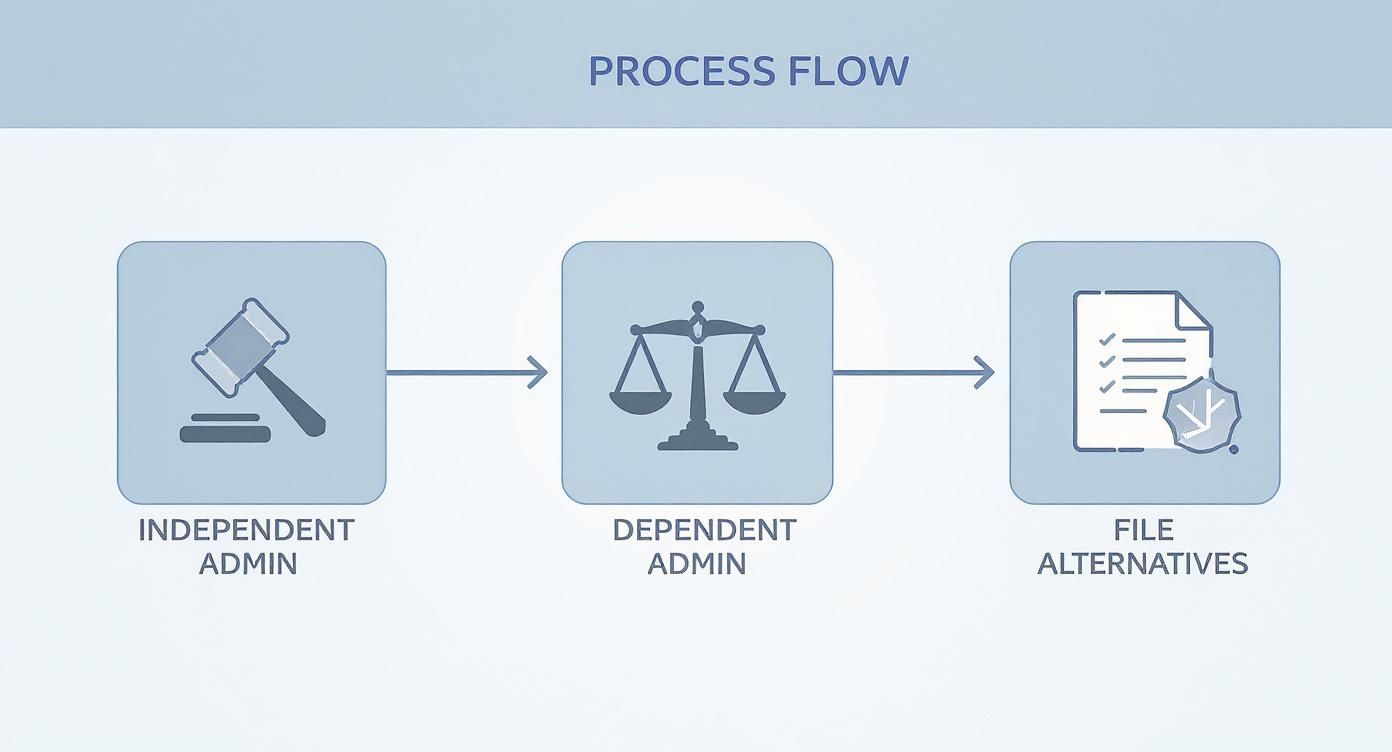
The visualization highlights that while Independent Administration is the primary route, Texas law provides flexible alternatives for simpler estates.
Managing Executor Duties and Responsibilities

Once the Harris County probate judge signs the order and you have Letters Testamentary in hand, your role makes a major shift. You’re no longer just an applicant; you’re the estate’s legal manager. This comes with a fiduciary duty—a serious legal obligation to act solely in the best interests of the estate and its beneficiaries. It’s a huge responsibility, and frankly, it’s where the real work begins.
The first few months are a whirlwind of communication and organization. Texas law is incredibly specific about who gets notified and by when. These aren’t just helpful suggestions; they are hard deadlines you absolutely must meet to stay compliant and avoid personal liability.
Notifying Beneficiaries and Creditors
Right out of the gate, you need to formally notify all beneficiaries named in the will. The law gives you 60 days from the day the will is probated to get this done. You’ll need to send them a copy of the will itself, along with the court order that admitted it to probate. This simple step ensures everyone is officially in the loop about the proceedings and their inheritance.
At the same time, you have to tackle the decedent’s potential debts. Texas requires you to publish a “Notice to Creditors” in a local newspaper. This has to be done within one month of your appointment. This formal notice acts as a call to anyone the deceased owed money, giving them a specific window to file a claim against the estate. It’s a critical step for uncovering all outstanding debts before a single dollar is distributed.
Think of yourself as the central hub for the estate. Your job is to gather all the pieces—the assets, the debts, the beneficiaries—and manage them transparently and according to the law.
Imagine your loved one owned a small business in Humble. You wouldn’t just be notifying family members; you’d also need to reach out to suppliers, lenders, and anyone else the business had financial dealings with. Getting the notifications right protects both the estate and you.
Compiling the Estate Inventory
One of the most labor-intensive tasks you’ll face is preparing the Inventory, Appraisement, and List of Claims. This document is a complete, detailed snapshot of every single thing the estate owns and is owed, valued as of the date of death. The court gives you a firm 90-day deadline from your appointment to get this filed.
This inventory has to be meticulous. It’s not a quick list off the top of your head. It must include:
- Real Estate: The family home in Atascocita, for example, complete with its legal description and fair market value.
- Bank Accounts: All checking, savings, and money market accounts, with the exact balance for each.
- Personal Property: Cars, furniture, jewelry, and other valuables, each assigned an estimated value.
- Investments: Any stocks, bonds, or retirement accounts that are designated as part of the estate.
- Claims: A list of money owed to the estate, like a personal loan the decedent made to a friend.
Putting a value on everything can be tricky. While you might be able to estimate the value of household furniture, you’ll almost certainly need a professional appraiser for real estate, art, or valuable collectibles to satisfy the court.
Safeguarding Estate Assets
While you’re busy with notifications and paperwork, you have another crucial, ongoing duty: protecting the estate’s assets. This is an active role, not a passive one. You are legally on the hook to prevent any waste, damage, or loss.
In practice, this means taking immediate, common-sense steps:
- Opening a new, dedicated bank account for the estate to avoid commingling funds.
- Continuing to pay the mortgage, utilities, and insurance on the decedent’s property.
- Paying the deceased’s final bills and any taxes that come due.
- Securing physical property, which could mean changing the locks on the house or moving a classic car into secure storage.
Juggling these responsibilities, especially while grieving, is a heavy lift. A simple mistake on the inventory or a missed deadline can cause significant delays and legal headaches. It’s for this very reason that so many executors right here in our Atascocita community choose to work with a probate attorney, ensuring every duty is handled correctly and with the compassion the situation deserves.
Avoiding Common Pitfalls and Critical Deadlines
Going through probate is one part following the rules and one part knowing how to dodge the landmines. The Texas Estates Code is loaded with specific deadlines and requirements, and a single misstep can lead to major delays, extra costs, and a world of frustration for your family. If you’re in the Atascocita or Humble area, getting familiar with these common traps is the best way to keep the process on track.
One deadline, in particular, is an absolute deal-breaker, and it catches a surprising number of people off guard.
The Four-Year Rule for Probating a Will
In Texas, you generally have four years from the date of a person’s death to file their will for probate. This isn’t a suggestion; it’s a hard and fast rule. Wait longer than that, and the court will likely refuse to accept the will.
So, what happens if you miss the window? The estate gets treated as if the person died “intestate,” meaning without a will. The court then has no choice but to follow Texas’s strict succession laws to decide who gets what. This could mean assets end up with distant relatives your loved one never intended to include, completely erasing their final wishes. It’s a truly devastating outcome that’s almost always avoidable.
Don’t let grief or uncertainty lead to a mistake you can’t undo. This four-year deadline is one of the most critical parts of the entire Texas probate process, and missing it can permanently change your loved one’s legacy.
Other Costly Mistakes to Sidestep
Beyond that critical four-year rule, a few other common errors can turn a straightforward process into a complicated mess for an executor. The best defense here is being organized and proactive from day one.
Here are some of the most frequent mistakes we see people make:
- Mismanaging Estate Funds: It is absolutely illegal to co-mingle estate funds with your own money. The executor’s first job is to open a separate bank account for the estate and run every single transaction through it. Using estate cash for personal bills, even with the intent to pay it back, is a serious breach of your legal duty.
- Failing to Properly Notify Creditors: You can’t just ignore a pile of bills and hope they go away. The law requires you to publish an official notice to creditors and handle all legitimate claims. If you don’t, the estate—and sometimes you, personally—could get hit with lawsuits down the road.
- Poor Communication with Beneficiaries: Keeping heirs in the dark is a surefire way to breed suspicion and conflict. Providing regular, honest updates on your progress is the best way to prevent arguments and expensive legal challenges. Good, detailed record-keeping will be your best friend.
This strict four-year filing window has been a cornerstone of Texas probate for decades. In fact, probate court statistics consistently show that a significant number of estates with perfectly valid wills run into trouble simply because of administrative delays or a lack of awareness about this timeline. You can find more details on the importance of meeting key probate deadlines and procedural requirements.
Thinking about these potential issues is a huge part of responsible estate planning—not just for the person writing the will, but for the executor who will eventually have to manage it. Knowing where the traps are laid is the first step to handling the estate with the care and diligence it deserves.
When You Need an Atascocita Probate Attorney
Some people try to navigate a very straightforward estate on their own, but the probate process can quickly become a maze of legal deadlines and emotional stress. Knowing when to ask for help isn’t a sign of weakness; it’s a smart move to protect your loved one’s legacy and your own sanity. For families here in Atascocita and Humble, having a local attorney by your side can make all the difference.
There are certain situations that are almost guaranteed to require professional legal help. If you find yourself staring down any of the following challenges, it’s a clear sign you need an experienced probate lawyer in your corner.
Navigating High-Stakes Scenarios
Let’s be honest, not all estates are simple. The moment things get complicated, the risk of making a costly, irreversible mistake goes through the roof. This is when legal guidance isn’t just helpful—it’s essential.
- A Contested Will: Is a family member challenging the validity of the will? If so, you’re no longer just administering an estate; you’re in a legal fight that demands a skilled litigator.
- Complex Assets: When the estate includes a family business in Humble, several real estate properties, or complicated investment accounts, you need a professional to manage everything correctly, maximize value, and meet all legal duties.
- Significant Debts: If the estate owes more than it’s worth or is facing a mountain of creditor claims, an attorney is crucial for negotiating with creditors and making sure all debts are handled by the book.
- High Family Tension: Even without a formal will contest, long-simmering family arguments can derail the entire process. An attorney can act as a neutral third party, focused solely on enforcing the will’s terms and keeping conflicts from boiling over.
Partnering with a probate attorney isn’t just about navigating the law—it’s about offloading a tremendous burden during a time of grief, allowing your family to focus on healing instead of paperwork.
An experienced lawyer does more than just file paperwork; they offer strategic advice that can save the estate significant money and time. The cost and length of probate can vary wildly depending on how messy things get. A straightforward, uncontested case in Texas might run between $3,000 and $7,000. But once disputes flare up, costs can easily jump over $10,000, dragging the process out for a year or more. An attorney helps you sidestep the common pitfalls that lead to these inflated costs and delays.
At The Law Office of Bryan Fagan, we’re dedicated to helping our neighbors in Atascocita, Humble, and across northeast Harris County. We know the local court system inside and out, but more importantly, we understand what your family is going through. You can read more about our firm’s commitment to the community and see how we put our clients first.
If you’re facing the responsibility of probating a will, you don’t have to go it alone. We invite you to schedule a free, no-obligation consultation at our Atascocita office. Let us answer your questions and give you the clear, compassionate guidance you deserve.
Answering Your Texas Probate Questions
When a loved one passes away, the last thing you want to deal with is a confusing legal process. As a law firm that’s been part of the Atascocita community for years, we’ve walked countless families through probate, and we’ve heard just about every question there is. Here are some of the most common ones we get about handling a will in Texas.
Does a Will Automatically Mean We Have to Go Through Probate?
Not always. While probating a will is the most common way to legally transfer property, some assets are specifically set up to bypass the court system entirely.
Think of things like life insurance policies or 401(k) accounts—if they have a named beneficiary, that money goes directly to them. The same goes for property owned as joint tenancy with right of survivorship; it automatically passes to the surviving owner. And for very small estates (valued under $75,000, not counting the homestead), a simpler alternative like a Small Estate Affidavit might be all you need. A quick chat with a local Atascocita attorney can clarify whether probate is actually necessary for your situation.
How Long Does This Whole Process Take in Harris County?
For a relatively smooth, uncontested probate with an Independent Administration, you’re typically looking at about six to nine months from the day you file the paperwork in Harris County.
But that’s just a ballpark figure. Things can get bogged down quickly. If someone decides to contest the will, beneficiaries start arguing, or the estate has tricky assets or a lot of debt, the timeline can stretch out considerably. Dependent Administrations, with their required court supervision for every little step, are almost always a much longer haul.
What If My Loved One Died Without a Will?
This is a common situation, and in legal terms, it’s called dying “intestate.” When this happens, Texas law steps in with a set of default rules known as intestate succession laws.
These laws dictate who gets what based on a rigid family tree formula. The court appoints an administrator to oversee everything, and the process is usually more complex, more public, and more expensive than if a will had been in place. The biggest downside is that the state’s plan might be completely different from what your loved one would have wanted for their Atascocita home and other assets.
A will is your loved one’s final instruction manual. Without it, the state of Texas provides its own, and the results often don’t match what the family expects or what the deceased would have chosen.
Who Is on the Hook for the Probate Costs?
This is a relief for many families: the estate pays for itself. All the costs tied to the probate process—court filing fees, the executor’s bond, attorney fees, and other administrative expenses—are paid out of the estate’s funds.
The executor is in charge of settling these bills before distributing what’s left to the heirs. So, you and your family members won’t have to reach into your own pockets to cover the costs.
Trying to figure out probate law on your own can feel overwhelming, especially when you’re grieving. At The Law Office of Bryan Fagan – Atascocita TX Lawyers, we’re here to provide clear, compassionate guidance to our neighbors in Atascocita, Humble, and the surrounding areas. Schedule a free consultation with us to get the answers you need and feel supported by a local attorney who cares about your family. You can find us online at https://www.atascocitaattorneys.com or call our Atascocita office today.