Skip to content
When a loved one passes away, one of the most immediate and confusing questions for families in our Atascocita community is what happens to their property. The answer in Texas often comes down to a simple rule: any asset owned solely in the deceased's name, without a designated beneficiary, is usually headed for probate. This includes things like a house, a car, or a bank account titled only to the person who died.
Your First Look at the Texas Probate Process
For many families here in Atascocita and Humble, the word "probate" can sound intimidating. It’s best to think of it as a formal, court-supervised process for sorting out and distributing a deceased person's property. The purpose is to ensure the will is valid and that everything gets to the rightful heirs, all under the watchful eye of a Harris County court.
This process exists for a practical reason. Without it, there would be no legal way to transfer titles or access funds locked away in the deceased’s name. Imagine trying to sell a home in Eagle Springs or close a bank account when the only person authorized to sign has passed on. The probate court grants the legal authority needed to handle these important tasks.
Understanding the Key Distinction
For every asset your loved one owned, you need to ask one key question: Does this have an automatic, built-in path to a new owner? If the answer is no, it's almost certainly going through probate. This simple decision tree lays out the basic questions that determine an asset's path.
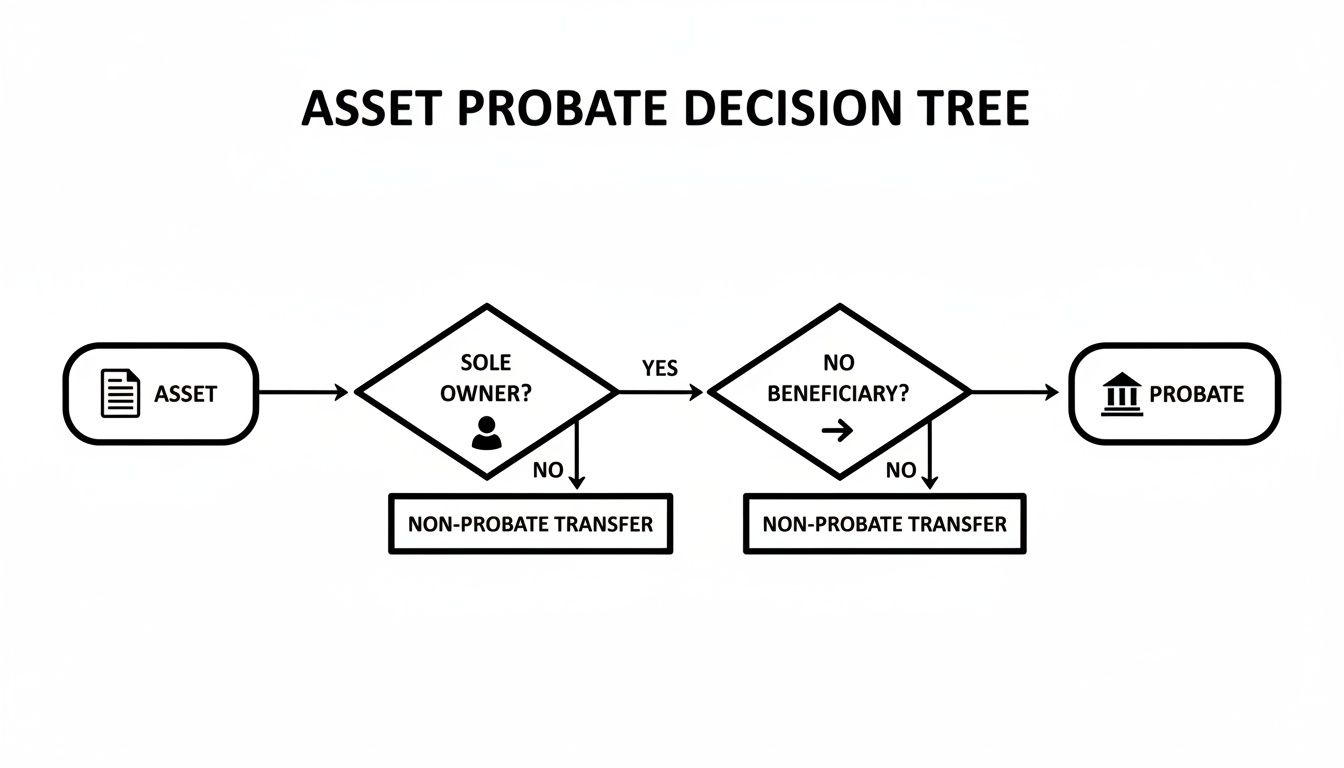
As you can see, sole ownership without a named beneficiary is the express lane into the probate system. Grasping this concept early is the key to organizing the estate and knowing what to expect on the journey ahead.
Think of the probate system as a safeguard. It’s there to make sure everything is handled transparently and correctly according to Texas law. A judge appoints an executor—often a family member named in the will—to manage the estate. This person is granted a powerful document called Letters Testamentary, which acts like a master key, giving them the authority to manage the estate’s assets.
For Harris County families trying to sort out an estate, it can be helpful to see a straightforward comparison. This table breaks down what typically falls into probate versus what doesn't.
Probate vs. Non-Probate Assets at a Glance
| Asset Type | Usually Requires Probate? | Reasoning |
|---|---|---|
| Real Estate (Sole Ownership) | Yes | No automatic transfer of title at death. |
| Bank Accounts (Sole Ownership) | Yes | The account is frozen; no one has legal access without a court order. |
| Vehicles (Titled in one name) | Yes | The title needs to be legally transferred to a new owner. |
| Life Insurance with Named Beneficiary | No | The payout goes directly to the person named in the policy. |
| 401(k) or IRA with Beneficiary | No | Funds pass directly to the beneficiary, outside of the will. |
| Jointly Owned Property with Right of Survivorship | No | The surviving owner automatically absorbs the deceased's share. |
| Assets in a Living Trust | No | The trust owns the assets, and the successor trustee distributes them. |
This quick reference should help you start categorizing assets and get a clearer picture of the road ahead.
Ultimately, probate is all about creating legal clarity. It's the official process that moves property from the deceased's name into the hands of their heirs, preventing future disputes and ensuring any outstanding debts are paid. For our neighbors in Atascocita and Humble, navigating the Harris County probate courts adds a layer of specific local rules. Every step, from filing the first application to distributing the last asset, must be done correctly. You can learn more about the specifics in our guide on how to probate a will in Texas.
Here at The Law Office of Bryan Fagan, we understand this is a difficult and emotional time. Our job is to demystify the process and offer clear, compassionate guidance to our neighbors in the Atascocita community. You don't have to figure this out alone.
Which Assets Actually Go Through Probate in Texas?
When a loved one passes away, the job of managing their estate can feel overwhelming. For families here in Atascocita, Humble, and across our part of Harris County, the first step is figuring out what exactly the court needs to supervise. The basic rule is pretty straightforward: anything titled only in the deceased's name, with no automatic transfer plan in place, is a probate asset.
Think of it this way: if a bank account or a house title is a locked door, and the only person with the key is gone, you need a legal locksmith. The probate court is that locksmith. It grants a specific person the legal authority to open those doors and transfer what's inside.
The Family Home and Other Real Estate
For most people in our community, their biggest asset is their home. If a house in a neighborhood like Eagle Springs or Walden on Lake Houston is titled solely in the name of the person who died, it has to go through probate. There's simply no other legal way to get the deed into an heir's name or to sell the property.
The court gives the executor a document called Letters Testamentary. This is the official key. It empowers the executor to manage the property, pay the mortgage or taxes, and eventually transfer the title according to the will or Texas law. Without it, the property is stuck in legal limbo.
Bank Accounts Without a Beneficiary
This is a scenario we see all the time with our clients. Someone has a checking or savings account at a local bank, and it's just in their name. If they never filled out a Payable on Death (POD) form to name a beneficiary, the bank’s hands are tied. They have to freeze the account when they learn of the death.
No matter how close you are—a spouse, a child—the bank cannot legally hand over that money. Only the probate process can grant an executor the legal power to access and distribute those funds.
This is such a critical point. A simple POD form is free and takes just a few minutes to complete at the bank. It can keep that entire account out of the courts, saving your family a great deal of time, money, and hassle.
Vehicles and Personal Belongings
It's not just houses and bank accounts. Other common assets that get pulled into probate are vehicles—cars, trucks, even boats—that are titled only in the deceased's name. Much like a real estate deed, the Texas DMV won't transfer a car title without legal authority, which comes from the probate court.
Beyond titled property, the probate estate also includes many other personal items:
- Jewelry and Heirlooms: Things like wedding rings, family watches, or valuable heirlooms must be accounted for and distributed correctly.
- Collectibles: This covers everything from art and antiques to coin collections or other hobbies.
- Household Furnishings: Technically, all the tangible "stuff" inside the home is part of the estate.
The executor is responsible for creating a detailed inventory of all these assets, keeping them safe, and then distributing them as the will directs. The court oversees this to make sure it’s all handled fairly. Understanding what gets caught in the probate net and what passes automatically is key to good estate planning. To see how different estate planning tools can help, check out our guide on the living trust vs a will in Texas.
In the end, probate is a structured process designed for protection. It ensures that ownership is transferred legally, creditors are paid properly, and your loved one's final wishes are carried out with the full backing of Texas law.
Navigating Complex Financial and International Holdings

While sorting out a simple estate with a house and a car can be fairly routine, things get complicated quickly when more complex assets are involved. For many families right here in Harris County, dealing with retirement funds, a family business, or property located abroad can turn a manageable process into a legal nightmare. Knowing what you're up against is the first step in getting through it.
When Retirement Accounts Enter Probate
Retirement accounts like 401(k)s and IRAs are supposed to skip probate altogether. That’s the whole point of naming a beneficiary—when you pass away, the money is meant to go directly to that person, no court required. But life is complicated, and it's all too common for these crucial details to get missed.
We see retirement funds get dragged into probate for two main reasons:
- No Beneficiary is Named: The owner simply never got around to naming someone, or the person they named passed away first.
- The Estate is Named as Beneficiary: Sometimes, people mistakenly (or intentionally) list their own estate as the beneficiary.
In either case, that retirement account is now officially a probate asset. The executor has to manage it through the Harris County court system, just like any other asset without a direct path to an heir. This not only causes major delays but can also create some significant and unexpected tax problems for the family.
Ownership in Local Businesses
For many entrepreneurs in our Atascocita community, their business isn't just a job; it's their legacy and most valuable asset. But an ownership stake in an LLC or partnership adds a serious complication to the probate process. If that ownership is held in the deceased's name alone without a solid succession plan, it gets stuck in the probate estate.
This can be devastating for a small business. The probate court process moves slowly, and a business needs someone at the helm to pay bills, manage employees, and make daily decisions. The executor will need the court's permission for just about everything, which can paralyze operations. To get a better handle on this, you can learn more about what happens when an LLC owner dies in our detailed guide.
The Challenge of Foreign and Out-of-State Assets
In today's global world, it's not unusual for families to own property outside of Texas. It might be a vacation home in Florida, a bank account back in Mexico, or inherited land in another state. These assets are a guaranteed headache because they almost always require a second probate process called ancillary probate.
Ancillary probate is essentially a whole separate probate case that must be opened in the state or country where the asset is located. This means your executor is suddenly managing two legal battles—one here in Harris County for the main estate, and another one somewhere else entirely.
Every state and country has its own rules, its own fees, and its own timeline, which adds layers of expense and complexity. What started as a local Atascocita matter can become a multi-jurisdictional puzzle. You can read more about how international assets are handled.
Untangling complex financial accounts, business interests, or international property is not a DIY project. These situations demand careful planning and guidance from someone who has been there before. At The Law Office of Bryan Fagan, our Atascocita team has the experience to guide you through even the most complicated estate issues. If you're facing these challenges, we invite you to Schedule a free consultation to discuss your case and find a clear path forward.
Common Misunderstandings About Community Property
Living and working here in the Atascocita area, we hear one question all the time: "Isn't Texas a community property state? Doesn't that mean my spouse automatically gets everything, and we can skip probate?" It's a perfectly logical question, but it’s also one of the most common—and costly—misconceptions in Texas estate law.
While it’s true that Texas considers most assets you acquire during your marriage to be community property, this status doesn't give you a free pass to avoid probate. All it means is that upon your death, your surviving spouse already owns their half of the community estate. Your half, however, is still part of your estate and needs to be legally passed on to someone.
If you have a will, your share of the community property goes to whomever you named. If you don't have a will, Texas law decides who gets it, which could be a combination of your spouse and your children. In either case, the probate court is almost always involved to make that transfer of ownership official.
Joint Ownership Is Not Always Equal
To figure out what happens to an asset when you die, you have to look past the "community property" label and get down to the details of how the asset is titled. The specific wording on a deed or account agreement can completely change whether it ends up in probate court. For families in Humble and the surrounding areas, two types of joint ownership can lead to very different outcomes.
Let's break down the two main ways you can own property with someone else in Texas.
Tenants in Common
This is the default form of co-ownership in Texas. If a deed doesn't say otherwise, the law just assumes you and your co-owner are Tenants in Common.
- What it means: Each person owns a distinct, separate share of the property. For example, two brothers could own a piece of land in Huffman as tenants in common, each holding a 50% interest.
- What happens at death: When one owner dies, their share does not automatically pass to the surviving owner. Instead, their portion becomes part of their estate and has to go through probate to be distributed according to their will or Texas's intestacy laws.
This is a critical distinction that trips up so many people. They assume their co-owner will simply inherit their share, but legally, that share must be probated first.
Joint Tenancy with Right of Survivorship
This is the type of ownership that actually creates the automatic transfer many people think community property provides. You'll often see it abbreviated as JTWROS.
To establish a right of survivorship, the legal document—whether it’s a deed, bank account agreement, or car title—must include specific language like "joint tenants with right of survivorship" or similar phrasing. Without this exact wording, it isn’t legally binding in Texas.
- What it means: All owners hold an equal, undivided interest in the property together.
- What happens at death: When one owner passes away, their share is automatically and instantly absorbed by the surviving joint owner(s). The entire process happens outside of the probate court.
Understanding this difference is everything. Simply relying on the community property label to avoid probate is a recipe for frustration and legal fees. The specific legal language on your title documents is what truly controls where your assets go.
If you're unsure how your property is titled, our team at The Law Office of Bryan Fagan is here to help. Schedule a free consultation at our Atascocita office so we can review your assets and make sure your estate plan will actually work the way you want it to.
How to Keep Assets Out of Harris County Probate Court

Knowing which of your assets are destined for probate is a great first step. But the real power lies in taking action now to help your family bypass the Harris County court system altogether. With some thoughtful estate planning, you can save your loved ones a tremendous amount of time, money, and heartache during an already difficult period.
The goal is to create direct, automatic pathways for your assets to transfer to your heirs. Thankfully, Texas law gives us several powerful and surprisingly simple tools to make this happen. You get to keep control while making life much easier for the people you care about most.
Using Beneficiary Designations Effectively
One of the most straightforward ways to steer clear of probate is to use beneficiary designations on your financial accounts. Think of it as leaving a set of express instructions for your bank or investment firm. These instructions tell them exactly who gets the asset when you pass away, with no court approval needed.
These are incredibly effective for many common assets:
- Life Insurance Policies: The death benefit is paid directly to the person you've named, completely outside of the probate process.
- Retirement Accounts: The money in your 401(k), IRA, or other retirement plans passes straight to your designated beneficiaries.
- Bank Accounts (Payable on Death): You can add a Payable on Death (POD) designation to your checking and savings accounts. The money is all yours during your lifetime, but it automatically transfers to your beneficiary when you're gone.
It's absolutely critical to review these designations every few years. Life changes—a marriage, a divorce, the birth of a child—and you need to make sure your beneficiary choices still reflect your wishes.
Powerful Tools for Texas Real Estate and Vehicles
When it comes to physical property like your home or car, Texas offers specific legal tools designed to skip probate. They are tailor-made to transfer titles efficiently without a judge's involvement.
A Transfer on Death Deed (TODD) is a real game-changer for Texas homeowners. You sign and file this deed now, but it only takes effect upon your death. This means your property in Atascocita or Humble can pass directly to your chosen beneficiary, completely bypassing the probate court. In a similar vein, Texas allows for a Transfer on Death designation for vehicle titles, creating a seamless transfer for your car.
The Revocable Living Trust: The Gold Standard for Probate Avoidance
For many families, the most comprehensive tool for keeping assets out of probate is the Revocable Living Trust. You can think of a trust as a private container you create to hold your assets. You then transfer the ownership of your property—your house, bank accounts, investments—into this container.
While you are alive, you manage the assets in your living trust just as you always have. Upon your death, a person you've chosen—the successor trustee—steps in to distribute the assets according to your private instructions, without any need for probate court oversight.
This method offers the ultimate privacy and control. Because the trust technically owns the assets, there is nothing left for the probate court to administer. For smaller estates that meet certain criteria, a Small Estate Affidavit Texas form can be a simplified and faster alternative to traditional probate, but a trust provides far more comprehensive protection.
Taking these steps now is a true gift to your family. If you'd like to explore the best strategies for your specific situation, we invite you to schedule a free consultation at our Atascocita office. Let us help you create a plan that provides real peace of mind.
Ready to Take Control of Your Estate Plan?

As we've seen, the probate process in Texas is a necessary step for some assets, but it doesn't have to be a nightmare for your family. You have the power to make things much simpler for them. It all starts with proactive estate planning—the single best way to give your loved ones in Atascocita and Humble lasting peace of mind.
Just by understanding which assets must go through probate and which can bypass it, you're already ahead of the game. That knowledge is the foundation for structuring your estate to reflect your exact wishes and sidestep unnecessary legal headaches.
Turning Knowledge Into Action
Knowing is one thing, but doing is another. The next step is translating what you've learned into a concrete, legally sound plan. A well-designed estate plan isn't just a document; it's a guarantee that your wishes will be honored and your family will be shielded from preventable stress and costs.
It's also worth remembering that a complete plan goes beyond the paperwork. Taking care of your physical property is a huge part of it. There are many hidden aspects of estate care services that can help you protect your real estate assets for the long haul.
Estate planning isn't just about dividing up your property. It's about leaving a legacy of security, clarity, and care for the people who matter most. It’s one of the greatest gifts you can give them.
We're here to help you take that next step. We invite you to schedule a free, no-obligation consultation with our team at the Law Office of Bryan Fagan in Atascocita. Whether you're ready to draft your first will, create a trust, or need guidance on a current probate issue, our experience is at your disposal.
Contact us today and let's secure your family’s future together.
A Few Common Questions About Texas Probate
When a loved one passes away, the last thing you want to deal with is a confusing legal process. For families here in Atascocita and Humble, probate often raises more questions than answers. Let's tackle some of the most common ones we hear every day.
Does every single estate have to be probated in Texas?
That's a great question, and the answer is no, not always. The need for probate really hinges on how your loved one owned their property.
Many assets can bypass the court system entirely. If assets were placed in a living trust, owned jointly with a right of survivorship, or had designated beneficiaries—think life insurance policies or 401(k)s—they usually pass directly to the intended person without probate.
There's also a shortcut for smaller estates. If the total value of the estate (not counting the homestead) is under $75,000, it might qualify for a simplified process called a Small Estate Affidavit. But, if there's real estate or bank accounts solely in the deceased's name, probate is typically the only path to legally transfer those assets to the heirs.
How long does probate usually take here in Harris County?
The timeline can vary significantly. For a simple, organized estate with a solid will and no family disputes, you might be looking at a six to twelve-month process in the Harris County courts. That's a pretty standard timeframe.
But things can get complicated fast. If someone decides to contest the will, if there are a lot of debts to sort out, or if the assets themselves are complex, the process can stretch out much, much longer. This is where having an attorney who knows the ins and outs of the Harris County court system can make a world of difference in keeping things on track.
What should I expect to pay for probate in Texas?
There's no single price tag for probate; it really depends on the complexity of the estate. A straightforward case might cost a few thousand dollars, but a contested or tangled estate could easily climb into the tens of thousands.
The main costs you'll encounter are:
- Court filing fees: These are the standard administrative costs just to open and process the case.
- Attorney's fees: Having an expert guide you through the legal requirements is essential.
- Executor compensation: The person in charge of managing the estate is entitled to be paid for their work.
While these expenses are part of the court process, they are almost always more than what it would have cost to manage the estate through a well-crafted plan, like a living trust. A little bit of planning today is truly the best way to keep these costs down and protect your family's inheritance tomorrow.
At The Law Office of Bryan Fagan – Atascocita TX Lawyers, we know you need clear, straightforward answers from someone who understands our community. We're here to provide that compassionate guidance. Schedule your free, no-obligation consultation today and let's talk about a plan that brings you real peace of mind.