 Skip to content
When parents in Atascocita can't agree on how to raise their children after a split, a judge sometimes needs a closer look to make the right call for your family. This is where a custody evaluation comes in. It's a formal investigation ordered by the court, conducted by a neutral expert—usually a psychologist or licensed therapist. Their one and only job is to provide an impartial recommendation for a parenting plan that serves the best interests of the child.
Understanding Custody Evaluations in Harris County
If you're in the middle of a tough custody battle, the phrase “custody evaluation” can sound downright scary. We understand. But it's crucial to see it for what it is: not a test you can pass or fail, but a detailed, fact-finding mission to help the court.
Think of it like this: when two parents in communities like Atascocita or Humble are at a complete impasse, the judge brings in a specialist. This specialist provides an in-depth, objective analysis to help break the deadlock and figure out what’s truly best for the kids involved.

The 'Best Interest of the Child' Standard in Texas
In every single Texas custody case, from the Harris County Civil Courthouse to local family courts, all decisions hinge on one guiding principle: the best interest of the child. This legal standard requires the judge to weigh a child's physical and emotional well-being, their present and future needs, and any potential dangers they might face.
When parents have completely different stories or the conflict is sky-high, a judge needs more than just courtroom arguments to make such a life-altering decision for your family. A custody evaluation provides that deep dive, giving the court a comprehensive picture of your family dynamics that they simply can't get from legal filings alone. It’s an indispensable tool in high-conflict situations where a misstep could harm a child for years to come.
Why a Judge Might Order an Evaluation in Your Case
Judges in Harris County don't order these evaluations for every disagreement. They are generally reserved for the toughest cases where parents have serious disputes or when very specific, troubling concerns are raised about a child's well-being.
Some of the most common reasons a judge in Atascocita might order an evaluation include:
- High-Conflict Disputes: When parents are locked in a battle and simply cannot communicate or cooperate enough to create a functional parenting plan for their children.
- Allegations of Abuse or Neglect: If one parent accuses the other of substance abuse, family violence, or child endangerment, an evaluator is brought in to investigate these claims thoroughly and impartially.
- Concerns About Mental Health: When a parent’s mental or emotional stability is called into question and could potentially impact their ability to care for the child.
- Parental Alienation: If there's a suspicion that one parent is actively trying to turn the child against the other parent, harming that relationship.
High-conflict divorces make up about 10-15% of all family court cases nationwide. Within that group, evaluators are appointed in up to 20% of cases to help judges navigate the complex family dynamics. That means thousands of custody outcomes in Harris County are shaped by these reports every year, impacting families right here in our community.
The purpose of a custody evaluation is to provide the court with an unbiased, child-focused perspective. The evaluator’s report helps a judge make a more informed and nuanced decision that truly protects the child’s well-being.
To give you a better idea of what this intensive process involves, here’s a breakdown of the typical steps.
Key Components of a Custody Evaluation
| Component | Purpose and What to Expect |
|---|---|
| Parent Interviews | The evaluator will meet with each parent separately to discuss their history, parenting style, and relationship with the child. Be prepared to share your perspective calmly and honestly. |
| Child Interviews | The evaluator will speak with your child (or children) in an age-appropriate way to understand their feelings and experiences without making them feel pressured. |
| Parent-Child Observations | You'll be observed interacting with your child. This helps the evaluator see your relationship in action, not just hear you describe it. |
| Home Visits | The evaluator may visit each parent's home in Atascocita or the surrounding area to assess the living environment and ensure it is safe and suitable for the child. |
| Collateral Interviews | The expert will talk to other important people in your child's life, such as teachers, doctors, therapists, or family members, to get a well-rounded view. |
| Document Review | The evaluator will review relevant documents, including court filings, school records, and medical or psychological records, to verify facts. |
| Psychological Testing | In some cases, parents may be asked to complete psychological tests to screen for mental health issues or assess personality traits that could impact parenting. |
Each of these steps helps the evaluator piece together a complete and objective puzzle of your family situation.
Understanding the significant impact of divorce on a child's mental health is a core reason these evaluations exist—to minimize harm and build a stable future. If you're facing a potential custody evaluation, remember its purpose is to protect your child. At The Law Office of Bryan Fagan, our compassionate attorneys can guide you through this complex process and fight to ensure your parental rights are protected. Contact our Atascocita office today for a free consultation to discuss your case.
Who Are Custody Evaluators and What Makes Them Qualified?
When a Harris County judge orders a custody evaluation for your family, the immediate question on your mind is, “Who, exactly, is this person?” It’s a completely valid concern. After all, this individual will have a tremendous amount of influence over your child's future and your life as a parent. It's crucial for you to know that not just any therapist or counselor can take on this high-stakes role.
In Texas, custody evaluators are highly trained and specifically credentialed professionals. They are almost always licensed psychologists, Licensed Professional Counselors (LPCs), or Licensed Clinical Social Workers (LCSWs) who have undergone specialized training focused on the unique pressures and legal standards of family law cases.
The Core Qualifications for a Custody Evaluator
For a professional to be appointed by the court in an Atascocita or Humble case, they need a very particular skill set. Their background isn't just in general therapy; it's deeply rooted in understanding the complexities that arise when a family is in conflict.
Think of them as investigators with a background in human psychology. Their expertise must include:
- Child Development: A deep understanding of what a child needs emotionally, mentally, and developmentally at every stage of life.
- Family Systems: The ability to see the family as a whole and analyze how each person’s behavior affects everyone else.
- Forensic Interviewing: Specialized techniques for interviewing both adults and children to gather accurate information without asking leading questions or introducing bias.
- Texas Family Law: A working knowledge of the legal standards in Texas, especially the guiding principle known as the "best interest of the child" standard.
These professionals are also bound by rigorous ethical guidelines from organizations like the American Psychological Association (APA). This code of conduct is there to ensure they perform their investigation with the utmost integrity and professionalism, giving your family a fair process.
The Single Most Important Qualification: Neutrality
Beyond all the degrees, licenses, and training, the one quality that matters most for a custody evaluator is unwavering neutrality. Their job isn't to pick a "winner" or a "loser." It’s not about finding fault. Their sole mission is to give the court a clear, unbiased, fact-based picture of your family situation.
A custody evaluator works for the court, not for either parent. They are not on "your side" or the "other parent's side." They are on the side of the child.
This impartiality is precisely why their final report carries so much weight with a judge. If an evaluator shows even a hint of bias or doesn't thoroughly investigate all claims, their report can be challenged in court and potentially disregarded.
For parents in our Atascocita community going through this, being able to trust the evaluator's expertise and fairness is everything. At The Law Office of Bryan Fagan, we know the high standards these evaluators must meet. We work to make sure that any professional appointed in your case has the right credentials and follows the strict ethical rules required for a fair process for your family.
If you’re facing a custody evaluation and have questions about the evaluator in your case, don't wait and wonder. Schedule a free consultation with our Atascocita office today to get the clear answers and guidance you need.
A Step-By-Step Guide to the Custody Evaluation Process in Harris County
If you're facing a custody evaluation, the unknown can feel incredibly stressful. Let’s demystify the process and give you a clear roadmap of what to expect, step-by-step. Knowing what's coming can help ease your anxiety and empower you to navigate each stage effectively with the support of a local attorney who understands.
The whole process begins when a Harris County judge officially appoints a custody evaluator. Once that order is signed, a well-defined process begins. While the specifics can vary from one family to the next, the evaluator follows a set of core steps to get a complete, 360-degree view of your family's situation.
Step 1: The Initial Interviews with Parents
Your first direct involvement will be an individual interview. This is your chance to sit down with the evaluator and share your side of the story—your parenting style, your bond with your child, and the history of your family. Expect detailed questions about daily routines, your child's specific needs, and what you envision for the future co-parenting relationship.
It's completely normal to feel nervous. The best advice we can give our clients is to be honest, be thorough, and keep the focus squarely on your child. This isn't the time for mudslinging or trying to score points against the other parent. An experienced evaluator is trained to see past the conflict and zero in on what truly matters: your child’s best interest.
These professionals aren't just anyone; they have to meet strict criteria to even take on this role for your case.
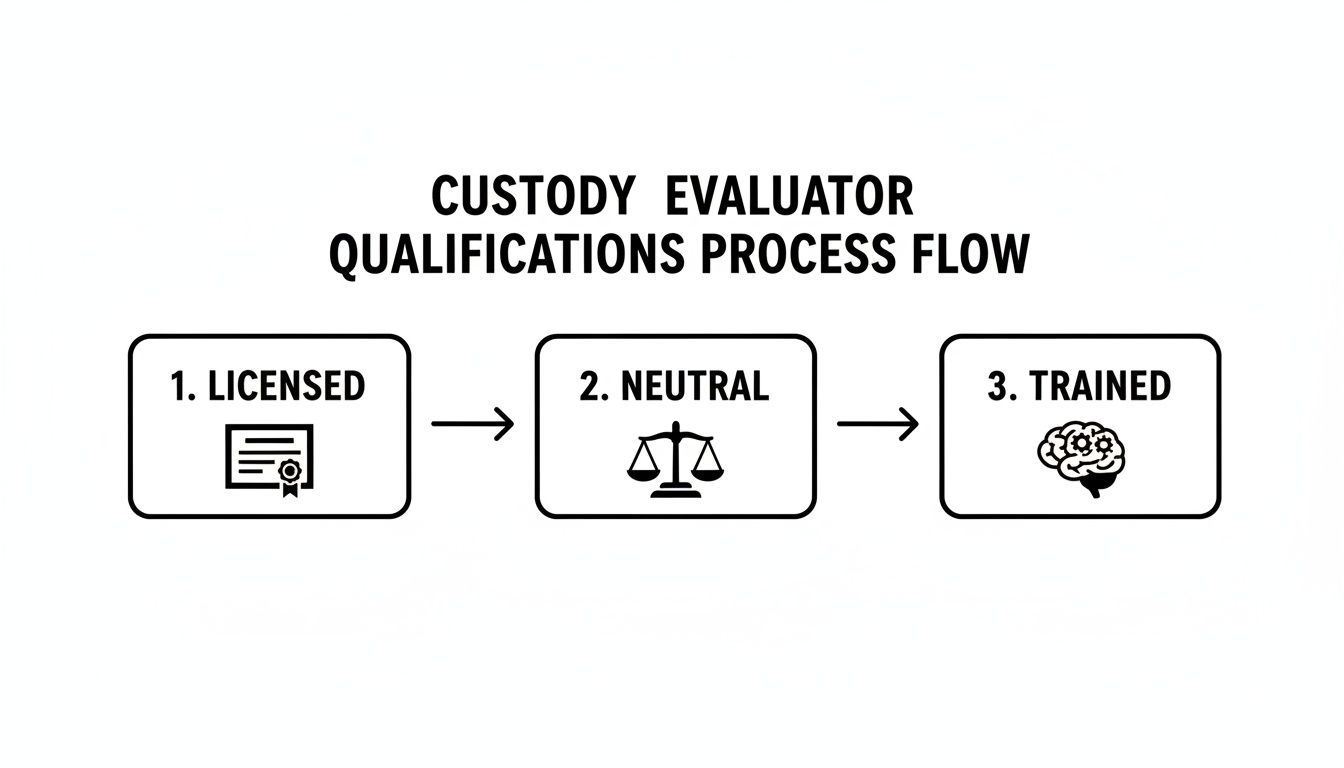
As you can see, every evaluator must be a licensed professional, remain completely neutral, and have specialized training. This is all in place to ensure the process is as fair and objective as possible for your family.
Step 2: Child Interviews and Home Visits
Next, the evaluator will want to meet with your children. These interviews are always handled in a way that’s appropriate for the child's age and maturity level. The goal isn't to put your child on the spot or make them feel like they have to "choose" a parent. It’s simply to get a sense of their world, their feelings, and their relationships with both parents from their own perspective.
Home visits are also a standard part of most evaluations. This means the evaluator will schedule a time to come to your home, whether you live in Atascocita, Humble, or anywhere else in northeast Harris County.
Don't panic about the home visit. The evaluator isn't there to judge your housekeeping or interior design choices. They are simply checking to see that the home is a safe, stable, and child-friendly environment where your child has what they need to thrive.
They are looking for common-sense things: a dedicated space for your child, age-appropriate toys or books, and a generally secure atmosphere. You don’t need a perfect home, just a loving and supportive one.
While these steps are crucial, remember they are just pieces of a much larger puzzle. For more in-depth guidance, our guide on how to prepare for a custody hearing offers practical steps that can help you feel more ready for court.
Step 3: Gathering Collateral Information
An evaluator’s job doesn’t stop with interviewing parents and kids. To ensure their report is thorough and unbiased, they also conduct what are known as collateral interviews. This just means they'll be talking to other important people in your child's life to get a broader, more objective perspective.
For your Atascocita family, these "collateral contacts" often include:
- Teachers or daycare providers in local schools who see your child's behavior and academic progress daily.
- Doctors, counselors, or therapists in the Humble area who have professional insight into your child's physical or emotional health.
- Close family friends or relatives who have witnessed your parenting and your child’s development over time.
Finally, the evaluator will dig into documentation. They'll review everything from school report cards and medical records to texts and emails between you and the other parent, as well as any previous court documents. Every piece of information helps them verify statements and build a report for the judge that’s grounded in objective facts, not just opinions.
How to Prepare for Your Custody Evaluation
Facing a custody evaluation can feel overwhelming. It’s natural to worry about saying the right thing or making a good impression. But let’s be clear: this isn’t about putting on a performance or trying to be a "perfect" parent. It’s about genuinely showing the evaluator who you are as a parent and how central your child is to your life.
The key is preparation, not rehearsal. A little organization and a shift in mindset can make all the difference, helping you feel more in control and confident. The best place to start is with your paperwork. An evaluator’s job is to gather facts, and when you hand them a well-organized file, you're not just making their job easier—you're demonstrating that you're on top of your child's needs.

Step 1: Gather Your Key Documents
Think of this as building a portfolio of your parenting. Start a binder or a set of folders—physical or digital—to create a clear, factual story of your involvement. This isn't just busywork; it's tangible proof of your consistent presence in your child’s life.
Here are the essentials to start collecting for your Harris County case:
- School Records: This includes report cards, but also dig deeper. Gather attendance printouts, notes from teachers, and even emails about a science project or field trip. It all shows you're engaged.
- Medical and Dental Files: Compile records from doctor's appointments, dentist visits, and immunization schedules. If your child sees a therapist or specialist in the Atascocita area, include those notes too. This demonstrates your proactive role in their health.
- Extracurricular Activities: Don't just list the activities. Print out registration forms, schedules for soccer practice in Atascocita, or the recital program from their Humble-area music class. These details show your involvement in their community life.
- Communication Records: This is crucial. Save important emails, screenshots of texts, and messages from co-parenting apps. The goal is to show a pattern of constructive, child-focused communication.
Step 2: Create a List of Helpful Contacts
The evaluator will want to speak to people who know your family. These are called "collateral contacts," and they provide an outside perspective. Giving the evaluator a thoughtful list of people who can speak to your relationship with your child is incredibly helpful.
Think about including people like:
- Your child’s teacher, school counselor, or principal at their Atascocita-area school.
- The family pediatrician or your child's therapist.
- A coach or a music instructor from a local program.
- A trusted family friend or neighbor who has seen you and your child together over the years.
Jot down a few notes on why each person is on your list and what they can speak to. This helps the evaluator understand who to call to get a well-rounded picture.
To help you stay on the right track, here is a quick guide on what to do—and what to avoid—during the evaluation process.
Do's and Don'ts During Your Custody Evaluation
| Do… | Don't… |
|---|---|
| Focus on your child. Keep every conversation centered on their needs and best interests. | Bad-mouth the other parent. This is a major red flag for an evaluator and can hurt your case. |
| Be organized and prepared. Have your documents and contacts ready to go. | Be defensive or argumentative. A cooperative, calm attitude goes a long way. |
| Be honest and transparent. If you've made mistakes, own them. It shows maturity and credibility. | Try to "coach" your child. Evaluators are trained to spot this immediately and it is very damaging. |
| Follow all instructions from the evaluator promptly and respectfully. | Interrupt or speak for the other parent during joint interviews or meetings. |
| Dress appropriately for interviews, as you would for an important professional meeting. | Vent about your personal frustrations with the legal process. Stay focused on your child. |
Think of this table as your roadmap for every interaction you have with the evaluator. Your conduct speaks volumes.
A critical mistake we see parents make is using the evaluation as a stage to tear down the other parent. Evaluators are highly trained to see right through that tactic, and it almost always backfires.
Staying focused on your child, your positive parenting, and your ability to work with your co-parent is far more powerful. If you have serious concerns about harmful conduct, such as parental alienation, it's crucial to present facts and evidence, not just accusations. Our guide explains more about how to prove parental alienation in a way the court will understand.
Ultimately, your attitude and actions throughout the entire process are just as critical as any document you provide. The evaluator is observing everything. Show them you are the stable, loving, and responsible parent your child deserves. If you need help preparing for this vital step in your Harris County case, our Atascocita team is here to guide you.
Responding to the Custody Evaluator's Final Report
The moment you receive the custody evaluator's final report can be incredibly tense. After all the interviews and home visits, the evaluator compiles everything into a single, comprehensive document. This report, which goes directly to the Harris County court and both parents' lawyers, contains detailed recommendations that carry a lot of weight with the judge.
The report will lay out specific suggestions for possession (who the child lives with), access (the visitation schedule), and who gets to make crucial decisions about your child’s schooling and medical care. It's vital to remember one thing: while this report is influential, it is not a court order. The judge has the ultimate say, and the report is just one piece of evidence they will consider.
What to Do When You Disagree with the Report
Reading a report that you feel paints an unfair picture or makes recommendations that you genuinely believe aren't good for your child can be devastating. But this isn't the end of the fight. This is precisely where having an experienced family law attorney from our Atascocita office in your corner makes all the difference. The very first step is to sit down with your lawyer and go through the report, page by painstaking page.
Our team at The Law Office of Bryan Fagan methodically dissects the report, looking for specific weaknesses:
- Factual Inaccuracies: Did the evaluator mix up dates, names, or key events related to your family?
- Evidence of Bias: Does the report seem to lean heavily toward one parent without solid, supporting evidence to back it up?
- Flawed Methodology: Did the evaluator neglect to speak with important witnesses you suggested or completely overlook critical documents you provided?
Pinpointing these issues is how we start building a strong strategy to challenge the evaluator's conclusions and fight for a better outcome for your family.
Challenging the Report in Court
If you and your attorney agree the report is flawed, you have clear options for pushing back in court. The main strategy is to file a formal objection and prepare to cross-examine the custody evaluator during a hearing or the final trial.
The evaluator is not above the law. They can be put on the witness stand and questioned under oath about their qualifications, the methods they used, and how they arrived at their conclusions. This is your chance to show the judge any weaknesses in their report.
During this cross-examination, your lawyer will work to expose inconsistencies, point out where the evaluator failed to follow established professional guidelines, and introduce evidence that directly contradicts their findings. The objective is simple: to convince the judge that the report is unreliable and shouldn't be the foundation for the final custody order for your child.
Knowing you can challenge an unfavorable report is a critical part of protecting your parental rights. For a deeper understanding of the legal system's checks and balances, learning how to appeal a family court decision offers valuable insight into the broader legal options you may have.
Some custody cases in our diverse Harris County community involve international elements. In international child abduction cases governed by the Hague Convention, for example, a custody evaluation is essential for assessing the child's needs and determining their "habitual residence." As you can read more on this subject, data shows that 88% of 'taking persons' in 2021 were the child's primary or joint-primary caregivers. This statistic highlights why a thorough, unbiased evaluation of each caregiver's stability is more important than ever.
If you've received a custody evaluation and are worried about what it means for your family's future, don't wait. Contact The Law Office of Bryan Fagan – Atascocita TX Lawyers today. We offer a free consultation to go over your case and explain exactly how we can fight to protect your rights as a parent.
Answering Your Top Questions About Custody Evaluations
When you’re facing a custody evaluation in Harris County, it's completely normal to have a flood of questions. For most parents in Atascocita and Humble, this is brand new territory, and the unknown can feel incredibly stressful. Our job at The Law Office of Bryan Fagan is to provide clear, direct answers so you can feel more in control of your family's situation.
Here are some of the most common questions we hear from parents just like you.
How Much Does a Custody Evaluation Cost in Harris County?
This is a critical question for every family. A custody evaluation is a significant financial commitment. Here in the Houston area, you can expect a comprehensive evaluation to cost anywhere from $5,000 to over $15,000, and sometimes more, depending on the complexity of your family's situation.
The price is driven by factors like the number of people to interview, the volume of documents to review (like medical records or emails), and whether psychological testing is required. Usually, the judge will order both parents to split the cost, often 50/50. However, if there's a large income gap, the court might order one parent to pay a larger share. An experienced attorney from our Atascocita office can help you understand this investment and advocate for a fair division of costs.
Can I Refuse to Participate in a Court-Ordered Evaluation?
It's a tempting thought, especially if you feel the evaluation is unfair. But because this is a formal court order, refusing to participate can seriously damage your case.
A refusal is often seen by a judge as a red flag, suggesting you have something to hide or are unwilling to cooperate for your child's well-being. It can instantly harm your credibility. The best approach is always to cooperate fully, but with a trusted Atascocita family lawyer from our office guiding you and protecting your rights at every step.
Your cooperation shows the court you're a reasonable, transparent parent who is focused on what’s best for your child. Full participation, with smart legal counsel, is your strongest play.
What Should I Do If the Other Parent Lies to the Evaluator?
This is a huge fear for many parents. First, take a deep breath. Experienced evaluators are trained forensic professionals who expect conflict and are experts at spotting inconsistencies. They don't just take someone's word for it; they look for independent proof to back up claims.
Your best strategy is to stay calm, stick to the truth, and focus on the facts. If the other parent is lying, we can help you push back by:
- Providing Concrete Proof: Using emails, text messages, school records, or financial statements to factually disprove their claims.
- Presenting Witnesses: Offering up collateral contacts—people like teachers, coaches, or neutral family friends from the Atascocita area—who can give the evaluator a more accurate picture.
- Maintaining Consistency: Your honest and steady account of events will stand in sharp contrast to their fabrications, which tend to fall apart under an evaluator’s questioning.
Your attorney can then package this evidence and point out every discrepancy for both the evaluator and the judge.
How Long Does a Custody Evaluation Usually Take in Texas?
Knowing the timeline is key to managing your own stress. From the day the judge orders the evaluation to the moment the final report is issued, a typical custody evaluation in Texas takes about 90 to 180 days.
This timeframe can shift based on:
- The Evaluator’s Caseload: A popular, in-demand evaluator might have a waiting list.
- The Complexity of the Case: More interviews and records naturally require more time.
- The Cooperation of All Parties: Delays in scheduling or providing documents will slow everything down.
We’ll help you get a sense of the likely timeline for your specific case in the Humble and Atascocita area so you know what to expect.
What Happens If My Child Refuses to Talk to the Evaluator?
It's actually common for kids, especially teenagers, to be reluctant or even refuse to talk. Evaluators are prepared for this and will never force a child to speak. Instead, they might try a different approach, like observing you and your child together, or they may simply note the child's refusal in their report.
Your job as a parent is to encourage your child to be honest but never to coach them on what to say or pressure them. The evaluator will see that you're being supportive, not manipulative, and that reflects well on your parenting.
As you think about how to handle sensitive conversations, questions about privacy often arise, including the legality of recording conversations. It's crucial to understand the rules in Texas, as a wrong move here could have serious legal consequences. Always talk to your lawyer before you consider recording any interactions related to your case.
Going through a custody evaluation is a tough road, but you absolutely do not have to walk it alone. The dedicated team at The Law Office of Bryan Fagan – Atascocita TX Lawyers is here to answer your questions, protect your rights as a parent, and fight for your child’s best interests. If you're facing a custody battle in Atascocita, Humble, or anywhere in northeast Harris County, call us today. We'll schedule a free, no-obligation consultation at our local office so we can give your family the guidance and support it deserves.


