 Skip to content
If you're going to prove parental alienation in a Texas court, you need to show a clear, consistent pattern of manipulative behavior. For families here in Atascocita, Humble, and across northeast Harris County, a successful case isn’t about general complaints; it’s about meticulously documenting specific actions and the damage they've caused to your relationship with your child.
A Harris County judge’s decision will come down to presenting compelling evidence that directly speaks to the "best interest of the child" standard. This guide will walk you through the practical steps you can take.
Recognizing Parental Alienation in Your Atascocita Family
It's one of the most painful experiences a parent can go through: watching your relationship with your child erode for reasons that just don't add up. When your child suddenly becomes distant, hostile, or even fearful of you, it's easy to feel completely helpless and confused.
The key is learning to tell the difference between a child's normal, often bumpy, adjustment to a separation and the specific, harmful tactics of parental alienation. Alienation isn't just about a co-parent being angry or difficult. It's a deliberate campaign to poison a child's mind against their other parent. The tactics can be subtle, like oversharing adult details about the divorce with your child, or they can be incredibly direct, like making false claims of abuse or neglect.
The Subtle and Overt Signs of Alienation
Spotting these signs is your first critical step. The behaviors often start small and then escalate, weaving a destructive narrative that your child starts to believe.
Some of the most common tactics we see in Atascocita families include:
- Constant Badmouthing: The other parent relentlessly criticizes you, your new partner, or your family in front of the child. They paint you as unloving, unsafe, or simply not good enough.
- Running Interference with Communication: They might block your calls, conveniently "forget" to give the child your messages, or invent reasons why the child is always "too busy" to talk to you.
- Blocking Your Parenting Time: The alienating parent may consistently sabotage your visitation, suddenly claiming the child is sick or has last-minute plans, which chips away at your time together.
- Forcing the Child to Take Sides: They create intense loyalty conflicts, making the child feel guilty for having fun with you or showing you affection.
It’s crucial to understand just how damaging this is. It's well-documented how verbal abuse damages children's mental health, and constantly tearing down one parent in front of a child is a textbook example of that abuse.
The real problem in parental alienation is one parent’s failure to separate their own anger from their child's fundamental right to a healthy relationship with both parents. A Texas judge will look at these behaviors through that lens—what is truly in the child’s best interest.
To help you get a clearer picture, it’s useful to compare alienation tactics with the normal emotional responses a child might have after a divorce.
Alienation Tactics vs Normal Post-Divorce Adjustments
| Behavior/Sign | Potential Parental Alienation Tactic | Typical Post-Divorce Adjustment |
|---|---|---|
| Child's Criticism | Criticisms are weak, frivolous, or parroted from the other parent. The child can't provide real examples. | The child expresses legitimate, age-appropriate complaints (e.g., "Dad's new rules are too strict"). |
| Feelings Towards You | The child shows unwavering support for the alienating parent and absolute hatred for you, with no middle ground. | The child has mixed feelings and can still recall positive memories with both parents, even when upset. |
| Source of Animosity | The child claims their negative feelings are entirely their own, but the reasons sound rehearsed or adult-like. | The child is open about their sadness or anger related to the divorce itself, not just one parent. |
| Guilt & Apology | The child shows no guilt or remorse for their disrespectful or hostile behavior toward you. | The child may act out but will often feel guilty later and be responsive to parental guidance. |
| Contact Refusal | The child completely refuses contact or visitation, often with a sense of panic or intense opposition. | The child may be reluctant to switch between homes but can be encouraged and eventually settles in. |
Seeing these behaviors laid out can help clarify whether you're dealing with a temporary adjustment period or a more serious, manipulative campaign.
This issue is far more common than many realize. One UK study revealed that while nearly 40% of divorced parents felt they'd experienced alienating behaviors, that number skyrocketed to almost 60% when they were asked about specific actions like badmouthing or visitation blocking. These aren't isolated incidents; family courts right here in Harris County see these destructive patterns all the time. You can learn more about these research findings on parental alienating behaviors.
Creating a Credible Evidence Log for Court
When you walk into a Harris County courtroom, it’s not enough to just tell the judge you’re being alienated. You have to show them. A judge needs to see a clear, undeniable pattern of behavior, not just hear about a few isolated incidents or your understandable frustrations.
This is exactly why building a detailed evidence log is the most powerful thing you can do. It transforms your case from a messy "he said, she said" fight into a fact-based argument that’s hard to ignore.
This isn’t about just scribbling notes when you’re angry. It's about methodically building a timeline that makes the alienating behavior obvious. Think of it as creating a story, piece by piece, that shows a consistent campaign to damage your relationship with your child. Every text, every canceled visit, every strange comment from your kid—it all adds up.
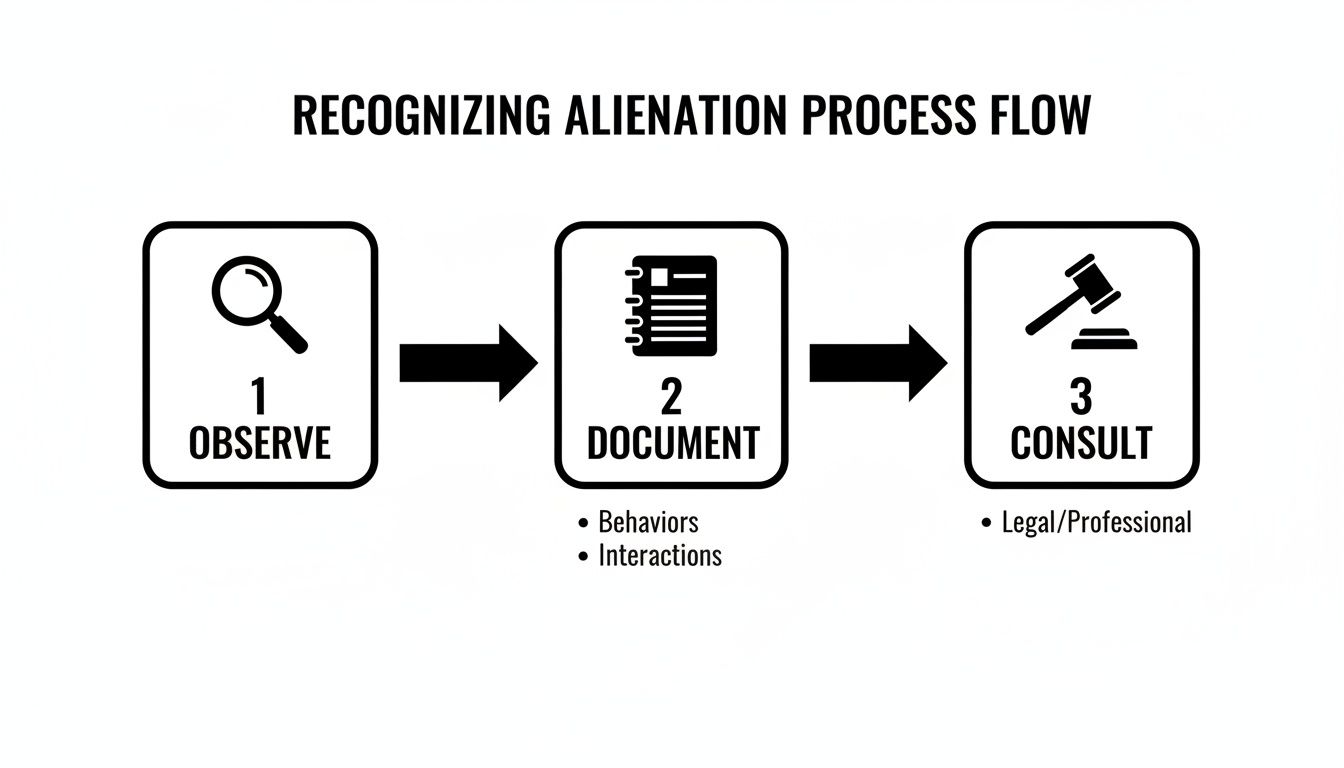
As you can see, the process is straightforward: you observe what’s happening, you document it meticulously, and then you work with a professional to build your legal strategy.
What to Document and How
Consistency and detail are your best friends here. A jumbled mess of notes won't have nearly the same impact as a well-organized log. Your job is to be a reporter, sticking only to the facts.
Keep your log objective and free of emotion. It’s tough, but it’s critical. Instead of writing, "He was a total jerk and ruined my weekend on purpose," stick to the facts: "Scheduled visitation for Friday at 6 PM. Received a text at 5:45 PM from ex-spouse stating our child was 'too sick' to come. Later saw a photo on social media of our child at a friend's birthday party, posted an hour later." See the difference?
Focus on tracking these key areas:
- Denied Visitations: Log every single time your court-ordered possession is denied, interfered with, or cut short. Note the date, the time, and the exact reason you were given. If the excuse felt weak—like a sudden "headache" that magically disappears—make a note of that, too.
- Disparaging Messages: Save every single text, email, or social media post where the other parent undermines you or speaks badly of you. The key is not to engage or argue back. Just screenshot, save, and document. Screenshots with visible timestamps are gold in court.
- "Parroted" Phrases: Has your child started saying things that sound completely out of character? If your eight-year-old in Humble suddenly starts lecturing you about "your child support obligations" or uses adult insults, write down the exact words, the date it happened, and the context. These are often huge red flags.
- Sudden Behavioral Shifts: Keep track of any abrupt and unexplained changes in your child's attitude. Are they suddenly anxious or quiet before coming to your house? Do they go from being loving and affectionate to cold and distant after a phone call with the other parent? Document it.
Practical Tools for Gathering Evidence
You don’t need any expensive or complicated software. For families here in Atascocita or Humble, simple, everyday tools are usually the most effective.
- A Dedicated Journal: An old-fashioned notebook works great, as does a password-protected document on your computer (like a Google Doc). The important thing is to make entries chronologically, always starting with the date and time.
- Your Calendar App: The calendar on your phone is an incredibly powerful tool for tracking denied visits. Schedule your possession times as recurring events. If a visit gets blocked, simply edit the event title to something like "VISITATION DENIED – EXCUSE: 'SICK'" and add details in the notes. Over a few months, this creates a damning visual pattern.
- Photo and Video Evidence: A picture really is worth a thousand words. If your ex sends a nasty text, screenshot it. If you have videos of your child laughing and having a great time with you, save them. This evidence can powerfully contrast with the alienated behavior you’re describing.
A strong evidence log tells a story. It gives the judge a clear timeline, showing how one parent's consistent, negative behavior has directly and unfairly damaged the child's relationship with the other parent.
We know that building this log is emotionally draining. It hurts to write these things down. But this hard work and discipline are what will give your case a solid foundation. It gives your Atascocita child custody attorney the ammunition they need to build a compelling argument that truly focuses on protecting your child.
The Role of Experts in a Harris County Custody Case
While your own detailed log of events is the foundation of your parental alienation case, sometimes it's not quite enough. Getting a Harris County judge to see the full picture of the psychological damage being done to your child can be tough. This is where objective, third-party experts become your most powerful asset.
These professionals provide the unbiased, clinical perspective a court needs to understand the complex and often subtle dynamics of parental alienation. Hiring the right expert can completely reframe the situation, moving it from a "he-said, she-said" battle to a clear-eyed assessment of your child's best interests. They are trained to see past the finger-pointing and get to the root of a child's distress.

Understanding the Key Professionals
In a Harris County custody fight involving parental alienation, you'll likely encounter a few different types of professionals. Each has a specific job, but they all serve one primary purpose: to give the court the information it needs to protect your child.
Here are the experts you might work with:
- Child Therapists or Counselors: If your child is already in therapy, their counselor can be an invaluable source of information. While their sessions are confidential, their notes might reveal recurring themes, anxieties, or specific phrases that clearly trace back to the alienating parent's influence.
- Custody Evaluators: This is a neutral mental health professional, either appointed by the court or agreed upon by both parents, who conducts a deep-dive investigation. They'll interview everyone involved—you, the other parent, your child, and even collateral contacts like teachers or grandparents—to deliver a comprehensive report and recommendation to the judge.
- Guardian Ad Litem (GAL): Think of a GAL as the court's "eyes and ears." This is an attorney appointed by the judge to represent only one person: your child. They conduct their own investigation to figure out what outcome is truly in the child's best interest. You can read more here about the specific role of a Guardian Ad Litem.
What to Expect During a Custody Evaluation
For parents in Atascocita and Humble, the thought of a formal custody evaluation can be nerve-wracking. Knowing what's coming can make the process much less intimidating. Remember, the evaluator’s job is to stay neutral and simply gather facts.
A typical evaluation usually includes these steps:
- Individual Interviews: You’ll meet with the evaluator one-on-one to share your side of the story and present your documentation.
- Interviews with the Other Parent: Your ex will get the same opportunity to speak with the evaluator.
- Observation Sessions: The evaluator will want to see you interact with your child. They will also schedule a separate time to observe the other parent’s interaction.
- Psychological Testing: In some cases, standardized tests may be used to get a clearer picture of the mental and emotional health of both the parents and the child.
The custody evaluator’s final report isn't binding, but it carries a ton of weight with the judge. Their impartial, professional findings can validate everything you've been documenting and give the court the objective proof it needs.
Our best advice? Be honest, organized, and keep the focus on your child's well-being. Present your evidence calmly and let the facts do the talking.
Why Expert Testimony Is So Crucial
Parental alienation isn't just a squabble between parents; it's a serious form of abuse with devastating, lifelong consequences. The children caught in the middle face significantly higher risks of depression, anxiety, substance abuse, and dropping out of school. The damage is very real and well-documented.
An expert witness can connect the dots for the court. They can take the behaviors you've documented and explain, in clinical terms, how those actions are causing direct harm to your child. Their testimony elevates your case from personal accusations to a matter of professional, evidence-based observation. An experienced family law attorney can guide you in selecting the right experts and preparing you for every interaction, ensuring you present the strongest case possible.
Meeting the Legal Standard for Alienation in Texas
Parents in Atascocita often ask us, "Where in the law does it say parental alienation is illegal?" It's a completely understandable question, but the answer can be frustrating. You won't find a Texas law that explicitly uses the term "parental alienation."
But that absolutely does not mean Harris County judges ignore this kind of destructive behavior. They just look at it through the one lens that matters most in family court: the best interest of the child.
This is the bedrock of every custody decision in Texas. Your goal isn't to prove the other parent committed a crime called "alienation." It's to show the judge, with clear and compelling evidence, that their specific actions are damaging your child's well-being and are fundamentally against their best interests.
Connecting Your Evidence to the Holley Factors
So, how does a judge decide what's in a child's best interest? They don't just go with their gut. Texas courts rely on a set of guidelines called the "Holley Factors," which provide a structured way to evaluate custody situations.
This is where your meticulous documentation pays off. The key is to work with your attorney to tie every piece of evidence—every text, email, and therapist's note—directly to one or more of these factors. This is how you translate your painful, real-world experiences into a legal argument a judge can understand and act upon.
In alienation cases, we often focus on these specific Holley Factors:
- The child's emotional needs, now and in the future. Your evidence needs to scream, "The other parent is ignoring my child's fundamental need to love and be loved by both parents."
- Any emotional or physical danger to the child. Parental alienation is emotional abuse. A mental health expert can explain to the court exactly how this behavior puts your child in immediate and long-term emotional danger.
- The parental abilities of each person. Is a parent who intentionally sabotages their child's other relationships demonstrating good parenting? No. It shows a profound inability to put the child's needs ahead of their own anger.
- The stability of the home. An environment filled with manipulation, secrets, and loyalty binds is the exact opposite of stable. This constant conflict creates a toxic emotional home for a child.
Framing the Harm to Your Child
Here's a piece of advice we give every client: A judge's primary concern isn't what's "fair" to you. Their sole focus is protecting the child. Simply listing off all the terrible things your ex has done won't get you very far.
You have to frame every single piece of evidence around one critical question: How is this specific action hurting my child?
Let's walk through a common Atascocita scenario.
The Situation: Your ex constantly tells your child, "We can't afford that because your mom/dad is late with child support again."
This is a textbook alienation tactic. But instead of just complaining to the judge, "She's badmouthing me about money," we frame it through the lens of harm to the child.
We would argue that this behavior forces an adult financial burden onto a child's shoulders, causing deep anxiety and guilt. It manipulates the child into blaming you for the family's financial struggles and poisons their perception of you with information they can't possibly verify.
When you connect the action to the emotional harm, you're speaking the court's language. You're showing the judge this isn't about your hurt feelings. It's about the other parent's repeated failure to provide an emotionally safe and stable environment—a direct violation of their duty to act in their child's best interest.
Proving parental alienation in a Harris County court is a strategic process. It requires careful documentation, a deep understanding of the Holley Factors, and the ability to clearly show a judge how the other parent's pattern of behavior is causing real, demonstrable harm. If this sounds familiar, it's time to get help from a local attorney who understands our community.
Bringing Your Case to the Courtroom
You can have a mountain of perfectly organized evidence, but that’s only half the battle. How you actually present yourself and that evidence in a Harris County courtroom is what can truly make or break your case. Your credibility is everything, and keeping your composure under the intense pressure of a hearing is what will allow the judge to see the situation clearly.
This is your moment to connect all the dots. Your testimony, backed up by your detailed evidence log and expert reports, is what brings the timeline of alienation to life. It’s completely normal to feel a storm of anxiety, but with the right preparation, you can walk in there and present your case with calm confidence.
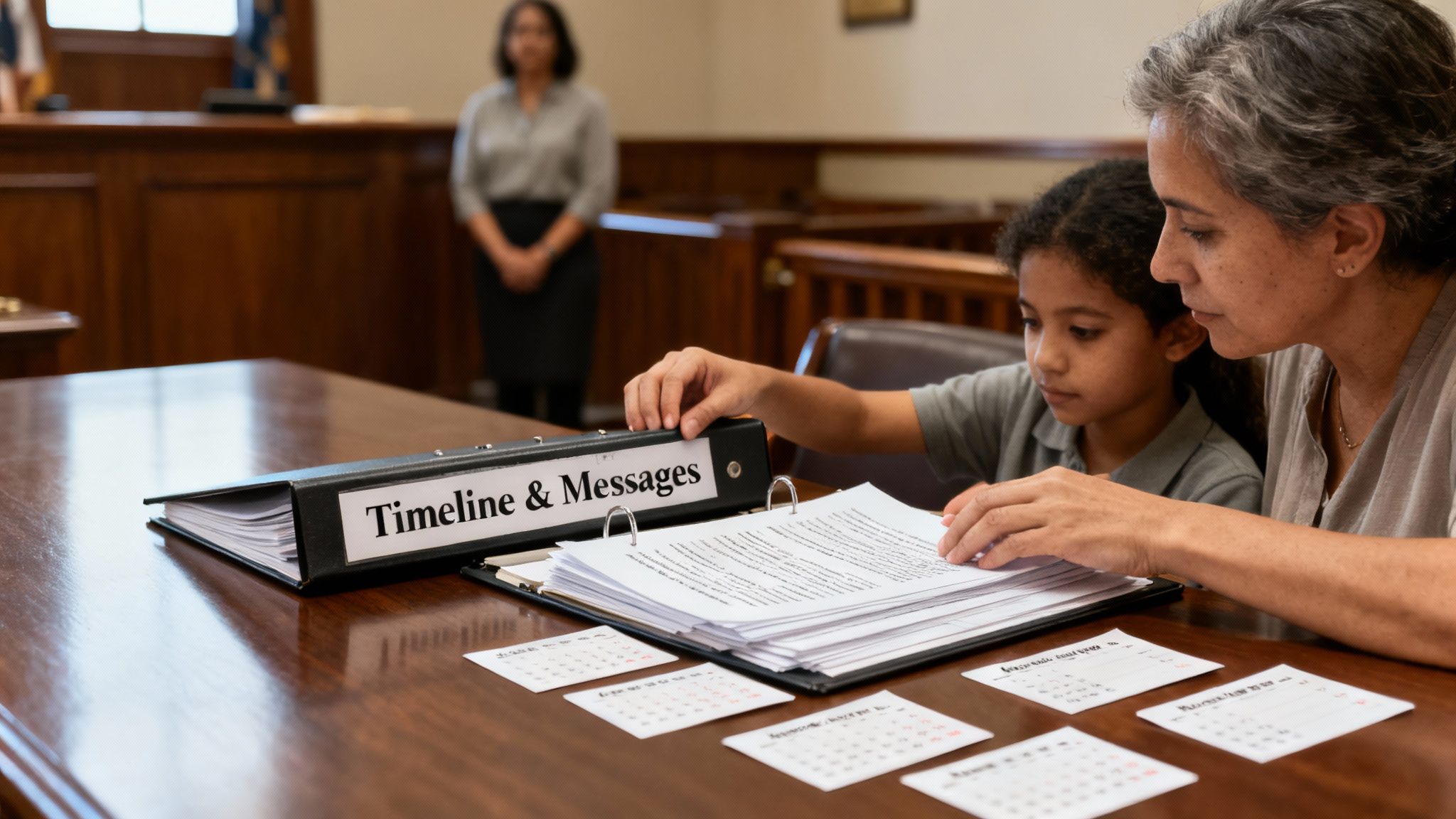
Testifying with Calm Confidence
When you take the stand, your single most important job is to be a credible, factual witness. We know this is a deeply emotional fight, but letting anger, frustration, or overwhelming sadness take over can, unfortunately, do more harm than good for your case. Be prepared—the other attorney might even try to push your buttons to get an emotional reaction and paint you as unstable.
Here are a few things we always tell our Atascocita clients to keep in mind:
- Stick to the Facts. Simply answer the question you are asked. Don't volunteer extra information or veer off on tangents. Your evidence log is your best friend here—rely on the specific dates, times, and events you’ve so carefully documented.
- Speak Clearly and Calmly. Before you answer, take a deep breath. It is perfectly fine to pause and gather your thoughts. A measured, steady voice carries much more weight than one cracking with emotion or rage.
- Focus on Your Child's Experience. Try to frame your answers around the impact on your child. For example, instead of saying, "He constantly lies to ruin my weekends," shift the focus: "When our son is told I am unavailable for my scheduled visit, he becomes withdrawn and anxious for days afterward."
Introducing Your Evidence and Witnesses
Your attorney will handle the legal mechanics of introducing your evidence logs, text messages, and emails. This is where all your meticulous organization really shines. Having everything neatly labeled and dated makes the process look smooth and professional in front of the judge.
Beyond your own documents, testimony from neutral, third-party witnesses can be incredibly powerful. For a Harris County judge, hearing from a respected teacher or coach from the Atascocita community can provide the crucial, unbiased corroboration you need.
Think about the people in your child's life who have no stake in your custody battle but have witnessed the changes firsthand. Their objective observations can validate your claims in a way your own testimony cannot.
Consider asking these types of individuals if they would be willing to testify:
- Teachers from Humble ISD: A teacher could testify about a sudden drop in your child’s grades or mention that they’ve overheard your child repeating negative, out-of-character things about you.
- Coaches in Atascocita: A coach might be able to speak to your child's sudden disinterest in a sport they once loved or a noticeable change in how they interact with their friends.
- Counselors or Therapists: A mental health professional can speak directly to the emotional distress and loyalty conflicts your child is being forced to navigate.
Learning how to prepare for trial is about more than just gathering evidence; it's about presenting a cohesive, compelling story. Your day in court is the culmination of months of hard work. By staying focused, factual, and composed, you give yourself the best possible chance of being heard. For a deeper dive into what to expect, check out our guide on how to prepare for your Harris County custody hearing.
Protecting Your Parental Rights and Your Child's Future
The steps we've outlined give you a solid game plan for identifying and proving parental alienation, but every family's story is different. The road to rebuilding your relationship with your child and securing your rights is rarely a short one. It takes patience, a smart strategy, and the right legal partner in your corner.
You should never have to walk this path alone.
Taking the Next Step in Atascocita
At The Law Office of Bryan Fagan, we've sat across the table from countless parents in Atascocita, Humble, and across northeast Harris County, helping them navigate these gut-wrenching situations. We understand what’s at stake—it's not just about you. It's about your child's emotional health for years to come.
Knowing how to spot parental alienation is one thing, but proving it in a courtroom is an entirely different challenge.
We are fierce advocates for a child's right to have a meaningful, loving bond with both parents. Our time in local Harris County courtrooms has given us a deep understanding of how to frame a case that truly addresses the "best interest of the child"—the standard that judges here care about most.
For a deeper dive into what it takes to succeed in court, you might find our guide on how to win child custody in Texas helpful.
Your child's future is simply too important to leave to chance. Taking informed, decisive action now is the most powerful thing you can do to reclaim your relationship and give your child the stable, loving environment they deserve.
We strongly encourage you to take the next step. Schedule a free, completely confidential consultation at our Atascocita office. We'll sit down, go over the specifics of your situation and the evidence you've already collected, and start outlining a clear path forward to protect what matters most: your child.
Navigating Common Questions in Parental Alienation Cases
When you're dealing with parental alienation, the questions can feel overwhelming. It's a deeply personal and confusing battle, and we've sat with countless parents from Atascocita and Humble who share the exact same fears and uncertainties. Let's walk through some of the most pressing questions that come up time and time again.
How Long Does It Realistically Take to Prove Alienation?
There’s no magic number here. The timeline really depends on the specifics of your situation and how backed up the Harris County courts are. Putting together a strong, undeniable case that clearly shows a pattern of alienating behavior isn't an overnight process—it often takes several months, and sometimes over a year.
You have to account for the time needed for legal discovery, getting a custody evaluation on the calendar, and lining up expert witnesses. The single best thing you can do to move things forward? Start documenting everything right now.
Can We Get a Temporary Order to Stop the Damage?
Yes, and this is often one of our first strategic moves. If we can present the judge with solid initial evidence that the other parent's behavior is causing immediate and serious harm to your child, we can file for temporary orders.
This is a powerful tool. A judge might order reunification therapy to start right away, appoint a neutral third party (an ad litem) to investigate, or even change the possession schedule to stop the bleeding while the case moves forward.
Think of a temporary order as a critical first-aid kit. It provides immediate protection for your child's emotional health and helps stop the alienation from taking deeper root.
What Do I Do If My Child Flat-Out Refuses to See Me?
This is heartbreaking, and it's one of the most common and painful outcomes of alienation. Your gut reaction might be to force the issue—to insist on your court-ordered time. But honestly, that can backfire and give the other parent more fuel for their fire.
From a legal standpoint, here’s the smarter approach:
- Document every single refusal. Log the date, the time, and exactly what your child said or did.
- Keep your cool. As hard as it is, stay calm and loving. Tell your child you love them and you’ll be there when they’re ready.
- Let the pattern speak for itself. We then take this detailed log to the court. Your attorney can use this evidence to make a compelling request for specialized reunification therapy, which is a structured process led by a therapist to safely rebuild your bond.
What Happens to the Alienating Parent if We Win?
A Texas judge isn't looking to punish a parent just for the sake of it—their sole focus is what’s best for the child. But if the court determines a parent has willfully and harmfully engaged in alienating behavior, the consequences can be severe.
They can range from ordering the alienating parent to pay all of your attorney’s fees to, in the most serious cases, completely flipping the custody arrangement and making you the primary parent to shield the child from more emotional abuse.
The road to proving parental alienation is tough, but it's not one you have to walk alone. The experienced team at The Law Office of Bryan Fagan – Atascocita TX Lawyers has the strategic know-how and genuine compassion to guide you. Schedule a free, confidential consultation today by visiting our Atascocita family law website and let's start fighting for your child's future.


