 Skip to content
When fathers in Atascocita ask me how they can win full custody, it usually comes from a place of genuine fear for their child’s well-being. The road to achieving that in Texas isn't easy, but it’s absolutely possible. For our local Harris County courts, it all boils down to showing a judge, with clear and convincing evidence, that making you the Sole Managing Conservator is what’s truly best for your child.
This means you have to prove you can provide a uniquely stable and nurturing home—and often, that the other parent simply cannot. At The Law Office of Bryan Fagan – Atascocita TX Lawyers, we understand the stakes, and we're here to help our neighbors in Humble, Atascocita, and across northeast Harris County navigate this challenge with clarity and support.
What "Full Custody" Really Means in a Texas Court
In my experience working with fathers across Humble and Atascocita, one of the first things we need to clear up is the legal terminology. When you say you want "full custody," what you're actually fighting for under Texas law is to be named the Sole Managing Conservator. This gives you the exclusive right to make the big decisions for your child.
This is a big deal because it’s a major shift from what Texas courts prefer, which is a Joint Managing Conservatorship where parents share those rights. For a Harris County judge to grant sole custody, they must be completely convinced it's in the best interest of the child.
The High Bar for Winning Sole Custody
Let me be direct: securing sole custody is an uphill battle. The court isn't focused on what you or the other parent wants. Its only concern is what your child needs to grow up safe, stable, and healthy.
To win, your case needs to prove one of two critical points:
- You are, without a doubt, the parent best suited to provide a consistently stable and supportive home.
- The other parent's lifestyle, choices, or environment poses a real risk to your child's physical or emotional well-being.
The goal isn't to punish the other parent—it's to protect the child. Every piece of evidence, every argument you make, must circle back to that fundamental principle.
Texas Custody (Conservatorship) at a Glance
To help you understand the legal landscape, it's useful to see how the different custody arrangements stack up. Texas law uses the term "conservatorship" to describe the rights and responsibilities of parents.
| Custody Type (Texas Term) | Who Makes Decisions | When It's Awarded |
|---|---|---|
| Joint Managing Conservatorship (JMC) | Both parents share decision-making rights, often with one parent having the final say on specific issues like where the child goes to school. | This is the default and most common arrangement, as courts presume it's in the child's best interest for both parents to be involved. |
| Sole Managing Conservatorship (SMC) | Only one parent (the "sole managing conservator") has the exclusive right to make most major decisions for the child. | This is awarded in situations involving family violence, substance abuse, neglect, extreme conflict, or one parent's absence. |
| Possessory Conservator (PC) | The non-primary parent in an SMC arrangement. This parent has rights to visitation (possession) but not to make major decisions. | Automatically assigned to the non-custodial parent when an SMC is named. |
Knowing these terms helps clarify exactly what you're asking the court for and what you need to prove to get there.
The Reality for Fathers in Custody Cases
While old biases are slowly fading, we have to be realistic about the numbers. It’s true that 40% of states are moving toward equal custody time, which is great progress. But the fact remains that mothers are still awarded primary custody in about 80% of cases nationwide.
Often, this is due to lingering assumptions about who has historically been the primary caregiver. For a dad to break that pattern and win sole custody, the case usually has to involve serious issues like the mother's proven substance abuse, neglect, or abandonment. That's when the dynamic in a contested case can completely flip. You can learn more about these trends in child custody statistics and see how the data is changing over time.
The most powerful custody cases are built on a foundation of documented facts, not emotional arguments. A judge in the Harris County Civil Courthouse will prioritize evidence that clearly illustrates a parent’s ability to provide long-term stability and sound judgment.
Ultimately, winning full custody requires a smart, evidence-based strategy. At the Law Office of Bryan Fagan, our Atascocita team is here to help you build that case from the ground up, ensuring every step you take aligns with what the court needs to see. Schedule a free consultation with us to talk through your situation and start building a plan to protect your child.
Demonstrating You’re the Right Parent for Your Child
Winning sole custody in Texas isn’t just about wanting it—you have to prove to a judge that placing the child primarily with you is in their absolute best interest. This isn't about tearing down the other parent; it’s about meticulously building an undeniable case that showcases your positive and active role in your child’s life.

The focus has to shift to the concrete, everyday actions that define good parenting. Are you the one showing up for parent-teacher conferences at Humble ISD schools? Do you handle the doctor's appointments? Are you the dad on the sidelines coaching the youth soccer team at Lindsay/Lyons Park in Atascocita? These are the details that matter to a local judge.
A Harris County judge won't just go with their gut. They will systematically analyze your situation using a legal framework known as the "Holley Factors" to figure out what's best for your child. Your job is to build a powerful narrative around these factors, painting a clear and convincing picture for the court.
Proving Your Stability and Involvement
Courts value consistency above almost anything else. A judge is looking for the parent who provides a predictable, secure, and supportive home where a child can truly thrive. This has nothing to do with having the nicest house in Atascocita or the biggest paycheck; it’s all about reliability.
To make your case, you need to start documenting everything that proves you are the anchor in your child’s world.
- Financial Stability: Gather proof of steady employment, a history of paying bills on time, and your demonstrated ability to provide for your child's needs without constant chaos or disruption.
- A Safe Home: Show that you maintain a clean, safe, and suitable home. This means your child has their own space, there’s healthy food in the fridge, and the environment is free from hazards.
- Active Daily Involvement: This is huge. Keep a detailed journal or calendar. Log every school drop-off, every homework session you supervised, every meal you cooked, and every bedtime story you read. This consistent pattern of hands-on involvement is incredibly powerful evidence.
This collection of proof becomes the very foundation of your argument. It shows the court that granting you sole custody isn't a disruption but rather a continuation of the stable life your child already depends on.
A mistake I see all too often is dads assuming that just being a good father is enough. In a courtroom, you have to prove it. A detailed log of your day-to-day parenting can be far more persuasive than emotional testimony because it provides a factual, long-term record of your unwavering commitment.
Meeting Your Child's Emotional and Developmental Needs
Beyond just keeping them safe and fed, the court will look very closely at which parent is better equipped to nurture the child’s emotional and psychological well-being. This is where you can really set yourself apart.
To do this, you need to show the judge that you:
- Foster a Healthy Co-Parenting Relationship: Unless there are legitimate safety issues like family violence, judges want to see a parent who will support the child's relationship with their mother. Never, ever speak badly about her in front of your child.
- Truly Know Your Child: Can you talk about your child's fears, their dreams, and who their best friends are? Do you know their teacher's name, what subject they love, or what they're struggling with at school?
- Provide Genuine Emotional Support: Show how you help your child process their feelings. Are you the one they come to when they're sad or hurt? Be ready with specific examples of how you've helped them navigate tough situations.
Of course, before any of this can happen, your legal relationship with your child must be formally established. If you haven't done so, it's critical to understand how to establish paternity in Texas, as this is the legal bedrock of your parental rights. A court can't grant you custody if you're not legally recognized as the father. Showing that you’ve taken these steps to plan for your child's future demonstrates to the court that you're a prepared, responsible, and forward-thinking parent.
Building Your Case Around the Other Parent's Unfitness
If you’re a father in Texas aiming for sole managing conservatorship, one of the most direct routes is to demonstrate that the other parent would endanger your child's physical or emotional well-being. This isn't about airing out personal disagreements or nitpicking different parenting styles. It’s about building a solid case based on factual, documented evidence of serious issues that make their home unsafe or unstable for your child.
For dads in Atascocita, Humble, and the surrounding Harris County area, this can feel like an incredibly tough mountain to climb. The goal isn't to be vindictive; it’s about protecting your child. You have to shift your mindset from making accusations to presenting objective proof that illustrates a clear and consistent pattern of behavior that directly harms your child or puts them at risk.
What "Unfitness" Actually Means in a Harris County Court
A Texas judge has a very specific definition of an "unfit parent." They focus on actions and conditions that you can prove compromise a child’s welfare. You can't just walk into court and say the other parent is "bad" or makes poor choices. You need to come armed with concrete evidence.
These issues generally fall into several key categories:
- Substance Abuse: This means documented problems with alcohol or drugs that get in the way of their ability to parent. Think DUI charges, failed drug tests, or credible testimony from a witness who saw them impaired while they were supposed to be watching the child.
- Family Violence or Abuse: Any history of physical, emotional, or sexual abuse is a massive red flag for a judge. Police reports, protective orders, records from a CPS investigation, and photographs are absolutely essential here.
- Neglect: This is all about failing to meet a child's most basic needs. Your proof might look like text messages showing the child was left home alone, school records detailing chronic absences, or a witness who can testify about the lack of food, clean clothes, or necessary medical care.
- Severe Mental Health Issues: A parent’s mental health only becomes a factor if it directly and negatively impacts their ability to provide a safe home. A diagnosis by itself isn't enough; you must connect that condition to specific dangerous or neglectful behavior.
As you build your case, you may need to gather evidence about the other parent's fitness. It can be helpful to understand psychiatric assessment processes, as these are sometimes ordered by the court to evaluate a parent's capacity to care for a child.
Gathering Evidence a Judge Will Actually Consider
Showing up with rumors or your own emotional testimony isn't going to get you very far. A Harris County judge needs to see objective, verifiable proof. Your job is to collect evidence that tells a clear, factual story without you having to add your own commentary.
The Kinds of Evidence That Make a Real Impact
- Official Records: These are your heavy hitters. We're talking about police reports, Child Protective Services (CPS) investigation files, and criminal background checks. They are often the most persuasive documents you can present.
- Digital Communications: Save everything. Text messages, emails, and social media posts can be a goldmine if they show neglect, instability, or other concerning behavior. Just make sure you preserve them in a way that can be authenticated for court.
- Witness Testimony: A credible, neutral third party can be incredibly powerful. This could be a teacher from Humble ISD who noticed signs of neglect, a neighbor who witnessed dangerous situations firsthand, or even a family member who can speak to a long-term pattern of instability.
- Parenting Logs: Keep a detailed journal. Document every missed visit, every late pick-up, and any incident where your child came back to you distressed, hungry, or in poor condition. Be specific with dates, times, and details.
It's also critical to recognize when parental alienation might be at play. Sometimes, an unfit parent will try to poison the child against you. If you think this is happening, it’s worth learning more about how to prove parental alienation, as it can become a crucial part of your overall custody strategy.
Your evidence must always circle back to the one thing the court cares about: the best interest of the child. A text message showing the other parent is angry with you is irrelevant. A text showing they left your eight-year-old home alone for hours is compelling proof of endangerment.
While it might feel like an uphill battle, the numbers are slowly starting to shift. U.S. Census Bureau data shows fathers made up just 20% of custodial parents in 2018, but that figure climbed to 25% by 2022—that's a 25% relative increase in only four years. Still, the reality is that courts grant full custody to fathers much less often, only in about 10-15% of contested cases. The key to overcoming those odds is proving the other parent is unfit through documented issues like substance abuse, neglect, or severe mental health problems.
Proving a parent is unfit is a high legal bar to clear, but for fathers whose kids are in a genuinely harmful situation, it is the most direct path to securing their safety. The Law Office of Bryan Fagan – Atascocita TX Lawyers can help you organize your evidence into a compelling case.
Making Your Way Through the Harris County Court System
For any father in Atascocita fighting for full custody, understanding the legal road ahead is more than just helpful—it’s essential. The whole process can feel like a maze, but knowing what to expect at each turn gives you a massive advantage. From the moment you file that first petition to the day of your final hearing at the Harris County Civil Courthouse, every single step is a chance to build and strengthen your case.
The journey officially kicks off when you file a Petition in Suit Affecting the Parent-Child Relationship. This is the formal document that lays out exactly what you're asking the court to do—in this situation, to name you the Sole Managing Conservator. Not long after, you'll probably have a temporary orders hearing. This is a critical first step where the judge makes initial rulings on where the child will live and other arrangements while the full case moves forward.
The Key Stages of a Harris County Custody Fight
The time between filing your initial petition and going to a final trial is where most of the heavy lifting happens. This phase is called the discovery process, and it’s when both sides formally exchange information, documents, and evidence. Your attorney will use legal tools like written questions (interrogatories) and official requests for documents to get a clear picture of the other parent’s circumstances.
During this period, the court often brings in other professionals to help the judge make a final decision that is truly in your child’s best interest.
- Amicus Attorney: The court might appoint an amicus attorney to act as the "eyes and ears" of the judge. This lawyer's job is to represent what's best for your child, not what you or the other parent wants. They will meet with everyone involved—you, the other parent, and your child—before making a recommendation to the court.
- Custody Evaluator: In some cases, a neutral mental health professional is appointed to conduct a deep-dive custody evaluation. This is an exhaustive process involving interviews, home visits, and even psychological testing to assess each parent's fitness and the child's specific needs.
Ultimately, winning a contested custody battle comes down to proving unfitness with solid, verifiable evidence. It's a three-step dance: collect, verify, and present.
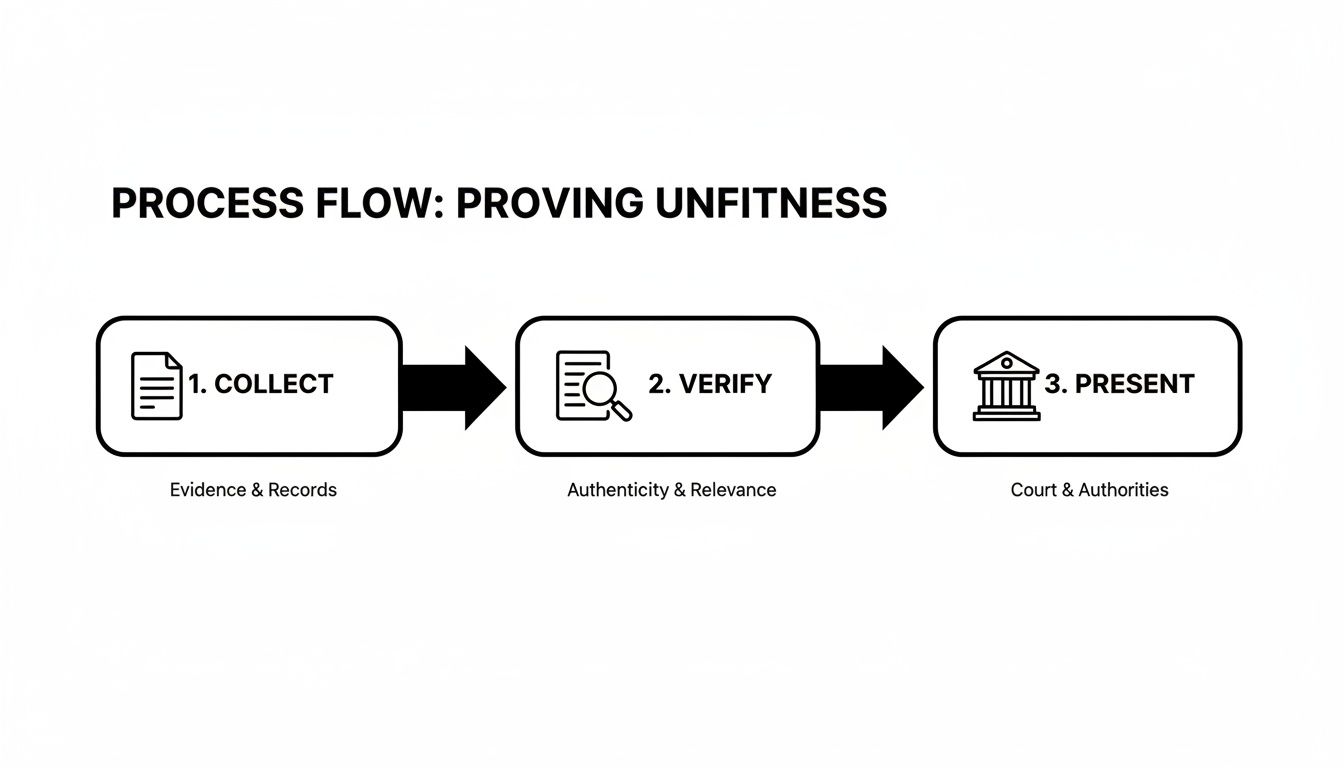
This simple diagram really drives home the point: a successful case is built on a methodical, evidence-first strategy, not just emotional arguments.
Mediation and Your Demeanor in Court
Before you ever step foot in a trial, you'll be required to attend mediation. This is a structured, confidential meeting where a neutral professional—the mediator—helps you and the other parent try to find common ground and reach a settlement. Coming to an agreement here can save you an incredible amount of time, money, and emotional strain. But if you can't reach a deal, your case will continue on the path to a final trial.
How you carry yourself through this entire process speaks volumes. A judge is always watching—how you handle stress, the way you talk about your child's mother, and your overall demeanor in the courtroom. Staying calm, being respectful, and keeping the focus squarely on your child’s well-being will always serve you better than letting anger or frustration take over.
It's also important to see the bigger picture. Joint custody arrangements have jumped by nearly 40% since 2010, as courts increasingly recognize that children do best with both parents actively involved. Even so, fathers only accounted for 25% of custodial parents in 2022. While 51% of custody cases still end with mom as the primary parent, that number can shift dramatically when a father brings a compelling, well-documented case proving the other parent is unfit.
For dads in Atascocita and Humble, knowing how to navigate these local legal hurdles is crucial. The Law Office of Bryan Fagan can help you anticipate each stage, prepare effectively, and build a strategy designed for success. For a closer look at what to expect, take a look at our guide on how to prepare for a custody hearing.
Critical Mistakes Atascocita Fathers Must Avoid
A custody battle is, without a doubt, one of the most draining and stressful things any father will ever go through. When emotions are running high, it's all too easy to make a simple, preventable mistake that can torpedo your entire case. Here at the Law Office of Bryan Fagan, we’ve seen so many good, dedicated dads from Atascocita and Humble accidentally weaken their own position simply by letting their frustration get the better of them.
Knowing what not to do is just as important as knowing what to do.

The absolute key is to act with integrity and keep your child's well-being front and center. A Harris County judge is looking for the parent who demonstrates maturity, stability, and good judgment, especially when under pressure. Every single thing you do—and everything you say or write—can and will become part of the court record.
Losing Control of Your Emotions and Words
During a custody case, your character is constantly under a microscope. It’s not an exaggeration to say that one angry outburst can undo months of careful legal preparation. It can instantly paint you as unstable or aggressive—exactly the image the other side wants the judge to see.
One of the most damaging things you can do is bad-mouth the mother to other people, and especially to your child. A judge will immediately see this as parental alienation, which flies in the face of the "best interest of the child" standard. The same goes for losing your temper in front of your child. Even if you feel completely justified, it can be framed as creating a chaotic and scary environment.
And then there's the digital minefield. Posting an emotional rant on Facebook or firing off a series of angry texts is like gift-wrapping evidence for the opposing attorney. Work from this assumption: every text, email, and social media post you create will eventually be read aloud by a judge.
Strategic and Legal Blunders to Sidestep
Beyond your personal conduct, there are some major strategic errors that can be just as fatal to your goal of winning full custody. These mistakes usually come from not quite understanding the legal maze or just underestimating how complex it all is.
- Waiting Too Long to Hire an Attorney: This is probably the single biggest mistake we see. Fathers try to handle things on their own, thinking they can save money or that it won't get complicated. By the time they finally call us, critical deadlines have been missed and damaging temporary orders are already in place.
- Failing to Follow Court Orders: If a judge has issued temporary orders for visitation, child support, or communication, you must follow them to the letter. Violating a court order, even in what seems like a minor way, tells the judge you don't respect their authority. It's a massive blow to your credibility.
- Ignoring the Discovery Process: The other side's attorney will send formal requests for information, known as "discovery." You are legally required to respond fully and honestly. Trying to hide information or being difficult will only drag things out and make you look bad in the end.
Remember, the court's primary goal is to create a stable and predictable future for your child. By demonstrating that you are the parent who consistently acts with calm, responsible, and child-focused behavior, you align yourself with the court's objective and strengthen your case for sole custody.
Critical Do's and Don'ts for Your Custody Case
To keep your case on track, a clear checklist of what to do and what to avoid can be a lifesaver. This is your guide to maintaining your integrity and focus when things get tough.
| Do This | Don't Do This |
|---|---|
| Keep a detailed journal of your parenting time, communication, and any relevant incidents. | Post anything about your case, your ex, or your personal life on social media. Go silent. |
| Encourage your child's relationship with their mother (unless there are safety concerns). | Speak negatively about the mother in front of your child. Ever. |
| Follow all court orders precisely, even if you disagree with them. | Withhold visitation or refuse to communicate about the children out of spite. |
| Respond to legal requests promptly and honestly through your attorney. | Introduce a new romantic partner to your children in the middle of the case. |
Avoiding these common mistakes isn't just about playing defense. It’s about proactively building a mountain of evidence that shows you are the stable, reliable, and loving parent your child needs. Every right decision you make reinforces the argument that you are the best person for the job of Sole Managing Conservator.
How a Local Atascocita Attorney Can Make the Difference
While this guide gives you a solid starting point, reading articles online can only take you so far. Think of it as the map, but you still have to navigate the terrain. Every family's situation is different, and a cookie-cutter approach just won't cut it when your children's future is on the line. This is where having an experienced, local family law attorney in your corner becomes absolutely critical.
An Atascocita lawyer does so much more than fill out forms and file them downtown. We know the Harris County family court system inside and out—the tendencies of the judges, the unwritten rules, and what it takes to build a case that gets noticed. Our job is to take all the things you do for your kids every single day and turn them into a powerful legal argument.
Turning Your Fatherhood into a Winning Legal Strategy
My role is to help you craft a case that leaves no doubt you are the best parent to be named the Sole Managing Conservator. This isn't something you can do effectively on your own. It involves a very specific skill set and legal knowledge.
Here’s how we work together to build that case:
- Finding the Right Evidence: It's not just about having proof; it's about having the right kind of proof. We'll pinpoint the exact documents, texts, photos, and witness statements that a judge will find persuasive and, just as importantly, legally admissible.
- Telling Your Story: We'll help you organize all that evidence into a coherent narrative. The goal is to paint a clear picture for the judge, showing how your involvement and stability directly serve your child's best interest.
- Managing the Maze: The legal process is a minefield of deadlines, formal requests for information (called "discovery"), and specific court procedures. One small misstep can seriously damage your case. We handle all of that for you, so you can stay focused on your kids.
- Keeping a Clear Head: Custody battles are incredibly emotional. It's easy to get sidetracked or make a decision in the heat of the moment that you'll later regret. We provide that calm, objective voice to guide you and help you avoid common pitfalls.
You are the expert on your child. I'm the expert on the law. When we combine your knowledge with my legal experience, we create a team that is laser-focused on one thing: protecting your child's future.
You don't have to walk this path alone. Fighting for your relationship with your child is the most important thing you will ever do, and you deserve to have a dedicated advocate by your side.
I invite you to come in for a free, confidential consultation at our Atascocita office. Let's talk about your family, your goals, and start putting together a real plan to secure your child’s well-being.
Common Questions from Dads Fighting for Custody
Here in our Atascocita office, we talk to dedicated fathers every day. They all share a deep concern for their children's well-being and often come to us with similar, pressing questions. Let's get right to some of the most common ones.
Does Texas Law Favor Mothers in Custody Cases?
Officially, no. The law in Texas is completely gender-neutral. A judge's one and only legal standard is the “best interest of the child,” and that has nothing to do with whether you're a mom or a dad.
That said, we have to be realistic about old habits. Historically, courts often saw mothers as the primary caregivers, and sometimes that outdated thinking can linger. The way we overcome this is by building a rock-solid, evidence-based case that leaves no doubt about your stability, your involvement, and your ability to provide the best home for your child.
Can My Child Tell the Judge They Want to Live with Me?
Yes, they can, but it’s not as simple as them making the choice. Once a child in Texas is 12 years or older, they have the right to speak with the judge privately in what’s called an "in-chambers interview." The judge will definitely listen and take their preference seriously.
However, the child's wish is just one piece of the puzzle. It is not the deciding factor. The judge still holds the final authority and will make a ruling based on all the evidence presented about what’s truly best for the child’s long-term well-being.
We’re on Good Terms. Do I Really Need an Attorney?
Even if things seem amicable now, getting an attorney is one of the smartest moves you can make. A verbal or handwritten agreement between you and the other parent is not legally enforceable. If they change their mind tomorrow, you have no legal ground to stand on.
An experienced family law attorney does more than just fight. They ensure your final custody order is drafted with precision, protecting your rights and anticipating future issues. We handle the proper filing with the Harris County courts, turning your agreement into a binding order that prevents future legal headaches.
A lot of fathers think you have to prove horrific abuse to win sole custody. That's a myth. Often, the winning case is built on meticulously documenting the other parent's chronic instability, neglect, or a consistent inability to provide a safe and structured home.
Going through a custody battle is tough, and it's not a journey you should take on your own. The legal team at The Law Office of Bryan Fagan – Atascocita TX Lawyers is here to offer the strategic guidance and powerful advocacy you need to secure your relationship with your children.
Let's talk about your situation. You can schedule a free, no-obligation consultation with us today by visiting our Atascocita family law website.


