 Skip to content
Deciding how to protect your family's future is one of the most important things you'll ever do. For those of us in Atascocita, Humble, and the surrounding communities in northeast Harris County, it often boils down to choosing between a living trust and a will. We understand that this can feel overwhelming, but our goal is to provide clear, supportive guidance to help you make the best choice for your loved ones.
The biggest distinction is this: a will only kicks in after you pass away and must go through the court system. On the other hand, a living trust is active during your lifetime and after your death, and it almost always keeps your family out of court. Getting a handle on which one is the right fit for you is the first real step toward securing your legacy and gaining some much-needed peace of mind.
Securing Your Family’s Future in Atascocita
Planning for what happens next is a powerful way to show your family you care. It’s about making sure the assets you’ve worked so hard for—your home in Eagle Springs, a local business in Humble, or the savings account for your kids' college—are passed down exactly how you want. At The Law Office of Bryan Fagan, we're committed to giving every family in our community a clear, supportive path to follow.
This guide is designed to walk you through two of the most effective estate planning tools we have under Texas law. Keep in mind that securing your family’s future often involves more than just legal documents; it's part of a bigger picture that includes smart financial planning and comprehensive estate management. Our job is to help you navigate the legal side of that process with compassion and expertise.
Let's start by breaking down the fundamental differences between a will and a living trust in plain English.

Key Differences at a Glance
Sometimes the easiest way to understand the choice is to see the two documents side-by-side. Each one has a different job to do and follows different rules here in Texas.
| Feature | Last Will and Testament | Revocable Living Trust |
|---|---|---|
| When It's Active | Only after your death, once validated by a court. | Immediately after it's created and you've moved assets into it. |
| Court Involvement | Requires probate, a public court process. | Bypasses probate, keeping your affairs private. |
| Asset Management | Offers no way to manage assets if you're incapacitated. | Lets a successor manage assets if you become incapacitated. |
| Privacy | Becomes a public record in Harris County. | Remains a completely private document. |
Think of a will as a letter of instruction to the probate court. It's an essential document, especially for naming guardians for your minor children and spelling out who gets what after you're gone.
A living trust, in contrast, is more like a private company you create to own your assets. You remain in complete control during your lifetime. Then, a successor trustee you've chosen steps in to manage things if you become unable to or after you pass away—no court permission needed.
Wondering which path makes the most sense for your family? The experienced attorneys at The Law Office of Bryan Fagan are here to provide clarity. Contact our Atascocita office today to set up a free, no-pressure consultation to talk through your specific situation.
Comparing Wills and Trusts for Texas Residents
Choosing the right estate planning tool for your family isn't just about filling out paperwork; it's about understanding how these documents actually work in the real world here in Texas. A will and a living trust are not interchangeable. They operate on fundamentally different principles, especially when it comes to court involvement and when they take effect.
A last will and testament is essentially a set of instructions that springs to life only after you pass away. Think of it as your final directive to the Harris County probate court, outlining exactly how you want your property divided and who you trust to care for any minor children. While you're alive, a will has no legal power.
On the other hand, a revocable living trust is a private legal structure you create and control during your lifetime. You actively transfer your assets—like your home in Atascocita or your investment portfolio—into the trust's name. You remain in the driver's seat as the trustee, and if you become incapacitated or pass away, the successor you’ve chosen takes over seamlessly, often without ever setting foot in a courtroom.

Core Functional Differences
The most critical distinction for Texas families often boils down to one word: probate. A will must go through the probate court system, while a living trust is specifically designed to avoid it.
Key Takeaway: The heart of the living trust vs. will debate in Texas is court supervision. A will guarantees public court involvement (probate), whereas a living trust keeps your affairs private.
This difference is massive. Probate is a public, court-supervised process where a judge validates your will. Every detail, from the value of your assets to who gets what, becomes a matter of public record. Trust administration, by contrast, is handled privately by your hand-picked successor trustee according to the rules you laid out in the trust document.
Will vs. Living Trust At a Glance for Texas Residents
To see these differences side-by-side, it helps to put them into a simple chart. Here’s a quick rundown of how these two powerful estate planning tools stack up under Texas law.
| Feature | Last Will and Testament | Revocable Living Trust |
|---|---|---|
| Effective Date | Becomes legally effective only after your death and upon court validation through probate. | Becomes legally effective as soon as it is signed and funded (assets are transferred into it). |
| Privacy | A will becomes a public document once it is filed for probate in Harris County courts. | A trust remains a completely private document, protecting your family's financial details. |
| Management During Incapacity | A will provides no mechanism to manage your assets if you become ill or incapacitated. | A successor trustee can immediately step in to manage your financial affairs without court intervention. |
| Cost Structure | Generally lower upfront cost to create, but can lead to significant backend costs during probate. | Higher upfront investment to create and fund, but typically saves money by avoiding probate fees. |
| Control and Flexibility | You retain full ownership of assets. Changes require a formal amendment called a codicil. | You retain full control as the trustee. You can easily amend, revoke, or change the trust at any time. |
This comparison makes it clear why many families in our Atascocita community are drawn to trusts. While a trust offers powerful advantages in privacy and probate avoidance, setting one up correctly is a more hands-on process. Every asset you want covered must be formally retitled in the name of the trust—a critical step called "funding." To get a more nuanced look at the benefits and potential downsides, it's worth exploring the revocable trust pros and cons in greater detail.
Ultimately, the best choice depends entirely on your personal goals, the complexity of your assets, and what you want for your family's future. The Law Office of Bryan Fagan is here to help residents of Atascocita, Humble, and the surrounding areas make that decision with confidence. Schedule a free consultation with our team to discuss your estate planning goals today.
Navigating the Texas Probate Process in Harris County
When you're deciding between a will and a trust, one of the biggest factors to consider is a court process called probate. For families right here in our Atascocita and Humble communities, getting a handle on what probate actually involves is a big deal—it directly affects the cost, timeline, and privacy of your estate.
So, what is it? Probate is the formal, court-supervised process here in Harris County that validates a will, settles any outstanding debts, and then legally transfers your assets to the people you named as beneficiaries. Now, it's true that Texas has a more straightforward probate system than many other states, but don't mistake "simpler" for "instant." It's still a formal legal proceeding with plenty of required steps.
What Probate Really Means for Your Family
Once a will is filed with the Harris County probate court, it kicks off a chain of legal requirements. The person you named as executor has to file an application, show up for a court hearing, publish legal notices for any potential creditors, and create a detailed inventory of everything in the estate.
Here’s the part that catches many families by surprise: that will and the detailed inventory become public records. Anyone can go look them up. That means details about your property, from your home in Fall Creek to your investment accounts, are out there for public viewing. For people who value their privacy, this public exposure is often the number one reason they look for ways to avoid probate altogether.
The Financial and Time Costs of Probate
Beyond the lack of privacy, probate comes with very real costs that can chip away at the inheritance you intend to leave behind.
These expenses typically include:
- Court Filing Fees: Every case filed in the Harris County courts comes with administrative fees.
- Attorney's Fees: An executor almost always needs a lawyer to guide them through the process, and those fees come out of the estate.
- Executor Compensation: The person managing your estate is legally entitled to be paid for their work from the estate's funds.
- Appraisal and Accounting Fees: Sometimes, assets need to be formally valued, or a final accounting needs to be prepared, adding to the total cost.
This is exactly why so many Texans choose a revocable living trust—the primary benefit is avoiding these costs. Studies have shown that probate can eat up between 3% and 7% of an estate's total value in fees and expenses. It’s no surprise, then, that over 60% of people with estates valued over $500,000 opt for a living trust to sidestep these expenses. You can discover more insights about these estate planning trends and see how they might apply to your own family.
The process isn’t quick, either. Even a smooth, uncontested probate in Harris County can take several months from start to finish. If a dispute pops up, it can easily drag on for a year or even longer. All the while, your assets are essentially frozen until the court gives the green light for distribution, leaving your beneficiaries waiting.
By design, a properly funded living trust completely bypasses the probate process. Your chosen successor trustee can manage and distribute your assets privately and efficiently, often within weeks, saving your family considerable time, money, and stress.
Why Avoiding Probate Matters
Here's the bottom line: a will guarantees your estate will go through probate. A living trust is specifically designed to avoid it.
While a will is a critical document—especially for naming guardians for your minor children—relying on it as your only tool for passing on assets means you're accepting the built-in costs, delays, and public nature of the probate system. To get a better feel for the specific steps involved, you can learn more about how to probate a will in Texas.
For many folks in the Atascocita area, the peace of mind that comes from knowing their family can handle their affairs privately and without long court delays is simply invaluable.
If making sure your legacy is transferred quickly, privately, and cost-effectively is a top priority, a living trust is almost certainly the better option. The team at The Law Office of Bryan Fagan is ready to walk you through these factors for your specific situation. Schedule a free, confidential consultation at our Atascocita office to discuss how you can protect your family from the headaches of probate.
Key Decision Factors for Your Estate Plan
While avoiding the Texas probate process is a huge reason many families in Atascocita look into estate planning, it’s really just one piece of a much larger puzzle. Deciding between a living trust and a will hinges on several other critical factors that will directly impact your family’s privacy, financial security, and how your legacy is handled.
Thinking through these key areas will help you see which tool truly lines up with what you want for your family's future. It's about looking past the basics and considering the real-world consequences for the people you love.
Planning for Incapacity
What happens if you can't manage your own finances because of an accident or illness? This is one area where the difference between a will and a trust couldn't be more clear.
A will does absolutely nothing for you while you are alive. It only kicks in after you pass away. If you only have a will and become incapacitated, your family would have to go to court in Harris County to get a guardianship. This process is public, often expensive, and can be an emotional nightmare.
A living trust, on the other hand, is built for this exact scenario. It includes provisions that let your hand-picked successor trustee step in and manage your finances right away, with no court involvement needed. This keeps the bills paid and your assets protected, making a tough time a little bit smoother for everyone. You can learn more about how a power of attorney document works in Texas to see how these documents often work together.
Privacy and Public Record
As we’ve mentioned, probate is a public affair. When a will is filed for probate in Harris County, it becomes public record. That means anyone—a nosy neighbor, a disgruntled relative, or even a con artist—can walk in and see:
- A detailed list of everything you owned.
- The total value of your estate.
- Who you left your assets to and how much they received.
For many families, that level of exposure is a non-starter.
A revocable living trust is a completely private document. Its terms, assets, and beneficiaries are never filed with the court, ensuring your family's financial matters remain confidential. This privacy is one of the most compelling reasons people choose a trust.
This simple flowchart shows how your feelings on privacy and speed can point you toward the right choice.
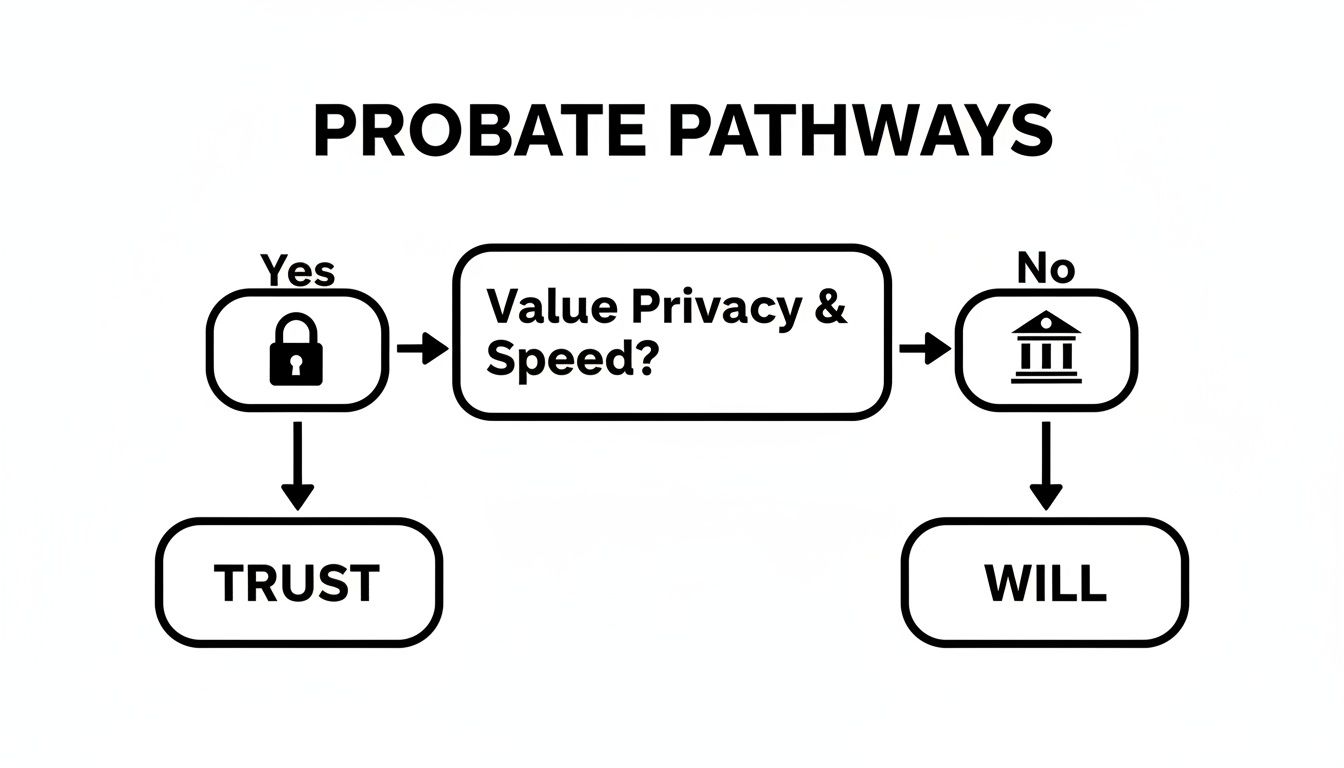
The picture is pretty clear: if keeping your family's business out of the public eye is important to you, a trust is the way to go.
Cost and Asset Protection Considerations
It's a common myth that trusts are only for the super-rich. While setting up and funding a trust costs more upfront than drafting a simple will, it often saves your family a ton of money down the road by avoiding probate.
Think of it as pre-paying for your estate administration privately and efficiently, instead of leaving your family to pay lawyers and court fees later. That initial investment in a trust is often a fraction of the 3-7% of your estate's value that could be eaten up by probate costs.
Of course, your estate plan is more than just a will or trust. You also need to consider other pieces of your financial life. For example, understanding what happens to life insurance without a will is crucial for making sure every asset is accounted for and your family is fully protected.
Handling Complex Family Dynamics
For many families here in Atascocita and Humble, life isn't always simple. A living trust gives you a level of control and flexibility that a will just can't match, which is critical in certain situations.
Take a look at these common scenarios:
- Blended Families: With a trust, you can provide for your current spouse for the rest of their life, while legally ensuring your assets ultimately go to your children from a prior marriage. It's tough to get that kind of guarantee with a will.
- Beneficiaries with Special Needs: You can build a special needs trust into your living trust. This lets you provide for a loved one with a disability without messing up their eligibility for crucial government benefits.
- Managing Inheritances: Worried about a beneficiary who isn’t great with money? A trust allows you to control how they receive their inheritance. You can set it up to be paid out in stages at specific ages—say, 25, 30, and 35—instead of all at once.
A will is basically a one-and-done distribution. A trust, however, can act as a management and protection tool for your loved ones for years or even decades after you're gone.
Feeling overwhelmed by these factors? You don't have to figure this out alone. The compassionate team at The Law Office of Bryan Fagan is here to help. Schedule a free consultation at our Atascocita office, and we'll help you build a plan that brings you peace of mind.
Practical Scenarios for Atascocita and Humble Families
Let's be honest, legal documents can feel a bit abstract. It’s tough to see how a "living trust" or a "will" really affects your life until you see them in action. So, let’s bring it home and look at a few common situations we see with families right here in the Atascocita and Humble areas.
Thinking through these real-world examples can help you see which path might make the most sense for you. After all, your family is unique, and your estate plan should be too.

Scenario One: The Young Couple in Eagle Springs
Let's start with a couple in their early thirties living in Eagle Springs. They have two little ones, ages two and five. They’ve got a mortgage, some savings, and life insurance. Their biggest worry isn't really about dodging probate—it's about making sure their kids are taken care of if something terrible happens.
What’s most important to them?
- Naming a Guardian: Their absolute top priority is deciding who would raise their children. This is something only a will can do.
- Managing Money for Minors: They need a straightforward plan to make sure any inheritance is handled wisely until their kids are grown up.
For this young family, a will is the non-negotiable first step. It’s the only legal document where they can name a guardian. Without one, a Harris County judge—a total stranger—would make that decision for them. That’s a nightmare scenario for any parent.
Our Takeaway: This family needs a solid will to name guardians and an executor right away. As their savings and assets grow over the years, adding a living trust to avoid probate will make a lot of sense, but for now, the will is their foundational protection.
Scenario Two: The Retired Couple in Fall Creek
Now, let's head over to Fall Creek and picture a retired couple in their late sixties. Their home is paid off, they've built up solid retirement and brokerage accounts, and they want to make things as painless as possible for their adult kids. They’ve heard horror stories from friends about probate dragging on, and they want no part of it.
Their goals are completely different:
- Avoiding Probate: They want to bypass the Harris County court system entirely, saving their kids time, money, and headaches.
- Keeping Things Private: They don't want their finances becoming a public record.
- Planning for Incapacity: What if one of them has a health crisis? They need a plan so the other spouse can immediately manage their joint financial life without a hitch.
In this case, a revocable living trust is the perfect fit. By moving their home, bank accounts, and other investments into the trust, those assets can pass directly to their children—no court required. Plus, if one of them becomes incapacitated, their successor trustee can step in instantly to manage everything, ensuring bills get paid and life continues smoothly.
Scenario Three: The Small Business Owner in Humble
Finally, think about a woman in her fifties who owns a thriving auto repair shop in Humble. Her business isn't just her biggest asset; it's the livelihood for her family and her employees. Her main concern is what happens to the business if she’s suddenly gone.
Her priorities are crystal clear:
- Business Continuity: Someone needs to be able to take over immediately—sign checks, manage payroll, and keep the doors open.
- Asset Protection: She wants to keep her business assets separate from her personal ones for a clean transition.
- Probate Avoidance: She knows probate could freeze the business bank accounts, which would be a death sentence for the company.
A living trust is absolutely critical for this business owner. A will would throw the business into the probate process, potentially halting operations for months while the court sorts things out. By placing her ownership of the business into a trust, she can appoint a successor trustee who has the know-how to run the shop or manage its sale right away. This protects the legacy she's built in a way a will simply can't.
Seeing how these tools serve different families in our community probably has you thinking about your own situation. If you recognize yourself in any of these scenarios, it’s a good sign that it’s time to take action.
Reach out to The Law Office of Bryan Fagan for a free consultation at our Atascocita office. We can help you build a practical plan that protects everything you've worked so hard to achieve.
Clearing Up Common Myths About Texas Estate Planning
Misinformation is probably the biggest hurdle keeping families right here in our community from getting their affairs in order. When you start looking into living trusts versus wills in Texas, a lot of myths get tossed around that sound like facts, and that can make it tough to know what to do next. Our goal here is to cut through that noise and give you some real clarity.
It’s not that people don’t care; it’s that the whole process feels overwhelming. In fact, national surveys from 2025 back this up, showing that around 55% of Americans don't have any estate planning documents. When asked why, 43% said they just "haven't gotten around to it," a feeling we hear all the time from busy families. It's interesting to learn more about these estate planning trends and see just how many people are in the same boat.
Let's break down some of the most stubborn myths we hear from folks in Atascocita and Humble.
Common Misconceptions Debunked
Getting the facts straight is the first, most important step. Here are three of the big ones we need to tackle right away.
Myth 1: "Living Trusts are only for the extremely wealthy."
This just isn't true. While trusts are fantastic for managing large, complex estates, their real workhorse benefits—like avoiding probate, protecting your privacy, and planning for incapacity—are incredibly valuable for any family that owns a home or has some savings put away. For many middle-class families in Harris County, probate costs can actually take a bigger percentage chunk out of their estate, making a trust a surprisingly practical and smart financial tool.
Myth 2: "If I create a trust, I lose control of my assets."
This is a huge misunderstanding, but we get why people worry about it. With a revocable living trust, you keep 100% control. You are your own trustee, which means you can buy, sell, refinance, or spend your assets exactly as you always have. You can also amend or even completely dissolve the trust whenever you want. It helps to think of it like a new filing system for your property—you’re just retitling things, not handing over the keys to the cabinet.
A revocable living trust is a management tool you control, not a vault you lock yourself out of. It simply creates a seamless transition plan for your chosen successor to step in if, and only if, you can no longer manage things yourself.
Myth 3: "Having a will means my family can avoid probate."
This one is exactly backward. A will is essentially a set of instructions written for the probate court. A will actually guarantees probate. It's the legal document that kicks off the entire court-supervised process for distributing your assets. Only a properly funded living trust can allow your estate to bypass the Harris County probate system entirely.
Getting your head around these truths is a big step forward. If any of these myths have been holding you back, let’s talk. You can schedule a free, no-obligation consultation at our Atascocita office. The team at The Law Office of Bryan Fagan is here to give you the straightforward, honest guidance you deserve.
Common Questions We Hear About Wills and Trusts
Deciding between a living trust and a will is a big step, and it's natural to have questions. Here in our Atascocita office, we often hear the same concerns from families trying to do the right thing. Let's clear up some of the most common points of confusion.
Our hope is to give you the confidence you need to build a plan that truly protects your family's future.
Can I Have Both a Will and a Living Trust in Texas?
Absolutely. In fact, for most comprehensive estate plans, we strongly recommend it. The two documents work together, with a special kind of will called a "pour-over will" acting as a critical safety net for your trust.
This isn't just a standard will; it's designed to do two specific jobs:
- It's the only place you can legally nominate guardians for your minor children. A trust can't do this, making a will essential for parents.
- It acts as a backstop, "catching" any assets you forgot or didn't have time to move into your trust. Upon your death, the will directs those assets into the trust, ensuring they are distributed according to your wishes.
Think of the pour-over will as the final piece of the puzzle, making sure no asset or, more importantly, no child is overlooked.
Does a Revocable Living Trust Protect My Assets From Creditors?
This is a major misconception we need to clear up. A standard revocable living trust—the kind most people use for estate planning—offers no protection from your creditors while you're alive. Since you maintain full control and can dissolve the trust at any time, the law views the assets as yours.
Asset protection comes from more complex, irrevocable trusts. These instruments are powerful but come with a significant trade-off: you must permanently give up control over the assets you place inside them. They're a specialized tool for very specific, advanced planning situations.
What's the Cost Difference Between a Will and a Trust in Atascocita?
Looking at the initial setup, a will is almost always less expensive than a trust. A living trust is a more complex legal document, and it involves the extra work of retitling your assets into the trust's name—a process we call "funding."
But you have to look at the total, long-term cost. While a trust costs more today, the expenses of probating a will in Harris County can easily dwarf that initial investment. The real value of a trust is that it can save your family a significant amount of money, time, and headaches down the road by keeping them out of court.
Every family's situation is unique, and the only way to know for sure which path is right for you is to sit down with someone who knows the local laws. The team at The Law Office of Bryan Fagan – Atascocita TX Lawyers is here to offer that clear, personal guidance. Let's talk about your goals and give you the peace of mind you deserve.
Schedule Your Free Consultation at Our Atascocita Office Now


