 Skip to content
Facing a divorce brings a whirlwind of emotional and financial questions. For many families in Atascocita, Humble, and across northeast Harris County, one of the most pressing is simply this: "What is alimony in Texas?"
The short answer is that what Texas law officially calls spousal maintenance is a form of temporary, court-ordered financial support. It’s paid by one spouse to the other after a divorce is finalized. The purpose isn't to punish anyone or to keep lifestyles perfectly equal; it's meant to be a financial bridge for a spouse who doesn't have enough property or income to cover their basic needs on their own. At The Law Office of Bryan Fagan – Atascocita TX Lawyers, we want to provide clear, practical answers to help our neighbors feel understood, informed, and supported.
Demystifying Spousal Support In Texas
When you're navigating a divorce in Harris County, getting a handle on the legal terms is the first step toward feeling back in control. While everyone says "alimony," our courts and the Texas Family Code use the term "spousal maintenance."
This isn't just semantics. The specific wording reflects our state's unique and somewhat reluctant approach to post-divorce financial support. The core idea is to give the lower-earning spouse a limited, clearly defined period to gain the skills or education they need to stand on their own two feet financially.
This cautious approach is deeply woven into our state's history. Believe it or not, Texas was the very last state in the U.S. to allow court-ordered alimony, finally passing the law in 1995 after decades of debate. That historical hesitation means spousal maintenance is far from a given in Texas divorces and is governed by some pretty strict rules. You can dive deeper into this topic in our dedicated article about whether Texas is considered an alimony state.
Two Paths To Spousal Support
It's absolutely crucial for Atascocita and Humble residents to know there are two completely different ways to arrange for post-divorce support. Getting this right from the start can make a world of difference for your financial future.
Court-Ordered Spousal Maintenance: This is the version a judge can order under the Texas Family Code. It’s the one with very specific eligibility hurdles, strict caps on payment amounts, and firm time limits.
Contractual Alimony: This is a private agreement that you and your spouse negotiate, usually as one piece of your overall divorce settlement. It offers far more flexibility and can be customized to fit your family’s unique situation, free from the state's rigid statutory limits.
Because these two options have very different rules for things like enforcement and future modifications, you need to be crystal clear on which path you're taking.
Court-Ordered Maintenance Versus Contractual Alimony In Texas
To help you see the difference, we’ve put together a straightforward comparison of the two main types of spousal support available to divorcing couples in Atascocita, Humble, and greater Harris County.
| Feature | Court-Ordered Spousal Maintenance | Contractual Alimony |
|---|---|---|
| Source of Authority | Texas Family Code, Chapter 8 | A private contract between the spouses |
| Eligibility Rules | Very strict (e.g., 10+ year marriage, family violence) | Completely negotiable between the parties |
| Payment Amount Cap | Capped at $5,000 or 20% of the paying spouse's gross income | No statutory cap; determined by agreement |
| Duration Limit | Limited by law (e.g., 5, 7, or 10 years based on marriage length) | Flexible; can be for any duration the parties agree upon |
| Enforcement Method | Enforceable by contempt of court (jail time is possible) | Enforceable like any other contract debt (no contempt) |
| Modification | Can be modified by the court if circumstances change | Can only be modified if the original contract allows for it |
| Tax Implications | Not tax-deductible for the payer or taxable for the recipient | Can be structured to be tax-deductible/taxable if desired |
Understanding these distinctions is key. Court-ordered maintenance offers the powerful enforcement tool of contempt, but contractual alimony provides the freedom to create a plan that truly works for your family without a judge's interference.
"The goal of spousal maintenance in Texas is not to equalize lifestyles but to prevent one spouse from falling into poverty after the divorce. It's about meeting 'minimum reasonable needs' while they get back on their feet."
Thinking about what your life will look like after a divorce can feel overwhelming, but you don't have to figure it all out alone. Here at The Law Office of Bryan Fagan, we've been helping our neighbors in the Atascocita community understand their rights and build stable, secure futures for years.
To get clear, honest answers tailored to your specific situation, we invite you to schedule a free, no-obligation consultation with our Atascocita office today.
Who Qualifies For Spousal Maintenance In Harris County
Let’s clear up a common misconception right away. Many folks in Atascocita and Humble are surprised to find out that spousal maintenance isn't a given in a Texas divorce. What you see on TV dramas rarely matches reality here—our state has some of the strictest rules in the nation. A Harris County judge can’t just order support because one person made more money. It’s simply not that straightforward.
Before a court will even consider ordering spousal maintenance, the spouse asking for it has to clear a significant hurdle: a crucial two-part test. This process is designed to ensure that support is a temporary bridge, not a permanent solution, reserved for those who genuinely need it.
The Two-Part Test For Eligibility
First, you have to prove to the court that you don't have enough property—including your separate property and the assets you'll get in the divorce—to cover your minimum reasonable needs. Think of "minimum reasonable needs" as the absolute essentials: a roof over your head, food, utilities, and healthcare. The court isn’t looking at your accustomed lifestyle, but what you truly need to get by.
Once you’ve proven that financial need, you’re not done. You then have to meet at least one of four specific legal conditions. It's like having to unlock two separate doors to qualify.
This decision tree can help you see the big picture and understand whether a court order or a private agreement is the right path for you.
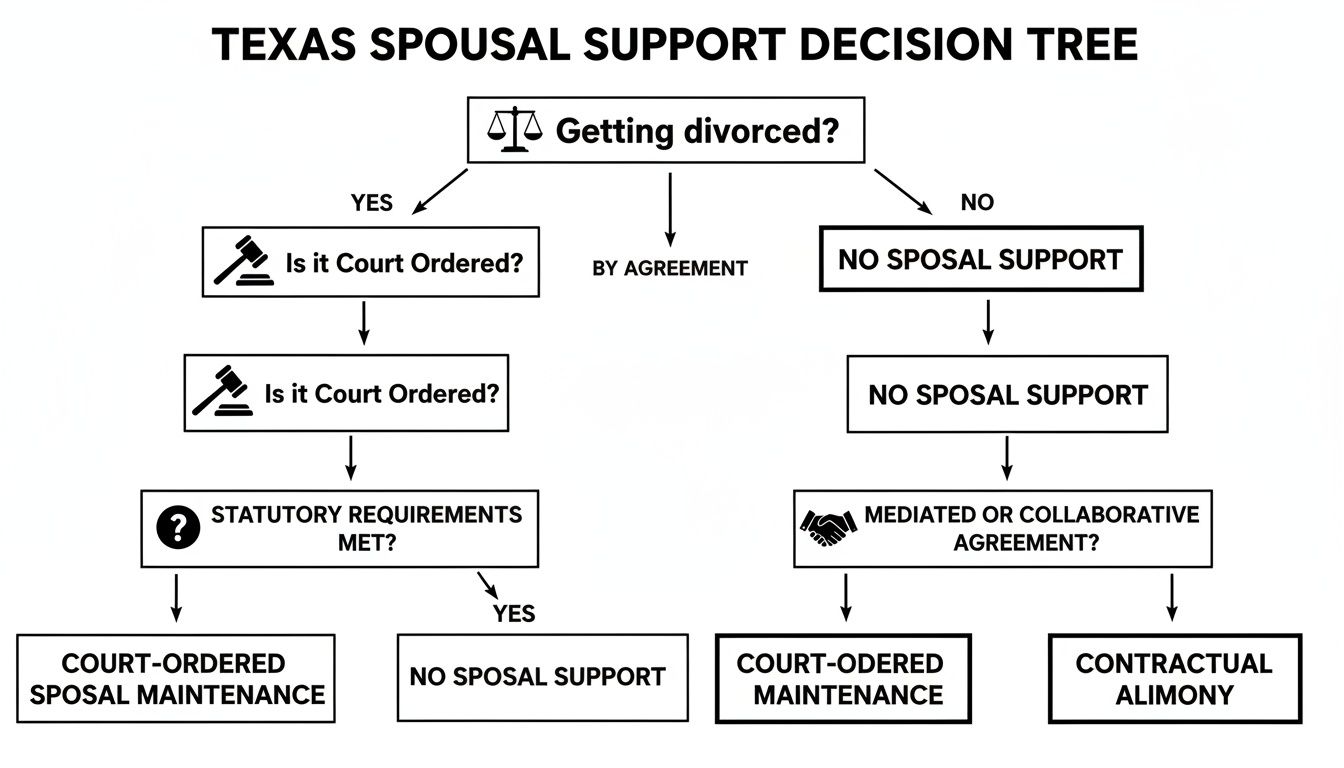
As you can see, your first major decision is whether to pursue a judge's order, which has very strict rules, or negotiate a more flexible private agreement directly with your spouse.
Four Paths To Qualification
So, assuming you’ve already shown you can't meet your basic needs, you must also prove that one of the following four situations applies to your case:
- The 10-Year Marriage Rule: This is the one we see most often. The marriage must have lasted 10 years or longer. You also have to show that you've made real, diligent efforts to earn a living or get job skills but still can't cover those minimum reasonable needs on your own.
- The Family Violence Exception: The 10-year rule is waived if the other spouse was convicted of (or got deferred adjudication for) an act of family violence against you or your child. The incident must have happened within two years of filing for divorce or while the divorce was ongoing.
- A Disabling Condition: If you have an incapacitating physical or mental disability that keeps you from earning enough to support yourself, you may qualify. The length of the marriage doesn't matter in this case.
- Caring for a Disabled Child: You can also qualify, regardless of marriage length, if you are the primary caregiver for a child of the marriage (any age) who has a disability requiring such substantial care that it prevents you from working.
Let's ground this in a local example. Picture a couple living in the Eagle Springs neighborhood of Atascocita for 15 years. One spouse was a stay-at-home parent, managing the household and raising the kids, which allowed the other to build a great career at a company down by the Port of Houston.
If they divorce, the stay-at-home parent might qualify for maintenance under the 10-year rule. They would have to demonstrate to the court that their long absence from the job market makes it impossible to immediately earn enough to pay for their basic needs, despite their best efforts to find work.
Making your way through these requirements can feel overwhelming, and the evidence you present to the court has to be solid and persuasive. You can learn more about the qualifications for alimony in Texas in our detailed guide.
Understanding these rules is the first, most critical step in protecting your financial future. If you think one of these scenarios fits your situation, it's time to start gathering the documents to back up your claim. At The Law Office of Bryan Fagan, we can help you figure out where you stand and build a strong case. Contact our Atascocita office for a free consultation to talk about your specific circumstances.
How Texas Courts Calculate Alimony Payments
So, you think you might be eligible for spousal maintenance. The next big questions are almost always, "How much will I get?" and "How long will it last?"
Forget what you've seen in the movies. A Harris County judge doesn’t just pull a number out of a hat. Texas law lays out a very specific framework for these calculations, starting with a hard ceiling on how much can be awarded. This ensures the supported spouse gets a leg up without placing an impossible burden on the paying spouse. Getting a handle on how this works is the first step toward setting realistic expectations for your life after divorce.

The Strict Caps on Alimony Amounts
Texas law puts a firm limit on spousal maintenance. A judge cannot order payments that exceed the lesser of these two amounts:
- $5,000 per month
- 20% of the paying spouse's average monthly gross income
Let’s make this real. Say we have a family in Atascocita, and the paying spouse makes an average of $10,000 in gross income each month. We calculate 20% of that, which comes out to $2,000. Since $2,000 is less than the $5,000 cap, the absolute maximum a judge could award is $2,000 per month.
Now, let's look at a higher-earning household in Humble where the paying spouse brings in $30,000 a month. Twenty percent of that income is $6,000. In this case, the $5,000 cap kicks in because it's the lesser amount. The maximum possible award here is $5,000 per month.
This calculation is a maximum, not a guarantee. The final amount is often lower and is based on a wide range of factors unique to your family's circumstances.
Beyond The Numbers: A Judge’s Discretion
That cap is just the starting point—the absolute upper limit. From there, the Texas Family Code gives judges a long list of factors they must consider to land on an amount that’s fair and just for everyone involved. It’s less like a simple math problem and more like a holistic review of your family’s unique story.
This is where a judge has the flexibility to shape an award based on specific needs and abilities. It's also where having an experienced local attorney to help you present a clear and compelling case on these points can make all the difference. For a deeper dive, you can learn more about how much alimony you might expect in Texas in our detailed article.
Key Factors a Harris County Judge Will Consider
When deciding on the final amount and duration, a judge will carefully weigh the evidence you and your spouse provide. They’ll be looking closely at things like:
- Financial Resources: What property is each spouse walking away with? Can each person meet their own basic needs independently right after the divorce?
- Education and Job Skills: What is each spouse's educational background and work history? How long would it realistically take the supported spouse to get the training needed to become self-sufficient?
- Length of the Marriage: A long-term marriage, particularly one where a spouse set aside their own career to support the family, often warrants more significant consideration for maintenance.
- Age and Health: The court takes into account the age, work history, and both the physical and emotional condition of the spouse asking for support.
- Contributions as a Homemaker: Texas courts explicitly recognize the value of a spouse's non-financial contributions—managing the household and raising children—which allowed the other spouse to build their career.
- Marital Misconduct: Did one spouse commit adultery or cruelty? Did someone wastefully spend community funds? This behavior can absolutely influence a judge’s final decision.
This multi-faceted review is precisely why Texas courts have a strict formula, as laid out in Texas Family Code Sec. 8.055. It’s meant to create a predictable and fair starting point. Remember, "gross income" is defined broadly—it covers wages, salaries, bonuses, and even self-employment income before taxes. This means the 20% calculation can be quite substantial, even with the cap.
How Long Do Spousal Maintenance Payments Last?
When it comes to spousal maintenance in Texas, the first thing to understand is that it’s not meant to last forever. Think of it as a temporary financial bridge, designed to help one spouse get back on their feet after a divorce, not as a permanent paycheck. For folks here in Atascocita and Humble, knowing the legal time limits is the key to planning a stable financial future.
The law is very clear on this. The amount of time someone can receive payments is directly tied to the length of the marriage. Texas lawmakers put these caps in place to create a predictable endpoint, encouraging the receiving spouse to work toward financial independence while still providing a defined period of support.
The Standard Time Limits in Texas
The Texas Family Code draws some pretty firm lines in the sand. With very few exceptions, the absolute longest you'll see a maintenance order last is 10 years, and that's only for very long-term marriages. The whole system is designed to be temporary.
In most cases, judges are actually pushed to order maintenance for the shortest time possible—just long enough for the receiving spouse to gain the skills or find the employment needed to support themselves. The maximum time a judge can order is based on a simple, tiered schedule:
- Marriages lasting 10 to 20 years: The absolute maximum duration for maintenance payments is 5 years.
- Marriages lasting 20 to 30 years: The cap on payments increases to a maximum of 7 years.
- Marriages lasting 30 years or more: For these very long-term marriages, the maximum duration is 10 years.
The goal is always to find the shortest possible duration that allows the receiving spouse to meet their "minimum reasonable needs" while they transition to being self-supporting.
A Clear Look at the Timeframes
To break it down even more clearly for our Harris County neighbors, here’s a straightforward table showing the maximum time a court can order someone to pay spousal maintenance.
Texas Spousal Maintenance Duration Limits
This table outlines the maximum duration a Texas court can order for spousal maintenance based on the length of the marriage.
| Length of Marriage | Maximum Duration of Alimony Payments |
|---|---|
| 10 to 20 years | 5 years |
| 20 to 30 years | 7 years |
| 30 years or more | 10 years |
| Less than 10 years (with a family violence conviction) | 5 years |
| Incapacitating disability of spouse or care for disabled child | Potentially Indefinite |
These are the hard-and-fast rules that guide judges in setting the end date for spousal support obligations.
The Exceptions: When Support Can Last Longer
While the law emphasizes temporary support, there are a couple of rare but important exceptions. In specific situations where becoming self-sufficient just isn't a realistic option, a judge can order payments for an indefinite period.
These aren't common and are reserved for very specific circumstances:
- An Incapacitating Disability: This applies if the spouse asking for maintenance has a physical or mental disability that is so severe it prevents them from earning enough to provide for their own basic needs.
- Caring for a Disabled Child of the Marriage: This can happen if the spouse is the primary caregiver for a child (of any age) who has a significant physical or mental disability. If that child requires so much care that it prevents the parent from being able to work and support themselves, indefinite maintenance may be ordered.
Even in these "indefinite" cases, the order isn't necessarily permanent. The court can always review it later if circumstances change for either person.
How Spousal Maintenance Can End Sooner
It's also really important to know that a maintenance order can end before the date set by the judge. Certain life events will automatically terminate the payments, no questions asked.
The obligation to pay spousal maintenance stops immediately if:
- Either party passes away. The responsibility doesn't get passed on to their estate.
- The receiving spouse gets remarried. The payments legally stop the day they say "I do" again.
- The receiving spouse moves in with a romantic partner. If the person receiving support starts cohabitating—living with another person in a romantic, supportive relationship—the paying spouse can go back to court and ask a judge to terminate the maintenance order.
These rules reinforce the core idea of maintenance: it's intended to support a single person until they can either stand on their own two feet or have found a new partnership to rely on.
Navigating your financial life post-divorce is complicated enough. If you have questions about how long you might be paying or receiving spousal support, our team at The Law Office of Bryan Fagan is here to provide clarity. Schedule a free, confidential consultation at our Atascocita office to go over your specific situation and get the answers you need.
Modifying Or Enforcing Your Alimony Order
The moment a judge signs your divorce decree, life doesn't just freeze in place. For families right here in Atascocita and Humble, a sudden job loss, a big promotion, or a serious health scare can completely upend the financial reality that existed during the divorce.
When that happens, a spousal maintenance plan that seemed fair at the time might suddenly feel impossible or completely inadequate. Thankfully, Texas law gets that life is unpredictable. A court order for spousal maintenance isn’t necessarily locked in forever, but changing it requires taking the right legal steps.
Seeking a Modification of Your Alimony Order
If you’re the one paying or receiving spousal maintenance and your financial world has been turned upside down, you can go back to court and ask for a modification. But—and this is a big but—you can't just ask for a change because you feel like it. The law has a specific requirement: you must prove there's been a material and substantial change in the circumstances of either you or your ex-spouse.
That’s a pretty high bar to clear. A small dip or rise in income probably won’t be enough to get a Harris County judge to rewrite the order. The change has to be significant, lasting, and often, something you couldn't have anticipated.
So, what counts as a "material and substantial change"? It often looks like one of these scenarios:
- Involuntary Job Loss: The spouse paying support gets laid off from their job.
- A Major Shift in Income: The paying spouse lands a huge promotion with a significant pay bump, or the receiving spouse gets a new, high-paying job that changes their financial needs.
- A Serious Health Crisis: One of you is diagnosed with a disability or illness that prevents you from working in the same capacity.
- Remarriage or Cohabitation: As we’ve covered, if the person receiving support remarries or moves in with a new romantic partner, that can be grounds to terminate the support order.
To get the ball rolling, you have to file a formal "Motion to Modify" with the very same court that handled your original divorce. From there, a hearing is set where both sides can present their evidence and make their case for or against changing the order.
Enforcing an Alimony Order When Payments Stop
A court order isn’t a friendly suggestion; it's a legal command. If your ex-spouse was ordered to pay you spousal maintenance and they simply stop, you have powerful legal tools to force them to comply. You should never be in a position where you have to beg for money that is rightfully yours.
An enforcement action is the court's way of reminding the paying spouse that its orders have teeth. The consequences for ignoring them are serious, ranging from financial penalties all the way to jail time.
The process starts by filing a "Motion for Enforcement" with the court. This legal document lays out the facts: precisely which payments were missed and the total amount owed, which is called the arrearages.
Once that motion is on file, a judge has a whole arsenal of tools to compel payment and hold the non-compliant spouse accountable.
Consequences for Failing to Pay Alimony
A judge doesn’t take kindly to their orders being ignored. The penalties for failing to pay spousal maintenance are designed to be severe enough to ensure compliance and get you the financial support you were awarded.
Here’s what a judge can do:
- Wage Garnishment: The court can send an order straight to the paying spouse's employer, forcing them to deduct the alimony payments directly from their paychecks.
- Contempt of Court: A judge can find the non-paying spouse in contempt of court. This can lead to heavy fines and even jail time for up to six months.
- Money Judgment: The court can issue a judgment for the entire amount of unpaid alimony, plus interest. This can wreck the other party's credit score.
- Attorney's Fees: The judge can order your ex-spouse to pay for the lawyer you had to hire just to file the enforcement action in the first place.
Whether your life has taken an unexpected turn or you're fighting to receive the support you were already awarded, you don't have to navigate this alone. The team at The Law Office of Bryan Fagan is here to help our neighbors in Atascocita and the surrounding areas. Schedule a free, confidential consultation today to talk about your case and learn how we can protect your financial stability.
Taking The Next Step With A Local Atascocita Attorney

This guide gives you a solid foundation for understanding spousal maintenance in Texas. But reading about the law is one thing; applying it to your own family’s circumstances is another beast entirely. This is where we move from just information to decisive action.
Knowing the rules is the first step, but securing a fair outcome requires sharp negotiation and a real-world understanding of how Harris County judges handle these cases. An attorney who lives and works in this community—who knows the courts and the local legal culture—can be your single greatest advantage.
Why A Local Attorney Is A Game-Changer
When you're going through a divorce in Atascocita or Humble, having a lawyer who is truly part of the community makes a real difference. A local attorney gets the economic landscape and family dynamics here because they're part of it, too.
That kind of on-the-ground insight is invaluable when building your case. It's also why so many people look to the power of online reviews for lawyers—it reflects an attorney’s reputation and track record right here in our area.
The best legal strategies are always built on trust, open communication, and a clear understanding of what you need to move forward.
Your Key Takeaways
As you think about what to do next, let's boil it all down to the most critical points about Texas spousal maintenance:
- It Is Strictly Regulated: You don’t get it automatically. You have to meet very specific, narrow criteria laid out in the Texas Family Code.
- It Is Temporary By Design: The entire point is to be a short-term financial bridge, not a permanent source of income. The law has strict time limits.
- It Is Never Guaranteed: Even if you qualify, a judge has the final say on the amount and duration, and they’ll consider a long list of factors.
We get how stressful this is. Our entire mission is to cut through the confusion and give you a clear path forward. You don't have to navigate this uncertainty by yourself.
The team at The Law Office of Bryan Fagan – Atascocita TX Lawyers is here to protect your rights and help you secure your financial future. We encourage you to take that next step. Schedule a free, completely confidential consultation at our Atascocita office, and let's talk about your situation and build a plan to move forward with confidence.
Answering Your Top Questions About Texas Alimony
Even after getting the basics down, you probably still have questions. That’s completely normal. Let's tackle some of the most common things folks in Atascocita and Humble ask about spousal maintenance in Texas.
Does Adultery Affect Alimony In Texas?
Absolutely. While cheating doesn't automatically mean someone gets or is denied alimony, it's a huge factor a Harris County judge will consider. The law allows judges to look at "fault" in the breakup of the marriage when making a decision.
If the spouse asking for support was the one who had an affair, a judge might be less inclined to grant maintenance or could award a smaller amount. On the flip side, if the paying spouse’s infidelity helped cause the divorce, that could strengthen the case for awarding alimony to ensure a fair and just outcome.
Is Contractual Alimony A Better Option?
It can be, but it really depends on your situation. Contractual alimony is an agreement you and your spouse make together, outside of a judge's order. This route gives you a ton of flexibility. You can agree to amounts and timelines that go beyond the state's legal limits and even structure the payments in a tax-friendly way.
The major trade-off? Contractual alimony usually can't be changed by a court later unless you specifically write that option into your agreement. Court-ordered maintenance is more rigid, but it comes with built-in legal pathways for enforcement and modification if life throws you a curveball. A skilled Atascocita attorney can walk you through the pros and cons to see which approach makes the most sense for you.
What Are Minimum Reasonable Needs In Harris County?
This is a common source of confusion because there's no magic number. "Minimum reasonable needs" is determined by a judge for each individual case, based on what it costs to cover your essential monthly expenses.
Think about what it takes to get by. A judge will typically look at costs like:
- Rent or mortgage payments
- Utilities (lights, water, gas)
- Groceries
- Fuel and car payments
- Health insurance premiums
The court’s aim is to make sure you can cover the basics—not to preserve the lifestyle you had while married. Putting together a detailed, honest monthly budget is one of the most important things you can do to prove your financial needs.
Navigating the details of spousal maintenance requires clear, trustworthy guidance tailored to your situation. The dedicated attorneys at The Law Office of Bryan Fagan – Atascocita TX Lawyers are here to provide that support. We invite you to schedule a free, no-obligation consultation at our Atascocita office to discuss your case and protect your financial future. Learn more by visiting us at https://www.atascocitaattorneys.com.


