 Skip to content
When you're facing a divorce in our Atascocita community, it's natural for your mind to race with questions about money and your future. One of the very first things our neighbors ask is, "Can you get alimony in Texas?” The short answer is yes, but it’s a far cry from the dramatic payouts you see on TV. Texas has some very specific, and frankly, very strict rules you need to know about. At The Law Office of Bryan Fagan, we believe an informed client is an empowered client, and our goal is to help you understand these rules so you can protect your family's future.
Understanding Spousal Support in Texas
The end of a marriage often brings a major financial shock, especially if one of you was the primary breadwinner. For families here in Humble, Atascocita, and throughout northeast Harris County, understanding your options is the first step toward stability. In Texas, what most people call alimony is legally known as "spousal maintenance." A judge will only order it if a very specific set of conditions are met.
But there's another path—one that offers a lot more flexibility and control.
It's critical to grasp that there are really two different kinds of post-divorce financial support:
- Court-Ordered Spousal Maintenance: This is the formal, judge-ordered support most people think of as alimony. It's only granted if you clear some high legal hurdles here in the Harris County courts.
- Contractual Alimony: This is a private agreement you and your spouse negotiate, usually as part of your overall divorce settlement. It gives you both far more control over the outcome and is a practical solution for many Atascocita families.
Knowing the difference between these two is the single most important first step in mapping out your financial future.
Why Texas Law Is So Strict
There's no sugarcoating it: Texas is one of the toughest states in the country for getting court-ordered alimony. Unlike in other states where support might be more common, our courts start from a different place. Here, the spouse asking for help must first prove they can't meet their own “minimum reasonable needs” before a judge will even entertain the idea of maintenance.
You can get a deeper look at the fundamentals in our guide to what spousal support is in Texas. This tough legal standard often means that for many marriages, especially those under 10 years, a court-ordered award simply isn't on the table.
The restrictive nature of Texas law is precisely why understanding all your options, including negotiation, is so vital. It places the power back into your hands, allowing you and your spouse to create a fair agreement that a court legally cannot.
This is also why contractual alimony has become such a valuable tool for divorcing couples in our community. It allows you to tailor a plan that actually fits the reality of your marriage, rather than being forced into the rigid, one-size-fits-all box of the law.
To help you see the differences more clearly, here's a quick comparison.
Court-Ordered Maintenance vs. Contractual Alimony At A Glance
This table breaks down the key distinctions between the two main types of spousal support available to Texas families, helping you see which path might be more suitable for your unique circumstances.
| Feature | Court-Ordered Spousal Maintenance | Contractual Alimony |
|---|---|---|
| Basis for Award | Must meet strict statutory eligibility rules (e.g., marriage duration, inability to self-support). | Based on mutual agreement between spouses; no strict legal requirements. |
| Flexibility | Highly rigid. Amount and duration are capped by law. | Highly flexible. Spouses can agree to any amount, duration, and terms they see fit. |
| Enforcement | Enforceable by contempt of court (jail time). | Enforceable as a breach of contract (money judgment). |
| Modification | Can be modified by a court if circumstances materially and substantially change. | Generally not modifiable by a court unless the agreement specifically allows it. |
| Control | A judge decides everything based on limited factors. | Spouses have complete control over the terms. |
As you can see, the path you choose has significant long-term consequences. While court-ordered maintenance provides powerful enforcement tools, contractual alimony offers the freedom to create a solution that works for both of you.
If you're worried about your financial stability after divorce, you need a clear, honest picture of what's possible under Texas law. The Law Office of Bryan Fagan is here to provide that clarity. We invite our Atascocita and Humble neighbors to Schedule a free consultation at our local office. Let's sit down, talk about your situation, and build a strategy to protect your future.
Meeting The Strict Eligibility For Spousal Maintenance
When someone from Atascocita or Humble asks, “Can you get alimony in Texas?” what they're really asking about are the state's very specific rules for court-ordered spousal maintenance. As your local legal team, we want to be blunt: the law sets a high bar. Simply wanting or needing financial help after a divorce isn't enough to get a judge to sign off on it.
You have to clear two major legal hurdles first.
The first hurdle applies to everyone. You have to prove to a Harris County judge that after the marital property is divided, you will still lack sufficient assets to provide for your "minimum reasonable needs." This is a critical phrase. It's not about maintaining the lifestyle you were accustomed to during the marriage; it’s about covering the absolute basics—rent or mortgage, utilities, food, and transportation right here in our area.
To help visualize the different ways spousal support can come about in Texas, this flowchart breaks down the difference between a court-ordered award and a private agreement.
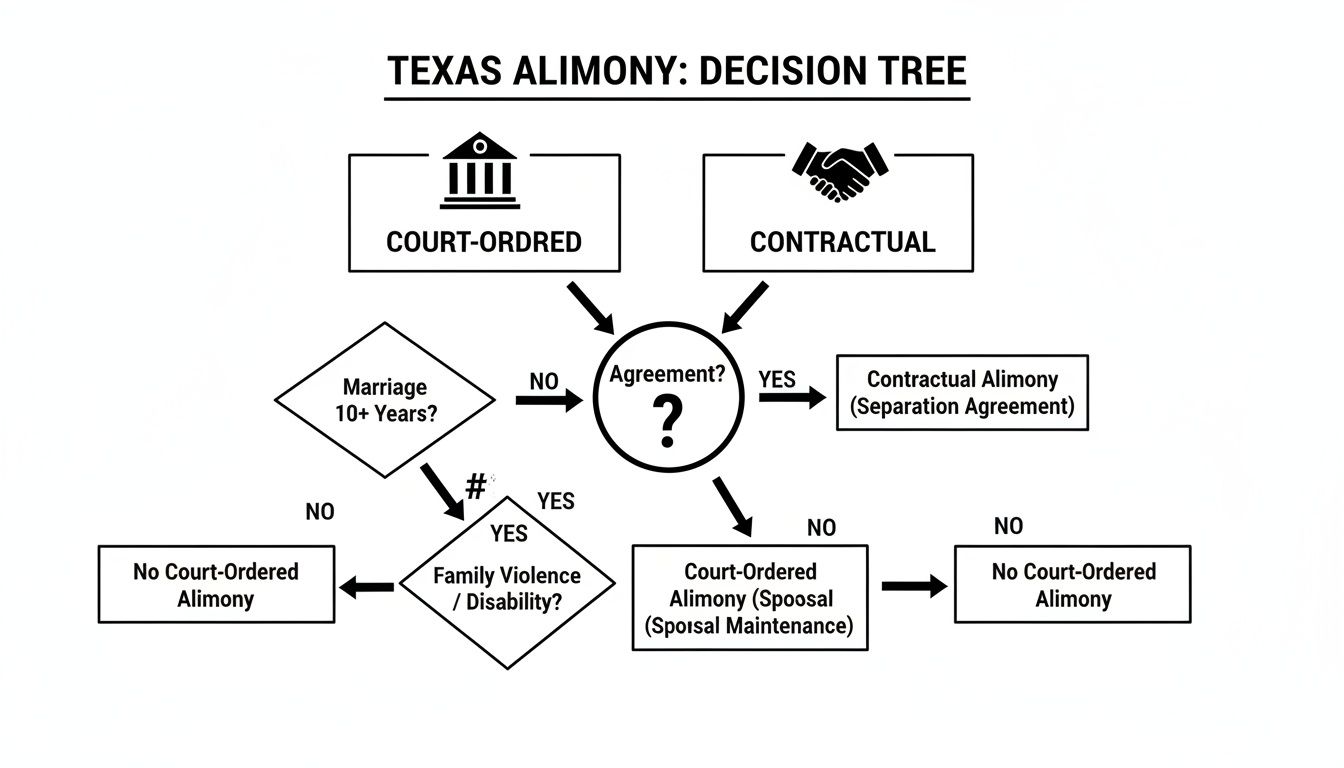
As you can see, the path splits dramatically depending on whether you and your spouse can agree on your own. A private agreement offers flexibility, while a court order means you have to fit into one of the law's narrow boxes.
The Second Hurdle: Four Paths To Qualification
Okay, so let's say you've shown the judge you can't meet your basic needs with the property you'll receive. You're still not done. You also have to satisfy at least one of the following four conditions. Just one will do.
-
The 10-Year Marriage Rule: This is the one we see most often in our Atascocita practice. You must have been married for 10 years or longer and be unable to earn enough to cover your minimum reasonable needs. The court will want to see that you've made real, diligent efforts to find a job or get training to become self-sufficient.
-
Family Violence Conviction: If your spouse was convicted of (or received deferred adjudication for) a criminal act of family violence against you or your child, this can be a path to eligibility. The offense must have happened within two years of filing for divorce or while the divorce case is ongoing.
-
Incapacitating Disability: You might qualify if you are unable to earn a sufficient income because you have an incapacitating physical or mental disability. This is all about your personal ability to work and support yourself.
-
Caregiver for a Disabled Child: Eligibility can also be established if you are the primary caretaker of a child from the marriage (of any age) who has a physical or mental disability that requires so much hands-on care and supervision that it prevents you from working enough to meet your own needs.
Let’s put this into a real-world context. Imagine a couple in Humble married for 12 years. One spouse was a stay-at-home parent with very little recent work history. If their share of the community property isn't enough to cover basic living expenses, they could potentially qualify for spousal maintenance under the 10-year rule—but they'll have to prove to the judge that they're actively trying to find work or get job skills.
Gathering The Right Evidence Is Key
Proving any of this isn't a matter of just telling your story. It requires hard evidence: financial statements, job search logs, and sometimes medical or criminal records. A judge won't just take your word for it; you have to present a compelling, documented case. This is where having a local attorney who knows the Harris County courts becomes invaluable.
For our neighbors in Atascocita and the surrounding communities, understanding these strict requirements is the first, most important step. We can help you figure out if you have a viable claim, gather the proof you'll need, and present your case effectively in court.
If you believe you might meet these criteria, don't wait. Schedule a free consultation at our Atascocita office to go over your specific situation and start protecting your financial future.
How Courts Calculate The Amount And Duration
So, you’ve cleared the first hurdle and meet the strict eligibility requirements for spousal maintenance. The next logical questions are, "How much can I expect?" and "How long will it last?"
Fortunately, Texas law doesn't leave these answers to pure chance. The courts operate within clear, statutory limits that anyone in Atascocita or Humble needs to understand before heading into a divorce.

Unlike some states where alimony calculations can feel a bit like a black box, Texas puts a firm ceiling on what a judge can order. These limits protect the paying spouse from being financially overwhelmed while still providing a bridge for the receiving spouse.
The Two Hard Limits On Payment Amounts
A Harris County judge has to follow a straightforward rule: the monthly spousal maintenance payment can be no more than $5,000 or 20% of the paying spouse's average monthly gross income—whichever is less. This "whichever is less" part is a critical detail that often catches people by surprise.
Let's break that down with a real-world Atascocita scenario.
Imagine a manager living in Eagle Springs earning $360,000 a year, which is $30,000 per month. A simple 20% calculation comes out to $6,000. However, because of the state cap, the court cannot order more than the $5,000 limit.
Now, flip that. What if the paying spouse is a teacher in Humble ISD making $70,000 a year (around $5,833/month)? In that case, 20% is only $1,166 per month. Since that amount is less than $5,000, it becomes the maximum possible award.
It's also important to know that "gross income" isn't just a base salary. It can include bonuses, commissions, rental income, and even business profits.
How The Length Of Your Marriage Sets The Timeline
Just like the amount, the duration of payments is also tightly controlled by state law. The timeline is tied directly to how long you were married—the longer you were together, the longer you might receive support. But even for very long marriages, there are absolute cutoffs.
The law starts with the assumption that maintenance should only last for the shortest reasonable time needed for the receiving spouse to get back on their feet financially.
Here is a table that clearly lays out the maximum timelines a judge can order based on the length of the marriage.
Maximum Duration Of Spousal Maintenance In Texas
| Length Of Marriage | Maximum Duration Of Payments |
|---|---|
| 10 to 20 years | 5 years |
| 20 to 30 years | 7 years |
| 30 years or more | 10 years |
Keep in mind, these are the maximums. A judge is not obligated to award these full terms. They will look at the whole picture—things like each person’s financial resources, job skills, age, and health—before deciding on a fair duration. Our attorneys can help you understand how much alimony is realistic in your Texas case based on these factors.
Even if you check all the eligibility boxes, the final award is never a given. This is where having experienced legal guidance is crucial to present your side of the story effectively, whether you're requesting maintenance or defending against an unrealistic demand.
The Power of Negotiating Contractual Alimony
Let's be honest: the court's rules for spousal maintenance are incredibly strict. For many families right here in Atascocita, the rigid requirements and caps just don't work. The good news? The Texas Family Code gives you a way out. It’s a far more flexible and collaborative alternative called contractual alimony.
This powerful tool lets you and your spouse sidestep the rigid courtroom framework. Instead of a judge making the call, you work together to design a financial support plan that actually fits your family’s unique circumstances.

Think of it less as a legal battle and more as a business negotiation for your family's future. Unlike court-ordered maintenance, contractual alimony is simply a private agreement—a contract—that you and your spouse craft as part of your divorce settlement. This puts you back in control, freeing you from the strict caps on amount and duration that a judge is forced to follow.
What Makes Contractual Alimony So Different
The real strength of contractual alimony is its freedom. A judge is legally chained to the "$5,000 or 20%" rule and the timelines based on how long you were married. A private agreement? It has no such constraints. This opens the door to creative, practical solutions a court simply cannot order.
Here are the key benefits that many Humble and Atascocita families find so valuable:
- No Eligibility Hurdles: You don’t have to prove you were married for 10 years or were a victim of family violence. If both of you agree that support is fair and necessary, you can write it into your divorce decree. Simple as that.
- Uncapped Amounts and Duration: You can agree to payments higher than $5,000 per month or support that lasts longer than the statutory timelines. This is a game-changer for a spouse who needs more than just a few years to get back on their feet.
- Customizable Payment Structures: Payments can be tailored to your life. Maybe it’s a one-time lump sum. Or perhaps it's "step-down" payments that decrease over time as the receiving spouse’s income grows. You can even tie payments to specific milestones, like finishing a college degree.
- Confidentiality: The details of your agreement stay between you and your spouse, not filed away in a public court record for anyone to see.
By choosing to negotiate, you and your spouse can build a forward-thinking plan that truly acknowledges each person's contributions to the marriage and addresses the financial realities of starting over.
For example, imagine a spouse in Kingwood who left a promising career 15 years ago to raise the kids. Under the law, they might only get five years of maintenance. Through contractual alimony, they could negotiate for eight years of support—enough time to finish a master's degree and relaunch their career on solid ground. That’s a more stable future for everyone.
Negotiation Is a Skill
While contractual alimony offers incredible flexibility, reaching a fair agreement requires skillful negotiation, especially when emotions are running high. This is where the guidance of an experienced family law attorney is absolutely essential.
An attorney can help you understand your complete financial picture, advocate for what you need, and draft an agreement that is clear, comprehensive, and legally sound. Most of these agreements are finalized through mediation, a process designed to help couples find common ground without stepping into a courtroom.
The goal is to land on an outcome that feels fair to both sides—something a judge’s order, bound by black-and-white laws, can rarely achieve. It completely changes the conversation from "Can you get alimony in Texas?" to "What kind of support makes sense for our family?"
If you think a negotiated approach is the right path for you, we're here to help. The attorneys at The Law Office of Bryan Fagan are skilled negotiators dedicated to helping Atascocita residents find practical, fair, and lasting solutions. Schedule a free consultation at our local office to discuss how we can help you craft an agreement that protects your financial future.
Navigating Your Alimony Case In Harris County
Whether you're the one asking for spousal maintenance or the one being asked to pay, the whole process can feel like a maze. It’s stressful. But understanding the actual steps involved can give you a much-needed sense of control. For our neighbors here in Atascocita and Humble, knowing how to navigate the Harris County court system is the first step toward protecting your financial future.
It all starts when one spouse files an Original Petition for Divorce. If you're the one who needs support, your request for spousal maintenance must be included in that initial petition. After that, the focus immediately shifts to gathering the proof you'll need to make your case.
Step-by-Step Guidance: Requesting Spousal Maintenance
If you need financial support to get back on your feet after the divorce, Texas law puts the burden of proof squarely on your shoulders. A judge won't just grant maintenance because you ask for it; you have to present a compelling case. Here’s a step-by-step guide to what that looks like:
- File Your Petition: Work with your attorney to file a petition for divorce that specifically requests spousal maintenance.
- Gather Financial Documents: Start collecting your financial life on paper. We're talking bank statements, pay stubs, old tax returns, and a detailed budget of your monthly expenses. You need to paint a clear picture of your income versus what the law calls your "minimum reasonable needs."
- Prove Your Efforts: Especially if you're qualifying based on a marriage of 10 years or more, you must show you're trying. Keep a detailed log of job applications, interviews, and any training or classes you're taking to improve your earning potential.
- Request Temporary Orders: Don't wait until the divorce is final to get help. You can ask the court for temporary spousal support to help you cover the bills while the case is ongoing. This is a common and often critical lifeline.
For a deeper dive into the initial paperwork, check out our guide on filing a divorce in Harris County for specifics on local procedures.
Step-by-Step Guidance: Defending Against a Request
Just because your spouse is asking for alimony doesn't mean it's a done deal. You have every right to build a defense. The goal is to show the court that maintenance either isn't necessary or that the amount they're asking for is unreasonable. Being the higher earner doesn't automatically mean you'll be writing a check every month.
- Respond to the Petition: File a formal answer to your spouse’s divorce petition, addressing their request for maintenance.
- Analyze Your Spouse's Assets: Work with your attorney to prove that your spouse will receive enough community property in the divorce—things like cash from a joint account, their share of retirement funds, or real estate—to provide for their own needs.
- Investigate Their Efforts: Present evidence showing that your spouse isn't making a genuine effort to find a job or get the skills they need to support themselves.
- Challenge the Budget: Scrutinize the list of expenses your spouse submitted, arguing that it’s padded with "wants" instead of actual, legitimate "needs."
In every alimony case, the details make or break the outcome. A Harris County judge is going to scrutinize the entire financial story of your marriage and what the future looks like for both of you. Having an experienced Atascocita attorney in your corner to organize the facts and present your case effectively is absolutely vital.
Whether you're fighting for the support you need or defending against an unfair claim, you don't have to go through this alone. The Law Office of Bryan Fagan is part of this community, and we're here to protect your rights. We invite you to come into our Atascocita office for a free, confidential consultation to talk about your situation and map out a clear path forward.
Common Questions About Texas Alimony
As you start to think about what comes next, you're bound to have a lot of questions. When we sit down with our neighbors from Atascocita and Humble, we tend to hear the same concerns over and over. Here are some straightforward answers to those common questions to help you feel more prepared for the road ahead.
Can I Still Get Alimony If I Was The One Who Filed For Divorce?
Yes, absolutely. Who files for divorce first has no bearing on who can receive spousal maintenance in Texas. A Harris County judge isn't going to hold it against you for being the one to start the process.
Eligibility for maintenance is all about the specific facts of your case—primarily, your financial need and whether you meet the state's strict criteria. Things like the length of your marriage or a history of family violence are what matter, not who filed the paperwork.
Are Alimony Payments Taxable In Texas?
This is a huge financial question, and the answer has changed in recent years. Thanks to a major shift in federal tax law, for any divorce finalized after December 31, 2018, the rules are different.
For the person paying, the payments are no longer tax-deductible. For the person receiving the money, it is not considered taxable income. This is a complete reversal of the old system, and it’s something you absolutely have to factor into your financial planning during settlement negotiations.
What Happens If My Ex-Spouse Stops Making Court-Ordered Payments?
This is a scary thought, but if your ex stops paying court-ordered spousal maintenance, you have powerful legal tools at your disposal. You can take action by filing an enforcement motion right here with the Harris County court to force them to pay.
A judge has several ways to make sure you get the money you are owed. They can order:
- Wage Garnishment: The court can order your ex's employer to take the payments directly out of their paycheck.
- Contempt of Court: A judge can find your ex in contempt, which could lead to hefty fines or even jail time for their refusal to pay.
- Attorney's Fees: The judge can also order your ex to cover the legal fees you had to spend just to get the payments you were already entitled to.
The key is to act quickly. Don't let the missed payments pile up before you speak with a lawyer.
A court order for spousal maintenance isn't a suggestion; it's a legal command. The courts have robust tools to ensure these orders are followed, protecting the financial stability you rely on.
Can Spousal Maintenance Be Changed After The Divorce Is Final?
Yes, it can, but there's a high bar to clear. To modify court-ordered maintenance, you have to prove there has been a "material and substantial change" in the circumstances of either person. A classic example would be the paying spouse getting laid off from a long-term job, or the receiving spouse landing a high-paying career.
Contractual alimony, on the other hand, is a different story. It usually can't be changed unless the original agreement you both signed specifically says it can be. It’s crucial to have an attorney look at your original decree to see what’s possible.
Getting a handle on the details of Texas alimony law is the first step toward securing your financial future, and you don’t have to do it alone. The team at The Law Office of Bryan Fagan – Atascocita TX Lawyers is here to answer your questions with the clear, compassionate guidance you deserve. We are your neighbors, and we understand the challenges you face. We invite you to Schedule a free consultation to talk about your specific situation. Let us help you move forward with confidence.


