Facing the possibility of divorce is a profound challenge, and the legal process can seem complex and intimidating. For our neighbors in Atasc-ocita, Humble, and across northeast Harris County, we want you to know that you are not alone in this. At The Law Office of Bryan Fagan, we believe that understanding the first steps can replace anxiety with a sense of control. Before you can address the big questions of property or parenting, you must first meet the basic legal requirements to file for divorce in Harris County. Getting this right is the foundation of a successful case.
So, what does that mean for you? It boils down to where you and your spouse have been living. To file your case here, either you or your spouse must have called Texas home for at least the last six months. Additionally, one of you needs to have been a resident of Harris County for the 90 days immediately before filing the paperwork.
Getting Started: The First Steps for a Harris County Divorce
The thought of divorce can be overwhelming, but the process is more structured than you might think. For folks in Atascocita, Humble, and our surrounding communities, knowing what to expect can bring a sense of calm and clarity.
A common misconception is that you must prove your spouse did something wrong to get a divorce. In Texas, that is not the case. We are a "no-fault" state, which means you do not have to assign blame to end the marriage.
The most common ground for divorce is insupportability. This is simply a legal term confirming that the marriage has broken down due to conflict and there is no reasonable chance of reconciliation. This allows you and your family to move forward with dignity, which is what most of our clients want.
The Original Petition for Divorce: What Is It?
The document that officially begins your divorce is called the Original Petition for Divorce. Think of it as the formal application you submit to the court. It is not an attack on your spouse; it is a necessary procedural step that provides the court with the essential details to open your case.
This petition outlines the basics, including:
- Names and addresses for you, your spouse, and any children.
- A statement confirming you meet the Texas and Harris County residency rules.
- The grounds for the divorce (usually insupportability).
- Your initial requests regarding child custody, support, and property division.
Filing this petition is a significant step, but the requests you make are not set in stone. They are a starting point for negotiation, mediation, or, ultimately, a judge’s decision. For example, a parent living in an Atascocita community like Eagle Springs might propose a specific visitation schedule, but that can—and often does—change as you work together to find what’s truly best for your children.
To make things clearer, here’s a quick breakdown of what the court needs to see before you can proceed.
Table: Key Requirements for Filing a Divorce in Harris County
This table summarizes the essential prerequisites for anyone starting the divorce process in our local courts.
| Requirement | What This Means for You | Local Tip for Atascocita/Humble Residents |
|---|---|---|
| Texas Residency | You or your spouse must have lived in Texas for at least 6 months before filing. | Even if you just moved to Atascocita, you can file here if your spouse has lived in Texas for the required time (and in Harris County for 90 days). |
| Harris County Residency | You or your spouse must have lived in Harris County for at least 90 days before filing. | The Harris County Civil Courthouse downtown is where you'll file. Plan for traffic and parking if you go in person. An attorney can handle this for you electronically. |
| Grounds for Divorce | You must state a reason. "Insupportability" (no-fault) is the most common. | Sticking with "no-fault" is usually the simplest and least contentious path forward for your family. |
| Official Petition | You must file an Original Petition for Divorce to formally open the case. | You can find the necessary forms on the Texas Law Help website, but ensuring they are filled out correctly is critical to avoid delays. |
Meeting these initial requirements is the non-negotiable foundation of your entire divorce case, so taking the time to verify your eligibility is time well spent.
You Are Not Alone in This
If you are facing a divorce, it’s easy to feel isolated. The reality is that thousands of your neighbors in our community navigate this process every year. Harris County has one of the highest volumes of divorce filings in the state, a reflection of our large and diverse population.
While Texas as a whole has a divorce rate of about 1.9 per 1,000 people, Harris County sees an estimated 28,500 divorce filings annually. This shows that for families in Atascocita and Humble, divorce is a legal challenge that many people successfully overcome. You can find more information about these trends in this detailed analysis of Texas divorce statistics.
Getting Your Divorce Filed and Served in Harris County
You've prepared the Original Petition for Divorce. What comes next? The next step is to file it officially with the court, which is the moment your divorce becomes a formal legal case. Don't let that sound intimidating—for our neighbors in Atascocita and Humble, this is a straightforward process that is handled almost entirely online.
In Harris County, every divorce case gets filed electronically through the state's official portal, eFileTexas. This system is incredibly helpful, allowing you or your attorney to submit all necessary documents directly to the Harris County District Clerk's office without a trip downtown. It is secure, efficient, and gets your case number assigned quickly.
To see how this fits into the big picture, take a look at the initial steps.
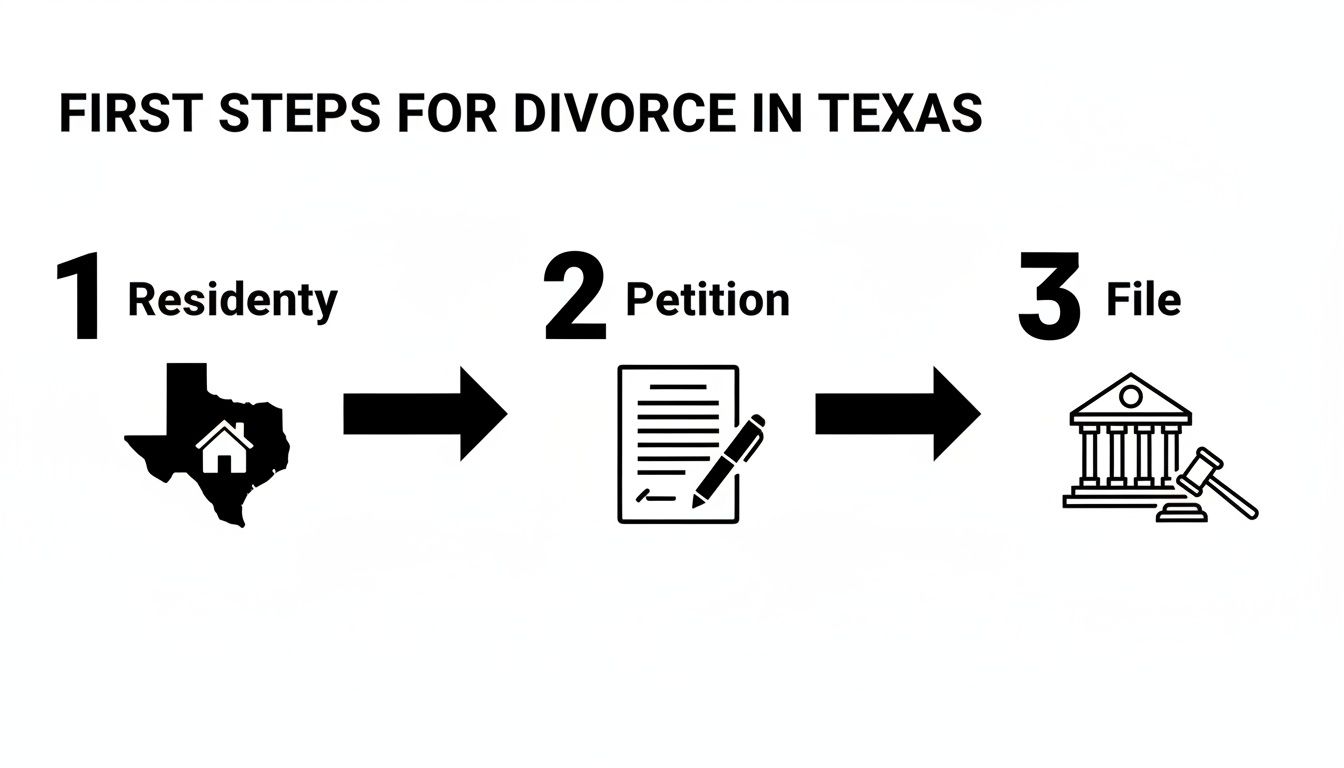
As you can see, filing is the final piece of this first phase, and it can only happen after you've met the residency rules and prepared your petition.
What About Filing Fees?
Filing with the court involves administrative costs. In Harris County, the filing fee is typically around $350, though this amount can change. This fee is paid when your documents are submitted through the e-filing system.
We understand that an unexpected expense like this can be a hardship. If you are facing financial difficulties, you have an option. You can file a Statement of Inability to Afford Payment of Court Costs. This document asks the judge to waive the fees based on your current financial situation.
Making it Official: Serving Your Spouse
Once your petition is filed and you have a case number, Texas law requires you to formally notify your spouse that a divorce has been initiated. This is known as service of process. The goal is to ensure your spouse is officially aware of the case and has a fair opportunity to respond. A simple text message or email is not sufficient.
Here are the proper ways to handle service in Harris County:
- Personal Service: This is the most common method. A sheriff, constable, or private process server will hand-deliver a copy of the petition and a court summons (called a citation) to your spouse, creating an official record of delivery.
- Waiver of Service: If you and your spouse are on amicable terms, they can sign a Waiver of Service in front of a notary. This acknowledges receipt of the divorce petition and saves time, money, and potential stress.
- Substituted Service: If your spouse is actively avoiding being served, your attorney can ask the judge for permission to use an alternative method. This could mean leaving the documents with another adult at their home or, in rare cases, even serving them via social media.
A common scenario we see involves a spouse living in a gated community like Eagle Springs or Fall Creek. A private process server is often more effective than a sheriff in these situations, as they have more flexibility to effectuate service at different times of the day.
Properly filing and serving the divorce papers is a critical, non-negotiable step. Our comprehensive guide on how to file for divorce in Texas dives deeper into these procedural requirements. For guidance tailored to your unique situation, the best step you can take is to speak with a local attorney who knows the Harris County court system.
The Law Office of Bryan Fagan is here to help our neighbors in Atascocita and Humble navigate this process with confidence. Call us today to schedule a free, confidential consultation.
Sorting Out Child Custody and Dividing Your Property
Once the initial divorce petition is filed in Harris County, the focus naturally shifts to the two things that matter most: your children and your finances. These are often the most personal and challenging parts of the process. For families here in Atascocita, Humble, and our surrounding communities, understanding how Texas law approaches these issues can make all the difference, helping you feel more in control of your future.

How Texas Handles “Custody”: It's All About Conservatorship
First, it’s helpful to know that Texas law does not typically use the word "custody." Instead, the legal term is conservatorship, which defines each parent's specific rights and responsibilities in raising their child.
The law begins with the strong belief that it is in a child’s best interest for both parents to be named Joint Managing Conservators (JMCs). This does not automatically mean a 50/50 split of time. What it does mean is that both parents share in the major decisions for their children—such as where they attend school, non-emergency medical choices, and religious upbringing. Harris County judges strongly favor this cooperative approach because it keeps both parents deeply involved in their child's life.
In some rare cases, one parent may be named the Sole Managing Conservator (SMC). This usually only happens when there is a history of family violence, substance abuse, or such extreme conflict that parents cannot make decisions together. It is a very high legal standard to meet and is not the typical outcome.
Creating a Parenting Schedule That Works
After establishing conservatorship, you will create a possession schedule—the calendar detailing when the children are with each parent. While you and your spouse can agree on any custom schedule that fits your family's needs, Harris County courts have a default plan called the Standard Possession Order (SPO).
The SPO is designed to provide children with a predictable and stable routine. For parents living within 100 miles of each other, it generally includes:
- Weekend Visits: The non-primary parent typically has the children on the first, third, and fifth weekends of a month.
- Holiday Rotation: Major holidays like Thanksgiving and Christmas are alternated each year, allowing both parents to build memories and continue family traditions.
- Summer Break: The non-primary parent usually has an extended 30-day period with the children during the summer.
For a family with children in Humble ISD, for example, the SPO provides a clear structure for the school year, making it easier for everyone to plan and stay on top of school events and extracurriculars.
A crucial part of the SPO is naming one parent the "primary" conservator. This is the parent who has the right to determine the child's residence (usually within a specific area, like Harris and surrounding counties) and who receives child support payments.
Dividing Your Marital Estate the Texas Way
Just as important as your children’s well-being is securing your financial future. Texas is a community property state. In simple terms, this means that nearly everything you or your spouse acquired during the marriage is considered jointly owned. This includes income, the family home, cars, retirement accounts, and even debt.
Property you owned before the marriage, or anything you received as a personal gift or inheritance during the marriage, is usually considered separate property and is not divided. Be aware, however, that the spouse claiming an asset as separate has the burden of proving it.
A Harris County judge will not simply divide everything 50/50. Texas law requires a "just and right" division, giving the court flexibility to consider your unique circumstances. The judge might look at factors like:
- Each spouse's earning capacity.
- Whether fault played a role in the divorce (if fault grounds were pleaded).
- The children’s needs and who will be their primary caregiver.
For instance, when dividing a home in an Atascocita community like Eagle Springs, a judge might award a larger share of the equity to the parent who will continue raising the children there. A 401(k) earned at a local job or a family business based in Humble would also be valued and split in a way the court deems fair. To learn more about these rules, please see our guide on what is community property in Texas.
Making the Most of the 60-Day Waiting Period with Temporary Orders and Mediation
After your divorce petition is filed and served in Harris County, Texas law imposes a mandatory 60-day waiting period before it can be finalized. Many of our clients from Atascocita and Humble initially see this as a frustrating delay. However, from an experienced attorney's perspective, this is not dead time. It is one of the most productive and important phases of your divorce.
This period is not just for "cooling-off." It is your opportunity to bring stability to your life and begin working toward a positive resolution.

Life doesn’t stop because you’ve filed for divorce. The mortgage is still due, the children have school and activities, and you both need clarity on who is responsible for what. This is where Temporary Orders are essential.
Creating Stability with Temporary Orders
Think of Temporary Orders as the official rulebook for your separation. These are legally enforceable court orders that establish the ground rules for how things will work while your divorce is pending. They create a temporary parenting plan and a household budget, designed to address the immediate issues that often cause the most conflict.
These orders bring much-needed structure by answering critical questions like:
- Who will live in the family home? The court can grant one spouse exclusive use of the home, ending arguments about living arrangements.
- How will bills be paid? The orders will clearly state who is responsible for the mortgage, car payments, utilities, and other monthly expenses.
- What is the schedule for the kids? A temporary possession schedule creates consistency for the children, so everyone knows where they will be and when.
- Will there be temporary support? The court can order temporary child support and spousal support to ensure financial needs are met.
- What are the financial rules? These orders almost always prevent either spouse from draining bank accounts, selling property, or harassing the other.
For a family in Atascocita, this means no more confusion over who picks the children up from their Humble ISD school or who pays the CenterPoint Energy bill. We explore how these orders can protect you in our article covering the waiting period in a Texas divorce.
The Power of Mediation in a Harris County Divorce
If Temporary Orders manage the present, mediation is the tool you will use to build your future. In Harris County, mediation is not just a suggestion—judges require virtually every couple to attempt it before they will consider a final trial. This is not just a box to check; it is, by far, the most effective way to resolve your case.
Mediation is a structured, confidential negotiation where you, your spouse, and your respective attorneys meet with a neutral third-party mediator. The mediator’s job is not to take sides but to facilitate a productive conversation, help you find common ground, and guide you toward crafting your own settlement.
I tell my clients this all the time: over 90% of divorce cases in Harris County are resolved in mediation. This process puts you in control, allowing you to make decisions about your family and finances rather than leaving them to a judge who only knows a fraction of your story.
The benefits are immense. Mediation saves a tremendous amount of time, money, and emotional energy. A successful session ends with a signed Mediated Settlement Agreement (MSA). This document is legally binding and becomes the foundation for your Final Decree of Divorce. It is your opportunity to create a customized solution that works for your unique family.
Getting to the Finish Line: Finalizing Your Divorce
You have navigated the waiting period, participated in mediation, and worked through the details of your new life. Now you have reached the final step of your Harris County divorce: making it all official. This culminates in one critical document: the Final Decree of Divorce.
Think of the decree as the official rulebook for your post-divorce life. It covers everything—the division of your property and debts, and the complete parenting plan detailing conservatorship, visitation schedules, and child support. Once a judge signs this document, it becomes a court order that you and your ex-spouse must follow.
How Your Case Actually Ends: Agreement vs. Trial
For most people here in Atascocita and Humble, a divorce concludes in one of two ways. The good news is that the vast majority of cases—well over 90%—end with an agreement, usually achieved through mediation.
When you have settled everything, the final step is typically a quick, informal court appearance known as a "prove-up" hearing. The word "hearing" can sound intimidating, but it is not a trial. It is a simple, 10-minute event where one spouse and their attorney appear before the judge. You will answer a few basic questions to confirm you signed the agreement voluntarily and that it is in the best interest of your children. The judge then signs the decree, and you are officially divorced.
Of course, sometimes a full agreement isn't possible. If you and your spouse are at an impasse on major issues, your case will be scheduled for a final trial. This is a much more formal process where both sides present evidence and call witnesses, and the judge makes the final decisions. While sometimes necessary, a trial requires far more time, money, and emotional energy than reaching a settlement.
This table gives you a rough idea of what to expect as you move through the process in Harris County.
Divorce Process Timeline in Harris County
This is an estimated timeline for a typical divorce process in Harris County. Keep in mind that high-conflict cases or those with complex assets can take longer.
| Stage | Typical Duration | Key Action Items for You |
|---|---|---|
| Initial Filing & Service | 1-4 Weeks | File the Original Petition for Divorce and ensure your spouse is properly served. |
| Mandatory Waiting Period | 60 Days (Minimum) | This is a state-mandated "cooling-off" period that starts the day you file. |
| Discovery & Information Exchange | 2-6 Months | Gather and exchange financial documents and other relevant information with your spouse. |
| Mediation | 1 Day | Attend a mandatory mediation session to attempt to negotiate a settlement. |
| Finalization (Agreement) | 1-4 Weeks Post-Mediation | Prepare the Final Decree, schedule, and attend the prove-up hearing. |
| Finalization (Trial) | 4-12+ Months Post-Mediation | If no agreement, prepare for trial, which involves more hearings and court dates. |
While every case is unique, understanding these stages can help you feel more prepared for the journey ahead.
Your Post-Divorce To-Do List
Once the judge signs the decree, your legal case is closed, but you are not quite done. There are a few crucial administrative tasks you need to complete to protect yourself and your assets.
-
Update Your Will and Estate Plan: Your old will likely names your ex-spouse as a primary beneficiary. It is essential to draft a new one that reflects your new circumstances.
-
Change Your Beneficiary Designations: The divorce decree does not automatically update your financial accounts. You must personally contact your bank, insurance company, and retirement plan administrator to remove your ex-spouse as a beneficiary on life insurance policies, 401(k)s, IRAs, and bank accounts.
-
Transfer Property Titles: If you were awarded the house in Atascocita or a vehicle, you need to complete the paperwork to put the title in your name alone. For a home, this usually requires a Special Warranty Deed to be signed and filed. For a vehicle, it involves formally signing over the title.
After a divorce, it's not enough to just have the decree in hand. You must take proactive steps to retitle assets and update your legal documents to align with the court's orders and secure your financial independence.
When Life Changes Down the Road
Life is not static. A new job, a significant change in income, or the need to move out of state can all arise years after your divorce is final. Texas law understands this, and the Harris County courts have processes to address it.
If there has been a "material and substantial change" in your family's circumstances, you can return to court to ask for a modification of the orders for child custody, visitation, or child support.
If your ex-spouse is not following the court's orders—for example, by failing to pay child support or turn over property—you can file an enforcement action to ask a judge to compel them to comply.
Finalizing your divorce is a significant milestone, marking the end of one chapter and the beginning of another. If you are ready to take the next steps or need clarity on what to do, The Law Office of Bryan Fagan – Atascocita TX Lawyers is here to guide you. Schedule your free consultation today to talk with a team that truly cares about your future.
Common Questions About Getting a Divorce in Harris County
Even with a clear roadmap, it is completely normal to have questions as you consider what a divorce in Harris County truly involves. To provide practical answers, here are the questions we hear most often from our clients in Atascocita, Humble, and our surrounding communities. Getting straightforward information can make a world of difference in helping you feel prepared.
What’s the Real Cost of a Divorce in Harris County?
This is often the first question people ask, and the most honest answer is: it truly depends. The total cost is not a single flat fee but a combination of different expenses.
Every case begins with the non-negotiable court filing fee, which is around $350 in Harris County. This is the administrative cost to officially open your case with the court.
From there, the biggest factor driving the cost is the level of disagreement between you and your spouse. If you have worked everything out and simply need the legal paperwork completed (an uncontested divorce), your costs will be the most affordable. If your case is contested and requires multiple court hearings, lengthy negotiations, or a trial, the legal fees will be higher.
You will also have the cost of mediation. A half-day session with a good mediator typically costs each person a few hundred dollars. While it is an expense, it is an investment that can save you thousands in attorney's fees by helping you settle your case amicably.
Will I Actually Have to Go to Court to Get Divorced?
Yes, but it is almost certainly not the dramatic trial you see on television. For the vast majority of people—well over 90%—the final step is a brief, low-key hearing called a "prove-up."
If you and your spouse have reached a complete agreement, one of you will go to court with your attorney for about 10 minutes. You will stand before a judge and answer a few simple, scripted questions to confirm you meet the residency requirements and are signing the final papers willingly. The judge then signs the Final Decree of Divorce, and it is official. Contested trials are rare and only happen when a couple cannot find common ground.
How Long is This Whole Process Going to Take?
Texas law has a mandatory 60-day waiting period for all divorces, which begins the day the Original Petition for Divorce is filed. No matter how quickly you reach an agreement, your divorce cannot be finalized in less than two months.
It's crucial to understand that the 60-day period is a legal minimum, not a typical timeframe. A more realistic estimate for a standard, uncontested divorce in Harris County is usually somewhere between three to six months from start to finish.
Factors that can extend the timeline include significant disagreements over child custody, complex assets to divide (like a family-owned business in Humble), or a high level of conflict between you and your spouse. An experienced attorney can provide a more accurate estimate based on your specific situation.
Can I Still File for Divorce Here if My Spouse Moved Out of State?
Absolutely. The court’s authority to handle your case, known as jurisdiction, is based on residency—and only one of you needs to meet the requirement.
As long as you have lived in Texas for the past six months and in Harris County for the last 90 days, you can file for divorce right here. It does not matter where your spouse lives. For example, if you live in Atascocita and meet these residency rules, you can file here even if your spouse now lives in another state. The court can still make rulings on your divorce and property.
The one important exception involves children. For the court to make orders about your children, it must also have jurisdiction over them, which is generally based on where they have lived for the last six months. This can add a layer of complexity when a parent lives out of state.
Figuring out the details of filing a divorce in Harris County can feel overwhelming, but you don’t have to piece it all together on your own. Our dedicated team at The Law Office of Bryan Fagan – Atascocita TX Lawyers is here to provide the clear, compassionate, and knowledgeable guidance you need. We invite you to schedule a free, no-pressure consultation to talk about your situation and see how we can help protect your family and your future. Reach out to us today at https://www.atascocitaattorneys.com.