 Skip to content
When you decide to file for divorce in Texas, it’s natural to wonder, "How long will this take?" For families in Atascocita, Humble, and across northeast Harris County, one of the first and most important timelines you’ll encounter is the state's mandatory 60-day waiting period.
This rule is a firm part of Texas family law. It means that no matter how straightforward or amicable your situation might be, a judge cannot legally finalize your divorce until at least 61 days have passed from the date you initially file the paperwork. This guide will walk you through what this means for you and your family.
Understanding the 60-Day Divorce Rule
For anyone in Atascocita, Humble, or anywhere in Harris County looking to file, this waiting period is a fundamental concept. The law essentially presses a mandatory "pause button" on the entire process, giving couples a chance to step back before making life-altering decisions.
Let's make this practical. If you file your divorce petition at the Harris County courthouse on March 1st, the absolute earliest a judge can sign off on your final decree is May 1st. This timeline applies to everyone, creating a built-in buffer for reflection and preparation.
Why Does This Rule Exist?
The purpose of the 60-day waiting period is to prevent rushed decisions made in the heat of an emotional moment. The Texas legislature wanted to ensure that people had a real chance to think through the significant consequences of ending their marriage.
This period serves a few key purposes for local families:
- A Chance to Reconsider: It gives couples a moment to breathe and even reconcile if they feel it’s the right choice for their family.
- Time to Prepare: It provides a crucial window to gather financial records, inventory property, and think through custody arrangements for your children without feeling rushed.
- Promotes Clear-Headed Decisions: It helps ensure that agreements on children, finances, and property are made thoughtfully, not impulsively.
A Longstanding Texas Tradition
This isn't a new rule. Texas has had a mandatory 60-day "cooling-off" period for divorces since the early 1900s, and it remains a cornerstone of the Texas Family Code. The clock starts ticking the day after the Original Petition for Divorce is filed. As you can read more about the history of this rule, its goal has always been to encourage stable and deliberate resolutions.
At The Law Office of Bryan Fagan, we encourage our clients in Atascocita and the surrounding communities to see this waiting period not as a frustrating delay, but as a strategic opportunity. It’s a chance to get organized, lay the groundwork for a solid legal strategy, and prepare for your next chapter from a position of clarity and strength.
Why the Forced 60-Day Wait?
When you’re ready to close one chapter of your life and start the next, Texas’s 60-day waiting period can feel like an unnecessary delay. It’s a common frustration, and we understand that. But from the perspective of Texas law, this isn't about punishment; it's about protection.
Think of it as a mandatory "cooling-off" period. The law recognizes that divorce is one of the most stressful, emotionally charged events a person can go through. The waiting period is there to give families in communities like Atascocita and Humble a chance to catch their breath, step back from the initial emotional storm, and make sure this is truly the path they want to take.
This pause is specifically designed to stop people from making life-altering decisions in the heat of the moment—choices about children, property, and finances that could have devastating, long-term consequences if made impulsively.
A Safeguard for Clearer Thinking
The 60-day window is your opportunity to turn a reactive situation into a proactive one. It’s the time to get your affairs in order. You can start gathering all the necessary financial paperwork, get a clear picture of your marital estate, and begin mapping out a co-parenting plan that genuinely works for your children. For many of the Humble families we work with, this transforms the waiting period from a source of anxiety into a period of empowerment.
By intentionally slowing things down, the law nudges couples toward more thoughtful, durable agreements instead of rushed settlements they might regret down the road.
There’s actually data to back this up. Studies have shown that a required pause can lead some couples to reconsider, seek counseling, or at least pursue a more amicable path like mediation. In fact, Texas's divorce rate has seen a notable drop in recent years, placing the state among the ten lowest in the country. Many legal experts believe the 60-day rule plays a role in this trend by encouraging more deliberate decision-making. You can dig deeper into Texas divorce statistics and their implications if you're curious.
The real purpose of the waiting period is to create a moment for clarity. We help our Harris County clients use this time to build a solid foundation for their future, ensuring every decision is made from a position of strength, not stress.
Here at The Law Office of Bryan Fagan – Atascocita TX Lawyers, we see these 60 days as a strategic advantage. Instead of just marking days off a calendar, we help you get organized, establish crucial temporary orders for custody and finances, and build a comprehensive legal strategy. This way, when day 61 arrives, you’re not just ready—you're fully prepared to finalize your divorce with confidence.
Can You Ever Get Around the Waiting Period?
While that 60-day clock is a firm rule for almost every divorce in Texas, the law carves out a very narrow exception. This isn't a loophole for people in a hurry; it's a critical safeguard designed to protect victims of family violence.
If you are in a dangerous situation in your Atascocita home, you need to know that Texas law prioritizes your safety over procedural timelines.
A judge has the power to waive the 60-day waiting period, but only under very specific circumstances involving proven family violence. It’s a high bar to clear, and it requires solid evidence.
What Does it Take to Waive the Waiting Period?
Simply telling a judge you've been a victim of abuse isn't enough to get the waiting period waived. The court needs official documentation to act.
A judge will typically only consider a waiver if the abusive spouse has been:
- Convicted of a crime involving family violence against you or someone in your household.
- Given deferred adjudication for that same type of offense.
Essentially, there needs to be a criminal record of the abuse. An active protective order against your spouse can also be grounds for a judge to waive the waiting period, as it provides a clear, documented history of threats or violence that justifies finalizing the divorce immediately for your protection.
Here’s the specific language straight from the Texas Family Code that outlines these exceptions:
As you can see, the law is very clear: the waiting period doesn't apply if you have a protective order or if your spouse has a conviction or deferred adjudication for family violence.
Your safety is what matters most. If you live in Atascocita, Humble, or anywhere in Harris County and are in a dangerous situation, please don't wait. The legal system has tools to help protect you and your children right now.
Trying to navigate this exception is not something you should do alone. It requires specific legal steps and a clear presentation of evidence. The team at The Law Office of Bryan Fagan in Atascocita is experienced in these sensitive matters. Please reach out to our Atascocita office for a free, confidential consultation to talk about your situation and figure out the safest path forward.
How the Waiting Period Affects Your Divorce Timeline
The 60-day waiting period divorce Texas rule isn't just a date on a calendar; it's the official starting line for your entire divorce process. For anyone in Atascocita and Humble facing this, understanding how this period fits into the bigger picture is the first step toward setting realistic expectations.
Think of your divorce timeline as having two very different paths. The 60-day rule plays a major role in both, but its impact can be quite different.
Uncontested Divorce Timeline
In an uncontested divorce—where you and your spouse are on the same page about big issues like property division and child custody—the 60-day waiting period is often the main stretch of the journey. After the initial petition is filed, these two months are typically used to draft and finalize your settlement agreement.
Once day 61 arrives, if all your paperwork is in order, you can go to court and get the judge to sign off on your decree. For many amicable splits in Harris County, this mandatory pause is actually the longest part of the entire process.
Contested Divorce Timeline
On the other hand, for a contested divorce, that 60-day period is just the beginning. If you and your spouse can't agree on key terms, the real work doesn't even start until after those two months are over. It's the first step in what can be a much longer, more complex road.
From there, the process usually involves several more stages:
- Discovery: A formal process where both sides exchange financial documents, evidence, and other information.
- Negotiation: Your attorneys will spend time trying to reach a settlement.
- Mediation: A neutral mediator steps in to help you and your spouse find common ground and hopefully avoid a trial.
- Court Hearings: If you still can't agree, you'll have to let a judge make the final decisions at a hearing or trial.
This flowchart maps out how the waiting period fits into the overall process and shows the rare exceptions that might change the timeline.
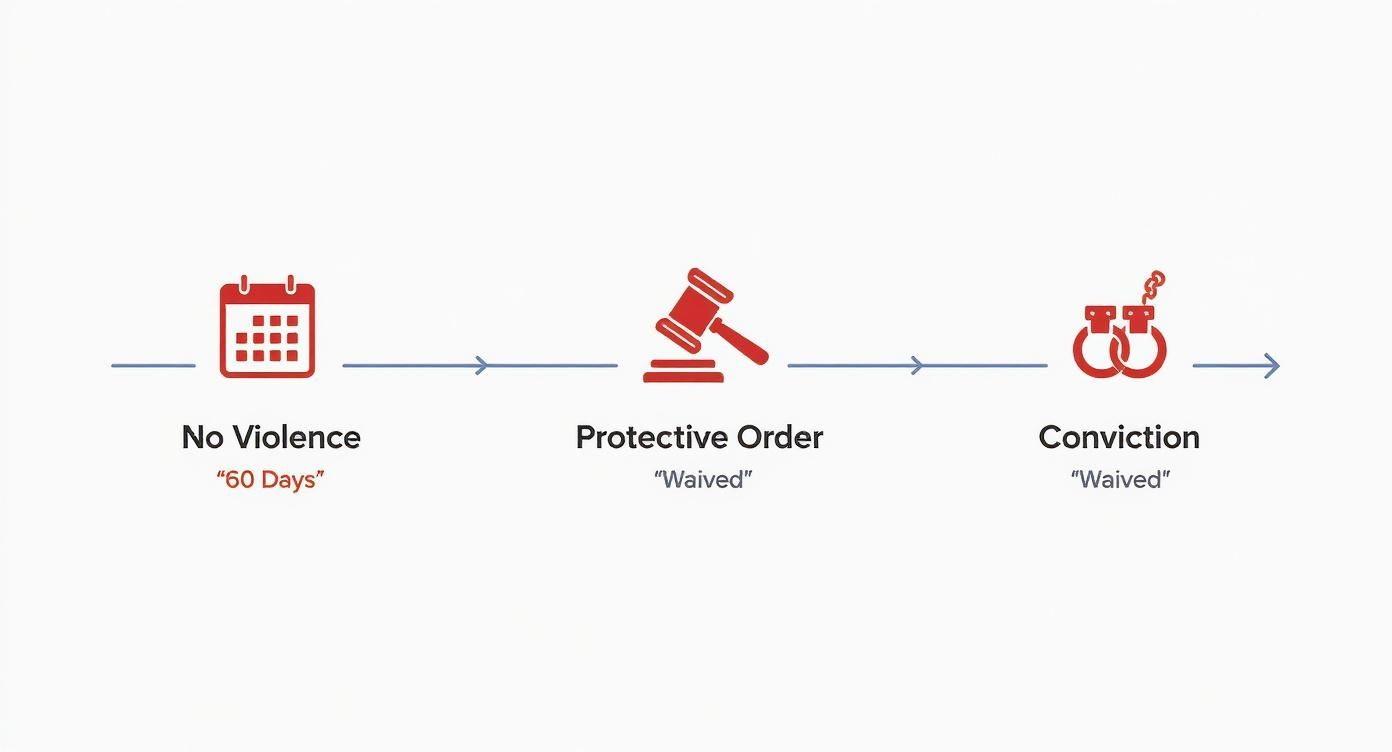
As you can see, while the vast majority of divorces require the 60-day wait, situations involving documented family violence can create an exception, allowing for a faster resolution to ensure safety.
Ultimately, the 60-day rule sets the minimum time for a divorce. An uncontested case might wrap up in about three to four months. But a contested divorce can easily stretch from six months to well over a year.
The key takeaway for Atascocita families is that reaching an agreement is the single biggest factor in how quickly your divorce can be resolved. The 60-day wait is set in stone, but the time you spend after that is almost entirely up to you and your spouse's ability to cooperate.
Getting these initial steps right is vital. To make sure you're starting the process correctly, check out our guide on how to file for divorce in Texas.
Making the Most of the 60-Day Waiting Period

When you're ready to move on, the mandatory 60-day waiting period for a Texas divorce can feel like an eternity. It’s easy to see it as just another frustrating delay. But in our experience, this time is a hidden advantage. For our clients in Atascocita and Humble, these two months represent a golden opportunity to get organized, sidestep future conflict, and lay a solid groundwork for the next phase of your life.
Think of it as preparation time, not a penalty. This shift in mindset is crucial. It lets you move from being reactive and emotional to being proactive and strategic. The intentional steps you take now will pay off significantly, making the entire process smoother and leading to a much better outcome once day 61 finally rolls around.
Step 1: Get Your Financial House in Order
One of the most powerful things you can do during these 60 days is to build a complete, clear picture of your marital finances. This goes way beyond knowing your checking account balance. It’s about mapping out the entire financial world you and your spouse created together.
Start gathering all the essential documents right away. Procrastinating on this just adds a mountain of stress later.
Key Documents to Collect:
- Tax Returns: You'll want the last two or three years of your federal income tax returns.
- Bank Statements: Grab recent statements for every checking, savings, and joint account.
- Debt Statements: Round up all credit card bills, mortgage statements, car loans, and any other debts.
- Retirement Accounts: Find the latest statements for any 401(k)s, IRAs, and pensions—for both of you.
- Insurance Policies: Collect information on your life, health, and property insurance policies.
With these documents in hand, you can build a detailed inventory of every marital asset and debt. This single organized list will become your roadmap during property division negotiations.
Step 2: Create Stability with Temporary Orders
Just because your divorce can't be finalized yet doesn't mean you have to live in limbo. The waiting period is the perfect time to work with your attorney to put Temporary Orders in place.
Temporary Orders are court-enforced rules that create much-needed stability for your family while the divorce is ongoing. They provide a predictable routine during an uncertain time.
These orders tackle the immediate "what-ifs" and stop small disagreements from becoming major conflicts. They typically cover the essentials:
- Child Custody and Visitation: Establishes where the children will live and sets a clear, predictable schedule for the other parent's time with them.
- Child and Spousal Support: Determines who pays for what, ensuring everyone's financial needs are met in the short term.
- Bill Payments: Lays out exactly how household expenses, like the mortgage and utilities, will be handled.
- Property Use: Decides who gets to stay in the family home in Atascocita and who gets to use the family car.
Putting these guidelines in place early on creates a stable, predictable environment for both you and your children, which is incredibly important for everyone's emotional well-being. It's also a smart move for getting ahead of negotiations. If you're hitting roadblocks, exploring options like divorce mediation in Texas during this period can be an effective way to resolve issues constructively.
The team at The Law Office of Bryan Fagan – Atascocita TX Lawyers is here to help you turn this waiting period into a productive one. Contact us for a free consultation, and let's build a plan that protects your interests right from the start.
Your Guide to Starting the Divorce Process in Atascocita
https://www.youtube.com/embed/tZ75eHZFbv8
While the 60-day waiting period is a statewide Texas law, your divorce journey unfolds right here in our local courts. Successfully navigating the Harris County court system is about more than just knowing the statutes; it’s about understanding the specific procedures and local practices that shape how cases move forward.
Having an attorney who is truly a part of the Atascocita and Humble communities can make all the difference. We know the local system inside and out—from making sure your Original Petition for Divorce is filed correctly the first time to anticipating how a particular judge might view your case. This kind of hands-on, local experience helps avoid the small mistakes that can cause frustrating delays, stretching your timeline well beyond the initial 60 days.
Taking the First Confident Steps
The start of a divorce can feel overwhelming, but it really boils down to a few clear, initial actions. Before anything else, we must confirm you meet the state's residency rules. It’s a simple check: has at least one spouse lived in Texas for the last six months and, more specifically, in Harris County for the last 90 days?
Once we've confirmed that, the next step is to work together to draft and file the initial divorce petition. This document officially starts the legal process, and getting it right is crucial. The details included here lay the foundation for everything that comes next, which is why having compassionate legal guidance from day one is so important.
At The Law Office of Bryan Fagan, we see ourselves as your community partners. We are here to provide the warm, knowledgeable, and steady support you need to move through this challenging time with confidence and clarity.
Picking the right legal advocate is probably the single most important decision you'll make in this process. You need someone who not only understands the law but also understands you. To help, we've put together a guide on how to choose a divorce attorney that fits your unique situation.
We believe every resident of Atascocita and the surrounding areas deserves to feel heard and supported. We invite you to schedule a free, no-pressure consultation at our Atascocita office. Let's sit down, talk about your situation, and figure out the best first step toward your new beginning.
Common Questions About the Texas Divorce Waiting Period
When you're facing a divorce, questions can pile up fast. For our clients here in Atascocita, one of the first things they usually ask about is the mandatory waiting period. It's a source of a lot of confusion, so let's clear up some of the most common questions we hear every day.
When does the 60-day clock actually start?
This is a big one. Many people assume the clock starts ticking the moment they separate or one person moves out of the house in Humble. That's not the case.
The official countdown begins the day after one of you formally files the Original Petition for Divorce with the Harris County District Clerk's office. It’s the filing date that gets the ball rolling, not the separation date.
Can we skip it if we agree on everything?
It's a logical question. If you and your spouse have already worked everything out and are on the same page, why wait? The answer is simple: you can't.
Even in the most straightforward, uncontested divorces where there are no disagreements, the 60-day waiting period is a hard-and-fast rule in Texas. It's a state law that can't be waived just by mutual agreement. The only exceptions are extremely specific and rare, usually involving documented cases of family violence.
The point of the rule is to give couples a "cooling-off" period. The state wants to ensure that a decision as significant as divorce is made with a clear head, not in a moment of anger or impulse.
What if we reconcile during the waiting period?
Life is complicated, and sometimes couples find their way back to each other. The waiting period actually accounts for this.
If you and your spouse decide to give it another go during these 60 days, you can simply file a motion to dismiss the divorce petition. It stops the legal process in its tracks. You can then put your energy back into your marriage without any legal prejudice.
Are there residency rules before I can even file?
Absolutely. Before you can even start the 60-day clock, you have to meet the state's residency requirements. It’s a two-part test:
- State Residency: At least one of you must have lived in Texas for the last six months.
- County Residency: One of you must have been a resident of the county where you plan to file (like Harris County for our neighbors in Atascocita and Humble) for at least the last 90 days.
Both of these conditions have to be met before the court will even accept your divorce petition.
Knowing how these rules fit your specific circumstances is the first real step toward moving forward. The experienced attorneys at The Law Office of Bryan Fagan – Atascocita TX Lawyers are here to give you clear answers and the local, compassionate guidance you need. Schedule your free consultation with us today and let's talk through your next steps.


