 Skip to content
If you’re facing a divorce in Atascocita or Humble, the thought of a courtroom battle can be overwhelming. But it's not your only option. Divorce mediation in Texas offers a practical, private, and often much more affordable path that keeps you and your spouse in control. Instead of a judge making the final calls, you work together with a neutral third party to craft an agreement that’s actually built for your family's future.
A Better Path Forward for Your Texas Divorce
Let's be honest, navigating the end of a marriage is one of the toughest challenges a person can face. The emotional weight, paired with worries about finances and your children, can feel crushing. Many people in our northeast Harris County communities automatically assume divorce means a drawn-out, expensive, and public court fight. The truth is, that's rarely the best way forward.

It helps to think of divorce mediation less like a fight and more like a structured conversation. It’s a process specifically designed to build a new future by empowering you to settle disagreements respectfully and cooperatively, focusing on solutions instead of getting stuck on who's to blame.
Embracing a Collaborative Approach
This guide is here to pull back the curtain on divorce mediation for families right here in Atascocita, Humble, and the surrounding communities. We want to show you a proven way to protect your finances, put your children first, and preserve your dignity through a difficult time. Mediation provides a safe, confidential space where you can tackle sensitive topics without the immense pressure of a courtroom.
Mediation gives you the power to write the final chapter of your marriage, rather than handing the pen to a stranger. It is about crafting solutions that are tailored to your family's unique needs, something a court order can rarely achieve.
Our mission is to give you clear, straightforward information so you can make decisions with confidence. We'll walk through exactly what the process looks like, from the first step of choosing a mediator all the way to finalizing a legally binding agreement.
Why Mediation Matters for Atascocita Families
For families here in our community, mediation has some very real, practical advantages. It opens the door to creative and flexible solutions that fit your actual life. For example, you can design custom possession schedules that work with local school calendars in Humble ISD or figure out a way to divide property that just makes common sense for both of you.
This approach boils down to a few key benefits:
- Greater Control: You and your spouse—not a judge—get the final say on your property, finances, and children.
- Reduced Costs: Mediation is almost always significantly less expensive than taking a divorce case to trial. That’s money you can use for your next chapter.
- Confidentiality: What happens in mediation stays in mediation. Court records are public; mediation discussions are not, which protects your family’s privacy.
- Faster Resolution: The process is typically much quicker than litigation, which means you can start moving forward with your life much sooner.
At The Law Office of Bryan Fagan, we are dedicated to helping our Atascocita neighbors navigate this journey with both expert guidance and genuine compassion. If you’re ready to explore a more peaceful way to resolve your divorce, we invite you to schedule a free consultation with our team at our local Atascocita office.
What Is Divorce Mediation in Texas, Really?
Let’s cut through the legalese. When you hear "divorce mediation," don't picture a stuffy courtroom. Instead, imagine you and your spouse sitting down with a neutral guide—someone whose only job is to help you build a new path forward for your family, together. It’s about collaboration, not combat.
Mediation is a private, guided conversation. A professionally trained mediator acts as a neutral third party, helping you and your spouse navigate the tough talks. They don't take sides or issue rulings. Think of them as a facilitator, keeping the discussion productive and respectful while you tackle the big issues, from dividing your assets to designing a parenting plan that truly works for your kids.
The entire point is for you and your spouse to create your own solutions. This puts you in the driver's seat, ensuring the final decisions are made by the two people who understand your family’s unique situation best—not a judge who has only known you for a few hours.
How Texas Courts, Especially in Harris County, View Mediation
It’s critical to understand that mediation isn't just a friendly suggestion in Texas; it's a deeply integrated and highly encouraged part of the legal process. Our local courts right here in Harris County, serving communities like Atascocita and Humble, are big proponents of this approach. In fact, most judges will order you to try mediation before they’ll even consider letting you set foot in their courtroom for a trial.
Why the strong push? Simple: it works. Divorce mediation is incredibly effective, with a staggering 85% of Texas divorces that enter mediation settling that very same day. This track record is why courts endorse it—it dramatically cuts down on the time, expense, and emotional turmoil of a drawn-out legal battle. You can get more details on the effectiveness of Texas mediation and see just how solid these agreements are.
That high success rate isn't just a statistic; it represents thousands of families who avoided the painful and costly experience of a courtroom fight. The agreements you forge in mediation aren't just informal handshakes; they are built to become legally binding court orders.
The Twin Pillars: Confidentiality and Enforceability
Two of the most powerful aspects of Texas mediation are that it's completely confidential and the final agreement is legally enforceable. Everything discussed during your mediation session is protected. It can't be brought up or used against you later in court if you don't happen to reach a settlement. This creates a safe, honest environment where you can freely explore options without worrying that your words will come back to haunt you.
When you do reach an agreement, it’s all put down in writing in a document called a Mediated Settlement Agreement (MSA).
An MSA isn't just any contract. According to the Texas Family Code, once it’s signed by you, your spouse, and your attorneys, it becomes irrevocable. That means you can’t simply change your mind later. It’s a done deal.
This signed agreement is then filed with the court, and a judge incorporates its terms into your Final Decree of Divorce. With the judge’s signature, your mutually crafted solutions become an official, enforceable court order. This gives you the security of a clear, legally sound resolution that you had a direct hand in creating.
Your Step-by-Step Guide to the Mediation Process
Knowing what to expect can take a lot of the fear out of the divorce process. For families here in Atascocita, Humble, and Kingwood, understanding the roadmap of divorce mediation in Texas makes the entire journey feel more manageable and far less intimidating. Think of this as a breakdown of the process into clear, predictable stages, so you can walk in feeling prepared, not panicked.
Mediation is essentially a structured, guided conversation. The whole point is to move from broad discussions about what you both want to a final, detailed agreement you can both live with.
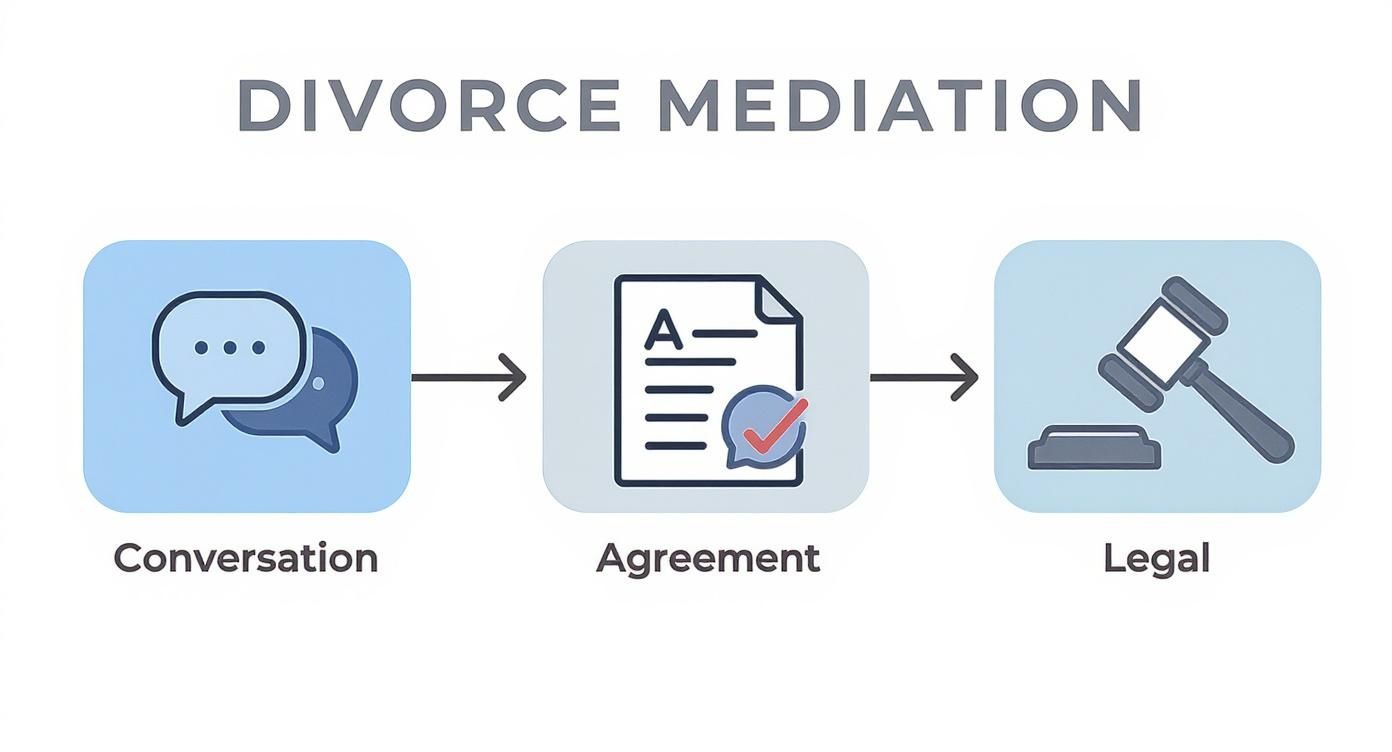
As you can see, the journey is designed to turn productive talks into a formal agreement that the court can then finalize, letting you sidestep a long, drawn-out trial.
Stage 1: Selecting a Qualified Mediator
First things first, you have to choose the right mediator. This person is a neutral third party whose entire job is to guide your discussions, so it’s absolutely critical that you and your spouse both trust them.
Often, your attorneys will give you a list of well-respected local mediators who know the ins and outs of Harris County family law cases. You're looking for someone who is not only a skilled negotiator but also deeply knowledgeable about Texas family law. This is key to making sure the agreement you craft is fair, covers all the bases, and will be readily accepted by a judge.
Stage 2: The Opening Joint Session
With a mediator chosen, the process kicks off with an opening joint session. This is where everyone gathers in the same room: you, your spouse, both of your attorneys, and the mediator.
During this initial meeting, the mediator lays the groundwork. They will:
- Explain the ground rules for communication to keep things respectful and productive.
- Clarify their role as a neutral guide—not a judge who makes decisions for you.
- Outline the day's goals and the specific issues that need to be tackled.
- Confirm that the entire process is confidential, which creates a safe space for honest negotiation.
This session really sets the tone for the rest of the day. It builds a framework for cooperation and shifts the focus to problem-solving. It’s also where you and your spouse get a chance to briefly state your perspectives and what you hope to accomplish.
Stage 3: Negotiation and Private Caucusing
After the joint session, the real work begins. More often than not, you and your spouse will separate into different rooms with your respective attorneys. From there, the mediator will move between the rooms, speaking with each of you privately. This is a technique called "caucusing."
Caucusing is one of the most powerful tools in mediation. It gives the mediator the chance to:
- Understand each person's true priorities and biggest concerns in a confidential setting.
- Help each side brainstorm solutions and compromises without the stress of a face-to-face confrontation.
- Defuse emotional flare-ups and keep everyone focused on finding common ground.
The mediator effectively becomes a shuttle diplomat, carrying offers, counter-offers, and new ideas back and forth. They help you realistically assess your position's strengths and weaknesses and, piece by piece, build an agreement on everything from dividing property to creating a stable parenting plan.
The heart of mediation happens in these private conversations. It’s where creative solutions emerge and where families in our community find a path forward without the bitterness of a courtroom battle.
Stage 4: Finalizing the Mediated Settlement Agreement
When you successfully resolve all your issues, the mediator and your attorneys will draft a Mediated Settlement Agreement (MSA). This is the official, legally binding document that spells out every single term you've agreed upon.
This is a critical moment. You and your attorney will review the MSA with a fine-toothed comb to ensure it perfectly matches your understanding and protects your future interests. Once you, your spouse, and your attorneys sign it, the agreement becomes irrevocable under Texas law. That means it’s final—it can't be changed or backed out of later.
The signed MSA is then presented to a judge, who incorporates its terms into your Final Decree of Divorce. For anyone just starting out, learning how to file for divorce in Texas is the first step that ultimately leads to this resolution. With the judge's signature, your mediated agreement becomes a legally enforceable court order, bringing your divorce to a peaceful and official close.
To give you a clearer picture, let's map out what this timeline often looks like.
The Texas Divorce Mediation Timeline From Start to Finish
This table breaks down the typical stages of the mediation process, showing what happens during each phase and how long you can expect it to take.
| Mediation Phase | Key Activities | Typical Duration |
|---|---|---|
| Phase 1: Preparation | Selecting a mediator, gathering financial documents, defining personal goals, and initial consultation with your attorney. | 1-4 weeks |
| Phase 2: The Mediation Session | The opening joint session, private caucusing, negotiation of terms, and reaching verbal agreements. | 4-8 hours (Half or Full Day) |
| Phase 3: Drafting the MSA | The mediator or attorneys draft the official Mediated Settlement Agreement based on the day's negotiations. | 1-3 days |
| Phase 4: Review and Signature | You and your attorney carefully review the MSA for accuracy before you, your spouse, and both attorneys sign it. | 1-2 days |
| Phase 5: Finalizing the Divorce | The signed MSA is filed with the court and incorporated into the Final Decree of Divorce, which is then signed by the judge. | 1-4 weeks |
This timeline provides a general framework, but remember, every family's situation is unique. The key is that mediation condenses a process that could take many months in court into a much shorter, more focused timeframe.
The Cost of Divorce Mediation in Texas
Let's be honest, for most families in Atascocita and Humble, one of the biggest anxieties in a divorce is money. The fear of watching your savings get eaten up by a long, drawn-out court battle is very real. This is exactly why getting a handle on the costs of divorce mediation in Texas can bring not just clarity, but a whole lot of relief.
It’s best to think of mediation as a smart financial move—an investment in a quicker, more peaceful resolution that protects not only your emotional health but your bank account, too.
How Mediation Fees Actually Work
Unlike the open-ended, often shocking bills that can come with litigation, mediation costs are usually pretty straightforward. Around Harris County, mediators typically charge in one of two ways:
- By the Hour: The mediator has a set hourly rate, and you and your spouse simply split the cost. This is a common setup, especially for cases that aren't overly complicated.
- By the Day (or Half-Day): Many mediators offer a flat-fee package for a four-hour (half-day) or eight-hour (full-day) session. The beauty of this is predictability—you know the exact price tag from the get-go.
These fees cover everything from the mediator's prep time before you walk in the door to the hours they spend helping you negotiate and hammer out the final details of your agreement. It’s a transparent model built for getting things done efficiently.
The Clear Financial Edge Over a Courtroom Fight
While mediation isn't free, it is almost always significantly cheaper than a contested divorce that ends up in front of a judge. The price of litigation can spiral out of control with frightening speed, piling on expenses for every court appearance, every legal document filed, and the sky-high attorney fees that come with preparing for a trial.
A contested divorce can easily soar past $20,000 per person, creating a massive financial hole at a time when you can least afford it. Mediation, on the other hand, keeps the costs contained and predictable. In Texas, you can expect to pay anywhere from $100 to $500 per hour for a mediator, with the total cost often landing somewhere between $1,500 and $5,000, depending on how complex your situation is. To really see the numbers side-by-side, you can learn more about how mediation costs compare to litigation fees in Texas.
Here’s an analogy: Mediation is like paying for a single, focused workshop to build your family's future solution. Litigation is like funding two opposing construction projects that are constantly at war with each other, with the meter running every single day.
The Hidden Price Tag of Litigation
It's not just about the legal bills. A full-blown court battle comes with a lot of "hidden" costs that mediation helps you sidestep entirely.
- Lost Time from Work: Court dates, depositions, and constant meetings with your lawyer often mean taking unpaid time off from your job.
- The Emotional Toll: The relentless stress of a public, adversarial process can take a real toll on your mental health and ability to focus, which has its own financial impact.
- Expert Witness Fees: If you have complex assets like a business or unique investments, you might have to hire expensive financial experts or appraisers just to make your case in court.
By choosing mediation, you’re opting for a process that respects your time, your privacy, and your financial stability. For Atascocita families who want to begin their next chapter on solid footing, the sheer cost-effectiveness of mediation makes it an incredibly practical and sensible choice.
Resolving Key Issues: Your Property and Your Children
When you get down to it, divorce really boils down to two major things: figuring out the finances and making sure the kids are okay. Mediation is where families in Atascocita and Humble can tackle these sensitive topics head-on, creating practical solutions that actually fit their lives. Instead of a judge who has never met you making these life-altering decisions, you and your spouse get to build an agreement that makes sense for your unique family.

This is where mediation really proves its worth. It allows for a level of creativity and common sense that you just can't get in a courtroom, helping you move forward with a clear, confident plan.
Crafting a Fair Division of Community Property
Texas is a community property state. In simple terms, this means most of what you and your spouse acquired during the marriage—assets and debts alike—is considered jointly owned. A judge is tasked with dividing this property in a "just and right" way, but their hands are often tied by rigid legal formulas.
Mediation, on the other hand, opens up a world of flexible solutions. For example, a court might just order you to sell the family home in Atascocita and split the proceeds. But in mediation, you could agree for one spouse to keep the house, while the other gets a larger share of a retirement account to even things out. This kind of creative problem-solving helps you hold onto the assets that truly matter most to you.
In mediation, you're not just hacking assets down the middle. You are strategically allocating resources to help both of you launch your next chapter on solid financial footing. It’s about building a practical settlement, not just winning a legal fight.
Putting Your Children’s Well-Being First
For any parent, the number one priority is protecting the kids. Mediation provides the perfect setting to create a detailed Parenting Plan that is built entirely around your children’s needs. This is about so much more than a simple visitation calendar; it's about laying the foundation for a cooperative co-parenting relationship that will last for years.
This collaborative spirit is becoming more and more common. While the divorce rate in Texas has been steadily declining, nearly half of all divorces in the state still involve children under 18. This trend highlights a significant shift away from courtroom battles, with approximately 49% of Texas couples ending their marriage through non-litigation methods like mediation by 2022.
Building a Practical and Detailed Parenting Plan
In mediation, parents from communities like Humble and Kingwood can work together to design schedules that actually work for their real lives. Instead of a judge’s one-size-fits-all order, you can craft a plan that considers things like:
- Local School Schedules: You can sync possession schedules with the Humble ISD or New Caney ISD calendars, accounting for holidays and teacher workdays.
- Extracurricular Activities: The plan can address who takes who to soccer practice in Kingwood or music lessons in Atascocita, and how those costs will be shared.
- Communication Protocols: You can set clear expectations for how you’ll talk about grades, doctor’s appointments, and other important updates.
- Future Flexibility: You can even build in a process for how you’ll handle disagreements or adjust the plan as your children grow and their needs change.
By working together, you create a stable and predictable world for your children. You shield them from unnecessary conflict and show them that even though your marriage is over, your commitment to being their parents isn't. The whole process helps you focus on what truly matters—their happiness and security.
The agreements you make for your children are among the most important parts of your divorce. Understanding your rights and options is crucial, which is why we provide in-depth guidance on these sensitive topics. You can learn more about how our firm approaches these issues by exploring our resources on child custody in Texas.
When Is Mediation Not the Right Choice?
As much as we believe in the power of divorce mediation in Texas, we also know it isn't a silver bullet for every single couple. It's an incredible tool for most, but our first job at The Law Office of Bryan Fagan is to protect the well-being of our clients in Atascocita and Humble. That means being brutally honest when the cooperative spirit of mediation could actually put someone at a disadvantage—or even in harm's way.
Think of it this way: mediation relies on a foundation of good faith, open communication, and a reasonably level playing field. If those core elements are missing, the whole process can crumble. Even worse, it can lead to a lopsided or dangerous outcome. Spotting the red flags early on is absolutely critical to choosing the right path forward.
Situations Where You Need a Different Approach
Some circumstances just don't fit the mediation model. When the safety and fairness of the process are compromised from the start, you need the structure and protection that only a courtroom can provide.
Here are the key warning signs that mediation probably isn't for you:
- Any Presence of Domestic Violence or Abuse: This is a non-starter. If there's a history of physical, emotional, or financial abuse, the mediation room is not a safe space. A victim can easily be intimidated or coerced, and that’s the last thing you need. The formal court process, often with a protective order in place, provides a necessary shield.
- A Serious Power Imbalance: Is one spouse used to calling all the shots? If there's a long history of control, manipulation, and intimidation, a fair negotiation just isn't in the cards. That's where a strong attorney becomes your advocate, working to level that playing field in court.
- Untreated Substance Abuse: It’s impossible to negotiate in good faith with someone whose judgment is clouded by an active addiction. Their ability to think rationally and stick to an agreement is severely compromised, making it incredibly difficult to reach a stable, lasting resolution.
- A History of Hiding Things or Lying: Has your spouse hidden assets before? Lied about money? If you can't trust them to be honest, mediation is a huge risk. Litigation comes with a powerful tool called "discovery," which allows your attorney to legally compel the truth through things like subpoenas and depositions—forcing hidden information into the light.
When you're dealing with abuse or a spouse who has always held all the power, the very things that make mediation great—collaboration and compromise—can be turned against you. The court system was built for these exact situations, to protect the vulnerable and ensure justice is served when cooperation fails.
Choosing how to proceed with your divorce is the most critical decision you'll make. If any of these situations feel familiar, it is vital to speak with an attorney right away. Your safety comes first, and we can help you find a legal path that offers real protection.
We invite you to schedule a confidential and free consultation at our Atascocita office to go over the specifics of your case and figure out the best way to move forward.
How Our Atascocita Lawyers Can Guide You
https://www.youtube.com/embed/CVmKjM7GfCU
If you're feeling like mediation might be the right path, you’re probably wondering what comes next. We’ve talked about how divorce mediation can save you money, protect your privacy, and give you more say in what your family's future looks like. Now, let’s talk about how we can help you get there.
The team at the Law Office of Bryan Fagan has been a part of the Atascocita and Humble communities for years. We're not just lawyers; we're your neighbors, and we're here to guide you through this.
You might need a strong advocate in the room with you during negotiations, or maybe you just want some solid advice before you even start the process. Either way, we're ready to stand with you. Our job is to make sure your rights are fully protected and that any final agreement is one you can actually live with, long-term. A big part of that is knowing how to choose a divorce attorney who truly gets your situation.
We’ve seen it time and again: a successful mediation hinges on good preparation. Our entire focus is on equipping you with the information and strategy to walk into that room feeling confident, not intimidated.
Let’s start with a simple conversation. We invite you to schedule a free consultation with our Atascocita family law team. We'll sit down, listen to what's going on, and help you figure out if divorce mediation in Texas is the best move for you and your family. No pressure, no obligation—just answers.
Answering Your Top Questions About Texas Divorce Mediation
When you're thinking about divorce, a lot of practical questions are bound to pop up. For our neighbors in Atascocita and Humble, getting clear, straightforward answers is the first step toward feeling confident in the path you choose. Here are some of the most common questions we hear about divorce mediation in Texas.
Do I Still Need My Own Lawyer for Mediation?
Yes, and this is incredibly important. Think of the mediator as a neutral referee—their job is to keep the conversation on track and help you both find common ground, but they can't give legal advice to either side. They don't work for you; they work for the process.
Your own attorney, on the other hand, is your advocate. They are there for one reason: to protect your interests. They'll advise you on how Texas law applies to your specific situation, help you understand if a proposed agreement is actually fair, and most importantly, review the final Mediated Settlement Agreement (MSA) before you sign anything legally binding.
What Happens if We Can't Agree on Every Single Thing?
That's perfectly normal. In fact, it happens all the time. The great thing about mediation is that it's not an all-or-nothing deal. Any progress is a win.
Even if you only agree on a few key issues, you’ve made a huge step forward. Every decision you make in mediation is one less thing you have to fight over—and pay for—in a courtroom. You can sign a partial MSA that locks in the things you did agree on, like a parenting schedule or how to divide certain assets. This dramatically narrows down what's left for a judge to decide, which saves everyone time, money, and a whole lot of stress.
Is the Agreement We Reach in Mediation Legally Binding?
Absolutely. Once you, your spouse, and your respective attorneys all sign the Mediated Settlement Agreement, it’s a done deal. Under the Texas Family Code, that agreement becomes irrevocable, meaning neither of you can just wake up the next day and change your mind.
From there, the signed MSA is filed with the court and becomes the foundation of your Final Decree of Divorce. It transforms from a private agreement into a fully enforceable court order.
Navigating a divorce can feel overwhelming, but you don't have to figure it all out by yourself. The dedicated team at The Law Office of Bryan Fagan – Atascocita TX Lawyers is here to answer your questions with the compassionate, expert guidance you deserve. Schedule your free, no-obligation consultation with our Atascocita attorneys today to see if mediation is the right path for your family.
Contact The Law Office of Bryan Fagan – Atascocita TX Lawyers


