Skip to content
When you are dealing with a difficult marriage situation in Atascocita, one of the first questions on your mind is probably, "how long does an annulment take?" There’s no single answer that fits everyone, but in Texas, you are generally looking at a timeframe of a few months to over a year. The biggest factor, by far, is whether your spouse agrees to the annulment or decides to contest it in court.
Your Texas Annulment Timeline: What To Expect

For many of our clients here in Atascocita and Humble, an annulment sounds like a much cleaner and faster option than a divorce. But it's critical to understand that an annulment isn't just a quicker divorce—it's an entirely different legal proceeding with a much higher standard of proof.
Think of it this way: a divorce ends a valid marriage, while an annulment is a legal declaration that a valid marriage never existed in the first place. This distinction is everything. It means you can't just sign a few papers; you have to build a compelling case and present evidence to a Harris County judge to prove why the marriage was invalid from the start. That's a much higher legal mountain to climb.
Factors That Speed Up or Slow Down Your Case
The path to an annulment is different for everyone in our community. Several key elements will directly influence how quickly your case moves through the local court system. Getting a handle on these upfront can help you set realistic expectations.
- Uncontested vs. Contested: This is the most significant factor. An uncontested case, where both you and your spouse agree on the annulment and the reasons for it, will always be the fastest route. If your case is contested, meaning your spouse disagrees, you're looking at a much longer process involving more court dates, legal arguments, and potential delays.
- Strength of Evidence: How long will it take to gather solid proof for your specific grounds, like fraud or duress? Strong, clear, and convincing evidence can significantly shorten the time a judge in Harris County needs to make a decision.
- Court Availability: The reality is that the Harris County court dockets are often packed. Simply getting on the calendar for hearings and a final ruling depends on the court's schedule, which is something neither you nor your attorney can control.
The table below breaks down how these common factors can influence your timeline.
Key Factors Affecting Your Texas Annulment Timeline
| Factor | Typical Impact on Timeline |
|---|---|
| Agreement (Uncontested) | Significantly Shortens: Both parties agree, streamlining the entire process. |
| Disagreement (Contested) | Significantly Lengthens: Requires hearings, discovery, and potentially a trial. |
| Clear Evidence | Shortens: Easy to prove your case to the judge. |
| Complex Evidence | Lengthens: Requires time to find witnesses, documents, or other proof. |
| Court Backlog | Lengthens: Delays in scheduling hearings are common in busy courts. |
| Hiring an Attorney | Shortens: An experienced lawyer avoids mistakes and navigates the system efficiently. |
Ultimately, a smooth process hinges on clear evidence and, ideally, cooperation from your spouse.
It's a common misconception that an annulment is faster because it bypasses the 60-day waiting period required for most Texas divorces. While that's technically true, the need to build and prove your case often makes the annulment process take much longer than a simple, uncontested divorce. To learn more about divorce timelines, check out our guide on the waiting period for divorce in Texas.
We know how stressful and confusing this can be. Just having a clear picture of what lies ahead can give you a much-needed sense of control during a very uncertain time.
Annulment vs. Divorce: Understanding the Difference
Here in the Atascocita community, we find a lot of people think an annulment is basically just a faster, simpler divorce. It's a common misconception, but the legal reality here in Texas couldn't be more different. The path you take—annulment or divorce—is a fundamental choice that changes everything, from how property is handled to what your official marital history looks like.
Let’s try a simple analogy. Think of a divorce as dissolving a legally sound business partnership. The contract was valid, everyone met the requirements to form it, and now you're just following the rules to end that partnership.
An annulment, however, is like arguing that the business contract was a sham from the very start. You're making a case to the court that because of a very specific problem—like fraud, being forced into it, or a lack of mental capacity—a real, binding agreement was never actually formed.
Why This Distinction Matters for Atascocita Residents
The legal bar for getting an annulment is set much, much higher than for a divorce. Texas is a "no-fault" divorce state, which means you don't need to prove your spouse did anything wrong. You simply have to tell the court that the marriage can no longer be supported.
For an annulment, you have the burden of proof. This is a critical point. You are the one who has to bring clear, compelling evidence to a Harris County judge to prove that one of the legally accepted grounds for annulment was true at the exact moment you got married. This need to build a strong, evidence-based case is a huge reason why the timeline for an annulment can be so unpredictable.
The core difference is this: Divorce says, "This marriage existed, and now it's over." An annulment says, "This marriage was never legally valid in the first place."
Erasing the marriage as if it never happened has some major downstream effects. For instance, there's generally no community property to split in an annulment because, in the eyes of the law, a marital estate was never even created. Each person just walks away with what they brought into it.
Is an Annulment or a Divorce Right for You?
Because the requirements are so incredibly strict, we often find that people who come to our Atascocita office asking about an annulment are better served by a divorce. An annulment isn't a workaround to avoid the label or process of a divorce; it's a specific legal remedy for a handful of very particular situations.
If your marriage was formed legally and in good faith but has simply broken down over time, a divorce is the proper legal tool to end it. To get a better handle on what that process looks like, you can learn more about how to file for divorce in Texas in our detailed guide.
Proving Your Case: The Grounds for Annulment in Texas
So, how long does an annulment actually take? The answer almost always comes down to why you're seeking one in the first place—the legal reason, or ground, you present to the court.
Here in Texas, you can't get an annulment just because the marriage was a mistake or didn't last long. You have to convince a Harris County judge that the marriage was legally invalid from the very beginning. This requires a specific, recognized reason under the law.
The entire responsibility for proving this falls on your shoulders. It’s a legal concept called the burden of proof, and it’s where most of the time in an annulment case gets eaten up. Digging up documents, tracking down witnesses, and piecing together a solid argument is usually the longest part of the journey.
Common Grounds and Their Impact on Your Timeline
Every reason for an annulment demands its own unique kind of proof, and that directly shapes your timeline. Let's walk through a few common scenarios that someone in Humble or Atascocita might run into.
- Fraud or Duress: This is probably one of the most frequent reasons people seek an annulment, but it’s a tough one to prove. Fraud means you were tricked into the marriage—maybe your spouse hid a previous marriage or knew they couldn't have children. Duress means you were forced into it. For either, you'll need solid proof like text messages, emails, or testimony from people who knew what was happening. Gathering all that can easily take months.
- Underage Marriage: This one is much more straightforward. If you or your spouse were married before turning 18 without a court order or your parents' permission, the grounds are clear. The timeline here is often much quicker because the proof is simple: birth certificates and the marriage license.
- Impotence: If one person was permanently impotent when they got married and the other person had no idea, this can be a valid reason for an annulment. Proving it, however, often involves medical records and sometimes even expert testimony, which can add a lot of time and complexity to the process.
- Concealed Divorce: Did you marry someone who had just been divorced less than 30 days before your wedding, and you didn't know? That can be grounds for an annulment in Texas. This is usually pretty easy to prove with official court documents, which makes the timeline far more predictable.
The Complexity of Proving Your Case
There's a common myth that annulments are faster than divorces, but that's rarely true in our experience. Across the United States, the length of the process varies a lot by state and the details of each case. But generally, annulments aren't a shortcut. They can be even more complicated than a divorce precisely because you have to prove these very specific grounds that invalidate the entire marriage. For a deeper dive, you can explore this step-by-step guide on annulments.
A key takeaway for our neighbors in northeast Harris County is this: the more complex your ground for annulment is to prove, the longer your case will take. A simple case based on public records will move much faster than one that relies on proving what someone was thinking or hiding at the time of the marriage.
The Annulment Process in Harris County Step by Step
To get a handle on how long it takes to get an annulment, it helps to see the road ahead. Trying to navigate the legal system on your own can feel overwhelming. So, for our neighbors in Atascocita and Humble, think of this guide as your map to the annulment process in the Harris County courts.
Knowing these steps lets you see what's coming and, more importantly, where the common speed bumps and delays pop up.
Step 1: Filing the Original Petition for Annulment
Your journey starts the moment you file a legal document called an Original Petition for Annulment with the Harris County District Clerk. This petition is the cornerstone of your entire case. It formally kicks things off and must clearly state the specific legal grounds you're claiming make your marriage invalid.
This isn't just a form to fill out. Any missing details or errors here can bring your case to a screeching halt right from the beginning. Working with an Atascocita attorney ensures the paperwork is solid, giving your case the strong foundation it needs.
Step 2: Serving Your Spouse
Once the petition is filed, the next legal requirement is to formally notify your spouse about the lawsuit. We call this service of process, and it’s not as simple as just handing them the papers yourself. To be legally valid, it has to be done by a certified process server or a sheriff's deputy.
The whole point is to give your spouse a fair chance to respond. If they're cooperative, they can sign what's called a Waiver of Service, which can seriously speed things up. But if they're hard to find or actively avoid being served, this step alone can drag on for weeks, or even months.
Step 3: The Discovery Phase
After your spouse has been served, the case moves into what lawyers call the discovery phase. You can think of this as the investigation or evidence-gathering stage. Both you and your spouse have the right to request information from each other to build your cases. This usually involves:
- Written Questions (Interrogatories): A formal list of questions that the other person must answer in writing, under oath.
- Requests for Documents: This is where you ask for specific proof, like emails, financial records, text messages, or anything else that helps prove your grounds for annulment.
- Depositions: These are formal interviews conducted outside of court. Your spouse, and any relevant witnesses, will have to answer questions under oath while a court reporter transcribes everything.
Discovery is often the longest and most drawn-out part of a contested annulment. It simply takes time to formally request, receive, and analyze all the information needed to prove the claims you made in your petition. This is where the real work of building your case happens.
This visual breaks down the basic flow of proving your case once you have all your evidence in hand.
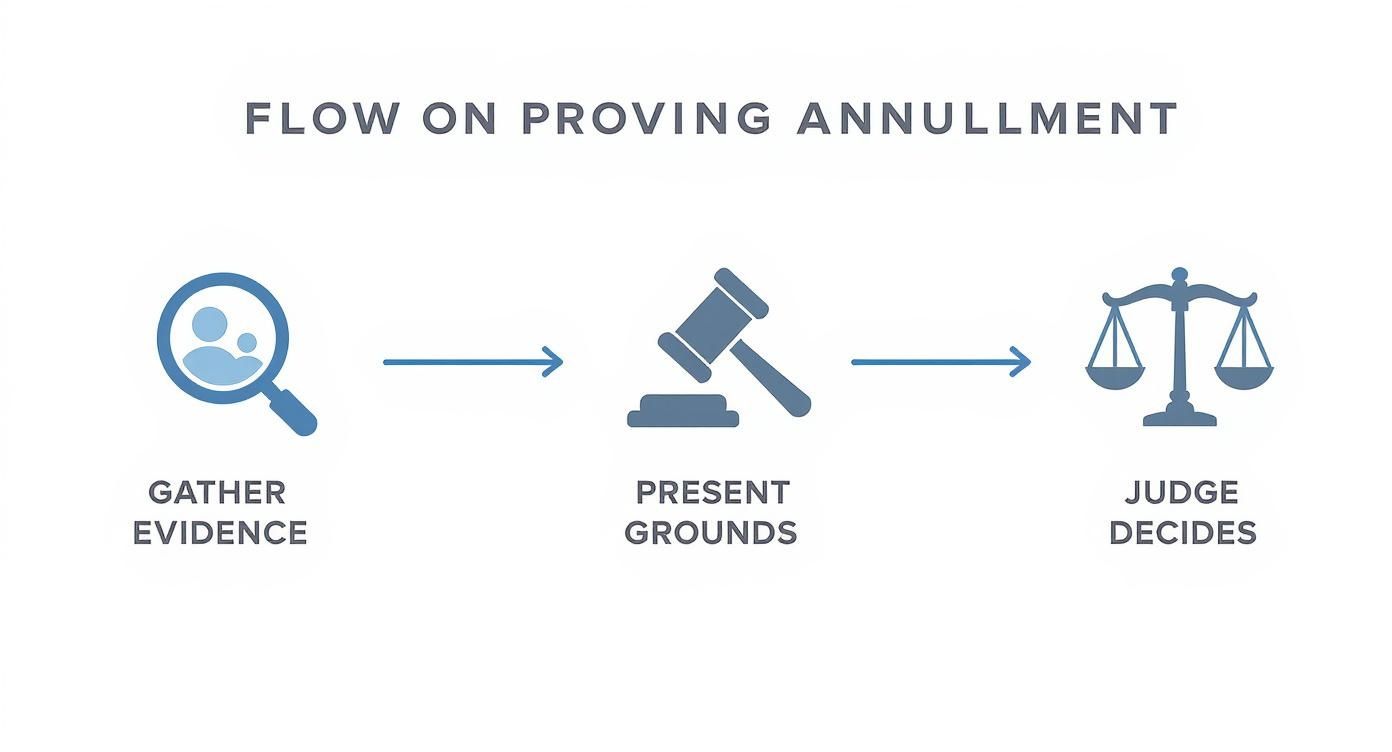
As you can see, after you've done the legwork of collecting proof, the action moves into the courtroom where the judge makes the final call.
Step 4: The Final Hearing
The last major step is the final hearing in front of a Harris County judge. This is your day in court, where you’ll present your evidence and testimony to support your case. If the annulment is uncontested and all the paperwork is perfect, this can be a relatively brief and straightforward appearance.
However, if your spouse is fighting the annulment, expect a much more involved hearing where both sides present their arguments and evidence. The judge will listen to everything and then make a final ruling. Even in simple cases, delays can happen here just because the court’s dockets are so incredibly busy.
It's also interesting to see how this process compares to other places. Legal, cultural, and religious factors can dramatically change how long an annulment takes. For instance, the average time for an annulment in India can stretch from 1 to 3 years, a far cry from what we see here, all depending on the case details and court efficiency. You can read more about these global perspectives on annulment timelines to see how different the process can be.
How a Contested Annulment Impacts Your Timeline
https://www.youtube.com/embed/TVBruc_Kogs
When you're trying to figure out how long an annulment takes, the single biggest question is this: does your spouse agree with you? That one factor can be the difference between a process that’s wrapped up in a few months and one that drags on for more than a year. The path forward splits into two very different journeys: uncontested and contested.
An uncontested annulment is the smoothest and fastest route. This is where you and your spouse are on the same page about both the annulment itself and the legal reason for it. For instance, if you both agree the marriage was based on fraud and are ready to sign the paperwork, a Harris County court can resolve the matter pretty quickly.
When Disagreement Leads to Delays
A contested annulment is a completely different ballgame. This happens when your spouse digs in their heels, disputes your claim, and refuses to agree. Say you file for an annulment based on duress, but your spouse argues that you both entered the marriage willingly. Just like that, you’re no longer just filing paperwork; you're heading into a legal fight. It’s this conflict that really stretches out the timeline.
When a case is contested, the whole process gets layered with complex and time-consuming steps. Instead, you should brace for:
- Formal Discovery: This is the evidence-gathering stage, and it can take months. It involves depositions (out-of-court testimony under oath), interrogatories (written questions), and demands for documents to build your case.
- Multiple Court Hearings: You'll likely find yourself in court for more than just the final decision. There could be temporary orders hearings, mandatory mediation sessions, and pre-trial conferences along the way.
- A Full Trial: If you can't reach an agreement through negotiation or mediation, your case will go to trial. This is where both sides present their evidence and call witnesses to testify before a judge, who then makes the final ruling.
A contested annulment isn't just a legal formality; it's a full-blown lawsuit. The game changes from simply presenting the facts to having to prove your case while your spouse is actively trying to disprove it. This adds a tremendous amount of time, expense, and emotional strain.
Navigating a Contested Case in Harris County
The time it takes to get through a contested case can be unpredictable. Court schedules, the judge's availability, and the specific details of your situation all play a role in how long things take. It means you have to be ready for a longer legal journey where the outcome isn't guaranteed. If you're interested in the broader trends, you can learn more about legal annulment rates and proceedings.
Trying to handle a contested annulment on your own is an uphill battle. Having a seasoned Atascocita attorney from the Law Office of Bryan Fagan in your corner is crucial. We can protect your rights, help you gather the evidence needed to make a strong case, and guide you through the complicated rules of the Harris County court system.
How an Atascocita Annulment Lawyer Can Help

As you've probably gathered, figuring out how long it takes for an annulment isn't about circling a date on the calendar. The timeline is shaped entirely by your unique story—the legal grounds you have, whether your spouse is on the same page, and a dozen other details. For our neighbors here in Atascocita and Humble, trying to sort through this alone can be incredibly stressful.
Finding your way through the Harris County court system is about much more than just filling out forms. It takes a strategic mindset, a solid grasp of Texas law, and an advocate who genuinely has your back. A seasoned family law attorney handles the heavy lifting—building your case, tracking every deadline, and managing all the back-and-forth with the court and your spouse.
The Value of Local Legal Guidance
A good lawyer does more than just give legal advice. They become your guide, helping you sidestep the common pitfalls that cause frustrating delays and add even more stress to an already tough situation.
Here’s how we can step in and help:
- Evaluating Your Grounds: We'll sit down with you and go over every detail to see if you have a strong, valid reason for an annulment under Texas law.
- Gathering Evidence: Our team knows what it takes to convince a judge. We'll help you pull together the documents, witness statements, and other proof needed to build a solid case.
- Navigating Court Procedures: We work in the Harris County courts every day. We know the procedures, the people, and how to keep your case moving forward efficiently.
Choosing the right legal partner is the single most important decision you will make in this process. You need an attorney with the right experience, but you also need someone who makes you feel heard and supported.
Making an informed choice is crucial. That's why we've put together resources to help you understand what to look for when you need to choose the right divorce or family law attorney for your specific needs.
Your Next Steps with The Law Office of Bryan Fagan
You don't have to walk this path alone. The emotional and financial toll of any family law case is real, and we are committed to giving folks in the Atascocita community the clear, knowledgeable, and compassionate support they deserve. We’re here to help you find the best way forward, whether that's an annulment or another solution that fits your life.
The first step is always just talking it through. At The Law Office of Bryan Fagan – Atascocita TX Lawyers, we invite you to schedule a free, no-pressure consultation at our Atascocita office. Let's talk about your situation, help you understand your options, and give you a realistic idea of what to expect.
Schedule your free consultation today at https://www.atascocitaattorneys.com.