Atascocita divorces are handled by the Harris County Family District Courts at the Civil Courthouse, 201 Caroline St., Houston, not by a local Atascocita court. If you meet Texas residency rules, your case is generally filed in Harris County and then assigned within that countywide family court system.
If you're living in Atascocita or nearby Humble, it's easy to assume there must be a local divorce court for your neighborhood. That assumption makes sense. Atascocita feels like its own community, and for many families it functions like one in daily life.
But courthouse reality works differently than neighborhood identity. Divorce in Texas follows county and state court rules, not local community labels. Once you understand that, the process gets a lot less confusing and a lot less intimidating.
For many families in northeast Harris County, the questions aren't just "Which court handles divorce?" They are: Where do I file, what courthouse do I go to, and what happens after my petition is submitted? Those are the questions that matter when you're trying to protect your kids, your property, and your peace of mind.
Finding the Right Court When You Live in Atascocita
A common situation goes like this. Someone in Atascocita has made the difficult decision to move forward with divorce. They search for "Atascocita divorce court," expecting a local building, a neighborhood judge, or a smaller nearby office.
Instead, they run into a tangle of Houston and Harris County court information and start wondering whether they should be looking under Atascocita, Humble, or Houston.
The answer most people need first
Atascocita is an unincorporated Harris County community, not a separate city with its own divorce court. One recent profile places the population at about 99,354, while another neighborhood guide places it at roughly 79,538, but both agree on the point that matters here: Atascocita is part of Harris County, and divorce cases are handled through the county's family court system rather than a local Atascocita court (Atascocita neighborhood and court overview).
That means your divorce case doesn't get filed in an "Atascocita family court" because there isn't one.
Why this confuses so many local families
Atascocita and Humble residents often organize life around local schools, neighborhoods, shopping areas, and commute patterns. So it feels natural to think court systems work the same way.
They don't. Divorce is handled by state district courts operating through Harris County. If you're sorting out whether your address changes anything, this guide on Atascocita vs. Humble divorce court and county questions helps clarify how local community names fit into county venue rules.
Practical rule: In divorce cases, your mailing habits and neighborhood identity matter less than your county and residency status.
That shift in perspective helps. Once you stop searching for a local Atascocita courthouse and start thinking in terms of Harris County family courts, the next steps become much easier to understand.
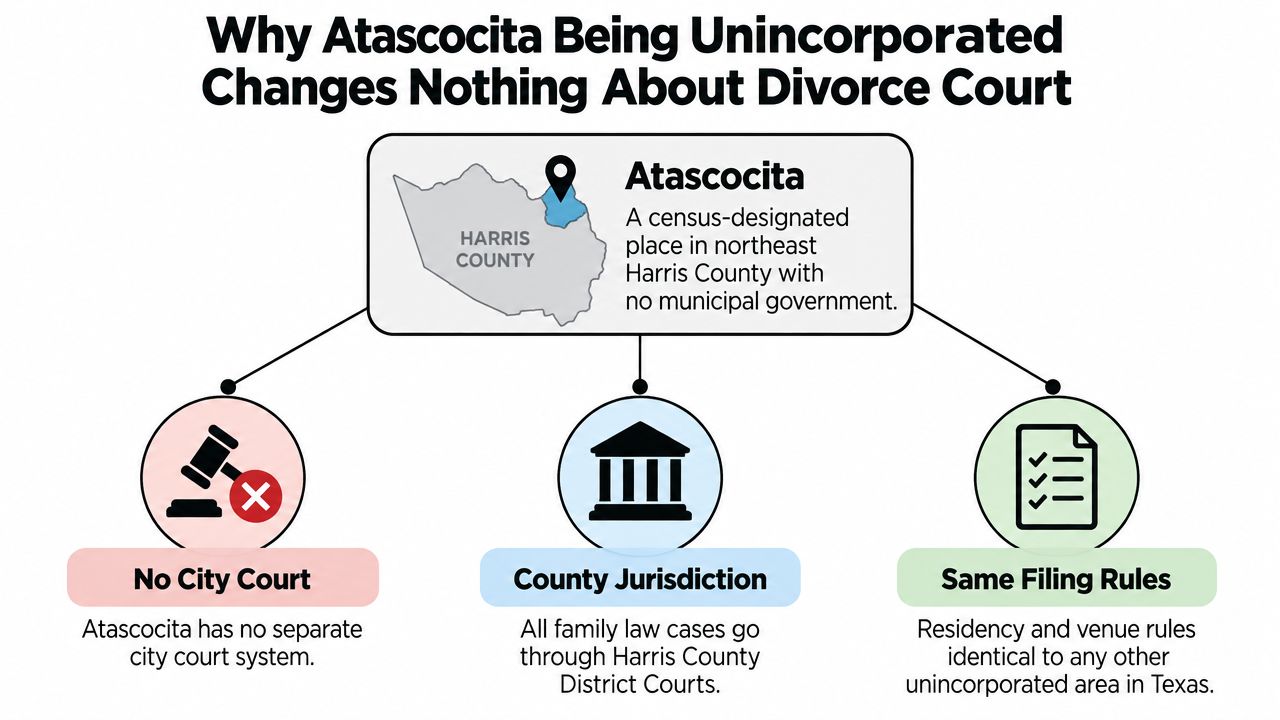
Why Atascocita Being Unincorporated Changes Nothing About Divorce Court
People often hear the phrase unincorporated area and assume it creates a special legal category for filing divorce. It doesn't work that way.
Atascocita's unincorporated status means it isn't an incorporated city with its own municipal government. It doesn't mean residents are outside the regular court system. It means divorce jurisdiction still runs through the same state district court structure that serves Harris County.
A simple way to think about it
Think of family courts like a countywide service map. Your neighborhood may have its own name and identity, but the court's service area is the county.
So if you live in Atascocita, Kingwood, Humble, or another part of northeast Harris County, the family court system doesn't split apart by neighborhood lines. The same county court network handles cases from across Harris County.
What Atascocita's status does and does not mean
Here is the part that matters most:
- No separate city court system: Atascocita doesn't have its own standalone divorce court.
- Same state law rules: Texas divorce law applies the same way whether you live in an incorporated city or an unincorporated community.
- Countywide family court access: Your case goes into the Harris County district court system if Harris County is the proper venue.
This is one reason local courthouse guidance matters. Harris County Family Courts: A Atascocita Resident's Guide describes how family law cases proceed in the Harris County courts serving Atascocita.
An unincorporated address can feel local and separate. Your divorce case still follows countywide court jurisdiction.
Why population and metro identity don't create a new court
Some readers ask a fair question: if Atascocita is large enough to be widely recognized and part of the Houston-Pasadena-The Woodlands metro area, why doesn't it have its own divorce court?
Because divorce venue isn't created by community size or local branding. It is created by Texas court structure and county jurisdiction. In practical terms, that simplifies things. You don't need to guess between a local Atascocita court and a Houston court. For divorce, the county system is the path.
If you've been searching Atascocita unincorporated Harris County which court handles divorce, the shortest answer is this: Atascocita's unincorporated status changes less than people think. The controlling court system is Harris County's family district courts.
Residency and Venue Rules That Determine Where You Can File
A common Atascocita scenario goes like this. You are ready to file, your mailing address says Atascocita or Humble, and you start wondering whether that affects where the case belongs. The answer usually turns on residency dates, not on the community name on your address.

The two-part filing test
Texas applies a simple two-part rule. One spouse must have lived in Texas for at least six months, and one spouse must have lived in the county where the case is filed for at least 90 days before filing (Texas divorce filing requirements).
For Atascocita residents, that usually points to Harris County. The key is the county line, not whether your address feels more like Atascocita, Humble, or greater Houston.
How to apply that rule in real life
The easiest way to check venue is to work backward from the day you want to file. If that filing date is today, ask whether either spouse has already completed the full six months in Texas and the full 90 days in Harris County by today, not by the end of the month.
Proof matters too. Courts and clerks often look to practical records such as a driver's license, lease, utility bill, voter registration, pay records, or other documents that show where a person has been living. You do not need a perfect stack of paperwork on day one, but you do want your dates to be honest and supportable.
A quick self-check
Ask these three questions:
- Texas residency: Has either spouse lived in Texas for at least six months before filing?
- County residency: Has either spouse lived in Harris County for at least 90 days before filing?
- Correct venue: If yes to both, Harris County is usually the proper place to file for an Atascocita divorce.
If one answer is no, the problem is often timing. Waiting a little longer can be the difference between a clean filing and a case that gets challenged.
Why the county choice matters
Filing in the wrong county can slow everything down. A venue mistake can lead to extra motions, a transfer request, added cost, or even dismissal in some situations. That is frustrating for families who were trying to get the process started the right way.
Check the dates before filing: In divorce cases, a simple calendar mistake can create weeks of delay.
A plain-English example
Suppose a couple lives in Atascocita today. One spouse has lived in Texas long enough, but the move into Harris County happened only a few weeks ago. They may be eligible to file in Texas soon, but not yet in Harris County. On the other hand, if either spouse already meets both time requirements, filing in Harris County usually makes sense even if an older address, workplace, or family home is in another area.
That is the courthouse reality for Atascocita. The label on the neighborhood does not control venue. The residency clock and the county do.
How Harris County Family District Courts Handle Divorce Cases
A common Atascocita moment goes like this: you are ready to file, you know Harris County is the right county, and then someone asks, “Which divorce court do I go to?” That question makes sense. The courthouse system sounds like there should be one local courtroom waiting for Atascocita cases.
Harris County does not work that way.

The family court system is countywide
For Atascocita residents, a divorce case enters the Harris County family district court system as a county case, not a neighborhood case. After filing, the case is assigned within that family-court system rather than being sent to an “Atascocita divorce court.”
A good way to picture it is a hospital with different departments under one roof. You check in through one system, then your case is routed to the department that handles that type of problem. Divorce, custody, support, visitation, and related family matters are handled through Harris County's family district courts.
That assignment matters because the judge, court coordinator, scheduling practices, and hearing procedures will be tied to the court that receives your case.
What that means for hearings
For many family matters, hearings are centered at the Civil Courthouse, 201 Caroline Street in Houston, according to the Harris County District Clerk's family court locations page.
For an Atascocita family, that is the practical courthouse reality. You may live near Humble or Kingwood, but your divorce case is usually handled through the downtown Harris County family court system.
This short video helps many families picture what a county family court process can feel like before a hearing date arrives.
Why the assigned court changes the details
The phrase “go to family court” can be misleading. It sounds like one room and one check-in desk. In real life, your assigned court controls much more than the courtroom number.
Some family court functions or specialized dockets may be handled in different locations. Current District Clerk listings, for example, show that the 280th Family District Court and Child Protection Court may operate at 1200 Congress on certain matters, as reflected in the current Harris County family court listings.
That is why two Harris County divorce cases can look similar on paper but unfold a little differently in practice. Hearing dates, standing orders, coordinator instructions, and required paperwork often depend on the specific court assigned to the case. If you want a clearer picture of the courtroom experience, this guide to what happens at a Harris County family court hearing explains what families usually see once a setting is scheduled.
| What people assume | What usually happens |
|---|---|
| There is one local divorce court | Cases are assigned within Harris County's family district court system |
| An Atascocita address decides the courtroom | County filing and court assignment decide where the case goes |
| Every family hearing happens in one identical location | Many hearings center at 201 Caroline, but the assigned court can affect the exact location and process |
Where and How Atascocita Residents Actually File for Divorce
A common Atascocita moment goes like this. Someone decides the marriage is over, opens a search bar, and starts looking for the nearest divorce court. Then the confusion starts, because there is no Atascocita divorce courthouse to drive to.
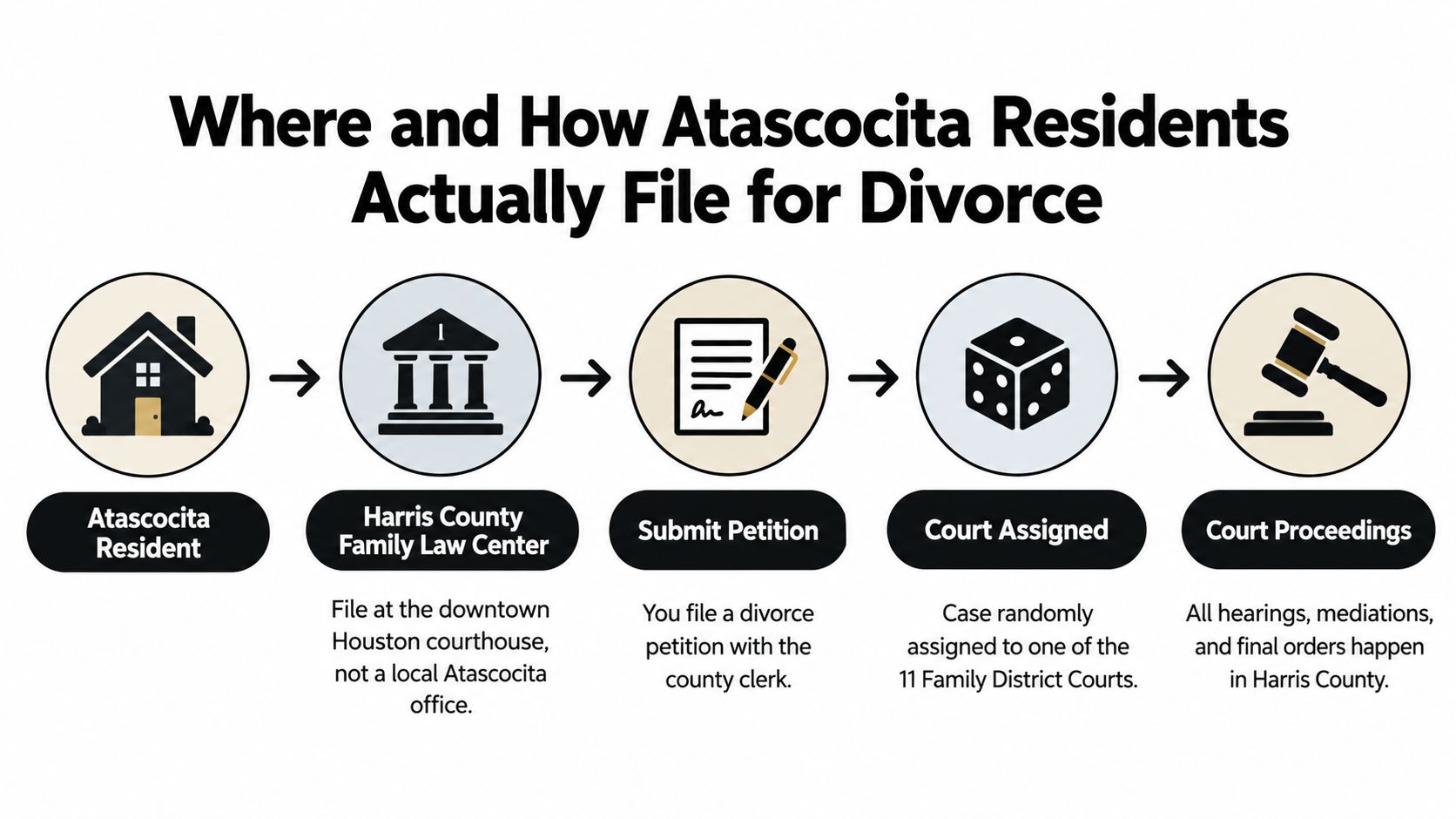
For Atascocita residents, divorce cases are filed through the Harris County District Clerk and placed into the county family district court system. Your ZIP code helps explain where you live. It does not create a separate local court for your divorce.
The filing path in plain English
The easiest way to understand filing is to picture a front desk for the whole county. You do not file with an "Atascocita court." You start the case in the Harris County system, and the system assigns the case to one of the family district courts that handles divorces.
Lawyers file electronically, and many self-represented parties use the county process set up for court filings as well. The practical point is simple. The case begins at the county level, then gets a cause number and a court assignment that will control hearings, deadlines, and instructions.
What the first steps usually look like
In real life, the opening steps are usually:
Prepare the Original Petition for Divorce.
This document tells the court who the parties are, confirms that the residency rules are met, and states what relief is being requested.File the case through the Harris County filing system.
The petition is submitted to the District Clerk, along with any required filing information and fees or a request for a fee waiver if one applies.Receive a cause number and court assignment.
Once accepted, the case is placed in one of Harris County's family district courts. That assigned court becomes the home base for the divorce.Move into the service and temporary-orders stage.
The other spouse must usually be formally served unless service is waived. If there are urgent issues involving children, bills, use of property, or safety, temporary requests may need attention early.
If you want a practical local walkthrough, this guide on filing a divorce in Harris County from Atascocita shows how these steps usually play out for families in this area.
What filing changes right away
Once the clerk accepts the petition, the divorce is no longer just a private family decision. It becomes a court case with rules, deadlines, and an assigned judge.
That shift matters.
If children are involved, early questions often focus on where they will stay, how school-week routines will work, and who will make day-to-day decisions until final orders are entered. If property is the main concern, attention often turns to bank records, debt information, access to important documents, and keeping assets from being changed or hidden.
Filing works a lot like getting onto the correct highway entrance ramp. The address is Atascocita, but the road you enter is Harris County's family court system, and the assigned court determines the route from there.
When families need help understanding that process, one option is the Law Office of Bryan Fagan – Atascocita TX Lawyers, which handles family law matters for residents in Atascocita, Humble, and Harris County, including divorce, custody, and related court filings.
What Happens After Filing Timelines and Next Steps in Harris County
Many people think the biggest hurdle is getting the petition filed. Filing matters, but the timeline after filing is what usually surprises families.
Texas divorces generally can't be finished in fewer than 60 days after the petition is filed, and that waiting period starts from the filing date, not the date of separation or service (Texas divorce residency, venue, and waiting period overview).
The waiting period families need to plan around
That rule affects expectations right away. A couple may have been separated for months. They may already agree on major issues. They still usually can't finalize the divorce until the waiting period runs from the filing date.
Texas legal aid also explains that the 60-day waiting period can be waived in two family-violence situations. One is when a spouse was convicted of, or received deferred adjudication for, family violence against the other spouse or a household member. The other is when there is an active protective order or magistrate's order because of family violence during the marriage (Texas divorce FAQ with children and waiting-period exceptions).
What often happens during that time
The waiting period doesn't mean nothing happens. It usually means the case moves through intermediate steps, such as:
- Service of process: The other spouse receives formal notice unless service is waived.
- Temporary orders: Parents or spouses may ask the court for short-term rules about children, property use, or finances.
- Information exchange: Each side gathers the documents needed to understand assets, debts, and parenting issues.
- Mediation or negotiation: Many cases work toward agreements before a final hearing.
A local example
Take an Atascocita parent who files in Harris County after meeting the residency rules. The waiting period begins on the filing date. If the case involves school schedules, possession arrangements, or access to the family home, those issues may need attention well before the final decree is possible.
That is why filing correctly the first time matters so much. The filing date doesn't just start the case. It starts the legal clock and shapes the whole schedule that follows.
Getting Local Guidance for Your Harris County Divorce
If you've been trying to sort out Atascocita unincorporated Harris County which court handles divorce, the answer is more concrete than many websites make it sound. The controlling forum is the Harris County family district court system, centered at 201 Caroline Street in Houston, and your ability to file depends on Texas residency and county venue rules.
For some people, that clears up the issue immediately. For others, it raises a new set of practical concerns. Which court will I be assigned to? Do I need temporary orders? What if we disagree about the children? What if I'm also dealing with urgent safety issues, a protective order, or concerns about property disappearing?
When local legal help makes sense
It may be time to speak with counsel if any of these apply:
- You aren't sure about venue: A wrong filing location can create delays and extra expense.
- Children are involved: Parenting plans, conservatorship, and school-related concerns often need careful early attention.
- The case is contested: Disputes about property, support, or fault usually require a more deliberate strategy.
- You're also facing related issues: Some families need help not only with divorce, but with custody enforcement, grandparents' rights, criminal accusations affecting the household, estate planning updates, or civil disputes tied to separation.
If your case may stay cooperative, you may want to compare options for an uncontested path. If conflict is already building, it helps to understand the differences between contested and agreement-based filings before paperwork is submitted.
For readers looking into those next steps, the firm's related resources on contested and uncontested divorce can help narrow the right approach before you commit to a filing strategy. The most important point is this: you don't need to guess your way through Harris County court procedure just because Atascocita doesn't have its own divorce court.
If you're in Atascocita, Humble, or northeast Harris County and need help figuring out where to file, what court will handle your divorce, or what happens after filing, the attorneys at Law Office of Bryan Fagan – Atascocita TX Lawyers offer free consultations focused on local court procedure and practical next steps. We help families understand Harris County filing, court assignment, custody concerns, and related legal issues so they can move forward with clarity.