Texas Family Code § 7.009 lets a spouse seek relief through a reconstituted estate by adding improperly depleted community funds back into the marital estate and then dividing the corrected total in a just-and-right manner. The court may award more of the remaining property, enter a money judgment, or use both remedies.
You may be sitting at a dining table in Atascocita with bank statements, tax returns, credit-card records, and a divorce petition spread in front of you. Your spouse says the money is gone because of ordinary household expenses, but the records suggest transfers to a relative, unexplained withdrawals, or an account you didn't know existed. That uncertainty can feel overwhelming, especially when every missing dollar affects housing, retirement, and your ability to rebuild after divorce.
Texas law doesn't treat every disappointing financial decision as fraud on the community. The court looks for proof that community property was concealed, transferred, spent, or misrepresented in a way that unfairly deprived the other spouse. For families in Atascocita, Humble, and northeast Harris County, the central question is often whether the evidence can show what belonged to the community, what happened to it, and how the conduct affected a fair property division.
Understanding Fraud On The Community In Your Atascocita Divorce
Consider a married couple who owns a home near Lake Houston, maintains joint accounts, and has retirement savings built during the marriage. During divorce, one spouse discovers that money moved from a joint account to a relative shortly before separation. Other statements show large withdrawals described only as “cash,” while the spouse who controlled the account insists the funds were used for routine expenses.
That situation raises questions, but suspicion alone doesn't establish fraud on the community. Texas courts examine whether the property was community property, whether it was depleted or transferred, whether the other spouse controlled or accessed the funds, and whether the conduct caused an unfair reduction in the estate available for division. The Texas community property overview can help explain the starting distinction between community and separate property.

Texas Family Code § 7.009 provides a remedy when fraud is proven. The court determines how much the community estate was depleted, calculates the estate that would have existed without the misconduct, and divides that corrected estate in a manner the court considers just and right. The court may award a larger share of the community property that remains, enter a money judgment against the spouse who committed the fraud, or combine those remedies.
This framework matters in Atascocita because financial misconduct often appears in ordinary records rather than dramatic admissions. Bank transfers, investment statements, business ledgers, property records, text messages, and tax filings may reveal the difference between ordinary marital spending and deliberate depletion. A careful review can also separate a genuinely disputed transaction from a misunderstanding about separate property or legitimate household expenses.
How Texas Calculates A Reconstituted Estate Under Family Code 7009
A reconstituted estate is an accounting tool. Instead of dividing only what remains in the accounts on the date of divorce, the court asks what the community estate would have looked like if proven fraud had not occurred.
The calculation has two stages:
- Determine the depletion. The court identifies community property that was improperly transferred, spent, concealed, or otherwise removed from the estate.
- Divide the corrected estate. The court adds the proven depletion back to the remaining community property, then makes a just-and-right division.
The statutory example makes the arithmetic easier to see. If the marital estate originally totaled $200,000 and one spouse improperly depleted $50,000, the remaining estate may appear to be $150,000. For purposes of the reconstituted estate, the court adds the proven depletion back, producing a theoretical corrected estate of $200,000. Those figures come directly from the statutory example in Texas Family Code § 7.009.
| Stage | What The Court Does | Example Result |
|---|---|---|
| Identify community property | Separates community assets from proven separate property | Community estate identified |
| Determine depletion | Adds back the value improperly removed | $50,000 depletion identified |
| Calculate corrected value | Combines remaining property with the depletion | $150,000 plus $50,000 equals $200,000 |
| Make the division | Allocates the corrected estate in a just-and-right manner | No automatic percentage |
The restored figure doesn't mean the court simply hands the innocent spouse the missing cash. The funds may no longer be traceable or recoverable from the original account. Instead, the corrected total gives the judge a fair accounting base for deciding how the remaining assets and any judgment should be allocated.
Tracing becomes especially important when funds moved between joint and individual accounts, paid business expenses, or became mixed with separate property. Records may need to be reconciled transaction by transaction. A resource on commingled bank account tracing in an Atascocita divorce explains why the account history often matters as much as the ending balance.
For families seeking counsel about the Property Division Lawyer in Atascocita, the relevant focus is division of community property and complex assets for Atascocita divorces.
What Conduct Qualifies As Fraud On The Community Estate
Texas courts don't label every questionable purchase as fraud. A spouse generally needs to connect the conduct to a specific community asset and show more than an argument that the spending was unfair.
In Stone v. Woodard-Stone, the Fifth Court of Appeals reported that clear and convincing evidence supported findings involving concealed lottery winnings, dishonest conduct, an intent to deceive the other spouse about the value of the community estate, transfers of community property, and spending designed primarily to deprive the other spouse of use and enjoyment of community funds. The decision also applied the reconstituted-estate calculation required by Family Code § 7.009. You can review the reported decision in Stone v. Woodard-Stone.
Conduct courts may examine
Examples can include:
- Concealing lottery, investment, or business proceeds.
- Transferring marital funds to relatives or another person without a legitimate community purpose.
- Misrepresenting account balances or the value of property.
- Using community funds primarily to deprive the other spouse of access or enjoyment.
- Spending or moving assets in a way that leaves the community estate unfairly depleted.
Property acquired during marriage generally is community property unless proven separate, and property possessed by either spouse at divorce is presumed community property. That presumption doesn't end the inquiry. A spouse claiming separate ownership may still need records tracing the asset to a separate source.
The strongest proof usually combines intent, timing, control, and amount. A transfer made shortly before a divorce filing may deserve scrutiny, but its timing alone doesn't prove fraud. The evidence should show where the money came from, who controlled it, why it moved, and how the transaction reduced the estate available for division.
Evidence matters: A vague accusation that money “disappeared” is harder to present than a dated transaction tied to a specific account, amount, recipient, and explanation.
For a plain-language visual explanation of the documentary process, this video may provide general background:
The court's task is fact-specific. Ordinary expenses, gifts made with both spouses' knowledge, and legitimate business transactions may require a different analysis from deliberate concealment. Your attorney will need to distinguish poor financial judgment from conduct that meets the legal standard.
Available Remedies And How Courts Divide The Corrected Estate
After the court calculates the corrected estate, the next question is practical: what can the wronged spouse receive? Texas Family Code § 7.009 gives the court several tools, but it doesn't impose an automatic penalty percentage.
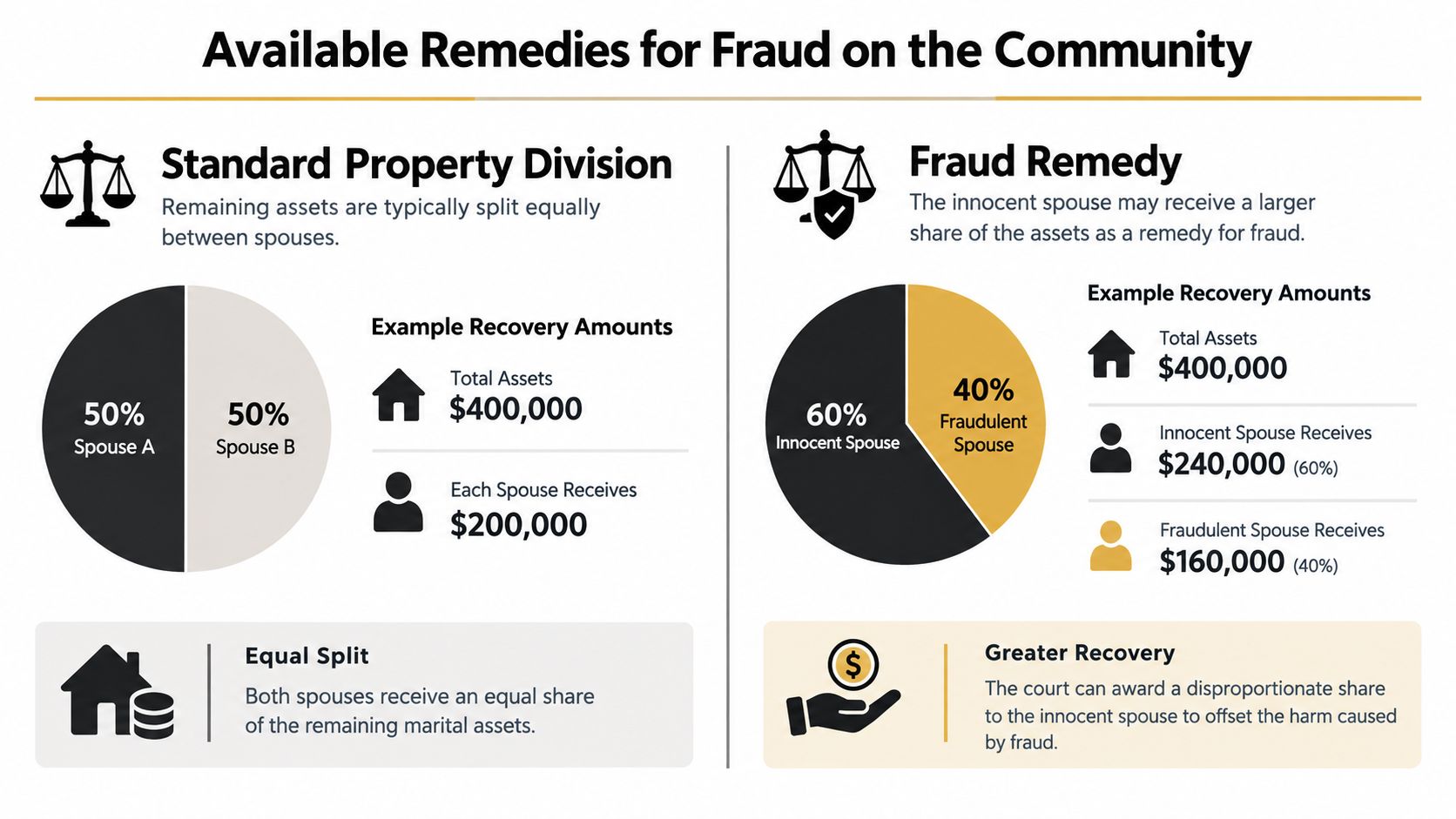
The judge may award a disproportionate share of the community property that remains. This can be useful when the depleted funds aren't available to return directly, but other assets, such as home equity, investment accounts, or retirement interests, can be allocated in a fair way.
A court may instead enter a money judgment against the spouse who committed the fraud. That remedy treats the proven depletion as a debt owed to the wronged spouse. The court may also use both remedies, awarding a larger share of remaining property and entering a judgment.
The appellate decision in Clarke v. Clarke describes these options as including a disproportionate award, a money judgment, or a combination. The court still must divide the corrected estate in a manner that is just and right. Clarke v. Clarke illustrates why the remedy depends on the evidence and the circumstances.
Why the result isn't automatically 50 percent
A reconstituted estate isn't a command that the innocent spouse receives a fixed percentage. The court considers the total circumstances, including the nature of the misconduct, the value of the depletion, the property still available, each spouse's financial position, and the effect of the proposed division.
For example, a judge may find that a money judgment is appropriate when the depleted amount is clearly documented and the responsible spouse has assets or income from which payment can be addressed. A disproportionate award may make more sense when the estate contains property that can be transferred without creating an unworkable collection problem.
A spouse preparing for court should connect each disputed transaction to a requested remedy. The question isn't only, “What was lost?” It is also, “What property remains, what can be valued reliably, and what division addresses the economic effect fairly?” Guidance about hidden assets in a Texas divorce can help frame the records and questions for a consultation.
Evidence, Forensic Accounting, And Procedural Considerations In Harris County
Fraud claims succeed or fail on the quality of the financial reconstruction. A judge needs a coherent story supported by admissible records, not a stack of disconnected statements.
Begin with a date-indexed collection of documents:
- Bank statements: Obtain complete statements, transaction details, cancelled checks, and transfer records.
- Tax returns: Compare reported income, deductions, business activity, and investment information.
- Retirement records: Review contributions, withdrawals, loans, beneficiary information, and account values.
- Credit-card activity: Identify personal charges, cash advances, transfers, and payments from community accounts.
- Business ledgers: Check revenue, owner draws, reimbursements, accounts payable, and unexplained expenses.
- Property records: Compare deeds, closing statements, loan documents, liens, and sale proceeds.
The most useful reconstruction often takes the form of a cash-flow schedule. Each entry identifies the date, account, amount, source, destination, stated purpose, and supporting document. That format lets an attorney, accountant, opposing counsel, and judge follow the same transaction without guessing how the conclusion was reached.
Protecting the evidence
Don't delete messages, reset devices, discard paper records, or edit spreadsheets in a way that removes the original information. Preserve emails, texts, cloud files, photographs, account alerts, and communications with banks or brokers. Keep original files where possible, and create working copies for sorting.
Procedurally, your lawyer may raise the issue through pleadings, discovery requests, subpoenas, depositions, temporary orders, or trial exhibits, depending on the case. Timing matters because records can become harder to obtain and because property cases may involve court deadlines, discovery limits, and preservation duties.
The family-law claim can also overlap with allegations of theft or fiduciary misconduct, but those are separate legal theories. A transaction may support a family-court argument about depletion without satisfying the elements of a criminal offense. Conversely, suspected criminal conduct doesn't automatically determine how the family court must divide the marital estate.
Related Issues Like Theft Charges, Fiduciary Misconduct, And Deed Fraud
A missing marital asset can create several legal questions at once. The family court may examine depletion during divorce, while a criminal investigation, civil claim, probate proceeding, or deed challenge may address different conduct and different remedies.
Texas Penal Code Chapter 31 defines theft through unlawful appropriation of property with intent to deprive the owner of it. That analysis is separate from fraud on the community, which primarily concerns the economic effect of misconduct on a divorce property division. Preserve the chronology and identify whether each asset was community, separate, estate, or third-party property before making accusations.
Estate administration adds another layer. Texas Penal Code § 32.45 addresses misuse of property held in a fiduciary capacity and identifies fiduciaries who may be covered, including trustees, guardians, administrators, executors, conservators, and receivers. An executor or administrator generally manages estate property for the estate and beneficiaries, not for personal use. Relevant records may include inventories, probate filings, account statements, receipts, cancelled checks, sale documents, and communications with heirs. The statutory text is available at Texas Penal Code § 32.45.
Deed records require immediate attention
The Harris County Clerk advises property owners to monitor recorded documents, register for the Property Alert System, and inspect unfamiliar filings promptly. Verification should use the legal description, not only the street address, and should compare the grantor, grantee, notary, signatures, consideration, liens, and later conveyances. The Clerk explains these steps through its Harris County property deed fraud guidance.
An alert is an investigative trigger, not a judicial finding. Preserve certified copies and related communications, don't alter original evidence, and obtain legal advice rather than confronting an alleged recipient. Families handling connected custody concerns may separately review Grandparents' Rights in Atascocita for custody and visitation rights for grandparents in Harris County.
A will also doesn't ordinarily transfer a surviving spouse's existing community-property interest. In many disputes, the first question is ownership before inheritance is calculated, not just who was named in the will.
Postdeath Discovery, Probate Risks, And What Surviving Spouses Should Know
Some Atascocita families discover suspected depletion only after a spouse dies. A surviving spouse may open a bank account, review a deed, receive an inventory, or examine fiduciary records and realize that community assets were transferred before death or misused during administration.
The divorce framework and the probate framework aren't interchangeable. Texas Family Code § 7.009 defines a reconstituted estate as the community estate that would have existed without actual or constructive fraud, then requires the court to calculate depletion and divide the corrected value in a just-and-right manner. A suspected transfer discovered after death may require analysis of whether the issue belongs in a prior divorce or property case, a probate proceeding, a claim against an estate representative, or another civil action.
Separate ownership from inheritance
A surviving spouse's community-property interest is an ownership question. An inheritance is a transfer of property that belongs to the deceased person's estate after ownership and creditor issues are addressed. A will generally cannot give away the surviving spouse's existing community-property interest by naming another beneficiary.
Texas law also preserves the surviving spouse's homestead rights whether the homestead was separate property or community property. That protection doesn't answer every ownership dispute, but it shows why probate planning and property classification must be handled together.
Gather the records before making a demand:
- Bank statements and transfer confirmations.
- Deeds, legal descriptions, liens, and closing documents.
- Beneficiary designations for retirement and financial accounts.
- Business ledgers, ownership records, and tax filings.
- Probate inventories, accountings, receipts, and court orders.
- Communications with the executor, administrator, beneficiaries, and financial institutions.
Don't assume the probate court can resolve every family-law issue, or that a divorce court can decide every administration question. The appropriate forum, deadline, notice requirement, and remedy depend on the facts. Prompt advice is especially important when property is being sold, accounts are being distributed, or an estate representative refuses to provide records.
Next Steps For Atascocita Families And Frequently Asked Questions
Start with a quiet record-gathering process. Download complete account histories, preserve communications, write a transaction chronology, and identify what you believe was community property. Don't confront a spouse, executor, or alleged recipient in a way that could destroy evidence or escalate the dispute.
Can ordinary spending become fraud on the community?
Not automatically. The evidence must connect the spending to community property, improper depletion, intent or dishonest conduct where required, and an unfair effect on the division.
Does a reconstituted estate guarantee repayment of every missing dollar?
No. The court calculates the corrected estate using proven depletion, then chooses a just-and-right remedy. That may involve remaining property, a money judgment, or both, and collection issues can matter.
What if the suspected transfer appears after a spouse dies?
Ask counsel to separate ownership, probate administration, surviving-spouse rights, and any prior divorce claim. Gather bank statements, deeds, beneficiary forms, business records, and fiduciary accountings before assets are distributed or altered.
Residents of Atascocita, Humble, and northeast Harris County can prepare for a consultation by bringing the financial records they already have, a list of disputed transactions, and their immediate concerns about housing, support, probate, or asset protection. The sooner the facts are organized, the easier it is to identify the right forum and preserve practical remedies.
The Law Office of Bryan Fagan – Atascocita TX Lawyers helps Atascocita and Humble families address divorce property division, suspected depletion, probate concerns, criminal allegations, and related civil issues. Schedule a free consultation to discuss your records and learn what steps may protect your community-property or estate interests.