In Texas, an adult driving a non-commercial vehicle in a public place commits DWI at a blood alcohol concentration of 0.08 or higher, the per-se intoxication threshold. Texas also defines intoxication as the loss of normal mental or physical faculties, so a driver can still face DWI below 0.08.
You might be reading this after dinner in Humble, wondering whether you should drive home to Atascocita. Or you might already have an arrest report on the kitchen table, trying to understand why an officer arrested you when your test result wasn't above the limit. Either way, the important question isn't just how much alcohol the test detected. It's which legal standard applies, what evidence supports the allegation, and what you need to do next.
A Friday Night on Will Clayton Parkway and the BAC Question Everyone Asks
You leave a Humble restaurant after drinks with friends. Home is in Atascocita, and the route along Will Clayton Parkway feels familiar. You're not stumbling, you can hold a conversation, and you're asking yourself the question that brings many worried drivers to an attorney's office: What is the legal blood alcohol limit in Texas?
For most adult drivers, 0.08 or more establishes numerical intoxication, but Texas Penal Code §49.01 independently recognizes intoxication when alcohol or another substance causes someone to lose the normal use of mental or physical faculties. Those are alternative definitions, not requirements prosecutors must prove together. Texas's statutory definition of intoxication is broader than the number people remember.
The difference between a benchmark and permission
Per-se intoxication means the applicable alcohol concentration satisfies the statute's numerical definition. It doesn't mean every allegation is automatically proven, and it doesn't eliminate questions about the evidence.
Impairment-based intoxication concerns how alcohol, drugs, or another intoxicating substance affected the driver's normal abilities. A lower result doesn't settle that question by itself.
Practical rule: Don't use the legal threshold as a drinking target. Arrange another ride rather than trying to calculate how close you can get.
For a resident heading home to northeast Harris County, that distinction changes the decision. Feeling comfortable behind the wheel isn't a legal assessment. Being familiar with the road doesn't answer whether your normal coordination or judgment has been affected.
If you've already been arrested, take the same distinction into your consultation. Bring the test result, but don't focus on it so narrowly that you overlook the officer's account, recorded observations, or your own statements. Ask your attorney which definition of intoxication the State appears to rely on.
The candid advice is simple: Don't assume a result below the headline limit ends the case. Equally, don't assume an arrest means the State's interpretation of what happened is correct.
How Texas Actually Measures 0.08 in Breath, Blood, and Urine
The familiar phrase “BAC percentage” hides an important statutory detail. Texas doesn't express every specimen result as a literal percentage of alcohol in blood. The law defines alcohol concentration through specimen-specific measurements.
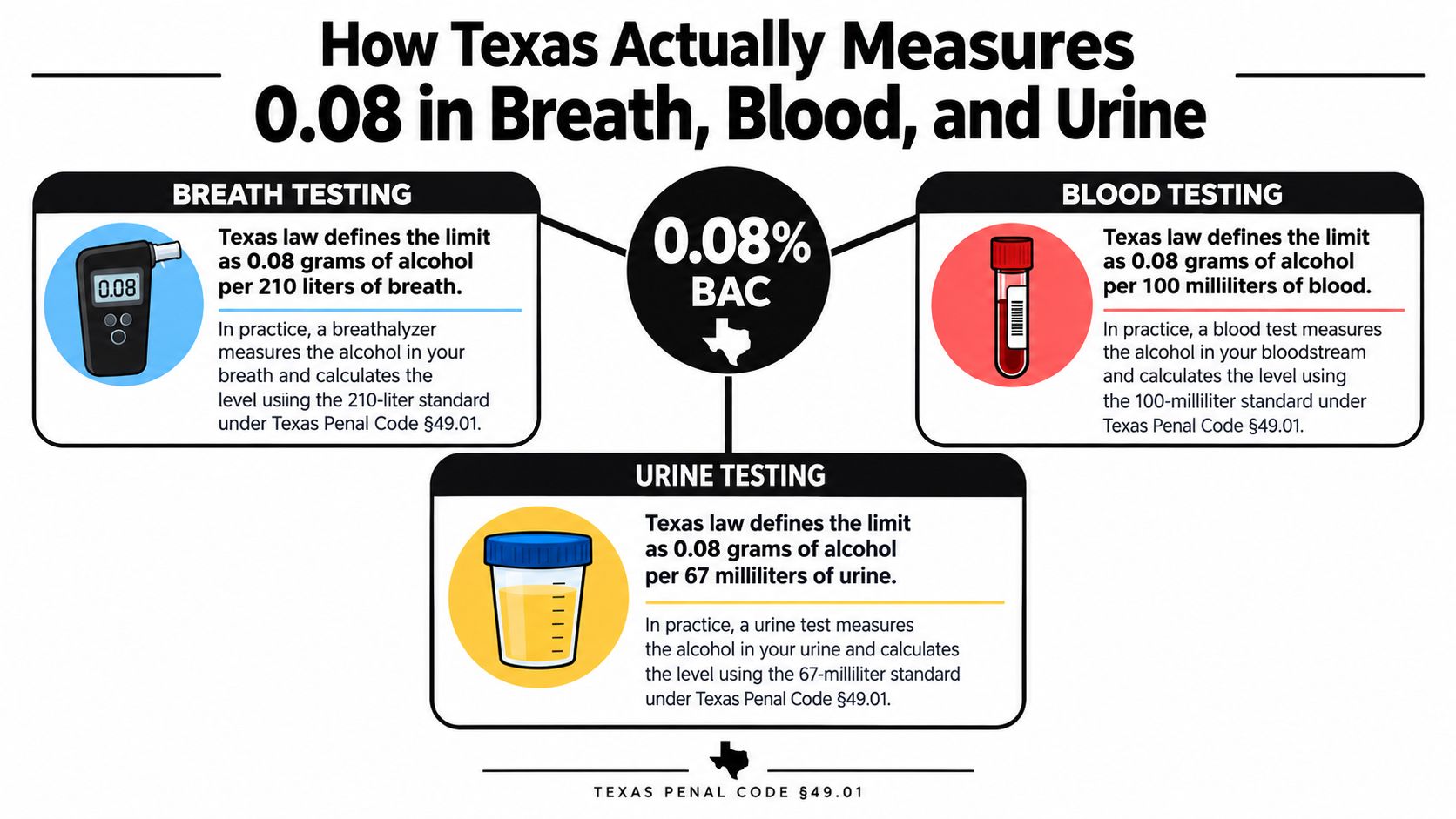
Under Texas Penal Code §49.01's measurement standards, the threshold corresponds to:
- Breath: 0.08 grams of alcohol per 210 liters of breath.
- Blood: 0.08 grams of alcohol per 100 milliliters of blood.
- Urine: 0.08 grams of alcohol per 67 milliliters of urine.
Each measurement above uses the ratios established in that statute. Think of them as different rulers for different specimens, rather than interchangeable labels for the same physical sample.
The visual below separates those statutory measurements.
Read the specimen and the units
A breath result is a breath-alcohol measurement under the statute. Calling it a blood-alcohol percentage can obscure what was collected and analyzed. Don't attempt your own conversion between specimen types or assume differently labeled reports are directly interchangeable.
For an Atascocita driver reviewing paperwork, the useful questions are concrete: Was the specimen breath or blood? What units appear on the report? When was it collected relative to the alleged driving?
- Identify the report: Separate the actual laboratory or instrument result from an officer's summary.
- Keep the timing: Preserve paperwork showing when the stop, arrest, and specimen collection occurred.
- Request an evidence review: Ask counsel what records are needed to evaluate collection procedures, sample handling, or instrument maintenance.
These questions don't establish that a test was wrong. They help your lawyer determine what the result proves.
A test report deserves careful review, not automatic acceptance or automatic dismissal. The prosecution's allegation concerns intoxication while driving, so the relationship between the specimen and the driving event matters. Counsel should also evaluate the independent impairment theory described earlier rather than treating the chemical result as the entire case.
Three BAC Tiers Every Texas Driver Should Understand
Your age and the vehicle you were operating change the analysis. A parent driving a personal vehicle, a commercial driver working near Humble, and an underage student heading home to Atascocita don't all face the same threshold.
Texas BAC Thresholds by Driver Category
| Driver Category | BAC Threshold | Primary Consequence |
|---|---|---|
| Adult operating a non-commercial vehicle | 0.08 or more, as established by the statutory standards above | Numerical intoxication for criminal DWI, with possible administrative license consequences |
| Driver operating a commercial motor vehicle | 0.04 or more, under Texas DPS's ALR thresholds | Administrative license consequences, with commercial-license concerns |
| Driver younger than 21 | Any detectable alcohol, under Texas's underage alcohol rules | Minor DUI enforcement and possible license consequences |
Commercial drivers need a separate review
The commercial threshold identified by DPS is an administrative standard. Don't confuse it with a blanket statement that the adult criminal DWI definition has been replaced for every commercial-license holder.
Tell your attorney both whether you hold a CDL and what vehicle you were operating. A work truck isn't automatically a commercial motor vehicle merely because you use it for your job. Your lawyer needs the actual vehicle and licensing information.
Underage drivers can't rely on the adult rule
For minors, detectable alcohol while operating a motor vehicle in a public place can constitute driving under the influence of alcohol by a minor. Parents should not dismiss the situation because their child didn't appear drunk or because the amount seemed small.
The underage guidance linked in the table describes consequences involving fines, alcohol education, community service, and license restrictions. A family should identify the exact allegation before assuming that minor DUI and adult DWI are interchangeable.
Prior history also deserves attention. If you've faced a previous allegation or conviction, bring the records and review the firm's information about second-offense DWI in Atascocita. Don't guess whether an earlier case counts or whether conditions from it still apply.
The practical recommendation is stricter than any threshold: commercial drivers should avoid driving after drinking, and underage drivers should never treat the adult benchmark as permission.
Implied Consent, the Statutory Warning, and the ALR Process
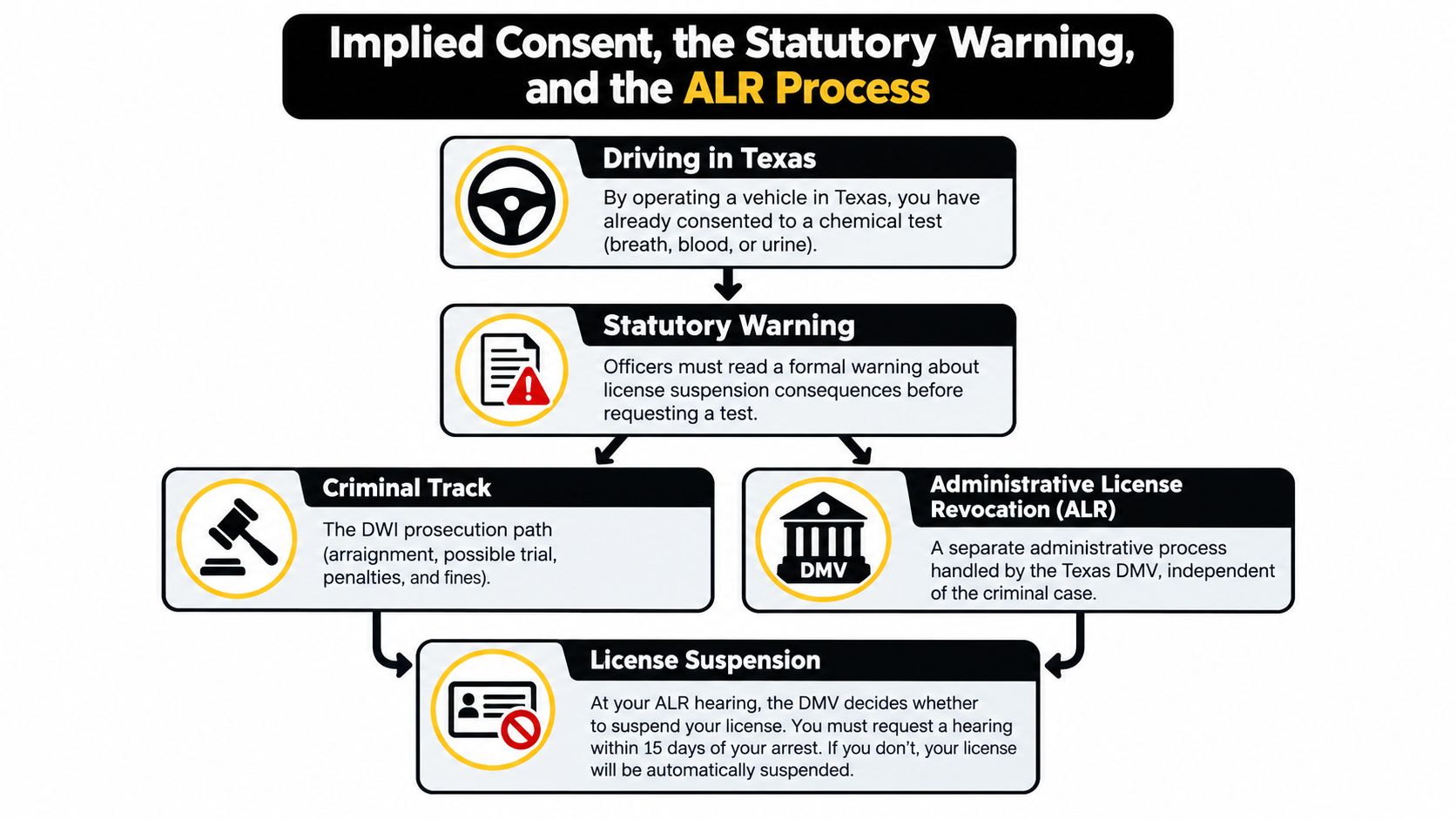
A DWI arrest can produce separate criminal and administrative proceedings. The criminal case concerns the charge. Administrative License Revocation, or ALR, concerns your driving privilege.
Texas's implied-consent framework treats qualifying driving followed by a qualifying arrest as consent to chemical testing under the applicable law. That shorthand doesn't mean every officer can demand any specimen under any circumstances. The arrest, request, warning, and testing procedure still need individual review.
This flowchart illustrates the separate tracks and why the warning paperwork matters.
What the warning means for your license
DPS's statutory warning states that a qualifying adult test result can lead to suspension or denial for at least 90 days, regardless of whether the person is later prosecuted; for an underage driver, detectable alcohol can support at least 60 days. The same Texas DPS alcohol-related offense guidance describes commercial disqualification of at least one year for specified refusals or qualifying results, and CDL disqualification following a DWI conviction.
Refusing a specimen carries its own license consequences. Don't rely on blanket internet advice that refusing always helps or that submitting always protects you. Neither statement addresses the facts of your stop or the separate administrative consequences.
A favorable development in the criminal case doesn't automatically resolve your license proceeding. Ask about both.
Act on the notice, not the court schedule
Keep the statutory warning, suspension notice, and any temporary driving paperwork together. Have counsel identify the hearing-request deadline from those documents immediately. Waiting for the criminal court date is the wrong approach.
Ask specifically whether a hearing request has been submitted and whether your current driving privilege remains valid. Don't assume that being released from custody authorizes you to keep driving.
For additional context alongside an individualized legal review, watch the following video.
What Actually Happens After a DWI Arrest in Atascocita
Consider a hypothetical resident stopped on FM 1960 while returning to Atascocita. This isn't a reported case or a prediction of how every stop unfolds. It's a way to organize the events your attorney will need to examine.
During initial contact, the officer may ask questions and observe the driver's speech, movements, and ability to follow directions. The officer may request field sobriety tests and later seek a chemical specimen. Don't assume breath and blood testing are an unrestricted choice the driver controls.
Reconstruct the sequence without filling gaps
If the encounter results in arrest, the resident may need to locate a towed vehicle, arrange transportation after release, and organize booking and court paperwork. The documents should identify the responsible agency and court. Don't assume every Humble or Atascocita stop follows an identical precinct-to-court route.
Build a factual timeline:
- The stop: Record the location, the officer's stated reason, and what you remember about your driving.
- The investigation: Note the instructions, tests requested, statements made, and any physical difficulty you experienced.
- The specimen: Preserve the warning and collection paperwork without guessing at missing details.
- After release: Gather bond conditions, court notices, vehicle-recovery information, and license documents.
Your obligations continue after release
Read every release condition. If an ignition interlock requirement appears, particularly where prior history is involved, ask counsel exactly what you must do and when. Don't assume it's optional or that every repeat allegation produces the same order.
Then arrange practical support: a ride to work, help with school pickups, and someone who can assist you in keeping documents organized. These aren't admissions of guilt. They're ways to prevent another problem while your lawyer reviews the case.
If a separate CPS investigation affects your family, the CPS Defense Attorney in Atascocita resource concerns defense against CPS investigations for Atascocita families. A DWI allegation and a family investigation require separate attention rather than assumptions about what either one proves.
Why 0.08 Is Not a Safe-to-Number and Other Common Misconceptions
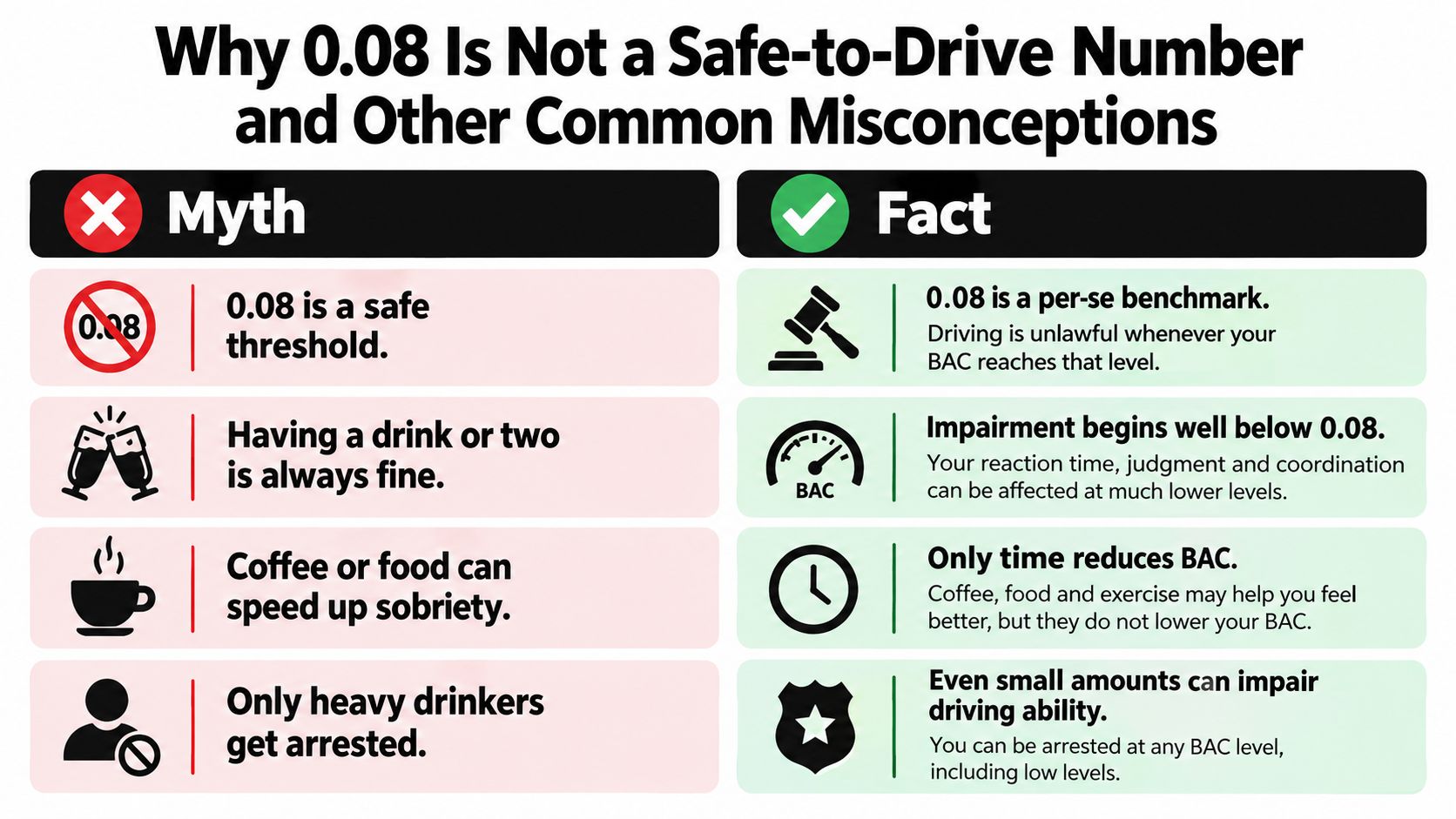
The legal limit isn't a promise that driving below it is lawful. Texas transportation guidance on impaired driving states that a person is legally intoxicated at 0.08% BAC, but driving is unlawful as soon as alcohol or drugs impair the ability to operate the vehicle.
That's the mistake behind many roadside explanations: the driver argues about the numerical limit while the officer describes coordination, statements, or driving behavior. The State may rely on those observations to support an impairment allegation.
Use this graphic as a reminder to replace drinking folklore with a transportation plan.
Don't substitute a ritual for a ride
Coffee, a meal, or a cold shower isn't a legal defense. Nor should you treat a short wait as proof that your normal abilities have returned. Don't build a driving decision around an unverified sobriety shortcut.
- Feeling alert: Your personal impression doesn't resolve the statutory impairment question.
- Counting drinks: A drink count doesn't establish the applicable concentration or your ability to drive.
- Checking a personal device: A home reading doesn't guarantee that officers won't observe impairment or that later evidence will match it.
Don't negotiate with yourself about whether you're probably safe. Choose transportation that doesn't require you to drive.
An accusation still needs scrutiny. Ask your lawyer to compare the officer's written account with available video and other evidence, and to investigate any relevant concerns about specimen timing, handling, or instrument records.
That review isn't a promise that the evidence can be excluded. It's the difference between evaluating the State's proof and accepting its conclusion without examination.
Immediate Steps to Protect Your License and Your Case
If you've just been released, focus on protecting deadlines and preserving information. You don't need to solve the entire case today. You do need to avoid decisions that make it harder to defend.
Start with the license deadline
- Request the ALR hearing promptly: The ordinary request window is 15 days. Have counsel confirm the triggering notice and applicable deadline immediately, rather than treating your next court date as the deadline.
- Preserve recordings: Identify possible dashcam footage, nearby business surveillance, receipts, and messages relevant to the timeline. Ask counsel how to secure them.
- Write a private account: Record what you remember about the stop, instructions, testing, and release. Distinguish what you know from what you're unsure about.
- Avoid public explanations: Don't post about the arrest or contact officers or witnesses to argue your case. Let your attorney handle case-related communications.
- Review before signing or speaking: Get legal advice before making substantive statements or agreeing to unfamiliar case documents. Continue complying with existing court orders.
Solve transportation separately
If your driving privilege is affected, ask whether an occupational license is available and what restrictions would apply. The firm's occupational-license guidance after an Atascocita DWI offers a starting point, not permission to drive before authorization.
For insurance planning, you can browse DUI car insurance options through QuoteFii, LLC's informational resource. Insurance questions are separate from whether you currently have a valid driving privilege.
Bring your paperwork to a confidential consultation with a local DWI attorney. Ask for a concrete plan covering the license proceeding, criminal case, evidence requests, and current release conditions.
Local Help for Atascocita and Harris County Drivers Facing DWI
The answer to the headline question is the adult statutory threshold explained above. The answer to your own situation depends on more: the impairment allegation, specimen evidence, age, vehicle category, prior history, and separate license proceeding.
For Atascocita and Humble residents, the immediate stakes are personal. You may need to drive to work, take a parent to an appointment, or manage school pickups. Tell your attorney about those obligations so legal advice and transportation planning address your actual daily life.
Bring questions that require specific answers
Ask what charge you face, what the State must prove, and which records counsel needs. Ask whether the license deadline has been addressed and which bond conditions require action. Leave with an explanation you understand, not mere reassurance.
The firm's Atascocita DWI defense resource is a starting point for residents seeking help with those questions. A consultation should evaluate your documents and concerns without promising a dismissal or a particular outcome.
If a custody dispute, divorce, civil claim, or estate-planning responsibility is also involved, identify it separately. Criminal defense addresses the allegation; family matters concern different orders and responsibilities; a civil claim requires its own review. Don't assume resolving one issue settles all the others.
You deserve clear advice and respectful treatment. An arrest doesn't define your place in the northeast Harris County community, but your response matters. Organize the documents, preserve the evidence, and seek guidance while there's still time to act.
The Law Office of Bryan Fagan – Atascocita TX Lawyers offers criminal defense alongside family law, estate planning, and civil representation for residents of Atascocita, Humble, and Harris County. Visit Law Office of Bryan Fagan – Atascocita TX Lawyers to schedule a free consultation at the Atascocita office, and bring your arrest paperwork, test records, and license notices so the team can discuss both your DWI allegation and your driving privileges.