A vendor sends you a service agreement late on Friday. Your Atascocita business needs the service Monday, so you sign after checking the price and the signature page. A few months later, the vendor says the agreement renewed automatically, your insurance must cover a risk you never discussed, and a missed notice deadline eliminated your chance to cancel. The problem wasn't that you failed to read the contract. You read it without a process for understanding what it required and who would track those requirements afterward.
That situation can arise in Humble, Atascocita, and throughout northeast Harris County. A purchase order, lease addendum, loan document, software subscription, employment agreement, or customer contract can create obligations that are easy to miss when the owner is also handling sales, payroll, and operations. A careful business contract review turns unfamiliar legal language into practical decisions, documented responsibilities, and deadlines your company can manage.
Why a Business Contract Review Matters in Atascocita
A local contractor might sign a supplier agreement with an unclear delivery schedule. A professional might accept a client's form contract with broad indemnity language. A family-owned company might agree to a personal guarantee without separating the company's obligation from the owner's personal exposure. None of these problems requires a lawsuit to become expensive.
World Commerce & Contracting estimates that the direct economic cost of commercial disputes approaches $900 billion worldwide. Its research also found that 61% of suppliers reported disputes in more than 10% of their contracts. The same research shows that 70% of buyers said disputes rarely or never result in legal claims or litigation, while 61% said they rarely or never result in contract termination. Those findings matter because a contract can damage a working relationship, disrupt cash flow, or create operational confusion without ever reaching a courtroom. (World Commerce & Contracting dispute research)
Practical rule: Review a contract for the disagreement you want to prevent, not only the lawsuit you hope never happens.
Suppose an Atascocita business signs a service agreement that says the provider will deliver “ongoing support” but doesn't define response times, covered services, or a process for extra work. When performance falls short, both sides may sincerely believe they followed the deal. The owner then has to choose between paying more, accepting poor service, or damaging a relationship the business still needs.
A review should identify the obligations that will affect daily operations:
- Scope and performance: What must each party deliver, and how will anyone know whether delivery is complete?
- Payment and changes: When is payment due, what can increase the price, and who approves added work?
- Risk allocation: Who carries responsibility for injury, property damage, data loss, defective work, or a third-party claim?
- Exit and enforcement: How can either party terminate, where can a dispute be handled, and what notices must be sent?
For a small firm, the owner often carries the consequences personally. That makes review a form of risk control, not a luxury reserved for large corporations. Businesses that rely on technology, vendors, or outsourced administration can also benefit from practical operational resources such as managed IT business resources from CloudOrbis Inc., especially when contract obligations involve access, security, or document management.
What a Business Contract Review Actually Is
A business contract review is a pre-signature inspection of the agreement, the transaction, and the risks your company is accepting. It resembles a pre-flight check. The contract is the aircraft, the business owner is responsible for the destination, and the attorney checks whether the controls, instruments, and safety systems work the way the owner expects before takeoff.
A useful review usually produces more than a document covered in tracked changes. It should give you:
- A marked-up agreement showing proposed edits and questions.
- A short risk summary identifying the provisions that deserve attention.
- Fallback positions explaining what to request if the other side rejects your preferred language.
- A plain-English explanation of what the agreement requires, when it requires action, and who should own that action.
The review starts by identifying the parties, the business purpose, and the documents that form the deal. It then moves clause by clause through scope, payment, liability, confidentiality, intellectual property, termination, dispute resolution, and incorporated policies. The reviewer compares the proposed language with your actual risk tolerance and operating capacity.
Some agreements need specialized attention. A loan document should be compared with the business purpose and repayment plan, not treated like a routine vendor form. Owners considering financing should understand the difference between a promissory note and a loan contract, including how the documents describe the parties' obligations.
A review isn't a guarantee that no dispute can arise. It isn't litigation defense, and it doesn't replace the owner's decision about whether a commercial opportunity is worth accepting. The attorney explains legal consequences and negotiation options. The owner decides whether the price, timing, relationship, and risk make business sense.
The same practical discipline applies outside commercial contracts. For example, Prenuptial & Postnuptial Agreements in Atascocita involve drafting and review of marital property agreements for Atascocita clients. In both settings, the value comes from turning an agreement into clear rights, duties, and decisions before the parties rely on it.
Key Clauses and Common Red Flags to Watch For
A contract can look balanced while assigning the most expensive risks to your company. Read the clauses below with one question in mind: What could this require us to pay, perform, insure, or accept later?
| Clause | Red Flag to Watch For | What It Can Cost You |
|---|---|---|
| Indemnification | One-way protection covering broad claims, including losses outside your control | Defense costs, settlements, and responsibility for another party's conduct |
| Limitation of liability | No cap, a cap tied to an unsuitable amount, or major exceptions that swallow the cap | Exposure far greater than the contract's expected value |
| Termination for convenience | The other party can leave immediately while you remain locked in | Lost revenue, stranded costs, or an abrupt service gap |
| Auto-renewal | Renewal occurs unless notice is sent during a narrow window | Another term, missed savings, or an unwanted obligation |
| Payment terms | Vague invoice disputes, open-ended expenses, or aggressive late fees | Cash-flow pressure and disputes over what is actually owed |
| Non-compete and non-solicitation | Broad restrictions covering ordinary customers, workers, geography, or future work | Lost business opportunities and expensive enforcement disputes |
| Exclusivity | You cannot use another supplier or serve certain customers | Dependence on one provider and reduced negotiating power |
| Governing law and venue | A distant forum or unfamiliar rules | Travel, local counsel expense, and practical barriers to enforcement |
| Assignment | The other party can transfer the agreement without consent | A new counterparty you didn't evaluate |
| Force majeure | Broad language excuses performance for events the party could control | Delays without meaningful remedies or replacement duties |
| Notice provisions | Notice must go to a particular address, person, or delivery method | A missed deadline or ineffective termination notice |
Indemnification deserves careful attention because it can operate separately from ordinary breach remedies. Ask whether it covers third-party claims, direct losses, or both. Confirm who controls the defense, who approves a settlement, and whether the indemnity is limited to harm caused by the protected party.
Liability caps require more than finding a dollar figure. Check whether the cap applies to each claim or the entire relationship. Then examine carve-outs for confidentiality, intellectual property, gross negligence, data obligations, or indemnity. A broad exception can leave you with the illusion of protection.
Termination and renewal should be converted into calendar events. Identify the notice period, cure period, early termination charge, renewal date, and post-termination duties. If nobody owns those dates, the contract can renew or expire without a deliberate business decision.
Payment language should match how your company invoices and collects. Define acceptance, disputed invoices, taxes, price adjustments, setoff rights, and late charges. A profitable contract can still strain a small company if its payment timing doesn't match payroll, materials, and overhead.
Boilerplate still matters. Assignment, force majeure, entire-agreement language, order of precedence, and notice rules determine which document controls when terms conflict. Don't assume the last pages are harmless because the parties negotiated the business points earlier.
Texas-Specific Legal Considerations for Local Contracts
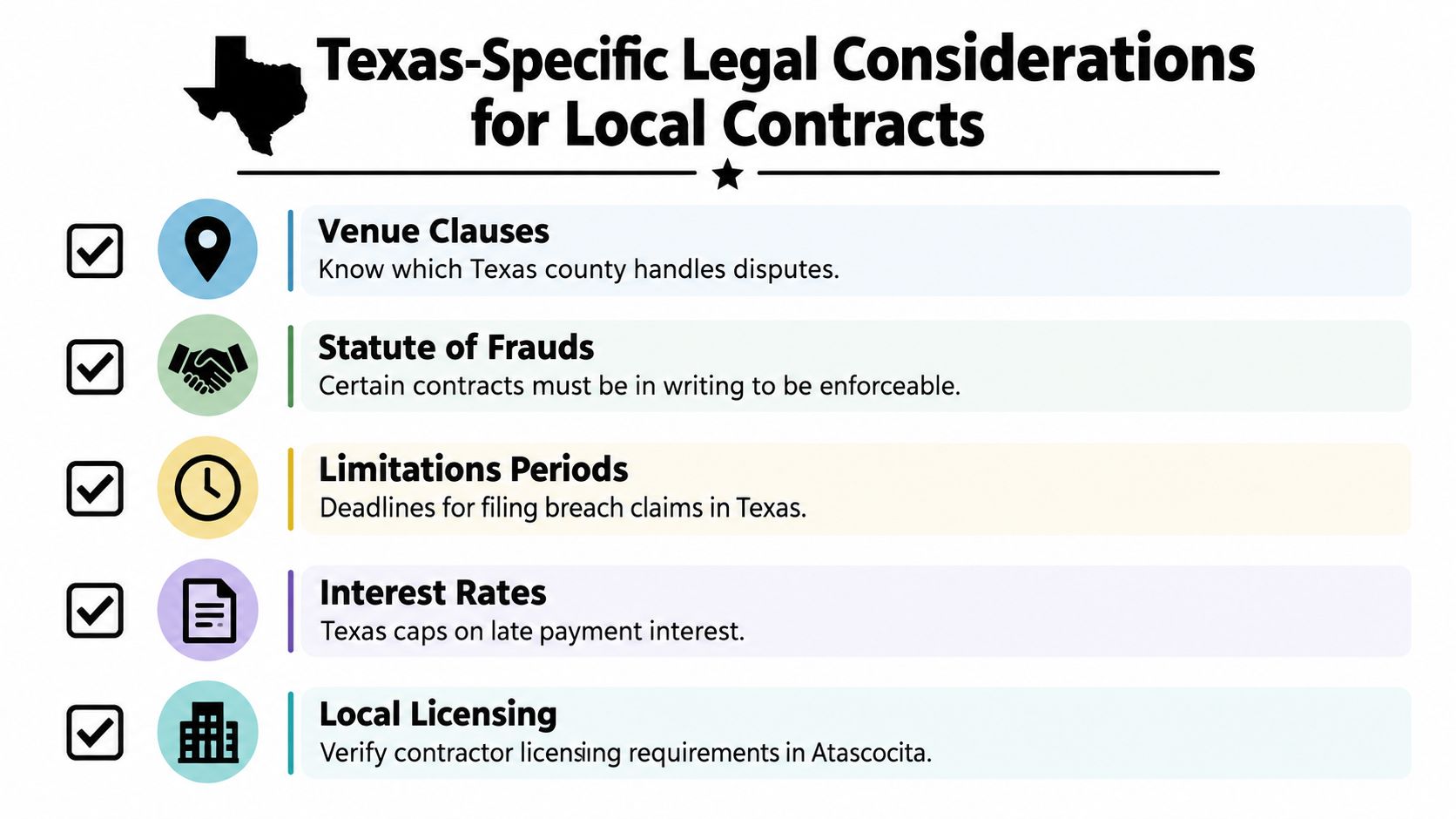
Texas law adds practical checks that belong in a local business contract review. The first question is not only whether the parties agree. It is whether the agreement is documented, signed, attributable, and enforced within the applicable legal framework.
Written agreements and financing
Texas's statute of frauds requires certain promises to be in writing and signed by the party who will be bound or an authorized representative. For a loan exceeding $50,000, the loan agreement generally isn't enforceable unless it is written and properly signed. (Texas Business and Commerce Code chapter 26)
Before relying on financing, an Atascocita or Humble business owner should confirm that the document identifies the parties, states the material financial terms, and shows execution by someone with actual authority. Emails and informal conversations may prove negotiations, but they may not satisfy every statutory writing requirement.
Sales of goods and filing deadlines
For contracts involving the sale of goods, Texas generally provides four years to file a breach-of-contract action after the claim accrues under Business and Commerce Code section 2.725. The parties may reduce that period by agreement, but they can't shorten it below one year or extend it beyond the statutory period. The statute generally measures accrual from the breach, even if the injured party doesn't yet know about it. (Texas Business and Commerce Code section 2.725)
A business receiving defective equipment should preserve purchase orders, invoices, inspection records, communications, and repair estimates. Review the contract for warranty terms, delivery dates, notice rules, cure periods, and any shortened limitations clause.
Electronic signatures and records
Texas recognizes electronic records, electronic signatures, and electronically formed contracts under the Uniform Electronic Transactions Act. A contract or signature can't be denied legal effect solely because it is electronic. Still, a typed name or scripted font doesn't answer every question. Review whether the signer intended to adopt the document and had authority to bind the company. (Texas guidance on electronic documents and signatures)
Attribution and evidence
Under Texas Business and Commerce Code section 322.009, an electronic record or signature is attributable to a person if it was that person's act. Attribution may be shown through any method, including a security procedure used to identify the signer. (Texas Business and Commerce Code section 322.009)
Save the audit trail, authentication records, signing certificate, access information, authorization documents, and relevant communications. A document-management process matters just as much as the signature itself. Businesses comparing options can see how Cloudvara helps firms organize legal records and improve access to final documents.
For disputes involving nonperformance, payment, or defective goods, a business owner can review the available breach of contract remedies with counsel. The remedy depends on the agreement, the facts, and the governing law.
What to Expect During a Step-by-Step Review Engagement
A good engagement starts before the attorney opens the agreement. During intake, explain what the deal is supposed to accomplish, when it must be signed, who negotiated it, and what worries you. Tell the attorney whether the other side supplied the form and whether any promises were made outside the written document.
Gather the materials that give the contract meaning:
- The complete agreement: Include schedules, exhibits, statements of work, order forms, and linked policies.
- Negotiation history: Provide important emails, proposals, term sheets, and notes about verbal commitments.
- Business context: Identify pricing, deadlines, expected revenue, operational dependencies, and essential terms.
- Authority records: Confirm who may sign for your company and whether another owner, lender, or board approval matters.
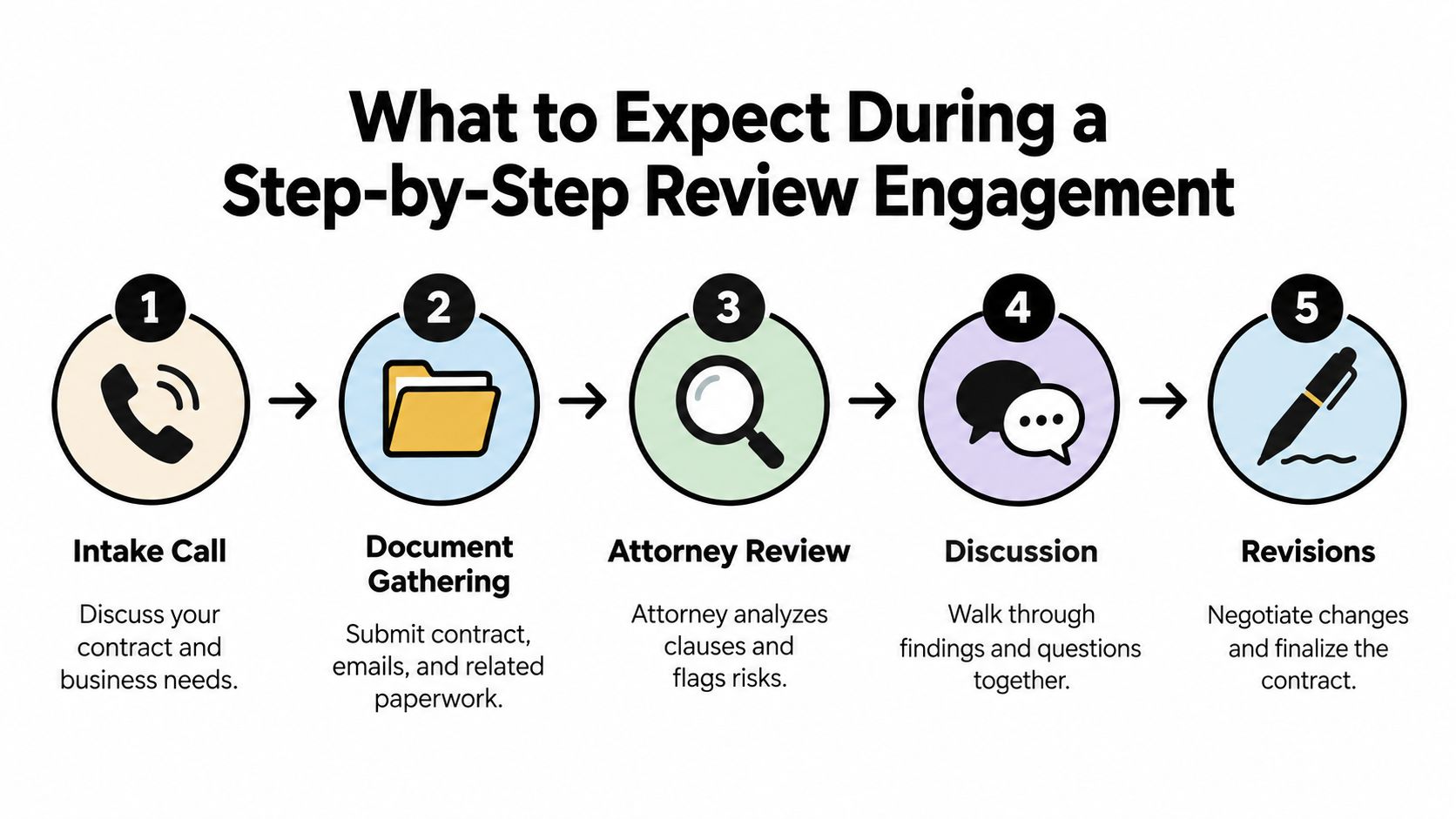
The attorney then triages the agreement. That means identifying urgent problems first, such as an imminent deadline, personal guarantee, uncapped liability, automatic renewal, missing exhibit, or obligation your business cannot perform. A detailed review follows, with questions directed to the owner when the legal language doesn't match the commercial understanding.
Expect the final work to separate deal-breakers, negotiation points, and acceptable risks. Not every sentence needs rewriting. A thorough reviewer should explain why a change matters, what alternative wording might work, and what the business gives up if the other side refuses.
Ask these questions before the engagement begins:
- What documents are included in the review?
- Does the work include a redline, risk summary, or negotiation support?
- How will urgent renewal or signature deadlines be handled?
- Will the attorney review incorporated policies and attachments?
- How many discussion or revision rounds are included?
A review is complete only when you understand the agreement and know what happens next. Use the discussion to assign responsibility for deadlines, insurance certificates, notices, payments, performance evidence, and storage of the final signed version.
A Sample Contract Review Checklist for Small Businesses
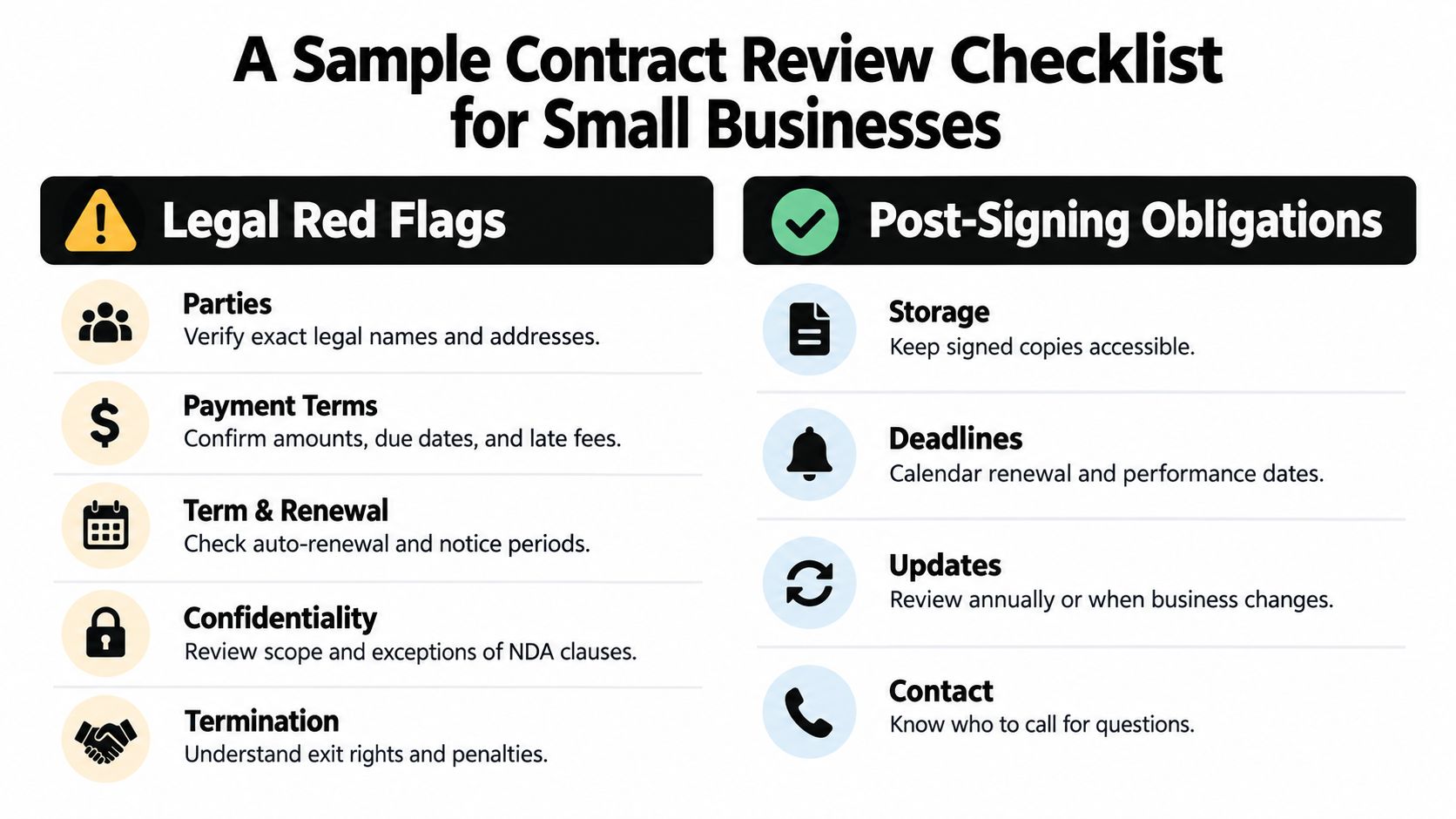
Use this checklist as a first pass, then send unusual or high-risk provisions to counsel. The point isn't to mark every clause as acceptable. The point is to connect each legal question to a person, a document, or a calendar entry.
Before signing
- Parties and authority: Verify exact legal names, addresses, entity status, and signer authority.
- Defined terms: Check that important terms are used consistently and that cross-references point to the correct provisions.
- Scope and deliverables: Match the body of the agreement to every statement of work, proposal, exhibit, and service level.
- Payment: Confirm price, due dates, taxes, expenses, late charges, invoice disputes, and price-adjustment rights.
- Term and renewal: Record the start date, end date, auto-renewal mechanism, and notice deadline.
- Termination: Identify termination for cause, termination for convenience, cure periods, fees, and surviving obligations.
- Insurance: Confirm required coverage, policy limits, certificates, additional-insured language, and renewal responsibility.
- Indemnity and liability: Mark who pays for which harm, whether a cap applies, and whether exceptions make the cap ineffective.
- Dispute terms: Record governing law, venue, arbitration or court requirements, mediation steps, and notice mechanics.
- Electronic execution: Preserve the final version, audit trail, signing certificate, and evidence that the signer had authority.
After signing
A signed contract should create an obligations register, not disappear into an inbox. Assign an owner for each item and record the source clause.
- Renewal tracking: Calendar the renewal date and the earliest notice date.
- Performance dates: Track milestones, delivery dates, acceptance steps, and service commitments.
- Insurance follow-up: Request certificates and monitor expiration or required policy changes.
- Payment control: Match invoices to the contract and escalate disputed charges promptly.
- Notice process: Keep current addresses, email recipients, and approved delivery methods.
- Document storage: Store the executed agreement, amendments, attachments, audit records, and negotiation history together.
- Change control: Require written approval for scope, price, schedule, or policy changes.
- Escalation: Decide who contacts counsel when the other side misses a deadline or claims a breach.
Contract visibility remains a serious operational problem. In the 2025 Legisway Benchmark, 60% of more than 700 in-house legal respondents identified lack of contract visibility as their most common contract-management challenge, while 52% said their organization lacked standardized contract-lifecycle processes. (Wolters Kluwer summary of the 2025 Legisway Benchmark)
That lesson applies to a small company without a legal department. A contract that looked reasonable at signing can become dangerous when nobody tracks the renewal, insurance duty, notice deadline, or service commitment.
How Much Business Contract Review Costs in Texas
The fee depends on the work, not just the page count. A short agreement with unusual indemnity, intellectual property, data, or personal-guarantee language may require more judgment than a longer standard form.
Ask what drives the estimate:
- Complexity: Does the agreement involve multiple parties, incorporated documents, or regulated activity?
- Depth: Are you receiving issue spotting, a full redline, negotiation advice, or all three?
- Volume: Will counsel review one agreement or a group of related contracts?
- Negotiation: Does the engagement include calls or revised drafts after the counterparty responds?
- Turnaround: Does an urgent deadline require the attorney to rearrange other work?
A flat fee gives you predictable budgeting when the scope is clear. Read the proposal carefully to see what happens if the agreement expands, attachments arrive late, or negotiations continue. An hourly arrangement can work better when the contract is evolving or the number of revisions is uncertain, but ask for a scope estimate and notice before substantial additional work.
Don't judge a proposal by the fee alone. Confirm the documents covered, expected turnaround, revision rounds, client calls, treatment of related agreements, and whether post-signing obligation planning is included. Ask whether the attorney will explain the business consequence of each major redline rather than just sending back a marked-up file.
Insurance language can also affect contract risk and review priorities. If your agreement includes liability coverage questions, an explanation of understanding 1st dollar coverage may help you prepare better questions for counsel. The contract review itself should still be customized to the actual policy, transaction, and Texas law issues involved.
Choosing the Right Local Attorney for Your Review
Choose an attorney who can explain the contract across the table, not one who returns a document full of unexplained edits. For an Atascocita, Humble, or northeast Harris County owner, local counsel can make meetings easier and provide context about the courts, venues, businesses, and community where a dispute may unfold.
Look for clear communication, transparent scope, plain-English explanations, and a willingness to identify which risks matter most to your business. Ask whether the attorney can help with related civil disputes, ownership concerns, estate planning, or family-business agreements when those issues overlap with the contract.
A partnership agreement illustrates why that broader judgment matters. Owners can review a dissolution of partnership agreement before a conflict becomes a fight over authority, money, customers, or company property. The right reviewer doesn't treat the contract as an isolated PDF. They ask how it fits the people, assets, operations, and future decisions of the business.
If you have a contract waiting for signature, an unexpected renewal, a payment dispute, or a concern about personal exposure, schedule a free consultation at the Atascocita office. Bring the complete agreement and the surrounding emails so the attorney can focus on the risk that most affects your company.
The Law Office of Bryan Fagan – Atascocita TX Lawyers provides legal guidance for business contract review, civil disputes, family matters, criminal defense, and estate planning in Atascocita, Humble, and Harris County. Schedule a free consultation to discuss the agreement, the deadlines it creates, and a practical plan for protecting your business after signing.