Skip to content

You've just left mediation in Atascocita. The agreement is signed, your phone is filling with messages, and you're wondering whether refusing to sign the proposed final order can undo what happened. Maybe you believe important information was withheld. Maybe you felt pressured, misunderstood a term, or changed your mind after speaking with family.
Mediated settlement agreement withdrawal in Atascocita, TX isn't usually a simple cancellation question. The important issues are whether the document satisfies Texas's statutory requirements and whether a legally recognized problem affected the agreement. Regret alone generally isn't enough, but fraud, duress, coercion, illegality, incapacity, or another serious defect may require immediate action.
The Moment You Wonder If You Can Take It Back
A parent from Humble might leave mediation believing the agreement was only a draft because the judge hasn't signed anything yet. A spouse in northeast Harris County might assume that refusing to sign the final divorce decree will reopen negotiations. Those assumptions can create serious problems when the signed document is a qualifying mediated settlement agreement, or MSA.
Texas generally treats a properly executed family-law MSA as binding immediately. Under Texas Family Code Section 153.0071, the rule applies to parent-child disputes involving custody, visitation, conservatorship, and support. The parallel divorce provision, Texas Family Code Section 6.602, applies the same basic principle to qualifying divorce MSAs.
That means the key moment usually isn't entry of the final order. It's the moment the parties sign a document that meets the statute's requirements. A later relocation, disagreement about wording in the proposed order, or realization that the bargain feels unfavorable ordinarily doesn't create a routine right to withdraw.
The practical question: Don't ask only whether you changed your mind. Ask whether the signed document is a compliant MSA and whether the signing process was legally tainted.
You should obtain the complete agreement, not just the final page or a mediator's summary. Keep the mediation signature page, every draft, emails, texts, and communications about what happened in the room. If you need help organizing documents before meeting counsel, Hire Paralegals can be a useful document-support resource, but a Texas family attorney must evaluate enforceability and legal defenses.
A calm review is more useful than an angry withdrawal email. The legal analysis turns on the document, the signatures, the attorney participation, the terms, and the evidence surrounding consent.
What Makes a Texas MSA Binding
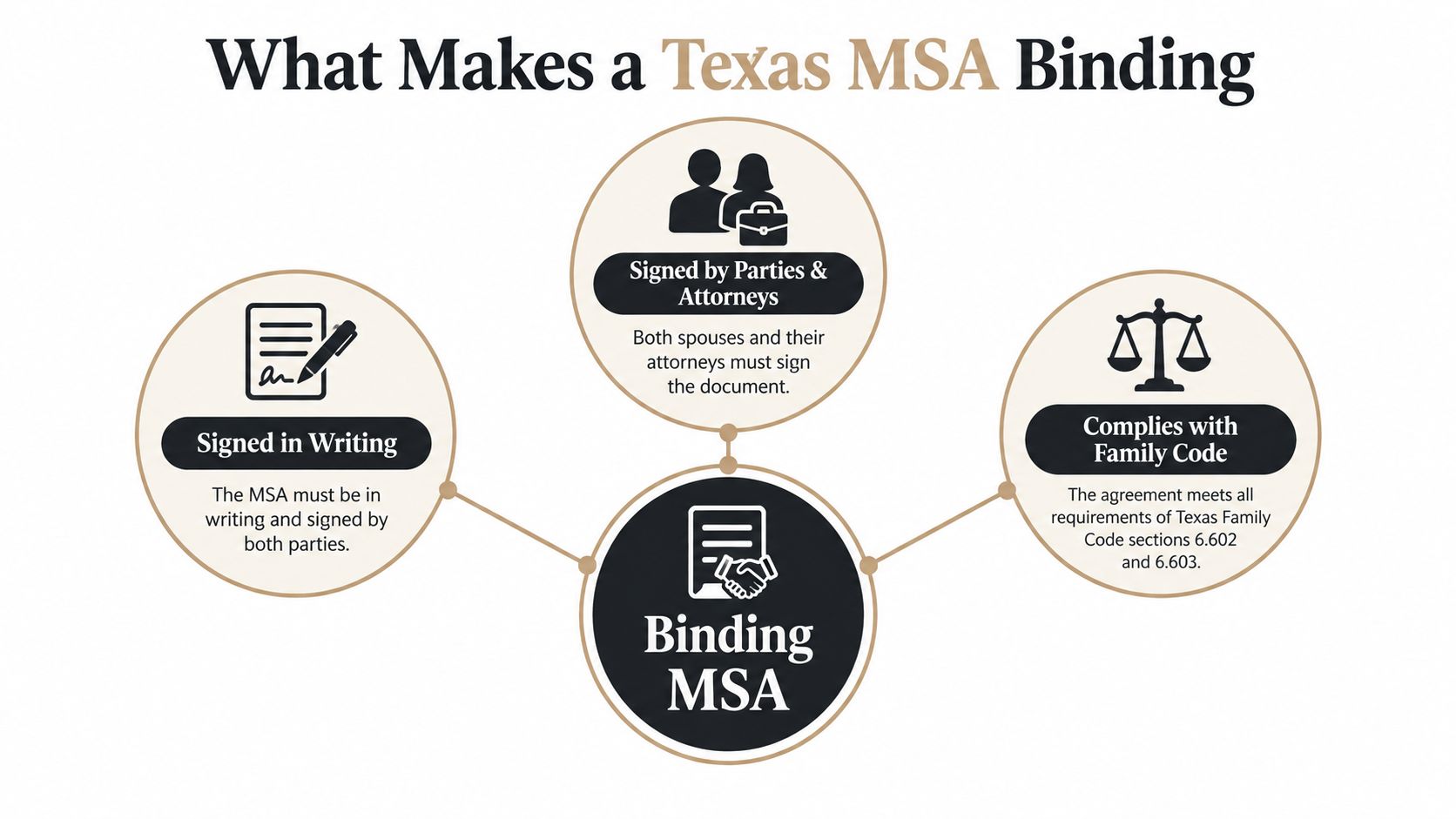
A statutory MSA has a specific structure. Texas law generally requires three central elements for a qualifying agreement:
- A prominently displayed statement that the agreement is not subject to revocation.
- The signature of each party.
- The signature of each party's attorney who is present when that party signs, when the party is represented and the attorney is present.
Read the non-revocation language
Look for the required statement in a prominent format. The language should be displayed using boldface, capital letters, or underlining so that the parties can see the agreement isn't subject to revocation. A vague sentence saying the parties intend to settle may not perform the same legal function.
Confirm every required signature
Check whether both spouses or parents signed the same executed document. Then check whether the attorney who was present at signing also signed, when applicable. A missing signature can change the analysis, but don't assume a technical issue exists until counsel reviews the exact document and circumstances.
Separate an MSA from an ordinary settlement
A mediator's notes, an unsigned term sheet, or an email describing a deal isn't automatically a statutory MSA. The document also needs sufficiently definite material terms. Property transfers, payment obligations, releases, custody arrangements, possession schedules, and support provisions should be stated clearly enough for a court to enforce.
For a broader overview of what makes a contract enforceable, remember that general contract principles don't replace Texas's family-law MSA requirements. A compliant MSA receives unusually strong enforcement treatment. Texas appellate authority recognizes that a court generally must render judgment consistent with such an agreement, even without additional approval from the court.
You can review the firm's discussion of mediated settlement agreement enforceability in Atascocita for a related explanation of the statutory framework. Separate from a post-mediation dispute, Prenuptial & Postnuptial Agreements in Atascocita concerns drafting and review of marital property agreements for Atascocita clients.
First Steps to Take If You Want to Withdraw
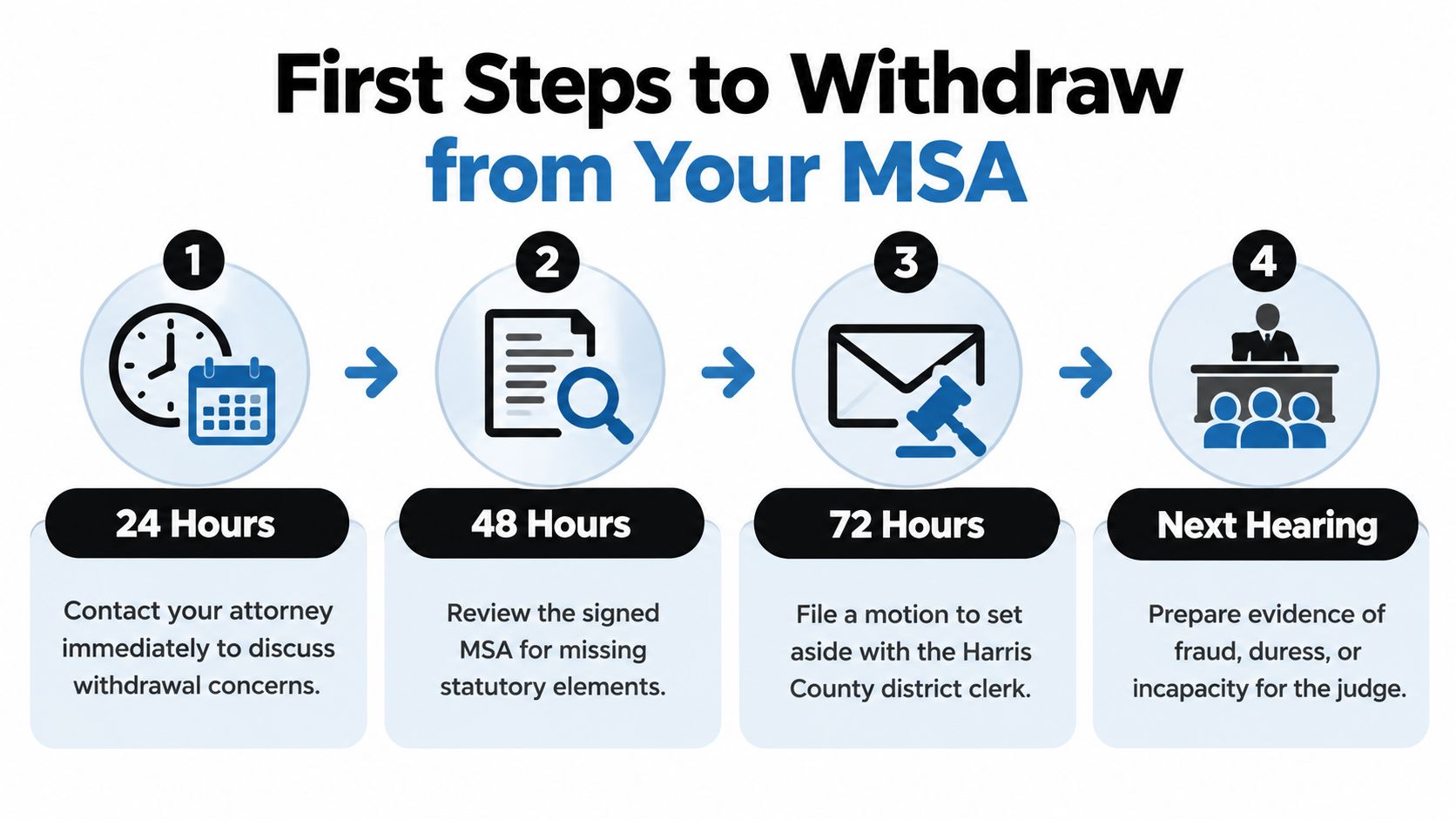
If you believe you may have grounds to challenge the agreement, act promptly and methodically. Don't delete messages, edit documents, or post an explanation on social media. A rushed public statement can create evidence that complicates your position.
Preserve the complete record
Gather the signed MSA, signature page, drafts, proposed final order, mediator communications, and messages exchanged before and after mediation. Write down what you remember about the signing while the details are fresh, including who was present, what was explained, and whether anyone objected.
Look specifically for evidence involving:
- Language access: Record whether an interpreter was needed, provided, or unable to explain the agreement adequately.
- Capacity concerns: Preserve medical information or other records relevant to medication, impairment, confusion, or inability to understand the transaction.
- Pressure or threats: Keep texts, emails, voicemails, and witness information showing coercive conduct.
- Missing information: Collect financial records or communications supporting an allegation that material information was concealed.
Get legal advice before sending a formal withdrawal
Contact an Atascocita family attorney before you send a letter declaring that you revoke consent. A written objection may be necessary, but the wording should identify the actual legal issue rather than announce regret. Counsel can compare the executed document with the proposed order and determine whether the dispute concerns a statutory defect, a validity challenge, or an ordinary disagreement about terms.
The divorce mediation process in Atascocita can involve both negotiated terms and court-related follow-through, so document review should happen before the next filing or hearing. For court procedure and location questions, Harris County Family Courts: A Atascocita Resident's Guide addresses how family-law cases proceed in the Harris County courts serving Atascocita.
If the other party is seeking judgment, your attorney may need to file a prompt written objection and request an evidentiary hearing before judgment is entered. Don't assume that waiting will preserve your options. A complete factual record is much stronger than a last-minute claim that the agreement feels unfair.
Grounds Courts Recognize for Setting an MSA Aside
A compliant MSA isn't immune from every challenge. Texas authority recognizes possible challenges based on illegality, fraud, duress, coercion, or other dishonest means. Family violence can also create a statutory exception in appropriate circumstances. The burden is on the person challenging the agreement to develop facts, not merely describe disappointment.
Fraud and dishonest conduct
Fraud may involve a material misrepresentation or concealment that affected consent. Examples can include hiding significant financial information, misrepresenting an asset, or using a false statement to induce a particular property or support term. The evidence should connect the conduct to the decision to sign.
Duress and coercion
Pressure becomes legally important when it goes beyond the ordinary stress of divorce or custody negotiations. Threats, intimidation, violence, improper influence, or circumstances that leave a person without a meaningful choice may support a challenge. Preserve messages, witness names, safety records, and communications with counsel or the mediator.
Incapacity and communication problems
A person may need to examine whether medication, intoxication, illness, cognitive impairment, or another condition affected the ability to understand the agreement. Language barriers and interpreter problems also deserve immediate review. A person who understood the general topic but didn't understand a material term may need counsel to investigate how the agreement was presented and signed.
Illegality or defective terms
A court won't enforce an illegal bargain just because it appears in a signed document. Counsel should examine whether a disputed provision conflicts with governing law or whether the agreement leaves essential terms unresolved. In custody matters, the proposed order must also address the child-related issues required by law.
Regret is not the same as coercion. “I should have negotiated harder” usually describes dissatisfaction. “I signed after a threat, deception, or inability to understand” describes a potential legal challenge.
Texas courts generally don't reweigh the merits of a compliant bargain. That distinction matters for Atascocita and Humble parents who believe the schedule, support amount, or property division was a bad deal. Evidence that the process was legally tainted is materially different from evidence that the result later became unpopular.
Families involved with child-safety investigations should treat the issues separately. A CPS Defense Attorney in Atascocita handles defense against CPS investigations for Atascocita families, while an MSA challenge focuses on formation, consent, validity, and enforceability.
Statutory MSAs Compared to Rule 11 Settlements
Not every mediation document follows the same legal track. A compliant statutory MSA under Sections 6.602 or 153.0071 is stronger than an ordinary settlement agreement governed by contract principles and Texas Rule of Civil Procedure 11.
| Element | Statutory MSA, Tex. Fam. Code §§ 6.602 and 153.0071 | Rule 11 Settlement |
|---|---|---|
| Core requirements | Prominent non-revocation statement, party signatures, and required attorney signature when applicable | Written and signed, filed with the case papers or made in open court and entered of record |
| Effect of signing | Generally binding immediately when statutory requirements are satisfied | Depends on contract formation and definite material terms |
| Withdrawal | Simple repudiation ordinarily doesn't undo the agreement | Withdrawal before agreed judgment may prevent entry of judgment by consent |
| Enforcement | Opposing party may seek judgment consistent with the MSA | Opposing party generally must enforce the agreement as a contract |
| Common defenses | Fraud, duress, coercion, illegality, dishonest means, statutory defects | Lack of formation, ambiguity, missing signatures, lack of authority, or contract defenses |
| Court's role | Courts generally don't evaluate the wisdom of a compliant bargain | Court may need pleadings, proof, summary judgment, or trial |
The distinction is especially important when the mediator provided unsigned notes or when the parties left essential terms for future negotiation. Filing a document doesn't automatically cure missing signatures, ambiguity, or an incomplete agreement.
A court generally can't enter an agreed judgment after consent is withdrawn if the document is only an ordinary settlement. The opposing party may still pursue contract enforcement, but that requires proof of formation and terms. By contrast, a compliant MSA may support judgment even when one party refuses to sign the proposed final order.
Before arguing about fairness, classify the document. The document's legal category often determines whether the dispute concerns withdrawal, enforcement, or a contract trial.
Local Practice in Harris County and Atascocita
Local procedure matters after mediation. Harris County's Domestic Relations Office states that mediation typically lasts four to six hours and that, when the parties reach an agreement, the mediator puts it in writing for review and signature by the parties and their attorneys before filing with the court. The office also states that executed mediation agreements are binding. See the Harris County Domestic Relations Office mediation FAQ.
The office's procedures state that the parties and lawyers must devote a minimum of five hours to mediation. They also identify a $100 termination fee when the required private mediation space isn't provided, with communication to the court. These procedural details don't decide whether your MSA is enforceable, but they explain why the mediation record and filing history deserve careful review.
Prepare before the next court event
Atascocita and Humble residents should keep a working file containing:
- The executed agreement: Include every page, signature, attachment, and exhibit.
- The docket history: Identify filings, settings, notices, and any request for judgment.
- The proposed order: Compare it line by line with the MSA.
- Financial records: Bring current information relevant to property, income, debts, and support.
- Parenting proposals: Preserve schedules, possession details, relocation language, and unresolved custody terms.
- Signing evidence: Keep communications showing what was explained and who attended.
Use the local court information addressed in which Harris County court handles an Atascocita divorce to understand the venue and procedural setting for your case. The immediate legal priority is notice and timing. If the other side presents a proposed final order, your attorney should identify inconsistencies and raise any valid objection before the court acts.
A local attorney can also evaluate whether a child-related term belongs in a later modification proceeding instead of an attempted withdrawal. A major change in circumstances may support modification of an order, but that is different from undoing the original MSA.
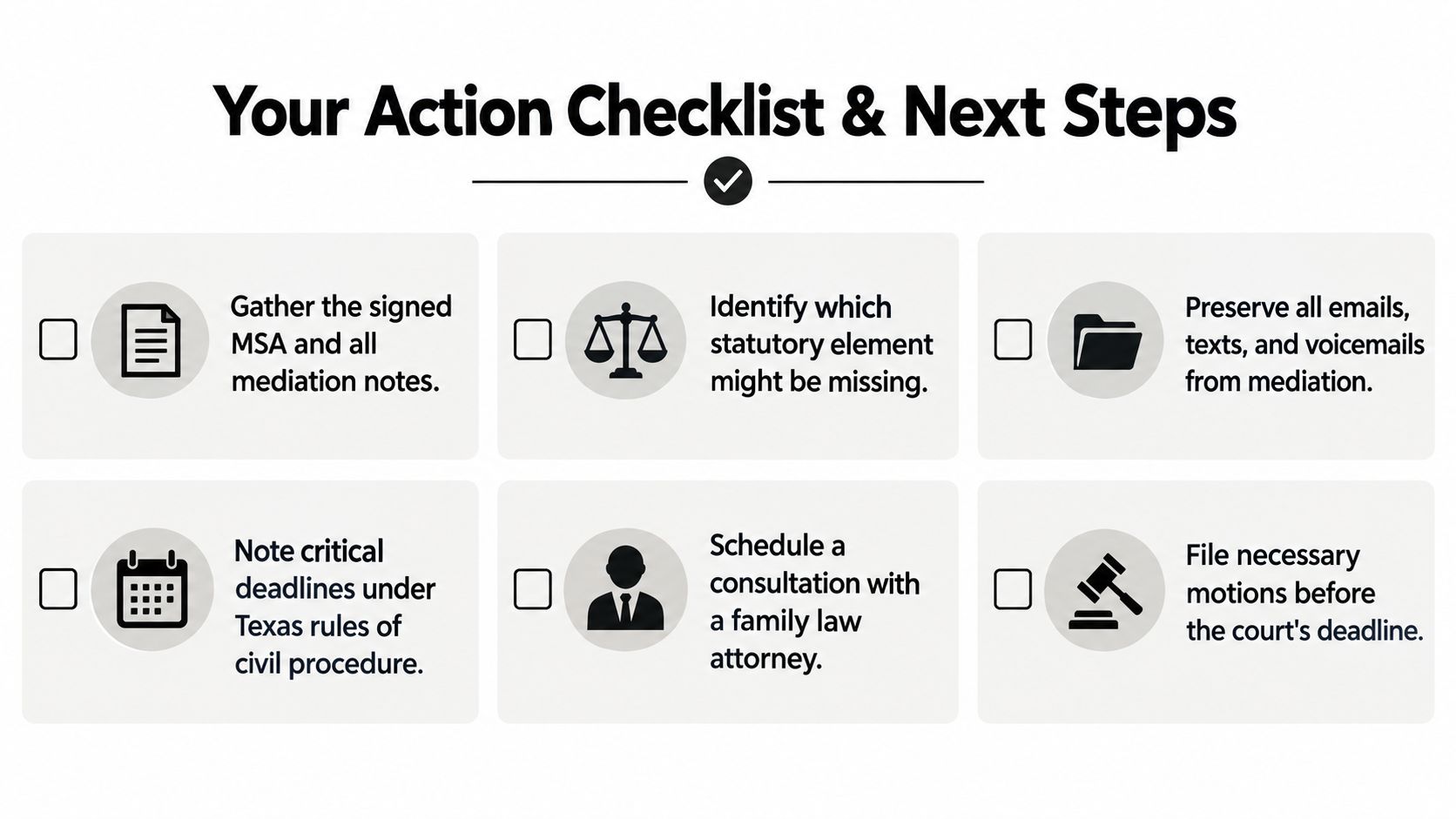
Your Action Checklist and Next Steps
You don't need to solve the entire case before seeking advice. Start with the documents and the signing process.
- Gather the agreement: Save the signed MSA, signature page, drafts, and mediation notes.
- Check statutory elements: Look for the prominent non-revocation statement and required signatures.
- Preserve communications: Keep emails, texts, voicemails, interpreter records, and mediator communications.
- Identify the legal theory: Separate regret from evidence of fraud, duress, coercion, incapacity, illegality, or another defect.
- Track deadlines: Note hearings, proposed orders, filing activity, and requests for judgment.
- Get counsel before acting: Schedule a consultation before sending a withdrawal letter or refusing a court filing.
The Divorce Process in Atascocita: What to Expect provides a step-by-step look at filing for divorce in Atascocita and Harris County. Whether your matter involves divorce, custody, support, property, or a related civil dispute, early document review gives you a clearer path than an emotional response.
The Law Office of Bryan Fagan – Atascocita TX Lawyers helps residents of Atascocita, Humble, and northeast Harris County review MSAs, evaluate withdrawal or enforcement issues, and prepare for family-court proceedings. Schedule a free consultation by visiting Law Office of Bryan Fagan – Atascocita TX Lawyers with your signed agreement and mediation records.