Skip to content

You've just spent hours in mediation, and the last thing you want is another surprise. The papers are signed, the room is quiet, and everyone's ready to go home. In Atascocita, Humble, and the rest of northeast Harris County, that moment often brings one big question, is this agreement binding now, or do we still have court steps left?
That question matters because a mediated settlement agreement, or MSA, can become the thing that finally closes a divorce, custody dispute, or civil case. In Texas, the enforceability of a mediated settlement agreement rests on statutes adopted in the mid-1990s and later family-law provisions, and Texas is one of the more settlement-enforcing states for both civil and family disputes. Under Texas Civil Practice and Remedies Code § 154.071(a), a written settlement reached in mediation is enforceable “in the same manner as any other written contract,” and § 154.071(b) allows a court to incorporate the agreement into its final decree. You can read the statutory framework in the Texas code for more detail on how that works in practice, and if you're also trying to understand the value of the deal itself, a plain guide on how to calculate a settlement can help you think through the numbers without getting lost in legal jargon.
For families in particular, the difference between a paper you signed and a court order that protects you can feel blurry. A local mediation process, such as the one described on divorce mediation in Atascocita, Texas, often ends with relief mixed with uncertainty. That's normal, and it's why the post-mediation steps matter just as much as the conversation at the table.
Your Signed Agreement After a Long Day of Mediation
By the time you leave mediation, the emotional part of the case may feel finished, but the legal part may just be starting. A parent in Humble might be holding a signed parenting plan. A spouse in Atascocita might be looking at a property division agreement and wondering whether the other side can still back out.
That worry makes sense. In Texas, a signed MSA is powerful, but its force depends on the kind of case you have and whether the document meets the statutory rules that give it legal teeth. For non-family disputes, the Texas Civil Practice and Remedies Code treats the mediated settlement as an ordinary written contract, and the court may choose to fold it into the final decree. For family cases, the Legislature built a stricter path that makes these agreements harder to undo once they're signed.
Why the paper matters more than the feeling
Mediation feels informal because people talk, negotiate, and compromise in a private room. The enforceability question is formal, though, because judges in Harris County look at the exact language on the page, the signatures, and whether the agreement fits the case type.
Practical rule: if the agreement was meant to end the case, assume the court will care about the wording as much as the outcome.
That's the part many people miss after a long day. They think settlement equals finality. In Texas, finality usually comes only after the agreement is reduced to the right form and, in many cases, entered as a court order.
A helpful outside reference on legal validity of e-signatures can also be useful if your mediation paperwork was signed electronically, since families increasingly handle parts of the process that way. For anyone working through the same issues locally, a Divorce Lawyer in Atascocita, TX handles divorce representation for clients in Atascocita and Harris County, which is often where these settlement questions first get sorted out.
What Makes a Settlement Agreement Binding in Texas
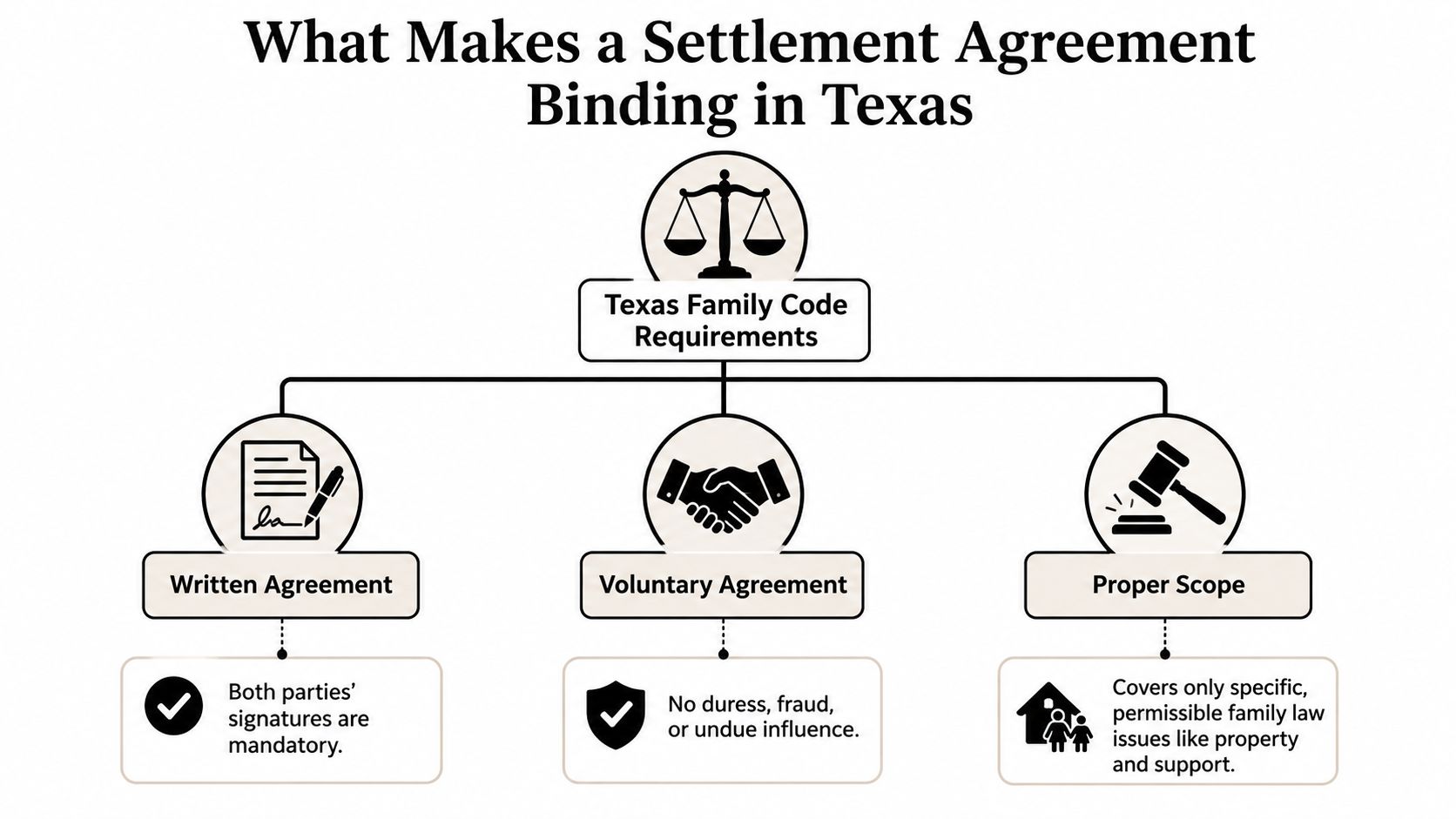
Family-law MSAs in Texas are not bound by vague promises or half-finished drafts. They become binding when they satisfy a specific checklist that the Legislature wrote into the law, and that checklist is what turns a negotiation into a document a judge is generally entitled to enforce. The Texas Family Code requires a prominently displayed statement in boldface, capital letters, or underlined text saying the agreement is not subject to revocation, plus signatures by each party and by any attorney present at signing. When those requirements are met, the party is entitled to judgment on the agreement notwithstanding Rule 11 or another rule of law.
The signing checklist that changes everything
Think of the statute as a lock with very specific requirements. If one piece is missing, the lock may not turn the way the law expects.
- Nonrevocation language: The agreement needs a clearly visible statement that it is not subject to revocation. The Legislature's bill analysis explains that the statement was designed to make the agreement harder to undo once execution happens.
- Party signatures: Each party must sign.
- Attorney signatures when present: If counsel is present, the attorney must sign too.
The family code rule is why a rushed signature can still be legally meaningful, while a casual promise usually isn't. A judge is not supposed to treat the MSA as a tentative draft when the statutory requirements are met.
Why form matters in electronic and paper versions
People sometimes assume that an electronic signature makes a document less serious. That's not how Texas settlement practice works. What matters is whether the agreement contains the required revocation language and the right signatures, not whether it was printed or signed on a screen. If you're reviewing a packet after mediation, read the exact words first, then check who signed.
A clean signature page does not fix a missing statutory statement, and a strong settlement term doesn't rescue a sloppy draft.
That is why families in northeast Harris County often want a lawyer to review the agreement before it becomes the backbone of the final decree. In family disputes, a careful review can prevent a deal from turning into a future enforcement fight.
Family Law vs Civil Litigation MSAs in Harris County
The biggest source of confusion for Atascocita residents is that not every mediated settlement agreement works the same way. A divorce or custody MSA is handled under family-law rules, while a business dispute, contract dispute, or other civil case usually falls under ordinary contract law. The result is different paths to enforcement, different levels of judicial discretion, and different risks if someone changes their mind.
Side by side, the difference is easier to see
| Feature | Family Law MSA (Divorce, Custody) | Civil Litigation MSA (Contracts, Disputes) |
|---|---|---|
| Governing framework | Texas Family Code | Texas Civil Practice and Remedies Code § 154.071(a) |
| Core standard | Specific statutory signing and nonrevocation requirements | Enforced as an ordinary written contract |
| Judge's role | Generally entitled to enter judgment if the statute is satisfied | Court may incorporate the deal into the final decree at its discretion |
| Main exception | Narrow safety valve in child or ward matters | Ordinary contract-law defenses and procedure |
| Practical risk | Formality problems can block entry of judgment | Delay can force separate enforcement steps |
For non-family Texas disputes, the settlement is enforced as an ordinary written contract, and the court may incorporate it into the final decree at its discretion. Because the agreement does not automatically alter an outstanding order unless it is incorporated into a later decree, parties often need prompt judicial incorporation to convert the deal into enforceable court-ordered obligations. That is a very different process from the family-law fast track.
Why Harris County families need to spot the branch they're on
If your case involves divorce, custody, or probate issues tied to family law, the statutory requirements are front and center. If your case is a civil dispute over money, performance, or business terms, contract principles usually control. That difference changes how quickly you can force compliance and what kind of motion or lawsuit you may need.
The family-law exception also matters. In child- and ward-related matters, the court retains a narrow safety valve and may decline judgment if the agreement is not in the child's or ward's best interests. That is a real judicial check, but it's limited, not a free pass to undo a deal because one side regrets it.
In practice, Harris County judges tend to focus on whether the paper before them fits the statute and the case type. Once you know that, it becomes much easier to understand why one settlement can be entered quickly while another needs more motion practice.
The Practical Steps to Enforce Your Agreement
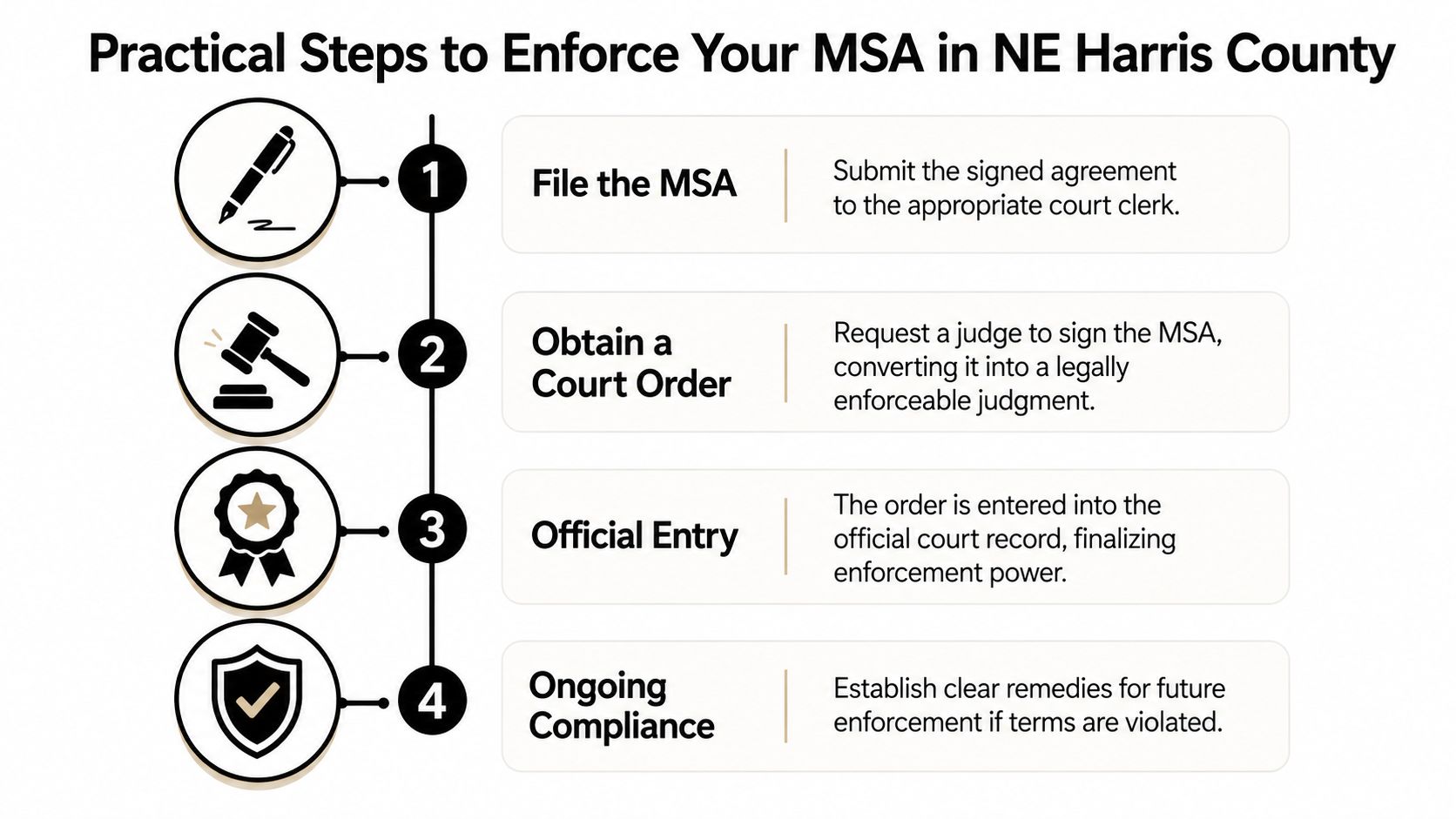
A signed MSA is important, but it usually isn't the final court paper. In Harris County, the practical goal is to turn the signed agreement into a final decree or order that can be enforced if someone later ignores it. That usually starts with a motion asking the court to enter judgment on the agreement, and it continues until the judge signs the order.
Step one, file the agreement with the court
The first move is usually to submit the signed MSA to the proper court with a motion asking the judge to enter it. In a family case, that filing often includes the settlement as an exhibit so the court can review the exact terms and the signatures. If you leave out the agreement, the court has less to work with, and that slows everything down.
Step two, set the hearing and present the order
After filing, the lawyer sets the matter for hearing and asks the judge to sign the final decree or order that matches the settlement. That hearing matters because the judge needs a clean record and a document that is ready to be entered. At this stage, the MSA is the key, but the decree is the lock that makes the outcome enforceable.
Step three, make sure the order gets entered
Once the judge signs, the order has to be entered into the court record. That step is easy to overlook when people are relieved that mediation is over, but it's the part that gives the settlement its real enforcement power. Without entry, you can still end up arguing about what the parties meant instead of relying on a clear order.
Step four, preserve the path for later enforcement
If someone violates the decree, the court can then address compliance based on a real order, not just a private agreement. That is why post-mediation follow-through matters so much in northeast Harris County cases.
The cleanest settlement is the one the court can enter without fixing missing language later.
A local lawyer can help move the paperwork from the mediation table to the judge's desk without unnecessary delay. In family matters, that often means making sure the decree tracks the MSA exactly and that the court record reflects what the parties agreed to. For Atascocita residents, that kind of precision can save a lot of stress later.
Common Defenses and Pitfalls to Avoid
One of the most common misunderstandings is that someone can change their mind after signing an MSA. Texas law doesn't work that way once the agreement satisfies the statutory requirements and the case reaches the point of entry. Still, there are limited defenses that can matter, and it's smart to know them before trouble starts.
The defenses that can still matter
Texas case law confirms that mediated settlement agreements can still be challenged on limited grounds such as illegality, fraud, duress, coercion, or other dishonest means, even though they are generally treated as contracts. Courts have also recognized that a party can ordinarily withdraw before the agreement is incorporated into judgment, subject to ordinary contract-enforcement principles.
That means a challenge has to be grounded in something real, not regret. A person who says, “I agreed too fast” usually has a very different problem from someone who can prove the other side misled them or forced the issue.
The drafting problems that create enforcement fights
Vague terms create expensive headaches. If an MSA says a spouse will pay “reasonable” expenses but never explains what that means, the parties may end up back in court arguing about the definition. If a custody schedule leaves out exchange times or holiday details, parents may disagree the first time a school break arrives.
A few practical traps come up again and again:
- Missing specifics: Terms about property, support, or possession need enough detail to be enforced without guessing.
- Conflicting language: One section can't say one thing if another section says the opposite.
- Unfinished attachments: If the agreement refers to a list or exhibit, make sure it exists and is attached.
- Rushed signatures: A signature page without the right statutory language can become a problem later.
If a judge has to guess what the parties meant, the settlement was drafted too loosely.
That's why post-mediation review matters even when everyone is tired and wants closure. A careful read through the final language can prevent a future enforcement hearing, especially in Harris County where family orders are often the backbone of day-to-day parenting and property compliance.
How an Atascocita Attorney Protects Your Agreement
A local lawyer's job doesn't end when the mediator leaves the room. Value often shows up in the hours and days after settlement, when the details either hold together or start to fray. A lawyer who knows Harris County practice can review the MSA, check the statutory language, and push the paperwork toward a final order that matches what was agreed on.
What careful representation changes
An attorney can spot missing nonrevocation language, fix unclear terms, and make sure the final decree lines up with the signed agreement. That matters in divorce, custody, probate, and civil disputes, because the agreement only protects you if the words on the page can survive later scrutiny. For families in particular, the wrong wording can turn a finished case into another round of motions.
The court process matters too. A lawyer familiar with Harris County family court practice in Atascocita can help you move from settlement to entry without losing momentum or missing a procedural step. That's often where local experience pays off, especially when the other side is already looking for a way to stall.
The Law Office of Bryan Fagan – Atascocita TX Lawyers also handles divorce, child custody, criminal defense, estate planning, and civil litigation for residents of Atascocita, Humble, and northeast Harris County. That broad experience helps when a settlement touches more than one legal issue, which happens more often than people expect.
If you've signed a mediated settlement agreement and want to know whether it will hold up in Harris County, talk with a lawyer who can review the language and the next filing step. Law Office of Bryan Fagan – Atascocita TX Lawyers helps clients protect family-law and civil settlements, and we invite you to schedule a free consultation at our Atascocita office so you can move forward with clarity and confidence.