You're living together, paying bills together, and maybe raising kids together in Atascocita or Humble, but the paperwork still doesn't reflect what your life already looks like. That gap becomes a real problem the first time someone asks for proof, whether it's for benefits, a school form, a hospital decision, a divorce filing, or an estate issue. An informal marriage declaration in Atascocita TX is the cleanest way to turn a relationship that already functions like a marriage into one that Texas law recognizes on paper.
What an Informal Marriage Declaration Means for Atascocita Couples
A lot of couples in northeast Harris County reach a point where they stop asking whether they're “really” married and start asking a harder question, whether they can prove it. They've built a home in Atascocita, maybe bought furniture together, raised children together, and introduced each other to friends and family as spouses. Then a claim, a breakup, a benefits issue, or a probate dispute makes the lack of formal proof impossible to ignore.

Texas treats an informal marriage as a legally recognized marriage when the couple either signs a declaration or proves they agreed to be married, lived together in Texas as spouses, and represented to others that they were married. The declaration is the document used to register a common-law marriage, and in Harris County that matters because the clerk runs an online informal-marriage filing process. The form itself is prescribed by the Texas Bureau of Vital Statistics, and once it's recorded it becomes prima facie evidence of the marriage, which is exactly why people file it before a problem starts, not after. Texas Family Code § 2.401
That declaration doesn't create a fake marriage. It formalizes a real one under Texas law and gives you a document you can use when a school, insurer, employer, court, or probate clerk wants proof. If you're raising children together, the declaration also sits alongside other family-law planning tools, including the issues discussed in Texas custody laws for unmarried parents, because family structure and legal status often get tangled together fast.
A declaration is not about romance. It's about proof.
If your relationship already meets Texas's informal-marriage standard, filing the declaration is smart. If it doesn't, filing anyway won't fix the problem, and that's where people get hurt later.
Eligibility Requirements You Must Meet Before Filing
A declaration only helps if the relationship already meets Texas law. If one part of the test is missing, filing the paper does not fix it, and that mistake can create bigger problems later for property, benefits, or a later divorce.
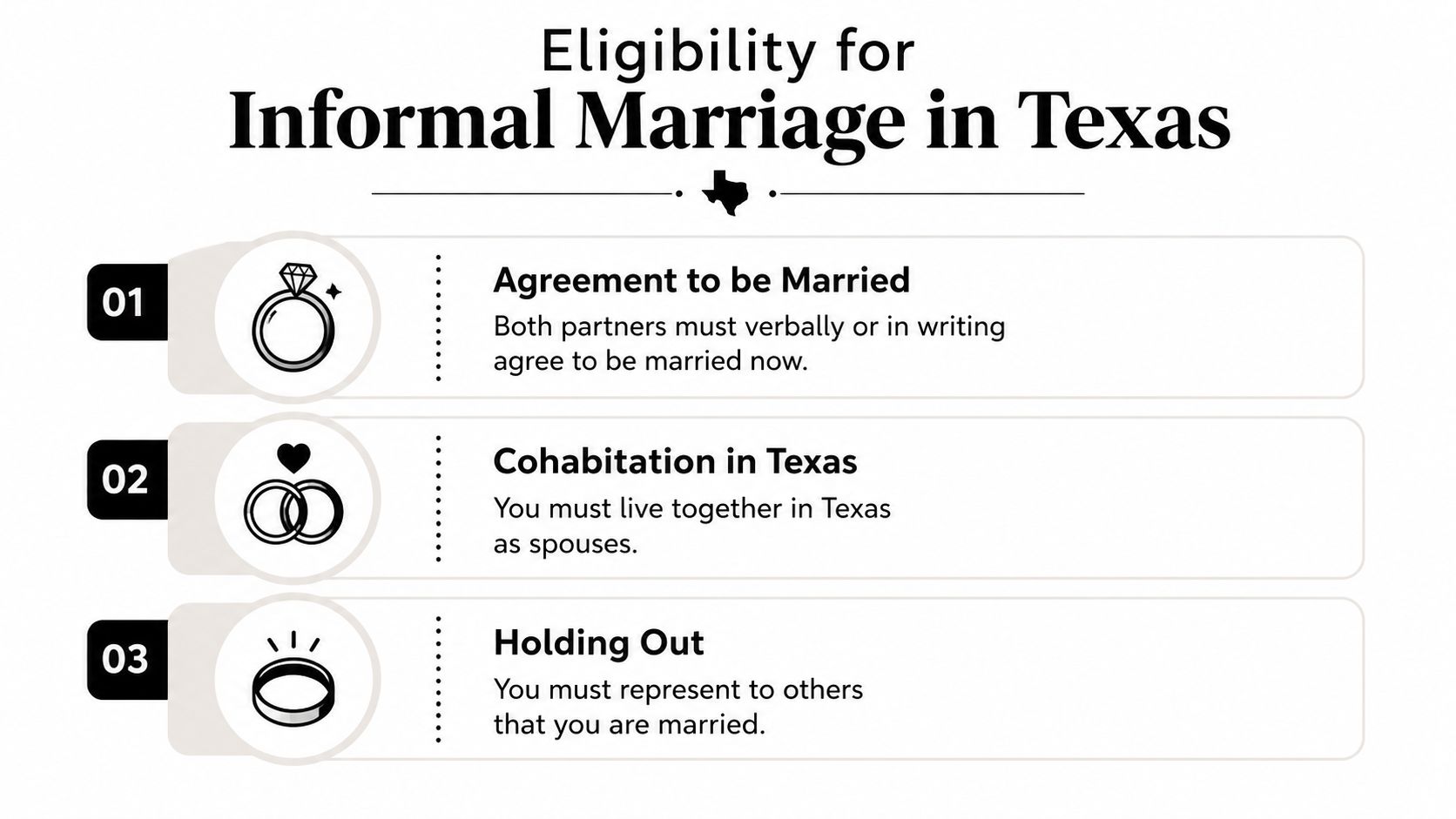
The three legal elements
Texas requires an agreement to be married, cohabitation in Texas as spouses, and holding out to other people as married. The agreement has to be present-tense. Both people must have meant, at that time, to be married now, not at some later point. Cohabitation means living together in Texas as a couple. Holding out means you presented yourselves to the public as married.
That is the part people usually get wrong. A couple can share a home and still fail the test if they never agreed to be married. They can also agree privately and still fall short if they never acted like spouses in front of others. The declaration records an existing marriage, it does not create one out of thin air. BoloSign on contract law basics is a useful parallel reference because both situations turn on mutual assent and clear intent.
A simple Atascocita example makes the point. If one partner introduces the other as “my wife” at a neighborhood event, the couple lives together in Humble, and both consistently use married status on ordinary records, that starts to support holding out. If the couple only lived together, or only talked about marriage in private, the legal proof gets weak fast.
Practical rule: if you cannot explain the agreement, the shared home, and the public representation without pausing, get legal advice before you file.
The hard stop eligibility issues
Both parties must be at least 18, unmarried to someone else, and outside the prohibited kinship categories. Prior marriages cause the most trouble in northeast Harris County, especially when a divorce was never fully wrapped up or the paperwork is unclear. If there is any question about a prior marriage, stop and verify status before you sign anything.
The same caution applies if the declaration is tied to other family-law issues. A Divorce Lawyer in Atascocita, TX can help sort out the fallout when marital status affects property, support, or a later court fight. TexasLawHelp also explains that a common-law marriage claim is strongest when the underlying facts line up and can be supported with real proof, which is why the facts matter as much as the form itself. TexasLawHelp on common-law marriage
A quick self-check before you file
- Agreement: Did both of you agree you were married now?
- Home life: Did you live together in Texas as spouses?
- Public conduct: Did you tell others you were married?
- Legal capacity: Are both of you unmarried, adults, and eligible to marry?
If any answer is shaky, fix that first. Filing a declaration does not cure a defective relationship history.
How to Complete and File Your Declaration in Harris County
The filing process is procedural, not ceremonial. That is good news, because it means preparation matters more than theatrics. Harris County will not fix missing facts, unclear dates, or a spouse who shows up unprepared to sign.
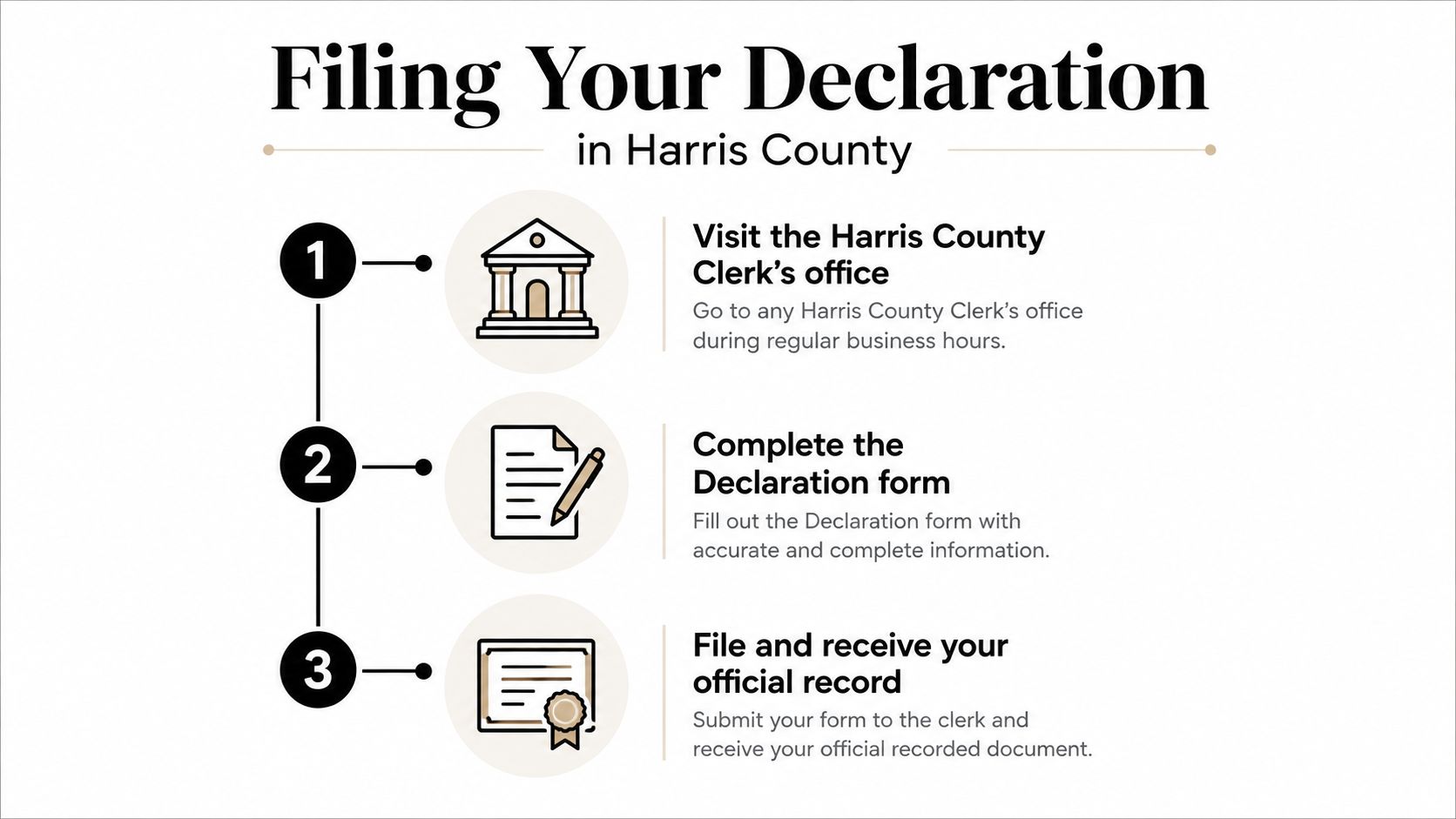
Walk in prepared, not hopeful
Bring completed identification and every detail the form asks for. The county clerk is not there to fill gaps for you, and the filing only goes smoothly when both spouses appear together with complete paperwork. In Harris County, the clerk verifies the required information, administers an oath to each spouse, watches both signatures, completes the clerk's certificate, records the declaration, returns the original to you, and sends a copy to the Texas Bureau of Vital Statistics. That is why this is an in-person legal execution process, not a simple drop-off. Texas informal marriage declaration workflow
If you want to organize your papers before you go, a free PDF signature app can help you keep everything in order. It does not replace the clerk's required in-person oath and witness steps.
What usually happens at the clerk's office
The clerk reviews the form for completeness, confirms identity and age, and makes sure both people are present. Then each spouse takes the oath and signs in front of the clerk. After that, the clerk completes the certificate and records the declaration.
Get a certified copy before you leave. A vague email receipt or a phone screenshot will not do the same job later. Certified copies are what you will use for name changes, benefits enrollment, and proof in court if the declaration is ever questioned.
Why preparation saves you time
County fees are usually in the general range of about $36 to $47, but fees are not what derail a filing. Incomplete paperwork does. So does showing up without both spouses, or failing to meet the in-person execution requirements. That is the usual failure point here, not a clerk making a personal judgment about whether your marriage is real.
If you live in Atascocita or Humble, treat this like any other legal filing. Bring the right documents, arrive together, answer the questions the same way on every form, and leave with the certified copy in hand.
Common Filing Mistakes That Delay or Derail Your Declaration
The problems I see most often are simple, and they are avoidable. A declaration usually goes sideways because the form says one thing, the couple says another, or the clerk cannot complete the filing with the information in front of them. One wrong date or one missing signature can create a mess that follows you into a later dispute.
Date errors create the biggest headaches
Harris County wants the date the couple began living together as spouses. People regularly write the date the relationship started instead, which is a different thing. If that date is before either person was 18, it has to be corrected to the person's 18th birthday.
That mistake matters later. A declaration with the wrong date can weaken your position in a divorce, custody case, or probate fight because the paperwork conflicts with your later testimony. Judges notice that kind of inconsistency. The safer course is to make sure the date matches the legal marriage facts, not the start of the relationship. TexasLawHelp on common-law marriage
Status problems do not disappear just because you file
Both people must be free to marry. If one spouse is still married to someone else, the declaration does not cure that problem. The prior marriage has to end first.
Do not sign the form if there is any doubt about a prior divorce, annulment, or death record. Clear up the status issue first.
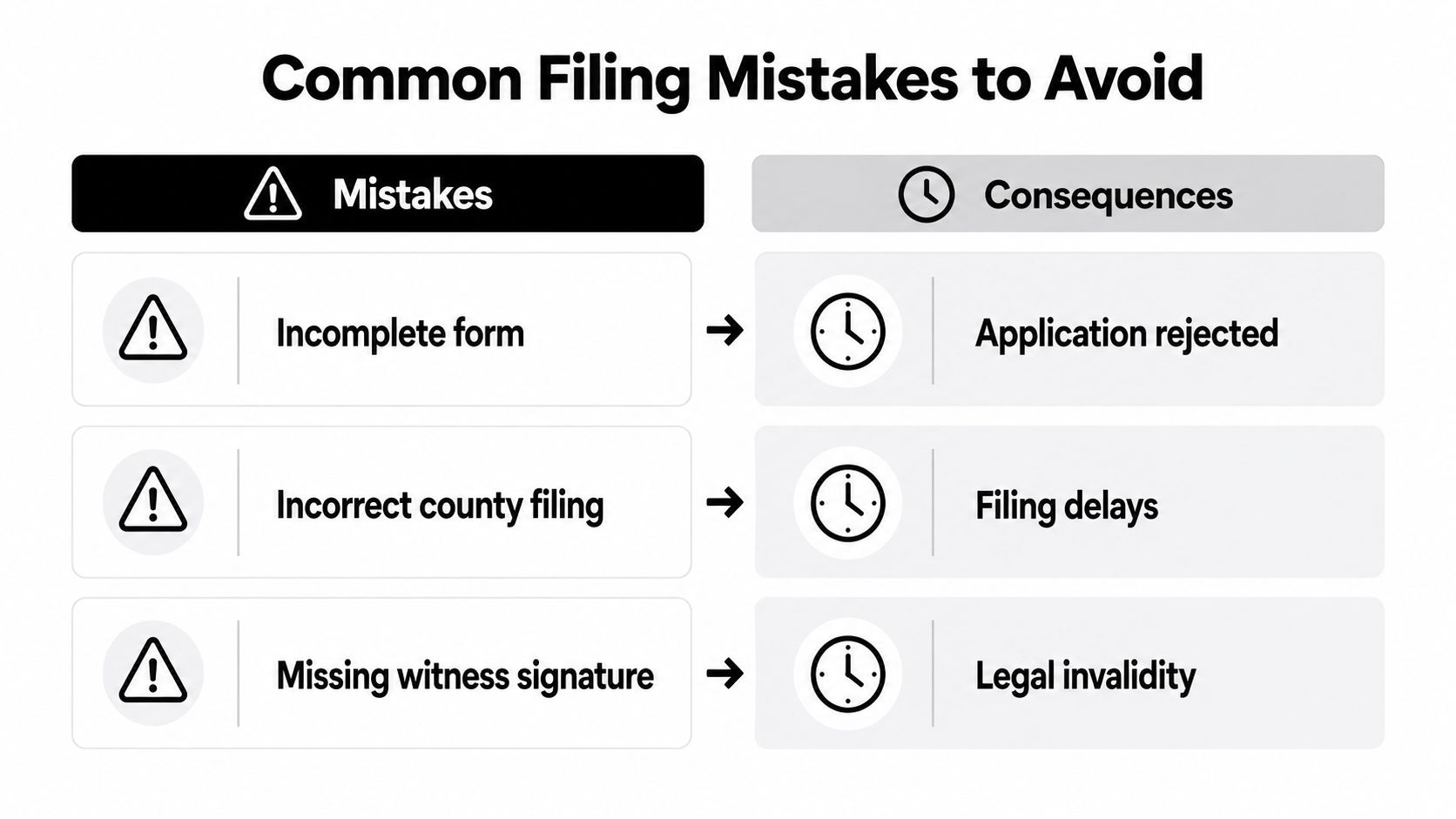
Paperwork problems cause another round of delay. If the clerk cannot verify identity, age, or the required form details, the filing stops right there. Harris County clerks are looking for complete forms and an in-person oath, not guesses or half-finished answers. A chart showing common filing mistakes like incomplete forms and their consequences such as application rejection. Texas law also ties the process to a recorded declaration, signed and completed the right way, so missing steps are not cosmetic problems, they stop the filing from doing its job. Texas informal marriage declaration workflow
Use the filing to strengthen, not weaken, later proof
If your family may later need to prove the marriage for divorce, custody, or probate, the declaration has to match the rest of your records. Your date, your address history, and the way you have held yourselves out to others should tell the same story. If they do not, the other side will use the mismatch against you.
That same paper trail matters in other family-law settings too, including proof questions tied to a child's legal status. For example, if you are also working through paternity issues, keep the records aligned with any Texas paternity establishment process so one filing does not undercut another. The fix is straightforward. Review the form before you go, correct any age issue immediately, confirm both spouses can appear together, and do not guess about marital status. Ten careful minutes at your kitchen table can save you months of fighting later.
Legal Effects of a Recorded Declaration for Your Family
Once the declaration is signed and recorded, Texas treats it as proof of marriage. That is the point. It ends the argument over whether you are spouses and shifts the focus to the legal consequences that follow.
What changes after recording
A recorded declaration matters in divorce because it helps prove both the date and existence of the marriage when the court divides property. It matters in custody cases because marital status can affect how families handle conservatorship, support, and decision-making. It matters in estate planning because a surviving spouse's rights often depend on proving the marriage first.
For families in Atascocita and Humble, that proof can keep a spouse from getting pushed out during a crisis. It also helps with insurance and employment benefits, where administrators usually want clear legal documents instead of a long story. If a medical provider needs confirmation of spouse status, the recorded declaration gives you something concrete to present. The same paper trail can matter in a Texas paternity establishment process because family-law records should tell one consistent story.
A filed declaration is more than a label. It is leverage when life gets complicated.
Why families should care early
People usually look for proof only after a conflict starts. That is the wrong time. If you wait until divorce, death, or a property dispute, you are scrambling to gather evidence under stress. A recorded declaration reduces that scramble because it already puts your marriage into a documented legal form.
The practical effect is simple. You move from trying to persuade people that your marriage exists to using a recorded document that says it does. That matters when a bank, court, employer, or probate court needs certainty instead of explanations. If your family also needs help proving a relationship for other legal purposes, browser-based legal conferencing can make those conversations with counsel easier to schedule and handle without wasting time on office logistics.
Why the declaration should match your broader planning
If your family owns a home, has children, or is thinking about wills and beneficiary designations, the declaration belongs inside a larger legal plan. It affects property, inheritance, and the way a court will view your relationship if a dispute ever lands in front of a judge. Treat it like a foundation document, not a box to check.
If you are already thinking about divorce, custody, or estate planning, this document should fit cleanly into the rest of your strategy. A mismatch between your declaration and your other records invites trouble you do not need.
When to Seek Legal Guidance Before or After Filing
Some couples can file on their own. If both people are eligible, the facts are clean, and the form matches reality, that's manageable. But if the situation has even one complicating factor, legal guidance is worth it before you sign.
Get advice when the facts are messy
Call a lawyer before filing if there's a prior marriage that may not be fully dissolved, if one of you owns a business or meaningful property, if you have children from previous relationships, or if the declaration is part of a broader estate plan. Those are the situations where the long-term consequences are bigger than the filing itself. The form may be short, but the fallout isn't.
If your situation may lead to a custody fight, the timing of legal advice matters. When should I hire a custody lawyer in Atascocita, TX is a good companion topic because custody issues often become more complicated once a marital status question is on the table. The earlier you sort out the family-law picture, the fewer surprises you'll face later.
Use counsel when the stakes are higher than the form
A local attorney can help you decide whether to file, how to document the relationship correctly, and whether another family-law step should happen first. That includes divorce planning, custody planning, and estate planning. The Law Office of Bryan Fagan – Atascocita TX Lawyers handles those issues for people in Atascocita, Humble, and northeast Harris County, and that kind of local familiarity matters when records, timing, and family history all intersect.
Browser-based consultations can also make it easier to get legal help without delaying the conversation, and tools like browser-based legal conferencing show how modern firms can speak with clients efficiently when schedules are tight.
If your facts are simple, file carefully and get the certified copy. If your facts are messy, don't gamble with a form that can affect divorce, custody, property, and estate rights later.
If you're dealing with an informal marriage declaration in Atascocita or anywhere in northeast Harris County, the safest move is to get the paperwork right before a dispute starts. The Law Office of Bryan Fagan – Atascocita TX Lawyers helps clients think through marriage proof, divorce, custody, and estate planning with practical guidance that fits real family life. Schedule a free consultation at the Atascocita office so you can protect your rights and avoid the mistakes that turn a simple filing into a bigger legal problem.