If you're staring at a bank statement that no longer makes sense, you're not overreacting. In Atascocita and across northeast Harris County, people call a family lawyer after they notice money missing, a business interest shifted to a relative, or retirement funds drained while the divorce was already underway. That kind of conduct fits the Texas concept of fraud on the community estate, and the court does have tools to fix it.
Texas does not treat this as a separate tort claim. It treats it as a property-division issue inside the divorce, which matters because the judge can adjust the division of the community estate after finding actual fraud or constructive fraud under Texas Family Code § 7.009. The court must calculate the depletion, figure out the reconstituted estate, and then divide property in a just and right way, including by awarding a disproportionate share of remaining community property, a money judgment, or both. That is real leverage when one spouse has already tried to hide or spend the money. See the statutory framework in Texas Family Code § 7.009 as summarized by FindLaw's text of the statute.

When a Spouse Secretly Drains the Marital Estate
A spouse in Atascocita opens the online banking app and finds the joint savings account nearly empty. The explanation changes twice. First, it was “bills.” Then it was “an investment.” Then the paper trail shows a transfer to a sibling. That is the kind of fact pattern that gets a Harris County judge's attention fast.
Texas law recognizes that a spouse cannot strip community property and expect the divorce court to shrug. In a fraud on the community estate claim, the question is whether the depletion was hidden, improper, or done to keep the other spouse from using and enjoying the asset. If that sounds like betrayal, it is. The law still gives you a remedy.
Practical rule: Do not wait for the divorce decree to sort itself out. If the money is gone now, the evidence can disappear with it.
The court does not stop at, “What is left?” Under Texas Family Code § 7.009, the judge can work backward from the loss and adjust the division based on what the estate should have looked like if the fraud never happened. That is why these cases still matter after the account is drained, the business is moved, or the retirement funds are gone. The court can still value the damage and correct the division.
For commingled accounts, tracing is usually the fight that decides the case. A spouse who dumps separate and community funds into the same account creates confusion on purpose or by carelessness, and the paper trail is what separates the two. Review commingled bank account tracing in divorce cases in Atascocita if you need the practical tracing rules that apply when deposits and withdrawals are mixed together.
If you're comparing asset-tracing options, the Property Division Lawyer in Atascocita page is a useful starting point because complex community property division is exactly where these disputes live. The point is simple. You are not chasing a moral victory. You are building a financial claim the court can enforce.
Understanding Actual and Constructive Fraud Under Texas Law
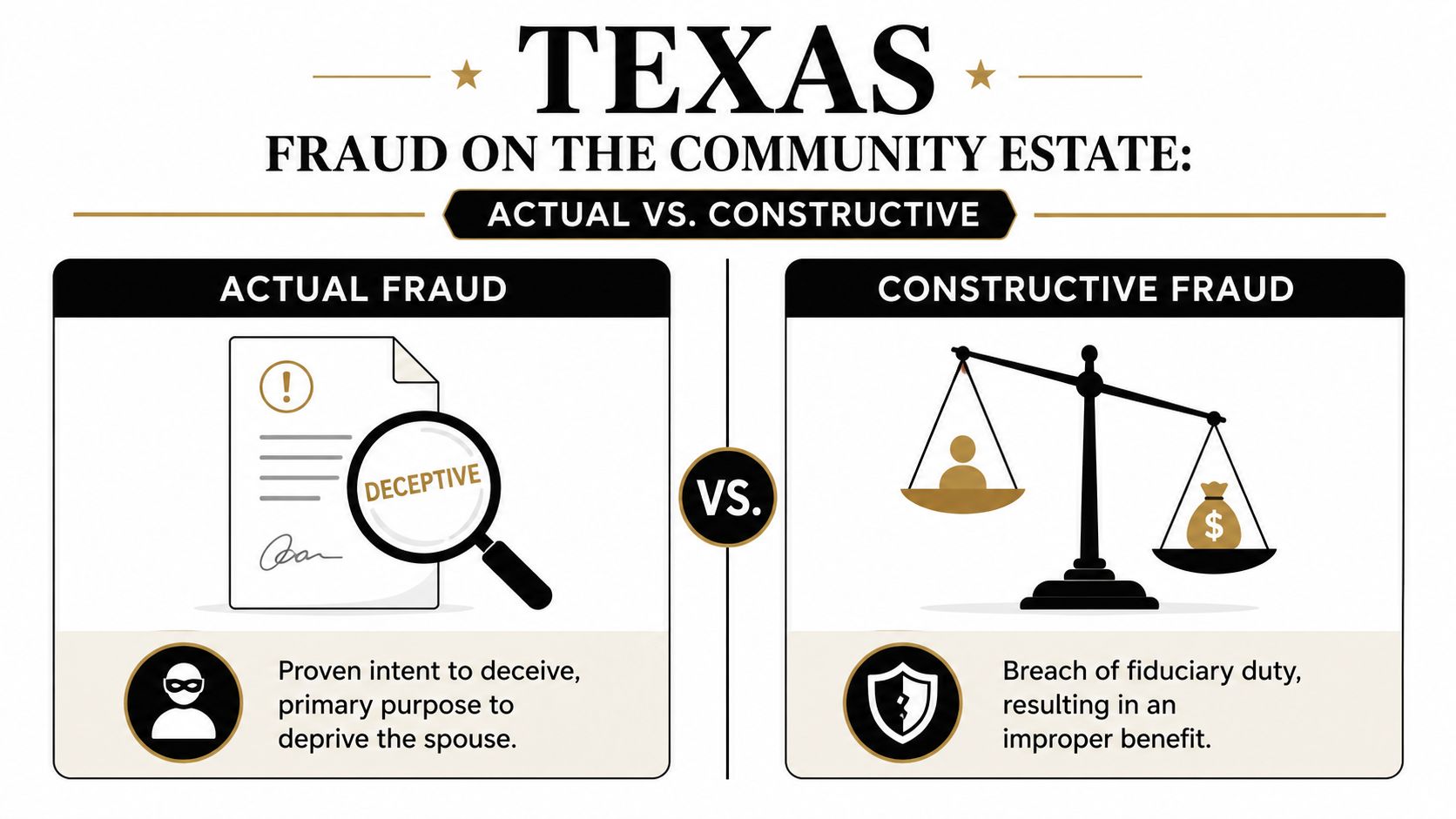
Texas family courts recognize two main versions of fraud on the community estate, and you need to know which one fits before you spend time and money on a case. Actual fraud is the more direct form. Constructive fraud is the more common one in divorce litigation, and courts often call it waste.
Actual fraud means intent
Actual fraud is the ugly version. A spouse transfers community property or spends community funds primarily to deprive the other spouse of the asset's use and enjoyment, and there's dishonesty or intent to deceive behind it. This is an intentional siphon, not a bad purchase or a careless decision.
That distinction matters because you have to prove the state of mind behind the transfer. Bank records matter, but so do texts, emails, and inconsistent explanations. If a spouse sends money to a third party, hides the transfer, and then gives shifting reasons for it, that's the kind of evidence a court may view as intentional conduct rather than a mistake.
Constructive fraud means improper depletion
Constructive fraud is different. It often shows up as waste, or a wrongful depletion of community assets without the other spouse's knowledge or consent. Texas commentary explains that courts may presume constructive fraud when one spouse disposes of community property without consent, especially when the transfer is hard to justify against the size of the estate. See the background treatment in the Winter 2020 report on fraud and reconstituted estates.
Think of constructive fraud like reckless spending that crosses the line into unfairness. The spouse may not have a smoking gun text saying, “I meant to deprive you,” but the court still asks whether the spending was proper, whether enough property remained for the innocent spouse, and whether the recipient was a family member, a lover, or some other insider. Those facts can shift the burden in a meaningful way.
A Texas divorce attorney has to decide quickly which theory fits, because the proof strategy changes. Actual fraud needs proof of deception. Constructive fraud leans on fiduciary duty, missing consent, and the fairness of the transfer. That's why a sloppy claim usually fails. The best cases are built with documents first, emotion second.
If the facts fit a broader asset split dispute, Estate Planning Attorney in Atascocita is relevant because families who are separating often need to think about beneficiary changes, wills, and long-term control of property at the same time. That's not a side issue. It's part of protecting the estate once trust is broken.
How Courts Calculate the Reconstituted Estate
Texas Family Code § 7.009 controls how a judge fixes a divorce case after community property has been drained by fraud. The court does not stop at the missing bank balance. It calculates what the community estate should have looked like if the improper transfer, spending, or concealment never happened. That reconstructed value is the reconstituted estate, and it becomes the starting point for a fair division.
The court works in layers
The judge first identifies the community property lost through actual fraud or constructive fraud. Then the court rebuilds the estate as if the wrongful conduct had never taken place. That second step matters because a depleted account does not show the whole story. The law lets the court make a just and right division after that calculation, including a disproportionate share of the remaining community property, a money judgment, or both.
A practical example
An Atascocita spouse moves community funds into an account the other spouse never sees, then spends the money or sends it to someone else. The court does not accept “the account is empty” as the end of the analysis. It follows the money, identifies how much left the estate, and uses that loss to correct the division. Hidden transfers create serious exposure for the spouse who made them.
The math only works if the proof works. A judge needs a clean paper trail, not a guess or a story that sounds plausible. Without tracing, the court may know the estate was damaged but still lack a reliable number to assign to the fraud. With tracing, the court can connect the loss to specific transactions and specific property.
Courts care less about a spouse's story than about where the money went.
That is why the reconstituted estate framework carries real weight in Harris County family courts. It gives the innocent spouse a path to meaningful relief even when assets were moved, spent, or hidden before trial. The court may not recover every dollar, but it can still correct the division in a way that reflects what really happened.
Common Scenarios That Trigger Fraud Claims in Atascocita
The same pattern shows up again and again in Humble, Atascocita, and the surrounding neighborhoods. A spouse says there's “nothing left,” but the records tell a different story. Three scenarios come up often enough that any careful lawyer should know them cold.
A hidden transfer of a business or real estate
One spouse transfers a family business interest, a rental home, or even a piece of land to a sibling or new partner. On paper, it may look like a sale. In reality, it may be an attempt to move community value out of the marital estate before the divorce judge can divide it. If the transfer happened without the other spouse's knowledge or consent, the court will care about the relationship between the recipient and the transferring spouse, the value of the asset, and whether the remaining estate still fairly supports the innocent spouse.
Gambling, affair spending, or unexplained cash withdrawals
Another pattern is cash leakage. The withdrawals start small, then become routine. A spouse claims it was for “expenses,” but the bank records show repeated ATM pulls, card charges, hotel stays, or travel that never benefited the marriage. Texas courts don't need a dramatic confession to treat that as constructive fraud or waste if the spending drained community assets unfairly. Transaction history matters more than arguments at the kitchen table.
Gifts or loans to adult children or other third parties
A spouse may also give large gifts or make “loans” to adult children from a prior relationship, a friend, or a romantic partner. If the other spouse didn't know and didn't consent, that transfer can trigger a fraud claim. The court will look at whether the transfer was reasonable in light of the whole estate and whether the innocent spouse was left with enough to support their half-interest.
If you're dealing with post-decree property fights or repeated noncompliance, Enforcement of Court Orders in Atascocita is the related issue because sometimes the fight starts as fraud and then becomes enforcement when one spouse refuses to fix the damage. The legal label changes, but the practical problem is the same. Someone moved property they shouldn't have moved.
Gathering Evidence and Preserving Your Claim
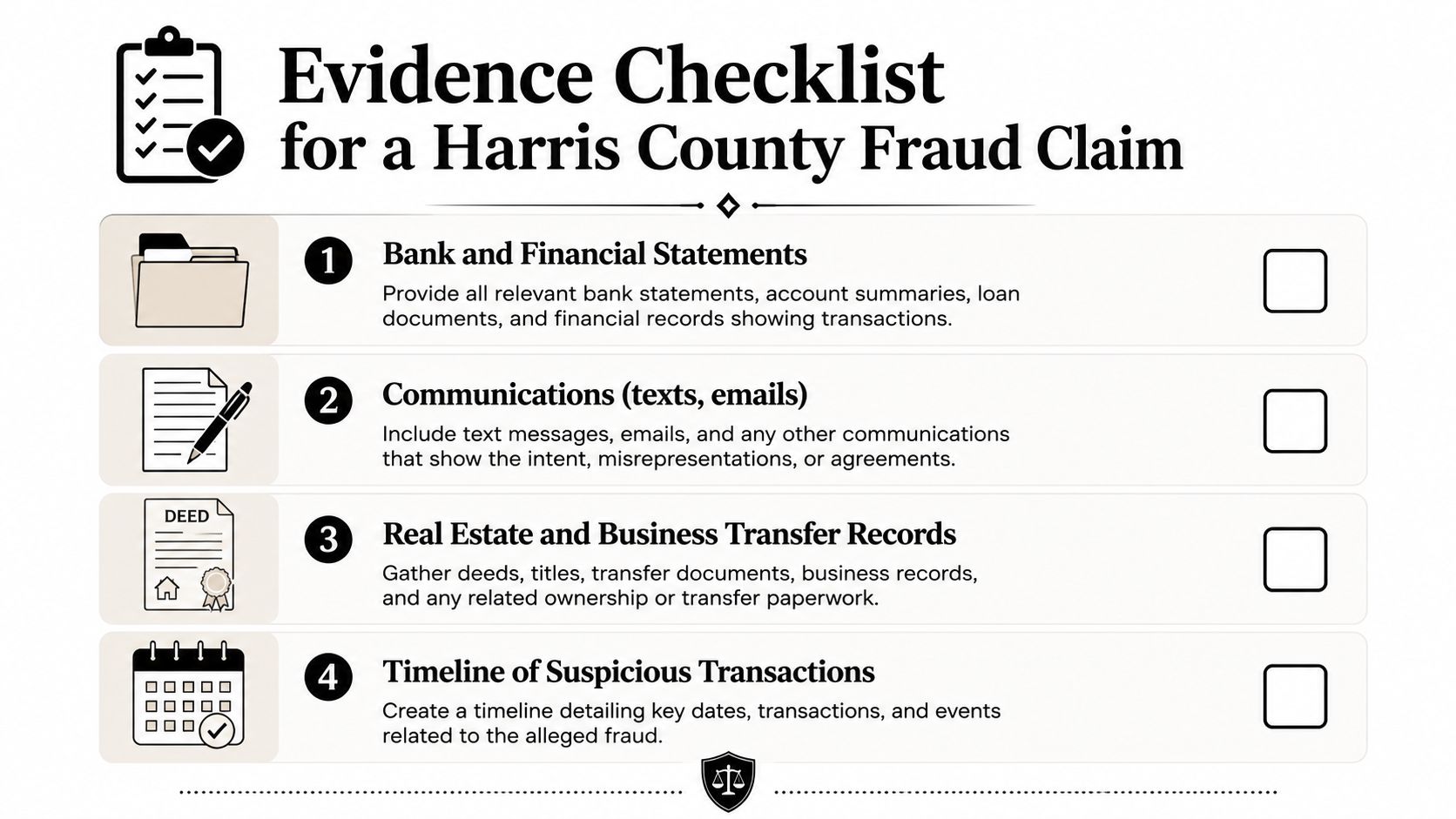
If you suspect fraud on the community estate, your first move is evidence preservation. Not confrontation. Not a heated text message. Evidence. Texas family court judges in Harris County take documents seriously because documents tell the story without the drama. That means you need bank statements, tax returns, business records, property records, emails, and texts before they vanish or get overwritten.
Start with the paper trail
Pull every statement you can legally access, especially for checking, savings, retirement, credit cards, and business accounts. Match the dates of suspicious withdrawals or transfers against calendar events, travel, and obvious changes in behavior. If a transfer went to a relative, an entity, or a new account, that recipient matters. The money trail often shows the motive the spouse won't admit.
For a deeper look at account hunting, the article on how to find hidden bank accounts in divorce in Texas is a direct next step for anyone who suspects the main account isn't the whole picture. If you need a broader digital-presence angle, practical OSINT for identity protection from Digital Footprint Check can also help you think about what online traces might exist, though financial tracing still belongs in the hands of counsel and, when needed, a forensic accountant.
Use tracing before the trail goes cold
Forensic tracing is the process of following community money from one account to another until you can identify where it landed. That might mean a transfer to a new bank, a cashier's check, a third-party payment app, or a business ledger entry. Good tracing is often the difference between suspicion and proof. Without it, you have a story. With it, you have a case.
Freeze the damage early
Temporary restraining orders and injunctions can stop a spouse from moving assets further. That relief matters when the other side is active, evasive, or already deleting records. If you think the money is still moving, you do not want to wait for a full trial schedule before asking for protection.
A careful divorce lawyer will also tell you what not to do. Don't log into accounts you aren't authorized to access. Don't tip off the other spouse before records are secured. Don't rely on a single screenshot when the full statement is available. The right move is to preserve evidence in a way the court can trust.
What to Expect in Harris County Family Courts
Harris County judges are used to property fights, but they do not hand out fraud findings because someone feels cheated. They want proof, organized cleanly. The case usually starts with filing and temporary orders, then moves into discovery, and often into depositions if one spouse is hiding the ball. Hidden asset cases tend to get more intense because the documents keep expanding as new accounts, transfers, or third parties appear.
Discovery is where many fraud claims gain traction. Interrogatories, requests for production, and depositions force the other side to answer under oath. If the answers don't line up with the bank records, that inconsistency becomes powerful evidence. Judges notice when one spouse gives selective answers or keeps changing the story.
What the judge actually weighs
A Harris County family court can award a disproportionate property division or a money judgment when fraud is proven, but the outcome depends on the quality of the evidence and the strength of the tracing. The judge is looking at fairness under the reconstituted estate framework, not punishing bad behavior for its own sake. If your case is thin, the court may still sense wrongdoing but limit the relief. If your case is documented, the remedy can be substantial.
Local representation matters. Attorneys who work these cases regularly know the discovery habits, the forensic experts, and the practical pace of Harris County dockets. They also know that the right evidence has to be delivered in the right order. Timing is strategy.
The Law Office of Bryan Fagan – Atascocita TX Lawyers can handle family law disputes, including property division issues like this one, and that matters because fraud cases rarely stay isolated. They often overlap with temporary orders, enforcement problems, and long-term planning. You want counsel that understands the full picture, not just one filing.
Protect Your Financial Future with Local Legal Guidance
Fraud on the community estate is not something you should try to out-argue alone. In Atascocita, Humble, and northeast Harris County, the people who recover the most are usually the ones who move fast, preserve records, and present a clean tracing story to the court. The law gives you tools to correct the damage, but those tools work only if the evidence is still there.
Start with the paper trail. Bank statements, account screenshots, business records, tax returns, credit card bills, text messages, and email can show where the money went and who knew about it. If a spouse moved funds to a friend, a relative, or a separate account, the transfer date, amount, and receiving account matter. A file that is organized early gives your lawyer something real to trace instead of a vague suspicion.
If you suspect hidden transfers, waste, or a quiet drain on the marriage, take the issue seriously now. A careful review of bank records, business documents, and communications can show whether you have a claim worth pursuing. If you are also trying to shield future assets from the same kind of abuse, speak with an asset protection attorney in Atascocita TX before you make any moves that could complicate a later fraud claim.
Courts in Harris County care about proof, not outrage. A judge wants to see a clear reconstituted estate theory, solid tracing, and records that tie the missing community property to a specific transaction or pattern. If you can show the court where the money went and how the other spouse handled it, you give the judge a reason to award a disproportionate division or enter a money judgment. If you cannot trace it, the court still may suspect misconduct, but the relief will usually be narrower.
That is why local legal guidance matters. A lawyer who handles these disputes regularly knows how to preserve the right records, push for discovery, and use forensic accounting where the numbers are tangled. The Law Office of Bryan Fagan – Atascocita TX Lawyers handles family law disputes, including property division issues tied to fraud on the community estate, and that matters because these cases often overlap with temporary orders, enforcement problems, and long-term financial planning. You want counsel who understands the full case, not just one filing.
If your spouse has hidden, wasted, or transferred community property, get legal advice before more money disappears. The Law Office of Bryan Fagan, Atascocita TX Lawyers helps clients build fraud-on-the-community claims, trace assets, and pursue fair property division in Harris County. Visit Law Office of Bryan Fagan – Atascocita TX Lawyers to schedule a free consultation and get clear advice on your next move.