A lot of people walk into an Atascocita divorce carrying the same quiet fear. Their spouse suddenly changed passwords, started grabbing the mail first, or began saying, “Don't worry about it, I'll handle the money.” Then the bank balances don't line up with the lifestyle, and something feels off.
If that's where you are, trust your instinct without letting panic drive the bus. Suspicion alone isn't enough for court, but it is enough to start getting organized. In northeast Harris County divorces, the spouses who do best are usually the ones who stay calm, collect records, and let the legal process do its work.
If you searched for how to find hidden bank accounts in divorce texas atascocita, you probably want a straight answer. Here it is. Hidden bank accounts are usually found through a combination of careful document review, formal discovery, and, in the right case, forensic accounting. The law gives you tools. Your job is to use them correctly and early.
Suspecting Hidden Assets in Your Atascocita Divorce
A spouse from Eagle Springs or Walden might sit down in our office and say the same thing in different words: “I can't prove anything yet, but my gut says money is missing.” Maybe the family used to talk openly about finances, and now there's silence. Maybe your spouse used to use one local bank branch and now there are unexplained withdrawals or transfers you can't trace.
That feeling is unsettling because it touches more than money. It affects your sense of trust, stability, and what your future will look like after the divorce. In Texas, though, this isn't a personal drama the court ignores. It's a property division issue, and that matters.
Texas family-law guidance regularly points to common concealment methods such as undisclosed bank accounts and transfers to third parties, and it warns that courts may respond by awarding a disproportionate share of the community estate, ordering attorney's fees, and imposing contempt sanctions, as discussed in this Texas family-law overview of hiding assets in divorce.
Why this matters in a Harris County divorce
Texas follows community property rules, which means the money earned and property acquired during the marriage often belong in the same conversation about division. If one spouse hides part of the picture, the court can't divide the estate fairly.
This isn't about revenge. It's about making sure the full estate is on the table before agreements are signed or a judge makes a ruling.
Practical rule: If your spouse is suddenly secretive about cash, transfers, or business income, treat that as a reason to document. Don't treat it as a reason to confront without a plan.
Some people find it helpful to read broader financial guidance during separation, especially on business and money issues. A useful outside perspective is Nanak Accountants' divorce business advice, particularly if your concerns involve a family business or self-employment income.
What you should do first
Start with your own records and observations. Write down what changed, when it changed, and what documents you've seen disappear or become harder to access. If your concern is hidden earnings as well as hidden accounts, this related guide on what happens if a spouse hides income in divorce in Atascocita can help you frame the issue correctly.
The biggest mistake I see is waiting too long because you don't want to seem suspicious. If money is being moved, delay helps the person moving it.
Recognizing the Warning Signs of Concealed Finances
Some warning signs are obvious. Others are easy to dismiss until you look at them together. One odd transfer may mean nothing. A cluster of odd behavior usually means you need to dig.

Behavioral changes around money
A spouse who is hiding funds often changes routine before they change paperwork. Around Atascocita and Humble, that might look like stopping joint online banking access, getting defensive about ordinary bill questions, or suddenly insisting all financial conversations happen verbally instead of by text or email.
Watch for patterns like these:
- New secrecy: Your spouse used to talk openly about accounts, taxes, or payroll, and now every question triggers irritation.
- Mail control: They start collecting mail first, switching statements to paperless, or using a separate mailing address or P.O. box.
- Financial gatekeeping: They tell you the business is “down” but keep spending as if nothing changed.
Document problems that shouldn't happen by accident
Missing documents matter. In a normal household, people misplace a statement now and then. In a divorce, selective disappearance of records is different.
Pay attention if you notice:
- Incomplete statements: A monthly statement is missing pages, or only certain months are unavailable.
- Tax return mismatch: Income shown on a tax return doesn't fit the accounts you know about.
- Loan paperwork surprises: A credit application, mortgage packet, or car loan file lists assets or accounts you've never seen before.
If a spouse can quickly produce documents that help them and “can't find” the ones that hurt them, that's not random. It's a clue.
Transaction patterns that deserve scrutiny
Consequently, hidden bank account cases often start to become provable. The concern isn't just that money moved. It's that it moved in ways that don't match normal family spending.
Look for these common red flags:
- Large cash withdrawals: Repeated ATM or teller withdrawals with no clear family purpose.
- Transfers to other people: Money sent to relatives, friends, or business contacts without a solid explanation.
- Small-bank activity: New transfers to institutions your family never used for daily banking.
- Odd payment shifts: Bills that were once auto-drafted from one account suddenly come from another source.
Lifestyle that doesn't match the story
Sometimes the cleanest clue is simple. The numbers on paper say one thing, but the household lifestyle says another. If your spouse reports financial strain while still funding travel, purchases, or side spending, don't ignore the mismatch.
A court won't decide hidden assets based on hunches alone, but lifestyle inconsistency is often the reason a deeper review makes sense. That's especially true when one spouse controls the family books, a closely held business, or most online account access.
Your Initial Steps for Gathering Financial Information
Before lawyers start firing subpoenas, you need a clean record of what you already know. That early work often decides how efficient and affordable the next stage will be.
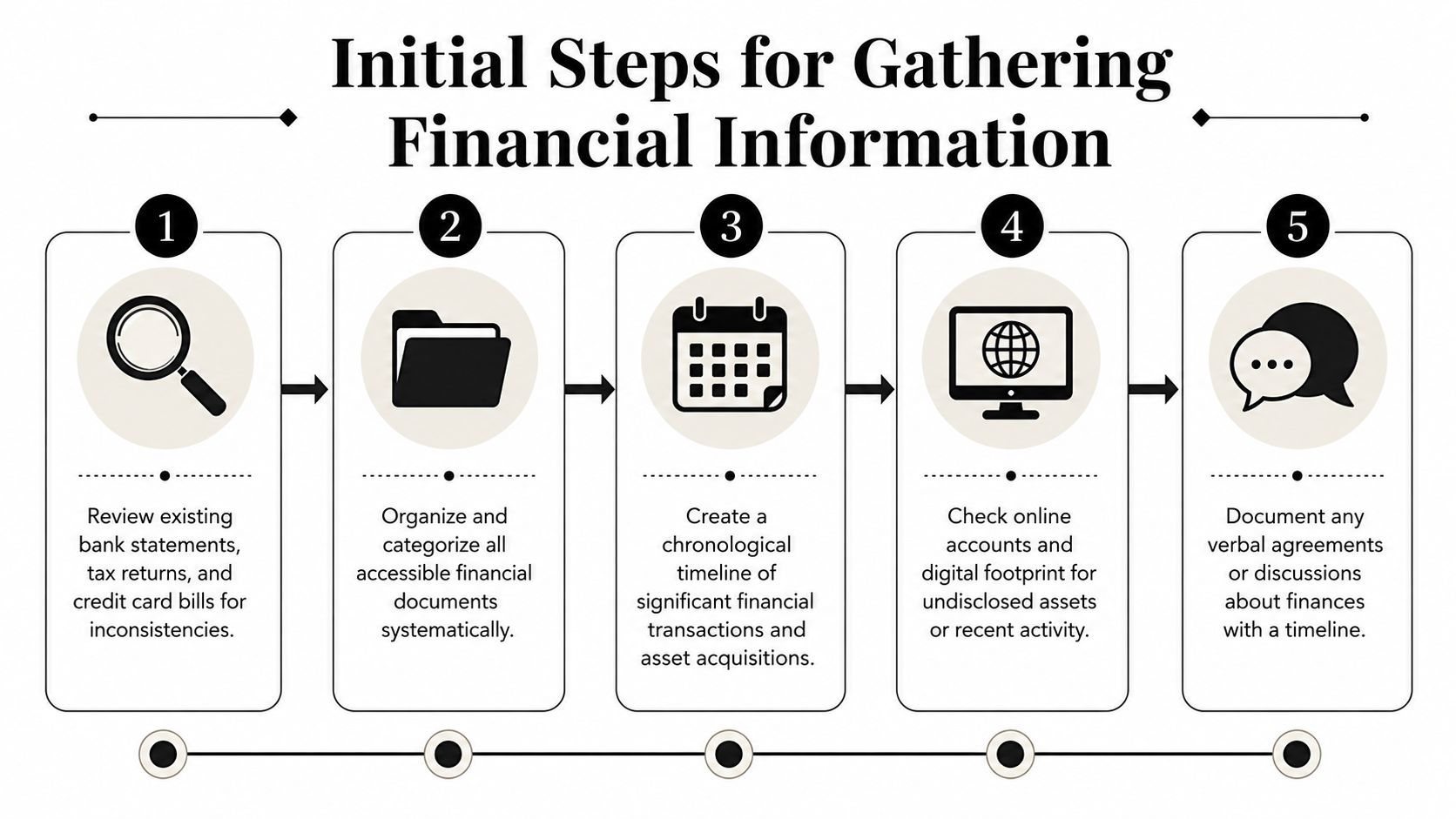
Texas practitioners often rely on a three-layer workflow: build a 24–60 month timeline from tax returns and statements, reconcile transactions against known income and expenses, and use formal discovery once the paper trail goes dark, as described in this Texas divorce asset-tracing guide. That same guidance emphasizes reviewing the last two to five years of records because hidden accounts often appear through unexplained transfers or accounts at smaller, less-used institutions.
Start with documents already in your hands
You don't need to break rules or invade private systems to begin. Use records you already lawfully access, such as joint account statements, tax returns, shared credit card bills, mortgage statements, and loan applications.
Gather and sort:
- Bank records: Every statement for joint checking, savings, money market, and known separate accounts you can legally access.
- Tax materials: Full returns with schedules, W-2s, 1099s, K-1s, and supporting documents.
- Debt records: Credit cards, personal loans, lines of credit, and HELOC statements.
- Business papers: If you have lawful access, save ledgers, payroll summaries, merchant account records, and expense reports.
Build a real timeline, not a pile of paper
Gathering documents is a common practice, but it often concludes at that point. That's not enough. You need a timeline that tells a story.
Create a chronological list of major events and transactions:
- Account openings or closures
- Large withdrawals or unexplained transfers
- Property purchases
- Business revenue spikes or dips
- Changes in payroll, bonuses, or commissions
- Cash movement to family members or third parties
If you're sorting PDFs and trying to compare line items across months, a practical tool can help transform bank statements into Excel so you can search, sort, and flag recurring transfers more easily.
Reconcile spending against income
Stop looking at statements in isolation. Compare deposits, spending, and debt payments against what your spouse claims the household earns.
Use questions like these:
- Does reported income support the mortgage, vehicles, travel, and household spending?
- Are there recurring transfers to an account you can't identify?
- Do tax return entries suggest income sources missing from divorce disclosures?
- Did cash withdrawals increase as the marriage started breaking down?
Local practice note: In Harris County cases, organized records give your attorney something usable. A banker's box full of unsorted paper usually just increases legal fees.
Preserve digital clues without crossing lines
Check account alerts, shared financial apps, stored PDFs, and household computers only if you already have lawful access. Don't guess on this. If access is questionable, stop and ask your lawyer first.
Useful lawful sources often include:
- Shared email receipts for transfers, account alerts, or loan notices
- Family tax software files showing account or institution names
- Online bill pay histories that reveal where money was sent
- Calendars and notes that help date major purchases or transfers
If you're getting ready to separate or file, this guide on how to prepare for divorce financially in Atascocita is worth reading alongside your document review.
Keep a clean evidence log
Write things down with dates. Save screenshots, statements, and notes in one secure folder. Label files clearly so your attorney can find them quickly.
Use plain labels such as:
| Document | Why it matters |
|---|---|
| Tax return with schedules | May show income streams or institutions not otherwise disclosed |
| Credit card statement | May reveal transfers, travel, or spending inconsistent with claimed finances |
| Loan application | Often lists assets and accounts more completely than divorce paperwork |
| Business expense report | Can expose personal spending or hidden cash movement |
Don't alter documents. Don't annotate originals. Save copies and keep your notes separate.
Using Formal Discovery to Uncover Hidden Bank Accounts
Once a divorce is filed in Harris County, the tone changes. You're no longer limited to what your spouse chooses to hand over voluntarily. Formal discovery is where hidden account cases often move from suspicion to proof.
In Texas divorce cases, the most reliable way to uncover hidden bank accounts is through formal discovery, because courts require sworn financial disclosures and allow attorneys to compel production of records. Texas lawyers commonly use subpoenas, depositions, and requests for production to chase down undisclosed accounts, including accounts held overseas or in other names, as explained in this discussion of formal discovery in Texas divorce cases.
Why formal discovery works when private suspicion doesn't
At home, your spouse can dodge questions. In litigation, that gets harder. Written responses are made under oath. Banks and employers can be compelled to produce records. A spouse who leaves an account off an inventory takes a real legal risk.
In practical terms, discovery lets your lawyer compare what your spouse says against what the documents show. That's the whole game.
The main tools and what each one does
Here's the simple version of the core discovery tools used in Texas divorce cases.
| Discovery Tool | Purpose | What It Uncovers |
|---|---|---|
| Requests for Production | Demand documents directly from the other party | Bank statements, tax returns, business records, loan files, account applications |
| Interrogatories | Require sworn written answers | Names of banks, account numbers, financial institutions, transfer explanations |
| Depositions | Ask live questions under oath | Contradictions, evasions, undisclosed financial relationships, account ownership details |
| Subpoenas | Compel third parties to produce records | Direct records from banks, employers, accountants, merchants, or business entities |
How these tools work together
A strong discovery strategy doesn't use these tools randomly. It stacks them.
For example, we might start with requests for production asking for all bank statements, tax returns, credit card records, loan agreements, investment records, and business documents. If the records show a transfer to an unfamiliar institution, interrogatories can force your spouse to identify that institution and explain the purpose. If the answer is weak or misleading, a subpoena goes directly to the bank. If the paper trail still doesn't make sense, a deposition locks the spouse into sworn testimony.
The biggest mistake in hidden account cases is stopping after one unexplained transfer. One transfer often points to the rest of the trail.
What this looks like in an Atascocita or Humble case
Say your spouse banks locally for daily expenses, but a statement shows repeated transfers to another institution you don't recognize. That's enough to justify targeted discovery. In a Harris County divorce, your attorney can pursue records from that second institution directly instead of waiting for your spouse to volunteer them.
If the money moved through a business account, the case may widen. Business ledgers, merchant account records, payroll records, and reimbursements can all become part of the document trail. That's one reason people with self-employment income, side companies, or cash-heavy businesses face harder questions when records don't line up.
What you should expect from the process
Formal discovery is not instant. It's structured, and that structure matters. Deadlines apply. Responses can be incomplete. Lawyers often have to press for supplementation, file motions to compel, or narrow and expand requests based on what turns up.
Local procedure matters in such situations. A lawyer who regularly handles Harris County family cases knows how to push discovery forward without wasting time on performative fights. One option for families dealing with divorce and property disputes is the Law Office of Bryan Fagan – Atascocita TX Lawyers, which handles family-law matters in this area.
What not to do while discovery is pending
People get frustrated while waiting for documents. That frustration can create bad decisions.
Avoid these common mistakes:
- Don't confront the bank yourself if you're not an account holder and don't have legal authority.
- Don't move or hide your own funds out of fear. Two wrongs don't help in family court.
- Don't rely only on joint account records. Hidden money often sits in separate accounts, business accounts, or other low-visibility places.
- Don't sign a settlement early just because your spouse says “that's everything.”
If the trail goes dark, that's usually a sign to push harder, not to give up.
Engaging a Forensic Accountant for Complex Cases
Some divorces are document-heavy but still straightforward. Others involve business revenue, layered transfers, side income, or records that technically exist but don't tell the truth clearly. That's where a forensic accountant earns their keep.

The highest-yield technical tool is forensic accounting paired with public-record correlation. Forensic accountants look for irregularities such as large cash withdrawals, serial transfers, and undisclosed income streams, while public-record searches can surface supporting evidence like undisclosed business registrations or real estate, as outlined in this explanation of forensic tracing in Texas divorce cases.
When I think a forensic accountant is worth it
I usually recommend bringing one in when the case has one or more of these features:
- A cash-heavy business: Restaurants, contracting work, retail, service trades, or operations where cash can disappear easily.
- Complicated account movement: Transfers bouncing between personal accounts, business entities, and third parties.
- Lifestyle mismatch: The family spends well beyond reported income, and the records don't explain how.
- Real estate or side ventures: LLCs, rental property, or undeclared business activity around Humble, Kingwood, or the FM 1960 corridor.
A lawyer gets the records. A forensic accountant reads the patterns inside them.
What the expert actually does
This isn't just “looking over statements.” A good forensic accountant reconciles deposits, compares them to tax filings, reviews business ledgers, and checks whether the reported income fits the spending and asset picture. They also help identify where to ask the next question.
Sometimes public records help clarify the case. A business filing, property record, judgment, or other public document can support a more targeted request for records.
If you want a plain-English overview of the broader work involved in investigating financial irregularities, that resource gives a helpful outside description of how financial investigations are built.
A forensic accountant is not for every divorce. But if your spouse owns the books, controls a business, or moves money through several channels, skipping that expert can be expensive.
What if You Find a Hidden Account After the Divorce?
This happens more often than people expect. The decree is signed, everyone assumes the property division is over, and then a statement, tax record, or account alert surfaces later. You are not always out of options.
A Texas attorney source notes that Texas law provides a post-divorce division process for previously undivided community assets discovered later, allowing a former spouse to file a new claim to divide the omitted asset even after the divorce is final, as discussed in this video explanation of post-divorce division of hidden assets.
What you should do immediately
Speed matters once you discover the account. Don't sit on it while you decide whether it's worth the trouble.
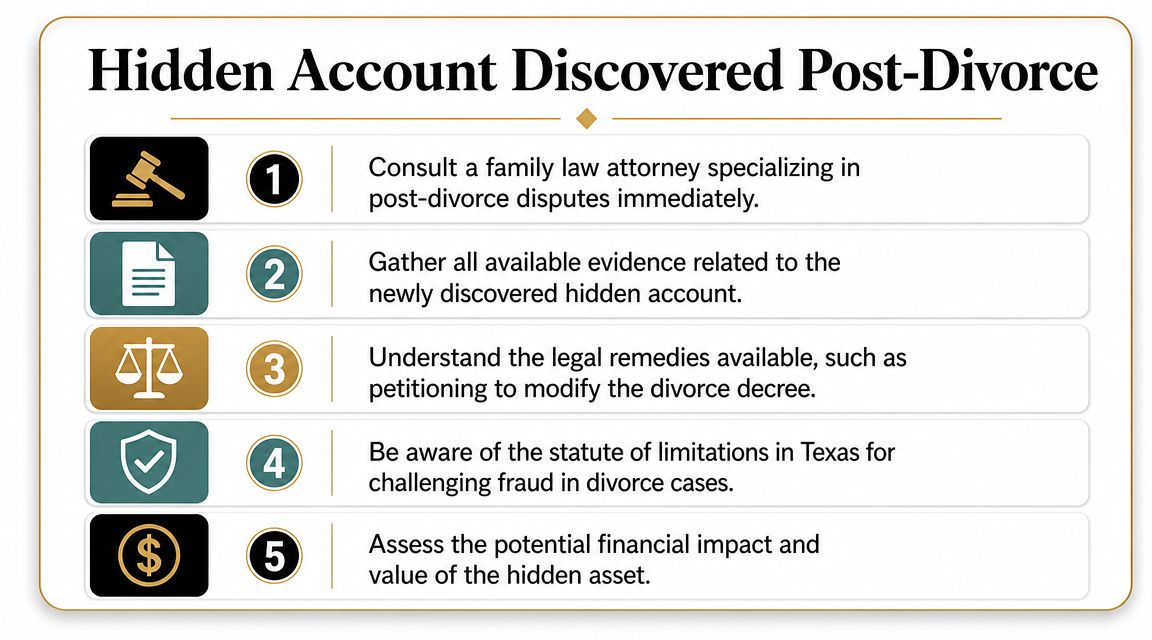
Take these steps:
- Call a family-law attorney quickly: Post-divorce property issues need fast evaluation.
- Gather proof: Save the statement, email, tax form, screenshot, or public record that exposed the account.
- Preserve context: Keep notes on when and how you discovered it, and whether it appears to have existed during the divorce.
- Avoid contacting the other party first: Let your lawyer decide strategy.
The legal question that matters
The key issue is whether the account was a previously undivided community asset. If it was left out of the divorce and should have been divided, Texas law may allow a separate post-divorce action to address it.
That doesn't mean every disappointing financial discovery reopens the whole case. Usually, the focus is on the omitted asset itself and the remedy available for that omission.
Here's a short video that helps frame the issue for Texas families:
Questions people in Atascocita often ask
A few practical questions come up again and again:
| Question | Short answer |
|---|---|
| Does the decree end everything forever? | Not always, if a community asset was omitted and later discovered |
| Do I reopen the divorce? | Sometimes the path is a new claim over the undivided asset rather than relitigating everything |
| Should I wait until I know the full balance? | No. Start with the evidence you have and let counsel evaluate next steps |
| Is proof still important after divorce? | Yes. Strong records still drive the outcome |
Don't assume a hidden account discovered after divorce is “too late to matter.” The real question is whether the law still gives you a path to divide what was left out.
Get Help from an Atascocita Attorney Who Knows Harris County Courts
Hidden bank account cases are rarely solved by one dramatic document. More often, they're solved by disciplined work. You gather the early records, identify the inconsistencies, use discovery the right way, and bring in financial analysis when the facts call for it.
That process gets easier when your lawyer knows the local court system, the filing rhythm, and how Harris County family cases move. Law on the books matters. Local procedure matters too.
Why local experience changes the result
An attorney handling divorces in Atascocita, Humble, and greater Harris County will understand the practical issues that affect these cases every day. That includes how to organize discovery efficiently, when to escalate a records dispute, and how to present a financial-concealment issue clearly rather than burying it in clutter.
If your case may head toward litigation, it helps to work with someone familiar with Harris County family court representation in Atascocita. Local experience won't replace evidence, but it often improves how effectively that evidence is developed and used.
What I recommend if you suspect hidden accounts
Keep it simple and do the next right thing.
- Start documenting today: Don't wait for certainty.
- Collect lawful records: Focus on statements, tax returns, loan files, and business records you already have access to.
- Stop informal guessing: Use facts, not arguments at the kitchen table.
- Get legal advice early: A short consultation can save months of drift.
- Act before settlement: Once you sign a bad deal, fixing it gets harder.
If your spouse is honest, proper disclosure will show it. If your spouse is hiding money, a calm and methodical approach gives you the best chance to find it and recover your share.
You don't need to solve this alone, and you don't need to accuse anyone recklessly either. You need a plan, good records, and a lawyer who understands both Texas divorce law and the local reality for families in Atascocita, Humble, and northeast Harris County.
If you're worried your spouse is hiding money, schedule a free consultation with Law Office of Bryan Fagan – Atascocita TX Lawyers. We can review your situation, explain your options under Texas law, and help you take practical next steps to protect your financial future.