You're sitting at the kitchen table with a proposed custody order, a lease for a home near Atascocita, and a school enrollment question that suddenly feels more important than anything else. You believed the neighborhood name settled the issue. Then the other parent points to a district map and argues that the home may fall within Aldine ISD rather than Humble ISD. The disagreement now affects where your child may attend school, how exchanges will work, and which parent's proposed residence appears more stable.
This is the hidden difficulty in an Atascocita home in Aldine ISD vs Humble ISD custody dispute. A postal address, subdivision name, or real estate listing may not establish the child's actual school assignment. Parents need to verify the property, understand Texas possession rules, and present evidence that connects the proposed schedule to the child's real daily life.
| Issue | Why it matters in custody court |
|---|---|
| Postal address | A mailing address may not identify the legally applicable attendance boundary. |
| District assignment | Aldine ISD and Humble ISD may have different enrollment and residency requirements. |
| Child's enrolled school | School start and dismissal times can shape exchanges and weekday possession. |
| Parent's residence | The court may examine whether the home supports stability, transportation, and continuity. |
| Custody order language | Joint managing conservatorship does not automatically create an equal possession schedule. |
| Evidence | Official maps, enrollment records, and residency documents are stronger than neighborhood assumptions. |
The Intersection of School Zones and Child Custody
A parent in Atascocita may move into a home believing the child will remain connected to a familiar Humble ISD campus. The parent may have chosen the home because it is close to relatives, activities, or the child's existing friends. Then enrollment staff identify a different district, or the other parent challenges the move by arguing that the new residence changes the child's school options and makes the current schedule harder to follow.
That discovery can feel intensely personal. You may hear the dispute framed as a technical boundary question, but you're thinking about your child's teacher, classmates, morning routine, and sense of security. The other parent may be thinking about transportation, decision-making authority, or whether the move effectively changes the parenting plan without court approval.
Texas custody courts focus on the child's best interest. The Texas State Law Library's child custody guidance explains that Texas begins with a presumption that parents should be appointed joint managing conservators, meaning they share decision-making authority. That presumption doesn't require a 50/50 possession schedule, and it doesn't answer which home should serve as the child's primary residence.
Practical rule: Treat the school boundary as evidence in the custody case, not as a side issue for the enrollment office.
The court may need to decide whether a proposed residence preserves educational continuity, supports reliable exchanges, and fits the child's needs. A parent asking to keep the child in a particular school should be prepared to prove the school's connection to the child's actual residence and enrollment eligibility. A parent opposing the move should show the concrete effect on school attendance, transportation, activities, and possession time.
The community name “Atascocita” won't resolve those questions by itself. The relevant facts include the property's location, the district's rules, the child's current enrollment, each parent's proposed schedule, and whether the arrangement can operate on ordinary school days.
Mapping Atascocita School District Boundaries
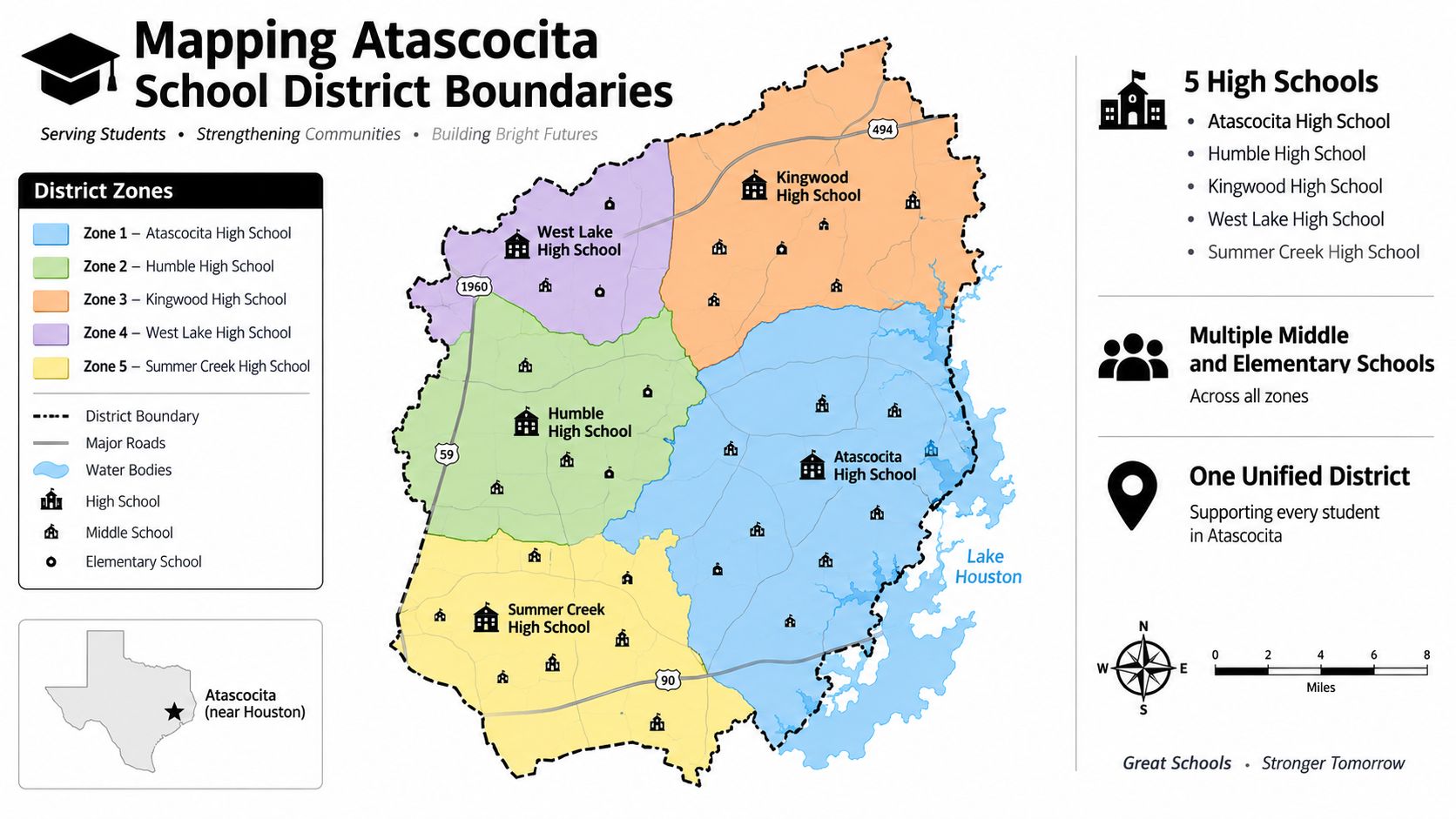
Atascocita isn't a standalone school district. Most of the community is associated with Humble ISD, but nearby western areas can fall within Aldine ISD. That makes residence-based placement especially important when a parent lives near the district line or relocates within northeast Harris County. Local district information identifies most Atascocita areas with Humble ISD while noting that some western-fringe areas can fall within Aldine ISD.
Verify the property, not the neighborhood
Use this process before making a demand in mediation or asking the court to approve a move:
Identify the complete physical address. Record the street address, city, county, and ZIP code. Don't rely only on an Atascocita subdivision name or a mailing city.
Check the official district locator. The Texas Education Agency school district locator emphasizes that district boundaries are defined through district, county, and region maps. Those boundaries can differ from postal addresses and community branding.
Confirm the attendance zone with the district. A district assignment is not necessarily the same as a broad district boundary. Ask the applicable district to verify the assigned campus for the specific property and school year.
Request written confirmation. Save emails, enrollment responses, locator results, and map screenshots. A written response is more useful in court than a parent's recollection of what a listing agent said.
Compare the proposed schedule with the campus location. Identify school start and dismissal requirements, transportation responsibilities, and the route between the child's school and each parent's home.
Real estate listings can be useful for identifying a property, but they aren't a substitute for district verification. The same ZIP code can include properties with different assignments, and a community label can obscure the actual boundary issue. A local Atascocita community guide identifies Atascocita High School as a Humble ISD campus and explains why residence and school-zone details matter in custody disputes.
If the home lies near the western fringe, treat the district question as urgent. Don't wait until the first day of school, a registration deadline, or a contested hearing to discover that the proposed residence doesn't support the school placement you expected.
How Texas Courts Evaluate School Zones in Custody
The judge's central question is not which parent feels more strongly about Humble ISD or Aldine ISD. It's whether the proposed arrangement serves the child's best interest. Texas law makes the child's best interest the primary consideration in custody, visitation, and support decisions. The Texas Supreme Court's Holley factors include the child's needs, safety, parental abilities, home stability, and the parents' acts or omissions, as summarized by TexasLawHelp's explanation of the best-interest standard.
Stability must be practical
School continuity can support stability, but continuity alone won't decide the case. A parent may argue that staying in the current school protects the child's peer network and established routine. The other parent may respond that the proposed home creates an exhausting commute, disrupts weekday possession, or places school transportation on one parent without a workable plan.
The court can examine:
- The child's needs: Does the proposed school arrangement support academic, medical, emotional, and extracurricular needs?
- Safety and supervision: Can each parent reliably supervise the child before and after school?
- Parental abilities: Can the parents communicate about enrollment, transportation, homework, and school decisions?
- Home stability: Is the proposed residence a genuine, suitable home where the child will live?
- Acts and omissions: Has either parent enrolled the child without authority, misrepresented an address, or withheld school information?
A court may view a school-zone argument skeptically if a parent treats enrollment as a way to gain an advantage. Accurate records and a child-focused proposal carry more weight than accusations unsupported by documents.
Joint conservatorship is not equal time
Texas generally presumes joint managing conservatorship, but that designation doesn't automatically produce an equal possession schedule. The court can assign different rights and duties, establish a primary residence, impose a geographic restriction, and order a possession schedule that reflects school demands.
For a parent asking to modify an existing order, the relevant issue may be a change in the child's school needs or the practical effect of a move. A focused resource on modifying custody due to a child's school needs in Texas addresses why school-related changes should be supported with specific facts rather than broad claims.
A Child Custody Lawyer in Atascocita, TX may handle custody and conservatorship representation for Atascocita families. The important point is strategic: your lawyer should connect the district map to the child's actual schedule, not argue only that one district is preferable.
A school boundary matters most when you can show exactly how it affects the child's mornings, transportation, attendance, relationships, and time with each parent.
Prepare a schedule that a judge can understand quickly. Show where the child wakes up, who handles school transportation, how exchanges occur, and whether the plan preserves meaningful contact without turning school days into travel days.
Aldine ISD vs Humble ISD Practical Implications
The label on the address is not enough. A Humble ISD residence may support continuity with a Humble ISD campus, but only if the child is eligible to stay there and the home is available for school use. An Aldine ISD residence on the western fringe can be workable too, but it often changes the enrollment question and the possession schedule at the same time.
Humble ISD is a large educational system. In 2026, it enrolled 47,856 students across 51 campuses, an increase of 18.0% from 2016, and Atascocita High School enrolled 3,595 students. The district's student body was 39.5% Hispanic and 50.1% economically disadvantaged, while Atascocita High School was 45.7% economically disadvantaged, according to district data published by The Texas Tribune. Those figures show why a boundary dispute affects many families at once. It is not just a map issue, it is a daily-school issue.
| Evaluation Criteria | Humble ISD Residence | Aldine ISD Residence (Western Fringe) |
|---|---|---|
| Residence verification | Confirm the property's Humble ISD assignment and assigned campus. | Confirm that the specific property falls within Aldine ISD rather than relying on a western-fringe assumption. |
| School continuity | May support an argument for remaining connected to an existing Humble ISD campus when enrollment rules permit. | May require review of whether the child can continue at a Humble ISD school or must follow local assignment rules. |
| Possession schedule | A schedule built around the enrolled Humble ISD school may be easier if the residence and campus are geographically compatible. | The schedule may need adjusted exchanges, transportation responsibilities, or a different school-year structure. |
| Evidence needed | District confirmation, enrollment records, residency documents, and the proposed school-year calendar. | Boundary maps, written district responses, proof of the physical residence, and a detailed transportation plan. |
| Court concern | Whether the proposed home genuinely supports stability and shared parenting. | Whether the move creates avoidable school disruption or makes regular possession unrealistic. |
Texas parenting-time rules tie possession to the child's enrolled school, and if the child is not enrolled, the statute looks to the public school district where the child primarily resides. The Texas Attorney General explains that in its overview of Texas parenting-time schedules. That means the district choice reaches into holiday periods, early-release days, and weekday exchanges. Confirm in writing which district calendar controls before you lock in a handoff plan.
Start with transportation, because judges do. Write down who drives, where exchanges happen, and how the child gets to school after an overnight stay. For a western-fringe Aldine ISD residence, map the morning drive from the 77338 area to the assigned campus and state plainly who absorbs that time on school days. If the schedule shifts the burden onto one parent, say so and show the court the practical cost.
Parents in Atascocita and Humble should also review the local filing and venue issues discussed in Atascocita versus Humble divorce court. School-district boundaries and court jurisdiction are different questions, and you should not blur them.
A school-boundary dispute is won with concrete proof. Use the district map, the actual campus assignment, the child's enrollment status, the possession calendar, and a transportation plan that a judge can follow without guesswork.
Real-World Scenarios for Atascocita Parents
Consider a parent who moves from one Atascocita home to a property near the western edge of the community. The parent assumes the child can remain in the same Humble ISD school because the family still identifies with Atascocita. The district, however, reviews the physical residence and its assignment rules. The other parent asks the court to prevent the move from changing the child's school placement.
The parent's strongest response isn't merely, “We're still in Atascocita.” It's a documented explanation of the property's district, the child's enrollment status, the available transportation, and the effect on the existing order. If the child can remain enrolled under applicable rules, that should be confirmed in writing. If the child cannot, the parent needs a realistic alternative that protects school attendance and meaningful possession.
A proposed apartment near a boundary
A parent may choose an apartment near the 77338 or 77346 area because it offers a manageable housing option or puts the parent closer to work. The postal information may look familiar, but nearby properties can have different district assignments. The parent should verify the exact property before presenting it as the child's school-year residence.
The court may ask whether the move changes the child's campus, who handles school transportation, and whether a weekday possession period still works. A parent who brings a district confirmation and a complete exchange plan is in a stronger position than one who relies on a listing or verbal assumption.
A parent wants to preserve the current campus
Another parent may argue that the child must stay at a particular Humble ISD campus because the child has friends, activities, and academic routines there. That concern can matter under the best-interest analysis, but it doesn't override district residency and local assignment rules. TEA guidance on public-school enrollment and parental rights states that a child generally has the right to attend the public school district where the child lives when the child is between 5 and 21 years old on September 1 of the school year. The guidance also recognizes circumstances in which a child may attend a district while not living there full-time when a parent is a legal guardian or conservator.
That rule doesn't guarantee a parent can select any campus or bypass district procedures. It means the custody order, conservatorship status, residence, and enrollment rules must be analyzed together.
What the schedule reveals
The parent who proposes a schedule that works around the enrolled school has a clearer custody argument. The parent who demands equal time without explaining school transportation leaves the court with an unresolved practical problem. Parenting time should preserve the child's relationship with both parents without making school attendance unreliable.
Gathering Evidence for Your Boundary Dispute
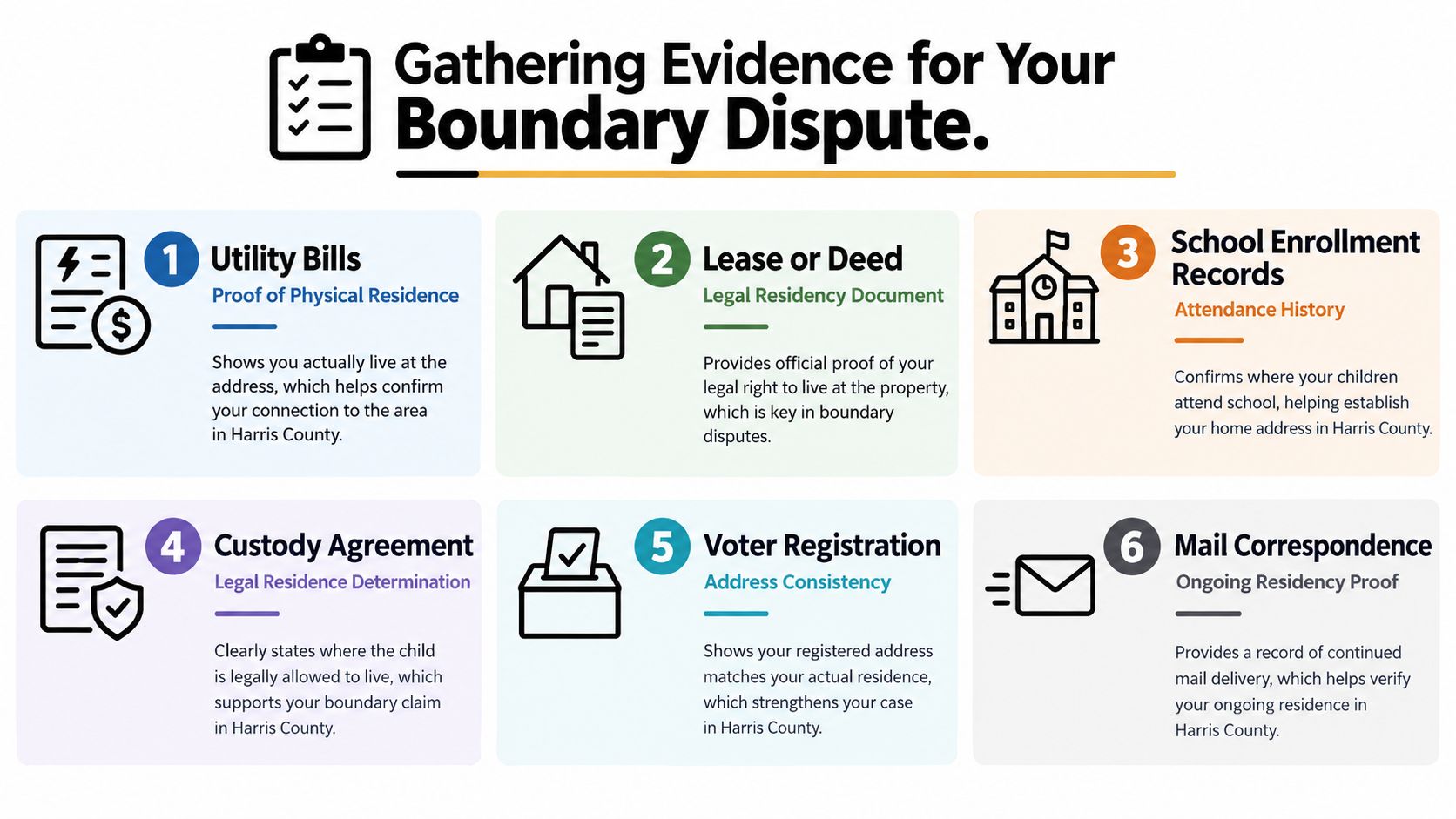
A boundary dispute becomes manageable when you replace assumptions with documents. Start with the property, then connect it to enrollment, the custody order, and the proposed schedule. The TEA district locator makes clear that district, county, and regional maps can differ from postal addresses and community branding.
Build the file in a logical order
Secure the lease or deed. This identifies the claimed legal residence and the period of occupancy. Keep the complete document, not only a signature page.
Collect utility and service records. Bills can help show physical residence, especially when the service dates match the claimed move. They should support, not replace, stronger residency documents.
Request school records. Obtain enrollment confirmation, attendance history, campus information, and communications about eligibility. These records can show continuity or identify a change that needs to be addressed.
Include the current custody order. The order may define the child's primary residence, geographic limits, decision-making rights, and possession schedule. Read the school and relocation language carefully.
Add consistent address records. Voter registration and mail correspondence may help show that the parent uses the address consistently. A single document rarely proves the entire residency question.
Prepare the official map response. Save the locator result and any written confirmation from Aldine ISD or Humble ISD. Mark the property and assigned campus clearly so the judge can understand the issue without guessing.
A well-organized packet should also include a proposed school-week schedule. Show morning drop-off, afternoon pickup, extracurricular transportation, homework time, and the location of exchanges. If the child will change schools, explain the timing, reason, and transition plan instead of presenting the change as an unavoidable conclusion.
For a broader checklist on documenting a custody dispute, review evidence needed for a custody case in Harris County. Keep original files, save district communications in their original format, and avoid editing screenshots in a way that could make the source or date unclear.
Bring the documents to your attorney before mediation or a hearing. Your lawyer can identify gaps, request additional records, and help present the evidence without turning the dispute into a personal argument about which community is more desirable.
Protecting Your Child's Best Interests in Harris County
The strongest custody position isn't always the parent who names the more familiar district. It's the parent who can show that the proposed residence, school placement, and possession schedule work together. In Harris County, that means verifying the property, confirming the district's position, and explaining how the plan protects the child's education while preserving a healthy relationship with both parents.
Don't treat a boundary dispute as a last-minute enrollment problem. If the other parent is moving, changing residences, challenging school placement, or seeking a new geographic restriction, gather the records early. An attorney can help separate the questions that belong to the school district from those that belong to the family court, then build one coherent strategy around the child's best interest.
You also need to protect the tone of the case. Keep communications focused on dates, addresses, transportation, enrollment, and the child's routine. Avoid threats, unilateral school changes, or unsupported claims that the other parent is trying to interfere. A Divorce Lawyer in Atascocita, TX may provide divorce representation for clients in Atascocita and Harris County, including custody issues that arise alongside the divorce.
The Law Office of Bryan Fagan, Atascocita TX Lawyers, represents families and individuals in Atascocita, Humble, and Harris County in family law matters including divorce, custody, support, and related legal planning. The firm's local focus makes it an option for parents who want to review district maps, residency evidence, and a proposed possession schedule with counsel familiar with the community.
Schedule a free consultation with Law Office of Bryan Fagan – Atascocita TX Lawyers to review your Atascocita, Aldine ISD, or Humble ISD custody dispute. Bring your custody order, property documents, school communications, and proposed schedule so the office can help you identify the strongest evidence and next steps.