
You're in mediation, your spouse wants to keep the Atascocita home, and everyone is treating the septic system and private well as if they're just maintenance items. That's a mistake. On a half-acre property off FM 1960, a working septic system and a 280-foot water well can affect the home's marketability, financing, inspection timeline, access rights, and the amount one spouse must pay the other.
Texas property division focuses on value, ownership, and fairness. If the person keeping the home also inherits a failing drainfield, uncertain well yield, missing permits, or an informal right to use a neighbor's land, the buyout calculation must account for that liability. A careful septic system and water well valuation in an Atascocita divorce starts with records and independent analysis, not assumptions.
Why Septic Systems and Water Wells Matter in an Atascocita Divorce
A private utility system is part of the property's practical function. Buyers need dependable water. Lenders need acceptable documentation. Inspectors need to know whether the septic system is operating, permitted, accessible, and likely to remain usable. Federal appraisal guidance treats private wells and septic facilities as value-relevant site features when public utilities aren't available, and the systems must be available and usable for the property to satisfy applicable appraisal expectations. See the Texas community-property guidance on property division for the broader legal context.
Atascocita's rural-fringe neighborhoods, lake-area properties, and older estate tracts can rely on private infrastructure even when nearby subdivisions use public water and sewer. That creates a practical difference between a home that looks comparable in a listing and a home that will pass inspection and underwriting.

Start with the person keeping the house
The spouse who keeps the home receives its equity, but also assumes future repair, compliance, and access risk. That risk belongs in the settlement conversation before the parties agree on a buyout figure.
Review the utility records before deciding whether the home should be retained, sold, or traded against other assets. The Texas guidance on who gets the house in a divorce can help frame the larger housing decision, but the septic and well evidence still needs separate attention.
FHA-related guidance commonly uses concrete benchmarks. A domestic well should be at least 50 feet from a septic tank, 100 feet from the drainfield, and 10 feet from a property line, and an existing well may need to demonstrate 3 to 5 gallons per minute in a pump test. Those figures come from the appraisal and lending guidance summarized in the Texas property-division reference above. A defect or failed test can affect saleability, repair negotiations, and the value assigned to the marital residence.
Practical rule: Don't negotiate the house buyout until you know whether the private utilities are functioning, documented, legally accessible, and financeable.
Texas Property Rules That Shape Septic and Well Valuation
Start with Texas's community-property framework. Property acquired during marriage is community property under Texas law, and the court divides the community estate in divorce. Texas also applies the inception-of-title rule, which usually determines a property's character when the right to acquire it first arises. Property owned before marriage may remain separate, even if its value increases during the marriage. The community estate may still have a reimbursement claim if marital money or labor contributed to that increase. This Texas explanation of appreciation of separate property addresses that distinction.
The same analysis reaches private utilities. A well drilled before marriage may be connected to separate property, while a pump, pressure tank, drainfield, aerobic treatment unit, or major repair paid from community funds may support a community interest or reimbursement claim. Payment records matter. Identify who paid, when the work occurred, what was repaired, and whether the expense preserved existing value or added new value.
Texas Family Code § 3.001 treats property acquired by gift, devise, or descent as separate property. Community property and community debt are divided in divorce. Separate property and separate debt are not divided as community assets. The Texas discussion of inherited assets in high-net-worth divorce provides statutory context for inherited property and later marital contributions.
| Scenario | Source of Funds | Likely Classification | Valuation Impact |
|---|---|---|---|
| Well and septic installed before marriage | Separate funds | Often tied to separate property | Establish installation records and current contributory value |
| New pump or drainfield during marriage | Community earnings or joint account | Community contribution or reimbursement issue | Credit may be needed for proven value or payment |
| Repair after separation | One spouse's post-separation funds | Fact-specific claim for reimbursement or offset | Preserve invoices and proof of payment |
| Inherited land with later marital improvements | Inheritance plus community labor or money | Separate land with possible community claim | Separate land value from improvement contribution |
For an Atascocita rural-fringe property, classify the land, equipment, access rights, and marital payments separately. A Divorce Lawyer in Atascocita, TX can assess the deed, closing records, bank statements, permits, invoices, and proof of payment. Those documents show whether septic and well value belongs to separate ownership, marital investment, or a reimbursement claim. They also identify property-rights problems that can reduce marketability even when the equipment still operates.
Building the Septic and Well Evidence File for Your Divorce
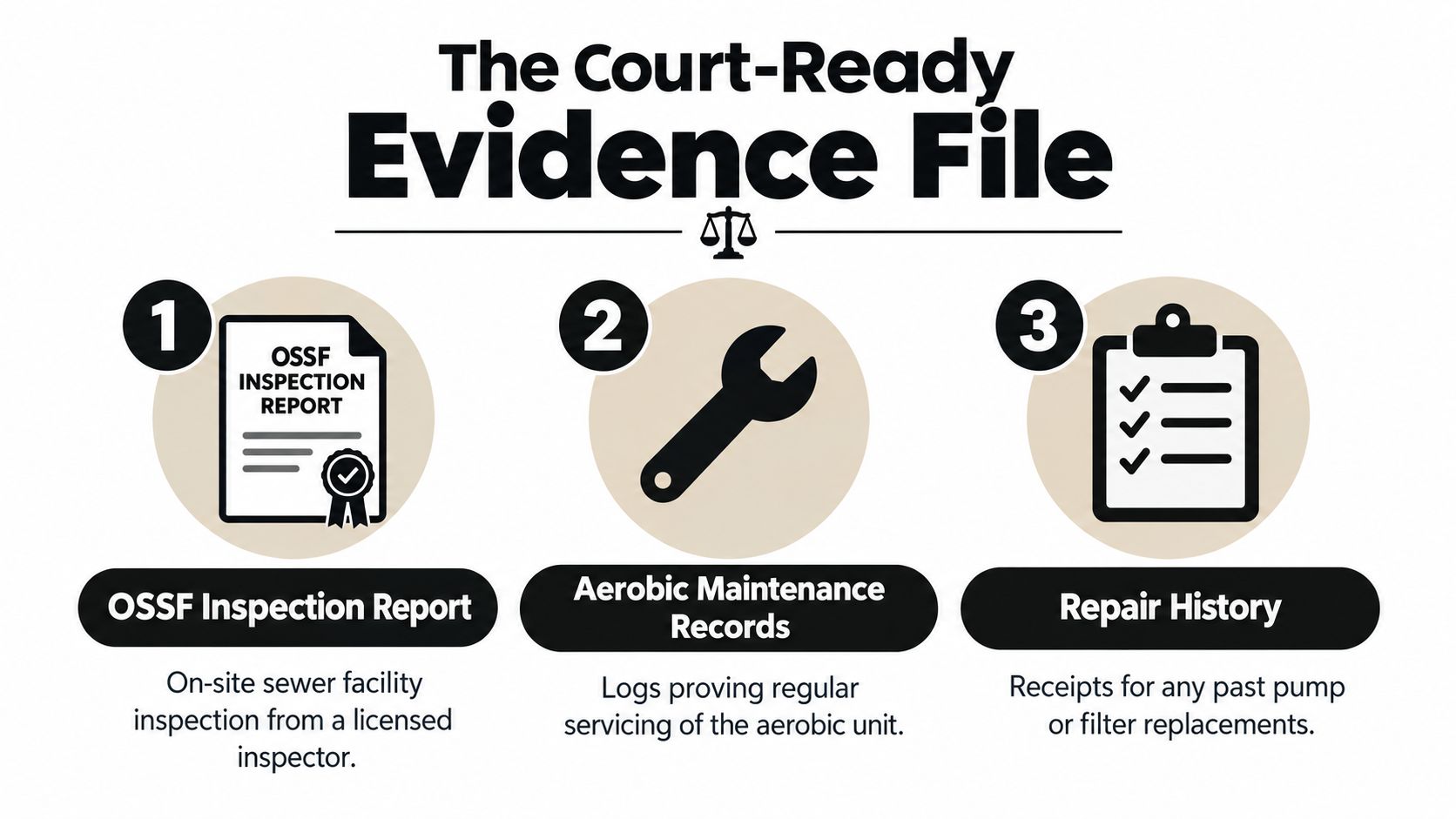
Bring your attorney and appraiser a file they can verify without chasing missing documents. Start with the septic side. Request the On-Site Sewage Facility inspection report, aerobic maintenance records, system design, service logs, and any Harris County or Texas Commission on Environmental Quality permit materials. If the system is conventional rather than aerobic, identify the tank, drainfield, installation date, and known repair history.
The well file should include the completion report, driller's log, casing information, depth, pump details, and the latest water-quality testing. Testing may address bacteria, nitrates, and arsenic, depending on the property's circumstances and the professional's recommendation. Add pumping receipts, repair invoices, pressure-tank records, and water-treatment documentation.
Preserve property rights, not just equipment records
A private system may serve the home from land that isn't included in the deed. Look for a recorded plat, utility easement, well-sharing agreement, access agreement, and written responsibilities for maintenance and replacement. An informal septic arrangement on adjoining land can create a marketability problem when there's no recorded easement or permanent right of access, as illustrated by the Alaska Supreme Court property-access decision.
Include warranty documents, lender inspection letters, prior appraisal addenda, photographs of the wellhead and tank lids, and any notice of violation. Organize the material by date. A clean file lets an appraiser distinguish normal aging from a correctable defect and prevents either spouse from exaggerating uncertainty during settlement talks.
Use the financial preparation guidance for divorce to organize the utility records with the broader financial disclosures. Don't alter, discard, or selectively provide documents. Missing records can become a credibility problem when the other spouse or a lender finds them later.
How Appraisers Value Septic Systems and Water Wells in Harris County
An appraiser usually starts by asking what the private utilities contribute to the property as a whole. Replacement cost provides a useful ceiling or reference point, but it doesn't automatically equal market value. A new system may cost more than buyers will pay for the feature, while a well-maintained existing system may provide dependable utility without adding the full cost of replacement.
Paired-sales analysis is often more persuasive. The appraiser compares properties with similar location, acreage, improvements, and buyer appeal, then examines whether private water or wastewater systems explain a price difference. Fannie Mae requires the appraisal to reflect the entire site and address market resistance tied to well, septic, or water issues. Its site-section appraisal guidance also supports analyzing how those conditions affect value and marketability.
The income approach is less common for a primary residence, but it can be relevant to a rental tract or property with income-producing use. Even then, the appraiser must connect the utility condition to the property's actual income potential rather than apply a flat deduction.
| Method | What It Measures | When to Use in Atascocita |
|---|---|---|
| Replacement cost | Cost to install or replace the improvement | When records are missing or a system needs repair analysis |
| Paired sales | Market-supported contribution compared with similar sales | When nearby properties provide meaningful utility comparisons |
| Income approach | Effect on income-producing use | For rental or tract property, not usually a standard homestead |
FHA-related guidance can make well location, separation distances, usability, and yield important to financing. HUD guidance also directs appraisers toward further inspection when septic concerns appear and toward considering connection costs where public utilities are relevant. The appraiser identifies conditions and explains market effects, but the underwriter decides whether a lender will accept the property under that loan program.
Don't rely on one comparable. Rural-fringe properties can differ sharply in water source, access, permits, and system condition. In a contested divorce, request an appraisal that separately discusses the house, land, well, septic system, and known repair or access issues.
A Practical Evidence Checklist and When to Hire an Expert
Put the following material in a binder or clearly labeled digital folder:
- Ownership records: Warranty deed, legal description, deed restrictions, and closing documents.
- Access proof: Recorded well-share agreement, septic easement, utility easement, and any maintenance obligations.
- Well history: Original well log, completion report, pump information, service records, and water analysis.
- Septic documentation: Harris County permit materials, system design, OSSF inspection, aerobic maintenance records, and pumping receipts.
- Condition evidence: Photographs of the wellhead, tank, drainfield area, control panel, filters, and visible repairs.
- Financial proof: Invoices, cancelled checks, bank statements, warranty records, and lender inspection letters.
Use a simple trigger test. Answer yes or no:
- Is the well shared, uncertified, or pre-1980?
- Is the well yield unknown or has the pump performed inconsistently?
- Is the septic system aerobic?
- Has the septic system gone without a current inspection?
- Are permits, easements, or access rights missing?
- Do the spouses disagree materially about the buyout value?
If the answer is yes to the first two, hire a licensed well driller or pump installer for a flow and integrity test. If the septic system is aerobic, hasn't been inspected in three years, or is older than the home's roof, hire a Texas-licensed OSSF inspector. If the disputed buyout difference exceeds 15% to 20%, obtain a real estate appraisal from someone familiar with rural-fringe comparables. These decision thresholds are practical screening rules, not automatic legal requirements.
Don't ask an expert to produce a number without giving the expert the records. A technical opinion is only as useful as the system history, access documents, and payment evidence behind it.
Repair, Replacement, and Access Costs That Change the Buyout Number
Texas land guidance places well, septic, and internet installation on raw land at about $15,000 to $50,000 or more, while another Texas guide estimates conventional septic systems at $10,000 to $15,000 and aerobic systems at $15,000 to $20,000. Those figures come from Texas rural land infrastructure cost guidance, and they're planning references, not a substitute for a site-specific estimate.
A divorce settlement should identify who bears each documented cost. The spouse keeping the home might receive a credit for a necessary repair. The parties might reduce the cash buyout, offset the expense against another marital debt, or require a seller-paid repair if the home will be listed. A vague promise to “handle it later” leaves the risk with the person who keeps the property.
| Item | Typical Reference Point | Negotiation Effect |
|---|---|---|
| Raw-land well, septic, and internet infrastructure | About $15,000 to $50,000 or more | Shows why undeveloped utility value can be substantial |
| Conventional septic system | About $10,000 to $15,000 | Supports a repair or replacement credit when condition is documented |
| Aerobic septic system | About $15,000 to $20,000 | May justify an inspection condition and targeted offset |
| Well or access problem | Site-specific | Can reduce marketability beyond equipment cost |
The legal issue isn't merely what a contractor would charge. The question is how a reasonable buyer, lender, and appraiser would treat the condition. A functioning system may contribute value, while an end-of-life or noncompliant system can become a liability-adjusted asset. Research from Miami-Dade County found a septic system associated with about a 3% premium after controlling for property characteristics and time effects, showing why a flat deduction is unreliable. The market study on septic-system contributory value supports using matched sales, condition, useful life, and replacement risk.
A simple worked example can show the mechanics without pretending every case follows the same result. If an appraisal identifies a $14,000 necessary septic replacement, the spouses can negotiate a credit tied to that documented cost. In a community-property settlement, a half-share approach would produce a $7,000 adjustment, but the final result may change if one spouse caused the damage, paid the bill after separation, receives the home, or accepts the repair obligation.
Access can matter more than the tank itself. A missing recorded easement, shared well, neighbor permission, or difficult route to the tank lids can cause a buyer to demand protection before closing. Treat those rights as part of title and marketability, not as afterthoughts.
Key Takeaways and Next Steps for Atascocita Families
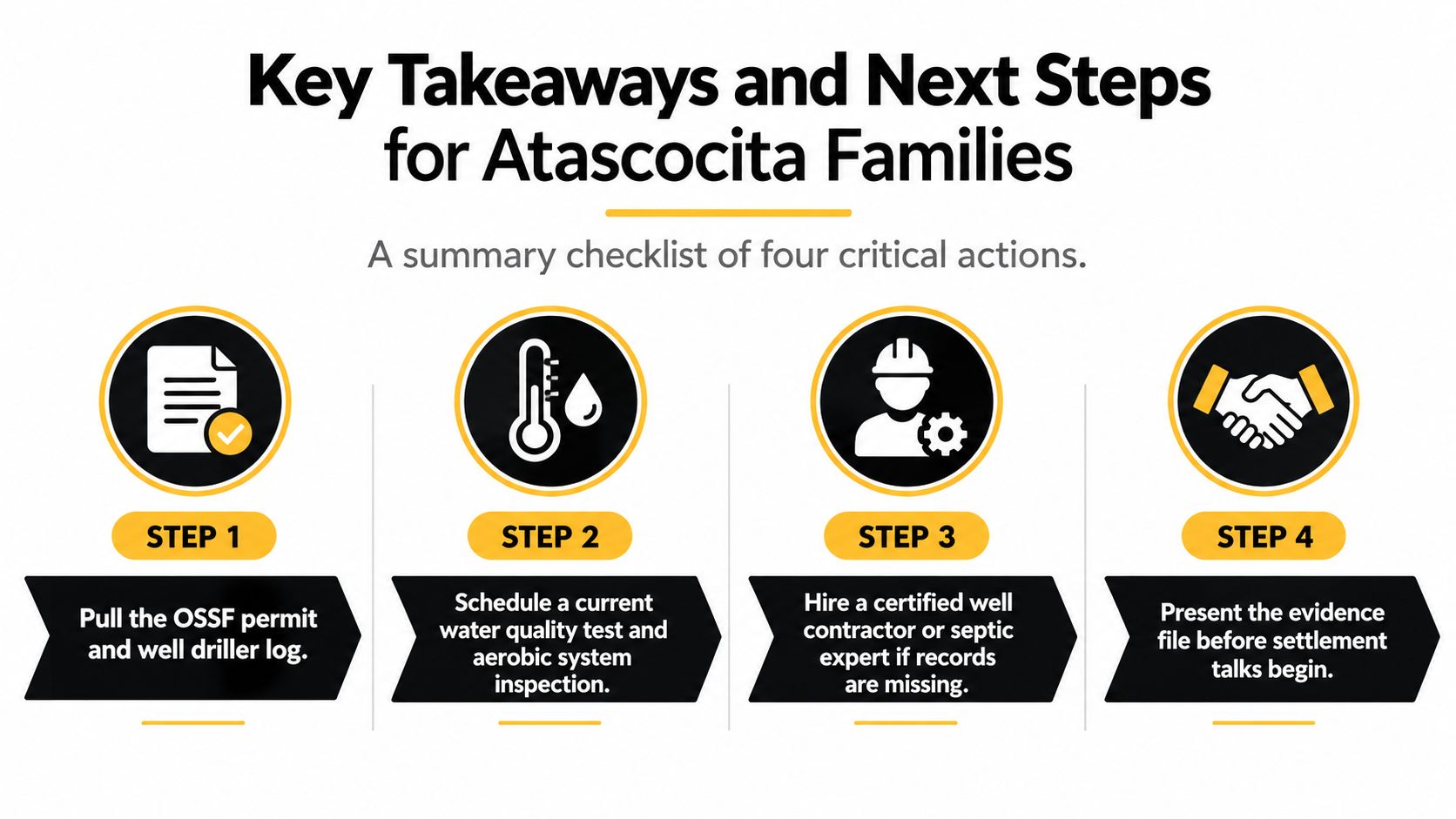
Before settlement talks, take four actions:
- Pull the OSSF permit and well driller's log. Confirm the system type, installation history, ownership, and any recorded restrictions.
- Schedule current testing. Obtain appropriate water-quality testing and an inspection of the septic or aerobic system.
- Separate the values. Ask for an appraisal that addresses the structure, land, private well, septic system, access, and documented repair conditions.
- Choose the settlement path. Compare keeping the home, selling it, or trading utility-related credits against other community assets and debts.
A property with private utilities isn't automatically worth less. In markets where septic and wells are common, buyers may treat functional systems as ordinary features. In other settings, uncertainty about yield, contamination, replacement, financing, or legal access can reduce confidence and delay a transaction. The correct adjustment must follow the evidence and local market behavior, not a blanket percentage.
Texas appraisal and transportation guidance treats domestic wells as improvements and focuses attention on condition, utility, and valuation. The Texas Department of Transportation guidance on water-well valuation is useful background, but a divorce settlement still requires an analysis of the specific home, records, ownership history, and marital funds.
Gather the evidence checklist, give it to counsel and the appraiser, and address missing permits or access rights before mediation. The sooner you identify a repair credit, reimbursement issue, or marketability defect, the less likely you are to negotiate from an inflated home value or accept a buyout that leaves you with an undisclosed liability.
The Law Office of Bryan Fagan – Atascocita TX Lawyers helps residents of Atascocita, Humble, and Harris County address divorce, property division, and related family-law questions. Schedule a free consultation at the Atascocita office to review your septic and well records, evaluate buyout credits, and set a practical timeline before your next mediation.