You've filed a divorce, custody, eviction, contract, or other civil case, and your process server has the respondent's Atascocita or Humble address. Then the first attempt fails because the property is outside city limits, the address belongs to a rural route, or the papers were sent to the wrong constable precinct. That problem is common in northeast Harris County, where a mailing address can suggest one city while the physical property sits in unincorporated territory.
An unincorporated address for service of process in Harris County isn't automatically defective. It does require more careful routing. You need the correct defendant, a serviceable physical address, the constable with jurisdiction over that location, and a lawful fallback if personal service doesn't work. The practical distinction between municipal boundaries and county precinct operations is also addressed in this Atascocita guide to the Houston ETJ and legal filings.
When an Atascocita Address Stops Behaving Like a City Address
A process server arrives at what appears to be a Houston-area street address near Atascocita. The road is paved, homes are occupied, and the respondent's name is connected to the property. But the location sits outside an incorporated city, behind a gate, or within a county area handled by a particular constable precinct. The server leaves without completing service, and the citation returns without the proof you need.
Harris County's city boundaries are a patchwork. A Humble mailing address, a Huffman road, or a Crosby lane may identify the general community without proving that the property lies inside the City of Houston or another municipality. A ZIP code is not a substitute for confirming the physical jurisdiction.
Why the wrong office matters
For civil process in Harris County, the sheriff's office generally isn't the routing solution for ordinary service requests. The constables handle civil-process work through precinct operations, and the correct precinct depends on the address where service is supposed to occur. Send a citation to the wrong precinct, and the papers may sit unassigned or be returned without a meaningful attempt.
The fix has four parts:
- Confirm whether the physical location is unincorporated.
- Match that location to the correct constable precinct.
- Follow the applicable Texas service rule, including the requirements governing citation and personal service.
- Prepare for substituted service or another authorized method before the first attempt fails.
The practical lesson
Don't treat “Atascocita,” “Humble,” or “unincorporated Harris County” as the service address. Those labels describe a community or general area. The server needs the actual street address, apartment or unit number, legal defendant's name, access information, and correct precinct.
That distinction matters in family cases, civil disputes, and enforcement proceedings alike. A parent serving custody papers, a spouse serving a divorce petition, or a business owner serving a contract lawsuit can lose time by assuming that a familiar mailing address automatically tells the clerk or constable where to send the process.
What an Unincorporated Address Really Means in Texas
An unincorporated area is a physical area outside an incorporated city. It isn't the same thing as an unincorporated association, and confusing those terms creates service problems.
The physical location determines which Harris County constable operation may handle delivery. The legal status of the defendant determines who must receive the papers. An individual may require personal service. A business association may require service on a managing agent or another legally authorized representative. A filing entity may have a registered agent and registered office. Those are separate questions, and answering only one of them isn't enough.
Separate the land from the legal entity
For a Texas filing entity, the registered office must be a physical Texas street address where the registered agent can be personally served. The entity must continuously maintain a registered agent and registered office, and the address cannot be only a mailbox service or telephone-answering service, according to the Texas Secretary of State's registered-office instructions.
That rule applies even when the company's principal operations are somewhere else. A business located in an unincorporated part of Harris County may use that location as its registered office only if the registered agent can be reached there for personal delivery during normal business hours.
An unincorporated association is different. Its service route depends on the organization's governing documents, managing agent, and the particular claim. Don't assume that an entity's trade name identifies the correct recipient.
Why this distinction prevents returned citations
A citation can fail because the server went to the wrong location, because the defendant was misidentified, or because the person accepting papers had no authority to do so. The unincorporated label alone proves none of those facts.
For parents handling child support matters, a Child Support Attorney in Atascocita may address establishing, modifying, and enforcing child support in Harris County, but the service question still requires the correct party and address.
The safest approach is to verify the property and the defendant independently. Don't use the community name as a legal conclusion, and don't use an entity label as a substitute for identifying the person authorized to receive service.
Confirming the Right Defendant and the Right Service Address
Before any papers leave the clerk's office, run a verification process. Many service failures begin because a plaintiff relies on an old address, a DBA, or an employee's informal statement instead of building a reliable record.
Start with the legal name
Use the exact legal name shown in the contract, deed, formation document, or pleading caption. If the defendant uses a DBA, include it where appropriate, but don't serve only the trade name when the legal defendant is a person, corporation, limited liability company, partnership, or association.
For an individual, confirm the full name and any identifying information that helps the server distinguish that person from another occupant. For an organization, determine whether the defendant is the organization itself, a registered agent, a managing agent, or an individual owner.
Verify the location and precinct
Use the Harris County Appraisal District parcel lookup to compare the street address and property description. Check Texas Secretary of State records through the SOSSearch portal when the defendant is a filing entity, then compare the registered-office information with the location you intend to use. Finally, confirm the address against the Harris County constable precinct map and the receiving office's civil-process requirements.
The point isn't to collect paperwork for its own sake. It's to answer one practical question: which authorized server should receive this citation for this exact address?
Build the diligent-effort file
Confirm the physical address through reliable records such as a driver's license record available to you lawfully, a deed of trust, a recent utility record, or other admissible documentation. Record the source, the date you checked it, and any information that could help a server locate the premises.
Your file should include:
- The legal defendant: Exact name, aliases, DBA information, and entity status.
- The service location: Street address, apartment or unit number, county, and any rural-route details.
- Access information: Gate codes, building instructions, landmarks, vehicle descriptions, or known work schedules.
- The service route: Personal service on an individual, service on an authorized agent, or another legally permitted route.
- The process record: Clerk-issued citation, petition, instructions, fee receipt, and return tracking.
Texas procedure requires the clerk to issue the citation, and service may be performed by a sheriff, constable, another authorized person, or a court-authorized adult who isn't a party or interested person. The Texas Rules of Civil Procedure control the method, so don't let a mailing address or “unincorporated” label decide the recipient.
Routing Service Through the Harris County Constable
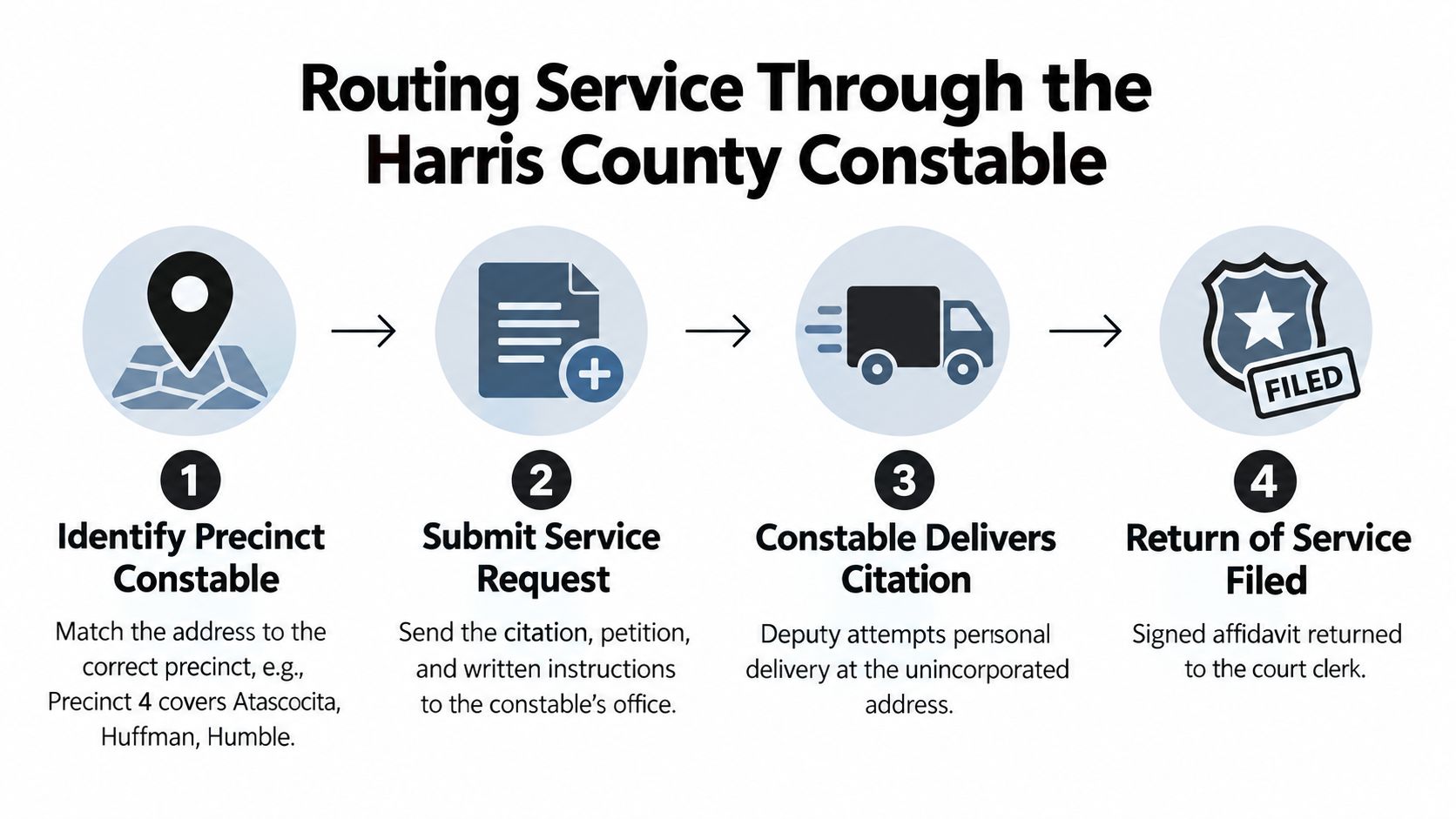
Once the defendant and address are verified, route the papers through the constable operation that handles the physical location. For Atascocita, Huffman, and nearby northeast Harris County addresses, confirm the applicable precinct before submitting anything. Precinct operations can have separate offices, delivery procedures, and acceptance requirements.
A practical example is the guide to which constable precinct serves Atascocita for service of process. Use current county information and confirm the office directly before you send a time-sensitive packet.
Follow the request-and-deliver sequence
- Obtain the citation from the clerk. The clerk must issue the citation. A petition or lawsuit by itself isn't a substitute for a properly issued citation when citation is required.
- Prepare written service instructions. Include the defendant's exact legal name, complete physical address, unit number, known access details, and any information that helps the deputy locate the person.
- Submit the packet to the civil-process division. Confirm whether the office accepts delivery in person, by mail, or through another designated method. Include the required process documents, copies, envelope, and fee.
- Track the attempt and return. Keep the submission receipt, assignment information, attempted-service notes, and eventual return of service. A signed return is the document that shows the court what happened.
- Respond properly if attempts fail. Texas procedure requires a diligent effort within the applicable period after filing, but that effort isn't a promise that service will succeed within that period. The rule and the court's requirements control what happens next.
Rural roads and large subdivisions create practical problems. A GPS pin may take a deputy to the wrong entrance, while a street address may not identify the correct driveway or building. Provide written directions, nearby landmarks, gate instructions, and alternate location information when you have it.
Separate issuance from assignment
The clerk's issuance of process, the constable's receipt and assignment, the actual attempt, and the filing of the return are separate events. A citation can be issued without being immediately delivered, and a delivery attempt can occur without a completed return reaching the court.
Don't assume that paying a rush fee eliminates those administrative steps. Call the civil-process division, confirm receipt, and monitor the docket or return rather than relying on an informal promise that someone is “handling it.”
Service Fees Timing and What a Standard Fee Actually Buys You
A service fee pays for an authorized attempt. It doesn't buy a guaranteed result, and it doesn't turn an incomplete address into a serviceable one.
Harris County's published fee materials identify an $85 standard service fee and an additional $85 expedited-service fee, with fees applying for each party or process. The same county information explains that extra hourly charges may apply after two hours, so a difficult rural location or complicated access situation can cost more than the basic filing amount. See the Harris County Constable fee information before submitting the packet.
| Service Item | Fee | What It Covers |
|---|---|---|
| Standard service | $85 | The standard constable service charge for a party or process |
| Expedited service | Additional $85 | The expedited-service charge added to the standard fee |
| Extra time | May apply after two hours | Additional time-based charges identified in county fee materials |
| Multiple defendants | Applies for each party or process | Separate service processing for each person or process |
The table tells you the published charges, not the likely outcome. If you're serving two defendants, expect the fee structure to apply separately to each party or process. If the first attempt fails because the defendant moved, the address lacks access information, or the wrong precinct received the papers, you may need a new submission and additional payment.
Timing pressure is procedural, not just financial
The timeline includes clerk issuance, delivery to the constable, assignment, attempted service, and preparation of the return. Those stages don't necessarily happen on the same day, and the expedited charge doesn't guarantee immediate personal delivery.
Your answer deadline matters as well. A defendant's response date may run from valid service, but a defective attempt can create disputes and delay the case. Track the citation, ask the clerk or constable about the return, and don't wait until the deadline is close to discover that the papers were routed to the wrong office.
The constable, not the county sheriff, is the office you should confirm for ordinary civil-process routing in the relevant precinct. The address determines the precinct, and the precinct determines where the service packet should go.
When Service Fails and How Substituted Service Works
An unincorporated address isn't a dead end. But substituted service isn't something a process server can improvise because a gate was locked or no one answered the door.
Texas Rule of Civil Procedure 106 allows a court to authorize an alternative method after the required showing. Depending on the circumstances, the order may allow delivery by leaving the citation and petition at a specified location, mailing them to a specified address, or using another method the court authorizes. The order matters because informal notice isn't the same as valid service.

Document the failed attempts
Build a chronological record. Include the date and time of each attempt, the server's identity, the precise address, observations at the property, gate or occupancy problems, returned mail, and facts connecting the defendant to the premises. A rural address isn't automatically difficult to serve. The court needs evidence that the server made a meaningful effort.
A motion for substituted service should identify the residence or usual place of business and explain why the proposed method is reasonably effective. The constable's return and the movant's affidavit of diligent effort are important parts of the record.
Practical rule: Never tell a private server to leave papers at the door unless a court order authorizes that method and location.
The court may authorize leaving copies at a designated place or with a person of suitable age and discretion, depending on the order and the facts. Service by publication is governed separately and should be treated as a last resort when the legal requirements are met, not as a shortcut for failing to verify an address.
Choose the correct fallback
If a Texas entity failed to maintain a registered agent or the registered agent can't be found at the registered office after reasonable diligence, the Secretary of State may become the statutory agent. The Texas Secretary of State's service-of-process FAQ explains that the required process, copies, and fee are delivered to the Secretary, who forwards a copy to the entity's most recent address on file.
That route can preserve notice when a registered office is defective, but outdated records may prevent actual receipt. If you're considering a waiver instead of personal service, review the requirements explained in what a waiver of service means. A waiver is not the same as a constable's return, and it must be handled correctly.
A Practical Checklist and When to Call a Local Attorney
Use this checklist before filing a return of service or paying for another attempt:
- Confirm the defendant's exact legal name, aliases, DBA information, and entity status.
- Verify that the physical location is in the correct Harris County jurisdiction.
- Identify the applicable Texas service rule and the citation or response deadline.
- Match the address to the correct constable precinct and civil-process office.
- Prepare the citation, petition, written instructions, copies, and required affidavits.
- Calculate the applicable service fee, expedited fee, and any additional charges before submission.
- Allow time for assignment, multiple attempts, and preparation of the return.
- Review the return of service before filing it with the clerk.
Know when the problem has outgrown a basic request
A straightforward personal-service request may be manageable when the defendant's identity and address are clear. Get legal help sooner when the defendant lives outside Texas, appears to be evading service, has moved repeatedly, or belongs to an association with changing leadership.
A prior failed attempt is another warning sign. So is deadline pressure, a disputed registered-agent address, a proposed motion under Rule 106, service by publication, service through the Secretary of State, or interstate service. Those issues affect more than convenience. They can determine whether the court has obtained valid service and whether the case can proceed.
The same discipline applies beyond service of process. In a divorce or custody case, identify the correct parties, court, and deadlines before attempting service. In a criminal matter, don't try to handle court notices or a warrant issue informally. For wills, trusts, probate, and estate planning, confirm the correct legal names and addresses of beneficiaries, fiduciaries, and interested parties before documents are signed or delivered.
If you're serving papers in Atascocita, Humble, Huffman, or another northeast Harris County community, the Law Office of Bryan Fagan – Atascocita TX Lawyers can review the defendant, address, precinct, and proposed service route with you. Schedule a free consultation at the Atascocita office when a failed attempt, evasive party, or Rule 106 issue makes guessing too risky.