A homeowner in Atascocita may be ready to divide a parcel, record a plat, apply for a permit, or challenge a property decision, only to discover that Houston rules might matter even though the address doesn't say Houston. A builder near Humble may ask Harris County where to file, while the City of Houston asks for its own review. A family dealing with a civil dispute may wonder whether the property's location changes the courthouse or only the paperwork.
That confusion is understandable. Extraterritorial jurisdiction, or ETJ, isn't the same thing as city limits, and it doesn't turn Atascocita into part of Houston. Instead, it can act as a trigger for land-use review, subdivision approvals, utility coordination, and other filing requirements. The answer depends on the specific parcel, not on the community name printed in a mailing address.
For residents of Atascocita, Humble, and northeast Harris County, the practical habit is simple: verify the property's jurisdiction before preparing or submitting legal documents. This guide explains what Houston ETJ means, how to check a parcel, what changes for plats and permits, what stays the same for court venue, and how annexation or ETJ release concerns may affect property owners.
Introduction Why ETJ Confuses Atascocita Residents
Consider a homeowner who owns land near Atascocita and wants to split it for family members. The owner may assume the process is entirely a Harris County matter because Atascocita is outside Houston's city limits. After speaking with a planner, however, the owner learns the property may fall within Houston's ETJ and that a county clerk may require governmental approval before accepting a plat.
Nothing about the property suddenly changed. The legal filing path changed because the parcel's location sits within a jurisdictional buffer connected to Houston. That distinction is easy to miss when people use “Houston,” “Humble,” “Atascocita,” and “Harris County” as everyday geographic labels rather than separate legal descriptions.
The same problem can arise in several settings:
- A subdivision filing: A landowner prepares a plat but hasn't confirmed whether ETJ approval is required.
- A construction project: A builder begins county-level planning without completing the City of Houston's ETJ plan review.
- A boundary concern: An owner hears about annexation and assumes ETJ status already means the property is inside Houston.
- A civil lawsuit: A party believes ETJ determines the courthouse, even though justice-court venue generally follows the defendant, claim, contract, or property connection.
Practical rule: Treat ETJ as a filing-status question first, not as a statement about where you live.
The issue can also affect families handling divorce, property division, probate, or estate planning. A deed, estate transfer, or property settlement may depend on accurate legal descriptions and recorded documents. If the underlying land-use status is unclear, a lawyer may need to investigate the parcel before advising on the next document.
The phrase Houston ETJ Atascocita what it means for legal filings becomes easier to understand once you separate three ideas: city limits, ETJ, and county jurisdiction. The sections ahead use local examples to show what each one means and which questions you should answer before filing anything with Houston, Harris County, or a court.
Understanding Houston ETJ in Plain English
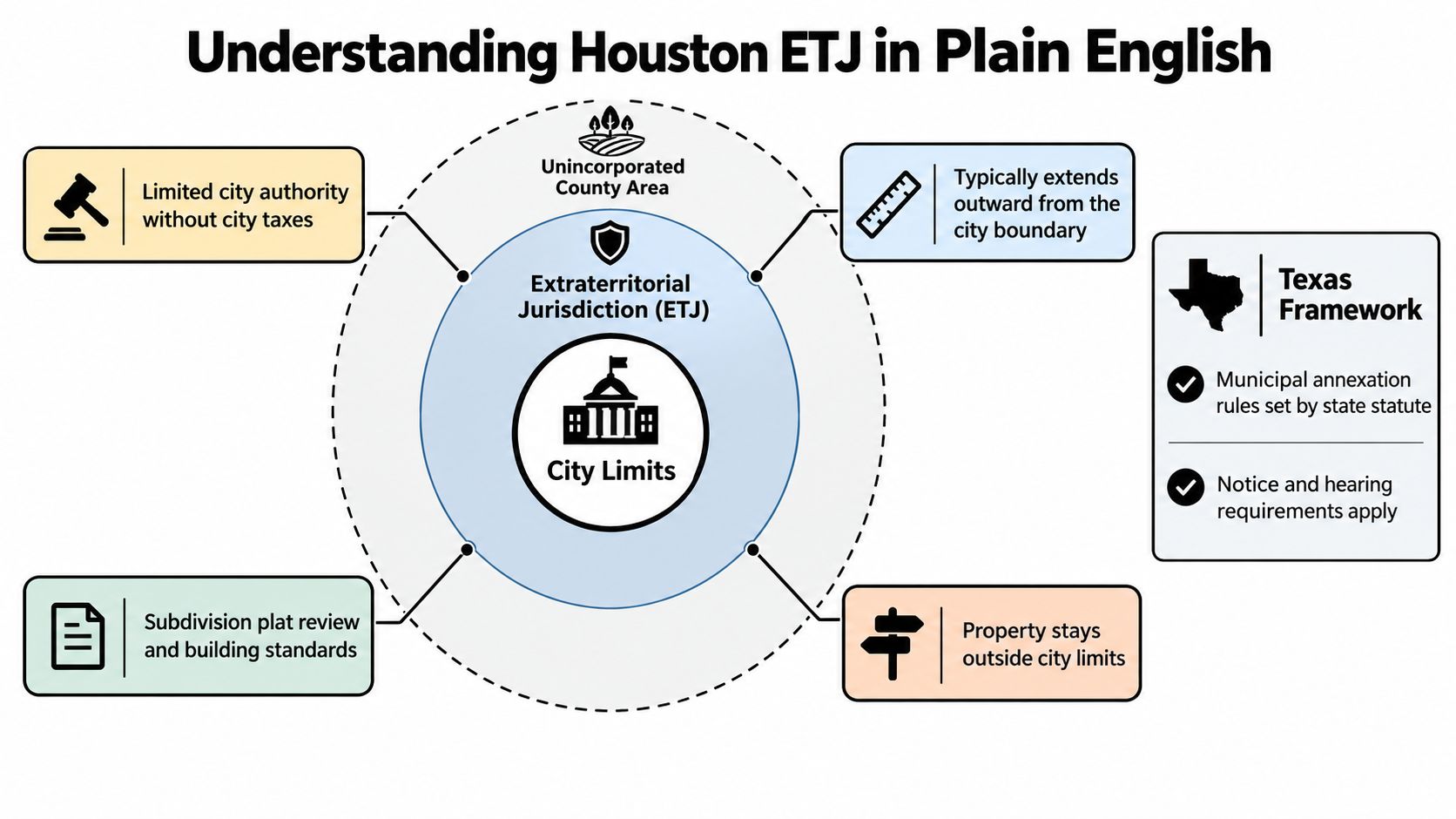
City limits mark where direct municipal governance ends. The extraterritorial jurisdiction, or ETJ, is the adjacent unincorporated area where state law gives a city limited authority over certain development and subdivision matters. For an Atascocita property owner, ETJ is best understood as a filing-rules trigger, not a second set of city limits.
Under Texas Local Government Code Chapter 42, an ETJ is the unincorporated area contiguous to a city's boundaries. Because Houston is a large municipality, its ETJ can extend up to 5 miles beyond the city limits. That distance helps screen a parcel, but it does not decide every property's status by itself.
What ETJ does and doesn't do
ETJ status can change the procedure for a plat, site plan, utility arrangement, or building-related approval. A property may remain outside Houston while a proposed project still requires city review. ETJ does not make the property part of Houston, create cityhood, or automatically place the owner under every Houston ordinance.
| Legal concept | What it means |
|---|---|
| City limits | The property lies inside the incorporated city and is directly governed by the city as a municipal area. |
| Houston ETJ | The property remains unincorporated but may face Houston review for specified development and subdivision matters. |
| County area outside ETJ | County procedures generally control, subject to other applicable laws and jurisdictions. |
| Annexation | A formal legal process that changes the city boundary. ETJ alone isn't annexation. |
Calling ETJ “almost Houston” may describe proximity, but it can mislead someone preparing a filing. A parcel in the ETJ remains outside the city limits unless a separate annexation process changes its status. The practical question is which government must review the particular document or project.
Family-law matters show why the labels need precision. Harris County Family Courts: A Atascocita Resident's Guide explains how family-law cases proceed in the Harris County courts serving Atascocita. ETJ generally does not create a separate family-court system. It is primarily a property and development status, although a deed, property settlement, estate transfer, or other court-related document may require an accurate legal description and recorded land information.
The city's limited role reflects the practical effects of development near its boundaries, including roads, utilities, subdivision patterns, and future planning. Before treating a project as county-only, confirm the parcel's ETJ status and identify whether the proposed filing triggers Houston review.
Is Atascocita Inside Houston ETJ and How to Check
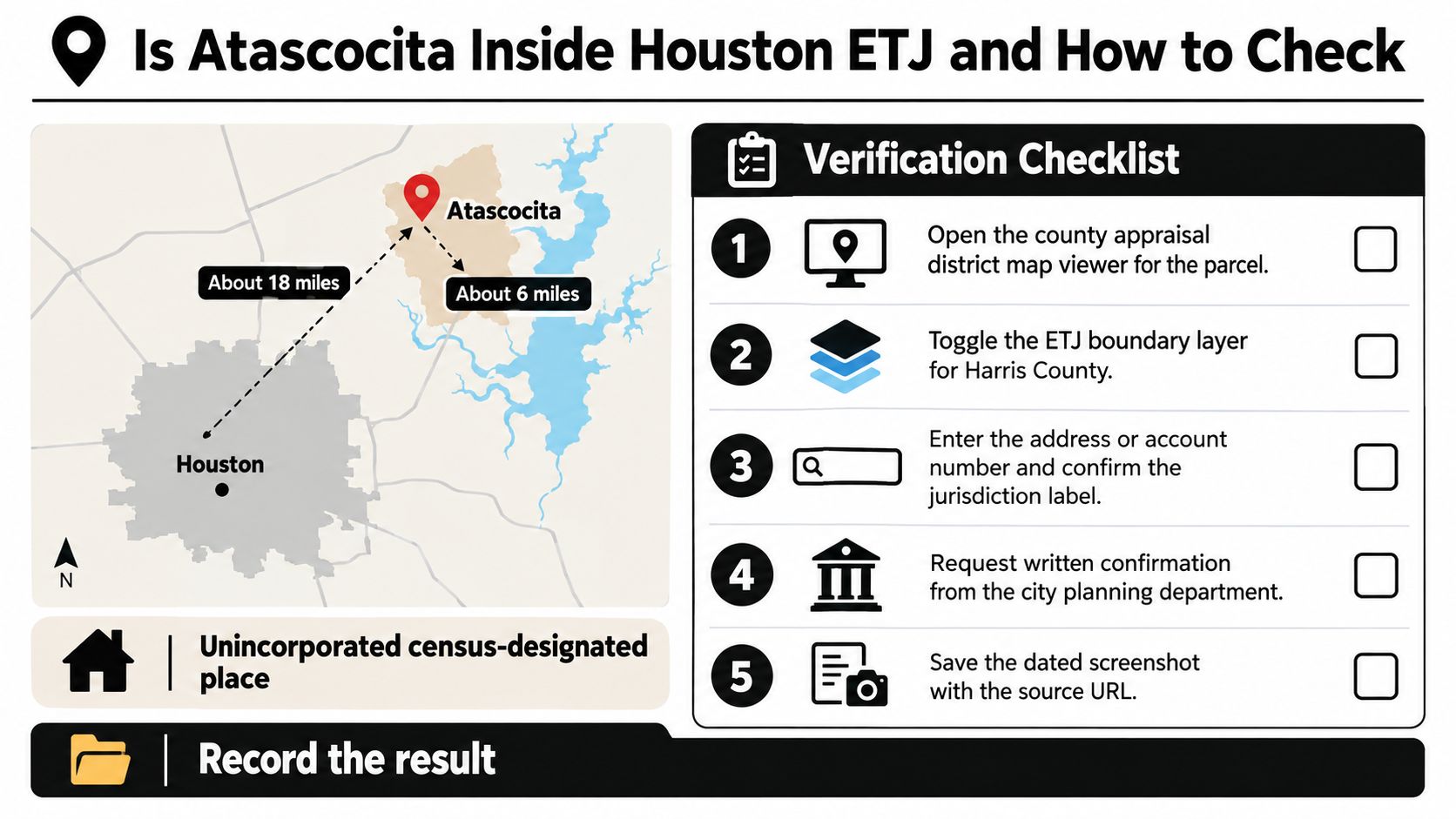
Atascocita is an unincorporated census-designated place in northeast Harris County, roughly 18 miles northeast of downtown Houston and about 6 miles east of Humble, as described by the Texas Almanac's Atascocita profile. Those community-level distances help explain why ETJ questions arise, but they don't establish the status of an individual lot.
The legal question is narrower: Is this specific parcel within 5 miles of Houston's city limit? A property can sit in Atascocita while having a filing status that differs from another property nearby. Roads, municipal boundaries, annexed areas, and irregular parcel lines can make a general community label unreliable.
A practical verification sequence
- Start with the legal parcel information. Use the street address, account number, legal description, and survey rather than relying on “Atascocita” alone.
- Check the boundary location. Houston's guidance identifies ETJ status by determining whether the site lies within 5 miles of the city limit.
- Review city planning and permitting materials. Look for the Houston ETJ map and instructions that apply to the proposed development or filing.
- Confirm the county record. Harris County records can help identify the owner, legal description, recorded plats, and prior instruments, but a county record alone may not answer every ETJ question.
- Request written confirmation when the result is close or disputed. Keep the response with the survey and filing materials.
Keep a paper trail: Save the map, the date you checked it, the parcel number, and any written response from the relevant planning office.
The verification should happen before drafting a plat, subdivision application, ETJ release petition, or construction package. It can also help a lawyer advise on a property issue arising during divorce. For example, a Property Division Lawyer in Atascocita may need accurate information about community property and complex assets, including the legal status and description of real estate.
For a visual explanation of the local geography and boundary-checking process, use the following video as a supplemental guide:
The final answer should come from parcel-specific verification, especially when a filing deadline, closing, construction start, or subdivision transaction is approaching.
How ETJ Affects Venue Jurisdiction and Everyday Filings
ETJ usually changes the land-use filing process, not the court where a lawsuit belongs. That distinction prevents one of the most common misunderstandings. ETJ is generally a local jurisdiction issue involving property regulation, approvals, and governmental authority. It isn't a separate court-venue category.
For civil matters in Harris County justice courts, the Harris County Justice Courts filing guidance states that venue generally belongs in the precinct where the defendant lives, where the claim arose, where the contract was to be performed, or where the property is located. A lawsuit involving an Atascocita property still requires a venue analysis based on those connections. The property's ETJ status may affect the facts and documents, but it doesn't automatically select a different courthouse.
Filing comparison
| Filing Type | Inside Houston ETJ | Outside ETJ |
|---|---|---|
| Subdivision plat | Houston approval may be required before county recording, depending on the parcel and filing. | The Houston ETJ approval step may not apply, but county and other governmental rules still must be checked. |
| Development construction | City review may be required before work proceeds, along with applicable county steps. | The filing path may rely on county or another applicable local authority. |
| Civil lawsuit | ETJ may supply important property facts, but venue follows ordinary legal rules. | Venue likewise follows the defendant, claim, contract, or property connection. |
| ETJ release request | A petition may require specific ownership, map, signature, and survey materials. | A Houston ETJ release request generally isn't the relevant filing. |
| Property evidence | Surveys, legal descriptions, approvals, and boundary records may become important. | The same documents may matter, but ETJ-specific proof may not. |
A municipal citation or development dispute can involve different parties depending on who issued the decision and what authority applied. Before responding, identify the issuing agency, the property's status, the document's deadline, and whether the matter is administrative, civil, or criminal.
Divorce and custody filings follow their own procedural rules. Atascocita residents should not assume ETJ determines family-court venue. For questions about whether a divorce belongs in a particular county court, review Atascocita versus Humble divorce court and county considerations, then obtain advice based on residency, children, property, and procedural history.
What to File Differently When Your Property Is in the ETJ
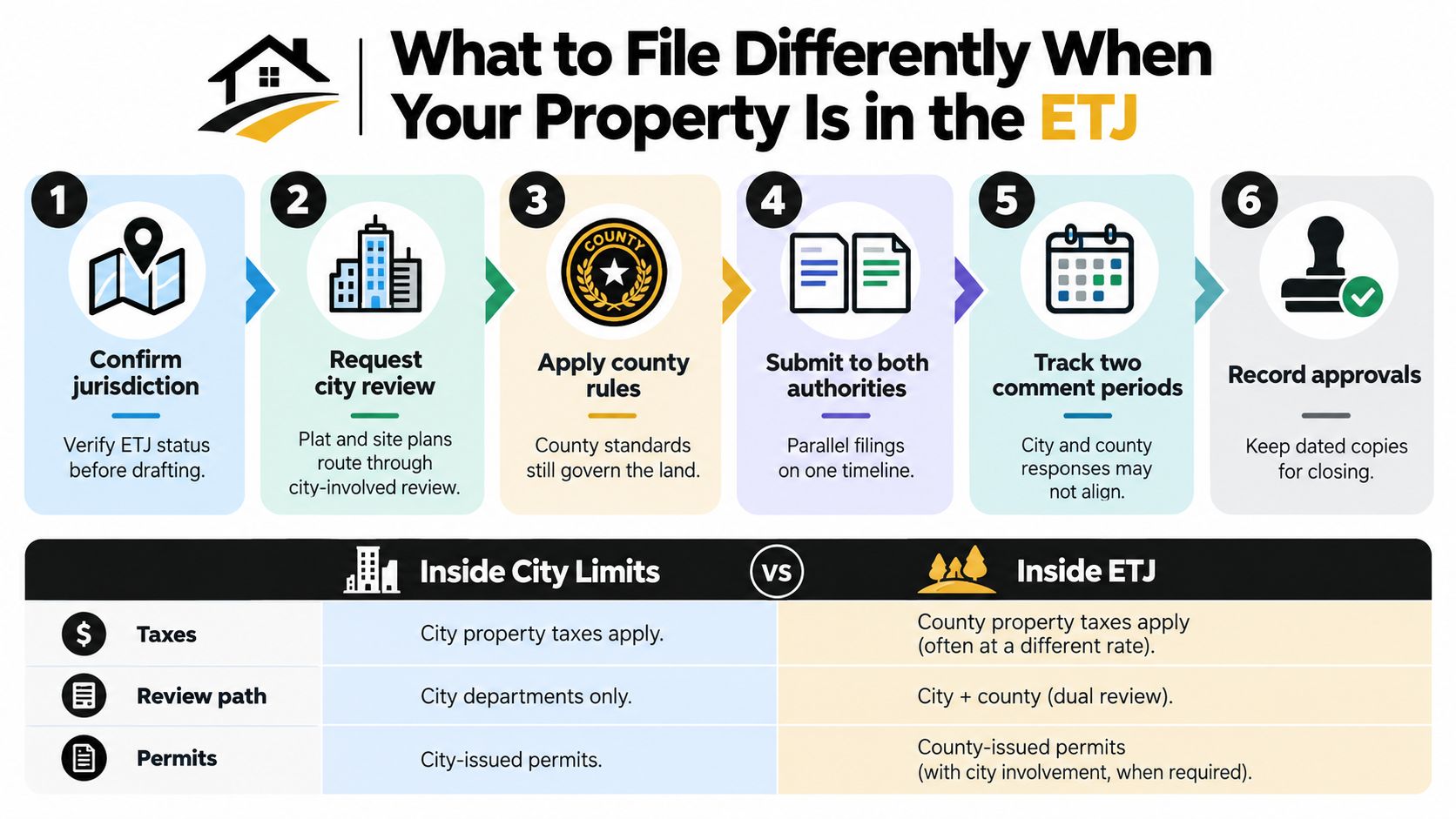
A homeowner in Atascocita may prepare a county filing and still need city review first. That sequence matters most for plats and development documents. Texas Local Government Code Section 242.001 generally restricts filing a plat for property in a municipality's ETJ with the county clerk until the required governmental approval is obtained, as explained in Texas Local Government Code Sec. 242.001.
Construction inside the ETJ buffer identified above may also require City of Houston review under the Houston permitting guidance for ETJ development. The process can include utility coordination, plan review, and permit sequencing. County requirements still apply where relevant, so one government's review does not replace the other's filing requirements.
A filing path for development work
Begin with jurisdiction, not forms. Verify the property's boundary status before paying for a final plat, ordering a complete site-plan package, or setting a construction schedule. A parcel can be outside Houston's city limits while still triggering a Houston review step.
For ETJ development, the applicant may need to address:
- Water and sewer availability
- A building permit application
- ETJ-specific plan review
The order depends on the project and the authorities involved. Coordinate city and county submissions carefully, because an approval or permit may have its own timing requirements while another application remains pending.
ETJ release petitions
A Houston ETJ release request may require original handwritten signatures, proof of ownership, a map, and a survey with a metes-and-bounds description. An online form or informal boundary statement may not satisfy those requirements.
Before submitting, gather:
- The current deed or other ownership proof.
- A survey that identifies the tract accurately.
- A map showing the requested area.
- Original handwritten signatures from the required owners.
- Correspondence confirming the parcel's ETJ status.
Property filings also arise during estate planning. A homeowner considering a transfer-on-death deed should review how the document affects title, beneficiaries, and recorded property information. The Atascocita transfer-on-death deed resource discusses that instrument. Verify ETJ status separately whenever the filing also involves development or subdivision approval.
Annexation Risk and ETJ Release Options for Atascocita Owners
ETJ status doesn't mean Houston has annexed the property. Annexation is a separate process that changes the city boundary and can create a different legal relationship between the owner and the municipality.
Texas annexation practice includes public-notice safeguards. Under Texas municipal annexation guidance, most municipal annexations require two public hearings, with notice published at least 20 days before each hearing. At least one hearing must be held inside the annexation area when a suitable site is reasonably available.
What owners should monitor
If an owner is concerned about a possible boundary change, monitoring public notices and Harris County records can provide early information. Keep copies of notices, proposed ordinances, maps, hearing materials, and any written communication from the city or county.
A separate recording step matters after annexation. The city generally must file a certified copy of the annexation ordinance with the county clerk, and the cited guidance says that filing should occur within 30 days of adoption, as explained in Texas municipal annexation recordation guidance. That filing creates a public record of the boundary action.
ETJ release developments
ETJ release procedures have become more formal, and recent Texas litigation has highlighted how statutory timing, acreage, and petition structure can affect eligibility. A 2026 federal case involving Austin's ETJ releases and a 2025 victory reported for petitioners seeking ETJ removal show that ETJ rights can turn on technical legal details rather than broad fairness arguments.
A July 2026 summary describes a cleaner release path for a 12-acre-or-larger tract, while smaller tracts may need to be bundled. Because release eligibility can depend on the statute in effect, filing date, ownership structure, and petition design, an owner should not rely on a general internet summary. The recent reporting on Austin ETJ litigation and release issues provides context, but Houston owners need parcel-specific legal analysis.
Before signing a release petition, confirm the tract, the owners, the applicable deadline, and the current statutory requirements.
Next Steps for Atascocita Residents Preparing a Legal Filing
Start with a jurisdiction check. Write down the property address, account number, legal description, and survey reference. Then determine whether the parcel is inside Houston's ETJ, inside city limits, or outside both.
Use this short preparation list:
- Identify the filing: Decide whether you're preparing a plat, permit application, ETJ release petition, deed, court petition, response, or appeal.
- Confirm the authority: Determine whether Houston, Harris County, another municipality, or a court must receive the document.
- Collect supporting records: Gather deeds, surveys, maps, ownership proof, approvals, notices, contracts, and prior filings.
- Protect deadlines: Record every submission date, hearing date, response deadline, and requested correction.
- Separate property status from court venue: ETJ may affect evidence and governmental approvals, while court venue follows the applicable procedural rules.
- Ask for legal review early: A local attorney can identify missing approvals before a rejected filing creates delay or affects a closing.
Families also need accurate court and estate records when a filing involves divorce, custody, probate, or inheritance. For estate administration, the Harris County probate clerk resource can help residents identify the relevant county probate process, while legal counsel can evaluate the documents and property issues in the broader matter.
The Law Office of Bryan Fagan – Atascocita TX Lawyers handles family law, criminal defense, estate planning, probate, and civil disputes for residents of Atascocita, Humble, and northeast Harris County. A consultation can help you organize the parcel records, identify the proper filing path, and address related divorce, custody, property, or estate concerns before you submit documents.
Schedule a free consultation with the Law Office of Bryan Fagan – Atascocita TX Lawyers to review your Houston ETJ or Atascocita filing questions with a local legal team. Bring your deed, survey, notices, proposed filing, and any city or county correspondence so the attorney can help you determine the next practical step.