Skip to content

Maria has lived in Atascocita for years, paid off her home near Atascocita High School, and wants her daughter to receive the house when she dies. She also worries about leaving her surviving son with a difficult Houston probate process. At her kitchen table, the question isn't whether a transfer on death deed in Atascocita, Texas avoids probate. The question is whether it will still work when the family has to deal with the Harris County Clerk, a mortgage, beneficiary problems, or a title company.
Maria could add her daughter to the deed now, but that would give the daughter a present ownership interest and could expose the property to her creditors or a future divorce. She could do nothing and hope the family sorts out ownership later. Or she could use a Transfer on Death Deed, properly executed and recorded in Harris County, while keeping control during her lifetime.
That choice is personal, but the legal mechanics aren't optional. Families need to understand recording in downtown Houston, strict revocation rules, the 120-hour survivorship requirement, and what happens after death. Anyone suddenly responsible for managing a loved one's estate may need a practical roadmap before making decisions about the home.
A Real Atascocita Homeowner's Question About Avoiding Probate
Maria's situation is common in Atascocita, Humble, and northeast Harris County. Her home may be the family's largest asset, but she doesn't want to surrender control merely to make inheritance easier. Putting her daughter on the deed today could create consequences Maria never intended. The daughter might later face a creditor claim, bankruptcy problem, or divorce dispute involving her ownership interest.
The three choices at Maria's table
Add the daughter now. This creates immediate co-ownership. Maria may need her daughter's cooperation for a sale, refinance, or other title decision, and the daughter's financial problems could affect the property.
Do nothing. The house may pass under a will or Texas intestacy rules, which can require probate administration. A surviving son or daughter may need legal help to establish authority, resolve debts, and transfer title.
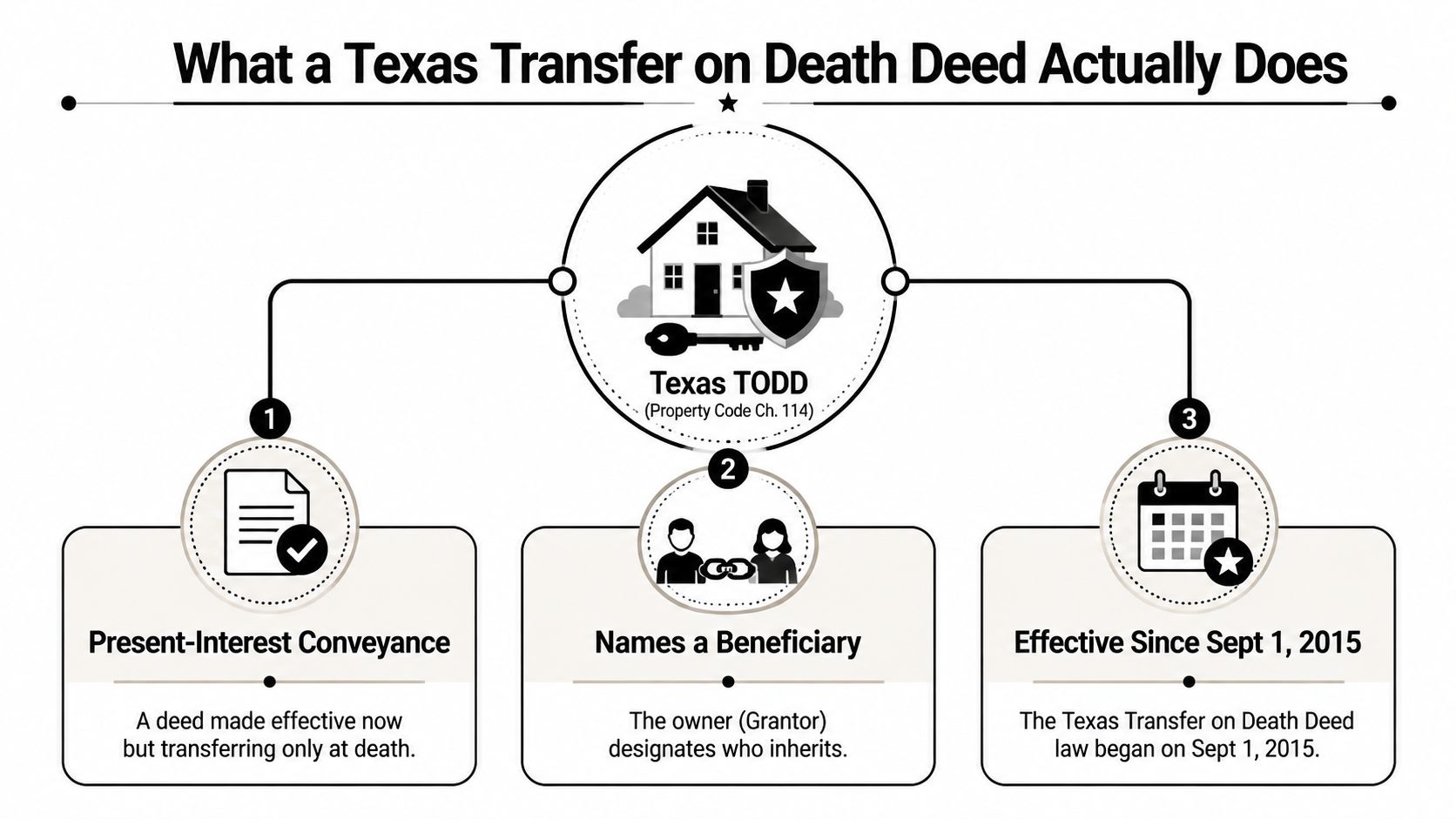
Record a TODD. A valid deed can designate Maria's daughter to receive the Atascocita home at Maria's death, without giving the daughter current ownership. Texas authorized this method through Chapter 114 of the Estates Code under Senate Bill 462, enacted by the 84th Legislature, with an effective date of September 1, 2015. The statute applies to deeds executed and acknowledged on or after that date and to owners who die on or after that date. Texas Chapter 114 authority provides the statewide framework.
The practical question: A TODD can be a strong fit for a single home and a straightforward beneficiary plan, but it isn't a substitute for reviewing the entire family situation.
Maria also needs to understand that a will doesn't override a properly recorded TODD. If she later changes her will but doesn't properly revoke or replace the deed in Harris County, the deed may still control the house. That is why the recording record matters as much as the document in her file cabinet.
What a Texas Transfer on Death Deed Actually Does
A Texas Transfer on Death Deed names one or more beneficiaries who receive the owner's interest in specified real property only at the owner's death. It is governed by Chapter 114 of the Texas Estates Code, and the statutory framework applies to eligible deeds executed and acknowledged on or after September 1, 2015. The owner remains the property owner during life.
The owner can generally live in the home, sell it, refinance it, or change the beneficiary arrangement while legally capable. The beneficiary doesn't receive a present ownership interest merely because the deed names them. The transfer is effective at death, not when the deed is signed.
What the deed can accomplish
A properly prepared and recorded TODD can move the covered real estate outside probate. The owner must record it in the deed records of the county where the property sits before death. For an Atascocita property, that means handling the instrument through Harris County records, not relying on a signed document at home or a provision in a will.
The deed is revocable. Texas law requires a later TODD or express revocation to be acknowledged after the earlier deed and recorded in the same county before death. A will cannot revoke or override the TODD. Homeowners researching ways to avoid probate with a beneficiary deed should compare the terminology carefully, because Texas uses its own statutory requirements for a transfer on death deed.
What it can't accomplish
A TODD controls the specified real property only. It doesn't distribute furniture, bank accounts, vehicles, or other personal property, and it doesn't name a guardian for minor children. It also doesn't erase the owner's mortgage, tax liens, or other encumbrances, and it isn't a lifetime shield against the owner's creditors, Medicaid-related claims, or IRS liens.
The same careful planning matters in other family matters. For example, a Child Support Attorney in Atascocita handles establishing, modifying, and enforcing child support in Harris County, which is a separate legal issue from deciding who receives a home after death.
How to Prepare, Sign, and Record a TODD in Harris County
A TODD isn't effective because it looks official. It must satisfy deed formalities, identify the property accurately, and reach the correct county records before the owner's death. Harris County homeowners should treat preparation and recording as four separate phases.
Phase one involves the property records
Start with the current recorded deed in the Harris County Clerk's Official Public Records. Confirm the owner's name, current vesting, and the complete legal description, including the lot and block information or other description used in the recorded instrument.
Don't copy the street address from a tax bill and assume the job is finished. TexasLawHelp warns that tax-roll descriptions can be incorrect, and a defective legal description can undermine the transfer. The county's property records, not a casual address reference, should control the drafting.
For help locating the appropriate probate and deed-recording information, homeowners can review the Harris County probate clerk resource.
Phase two requires deliberate drafting
Use the statutory requirements in Texas Estates Code Section 114.055 as the drafting checklist. The deed should clearly identify the transferor, describe the property, state that the transfer occurs at death, and name beneficiaries with complete vesting language.
Name primary beneficiaries precisely. If the owner wants a backup plan, identify contingent beneficiaries rather than relying on a vague class such as “my heirs.” Include mailing information needed for later notices and consider how multiple beneficiaries will hold the property together.
Recording principle: The deed should be prepared for the title examiner who will review it after death, not merely for the homeowner who signs it today.
Phase three is execution before a notary
The owner must sign the TODD with the formalities of a recordable deed and obtain a proper notary acknowledgment. Check the signature, printed name, notary seal, acknowledgment wording, and dates before leaving the appointment.
A credible witness can help document capacity and intent, especially for an older homeowner or a family situation that may later be challenged, although the statutory deed requirements should remain the focus. A notary service such as by Business Mail Boutique LLC may be useful for general notarization logistics, but notarization alone doesn't correct a bad legal description or defective beneficiary language.
Phase four is timely Harris County recording
Record the original, properly executed deed with the Harris County Clerk's office at 201 Caroline, Houston. Confirm the current recording fee, any required Texas Property Tax Statement, return-mail instructions, and indexing details directly with the clerk because administrative requirements can change.
The deed must be recorded before death. A family can't deliver an unrecorded TODD after the owner dies and expect post-death filing to cure the defect. Keep the recorded information with the estate plan, and give the future beneficiary clear instructions about where the deed is recorded.
TODD Compared to Wills, Trusts, and Joint Tenancy
Atascocita homeowners often choose a TODD because it preserves lifetime control while directing the home to a beneficiary at death. That doesn't make it universally superior. The right instrument depends on the owner's family structure, debts, other assets, and need for ongoing management.
Consider a 2024-vintage Atascocita single-family home valued at $340,000. The deed method affects who controls the property during Maria's life, what happens at death, and whether the family must resolve ownership through a court or title process.
| Feature | Transfer on Death Deed | Last Will and Testament | Revocable Living Trust | Joint Tenancy With Right of Survivorship |
|---|---|---|---|---|
| Probate avoidance | Can transfer the covered real estate outside probate | Usually requires probate for assets controlled by the will | Can avoid probate for assets properly placed in the trust | May transfer the jointly owned property outside probate |
| Medicaid look-back exposure | Doesn't eliminate Medicaid planning or recovery issues | Doesn't provide a special TODD solution | May require specialized planning and careful funding | Doesn't solve Medicaid planning concerns |
| Mortgage and due-on-sale concerns | Mortgage and liens remain attached to the property | Mortgage and liens remain attached to inherited property | Mortgage and liens remain attached to trust property | Mortgage and liens remain attached to jointly owned property |
| Basis treatment | The beneficiary receives inherited property subject to applicable tax rules | Inherited property remains subject to applicable tax rules | Inherited property remains subject to applicable tax rules | Inherited property remains subject to applicable tax rules |
| Creditor protection | Beneficiary has no present ownership interest before death, but the deed doesn't erase the owner's debts or post-death claims | Beneficiary has no present interest before death | Depends on trust terms and applicable law | Co-owner's present interest may expose the property to that co-owner's creditors |
| Revocation | Owner can change or revoke during life by following statutory rules | Can be changed while the testator has capacity | Can generally be amended or revoked under trust terms | Changing ownership usually requires cooperation from co-owners |
How the options play out
A will is still essential for personal property, executor instructions, and guardianship designations, but it generally sends the covered property through probate. A revocable living trust can handle a broader group of assets and may suit a blended family or owners with multiple properties, but it requires careful funding and administration.
Joint tenancy gives the other owner present rights immediately. If Maria adds two children as joint owners and one later dies, the survivor may receive that interest, but disagreements among siblings can still create a partition lawsuit. The surviving owner may not be able to keep the property without addressing the other owners' rights or estate interests.
A TODD is often the most focused choice for a single home when the owner wants no current co-owner, a revocable beneficiary designation, and a nonprobate transfer. It isn't automatically free in practice because drafting, recording, title review, and later administration may involve costs. Owners comparing a TODD with a Lady Bird deed in Texas should get advice based on the actual deed, homestead status, family structure, and long-term goals.
What Happens After the Owner Dies
The TODD doesn't end the family's work. It changes the work from ordinary probate administration of the home to a post-death title and estate process that still requires careful handling.
The first issue is survivorship
Texas law applies a 120-hour survivorship rule. A designated beneficiary must survive the transferor by that period. If the beneficiary doesn't, that share lapses and passes under Texas estate rules as though the TODD were a devise in a will. That can matter greatly when two family members die close together or when the deed names several beneficiaries.
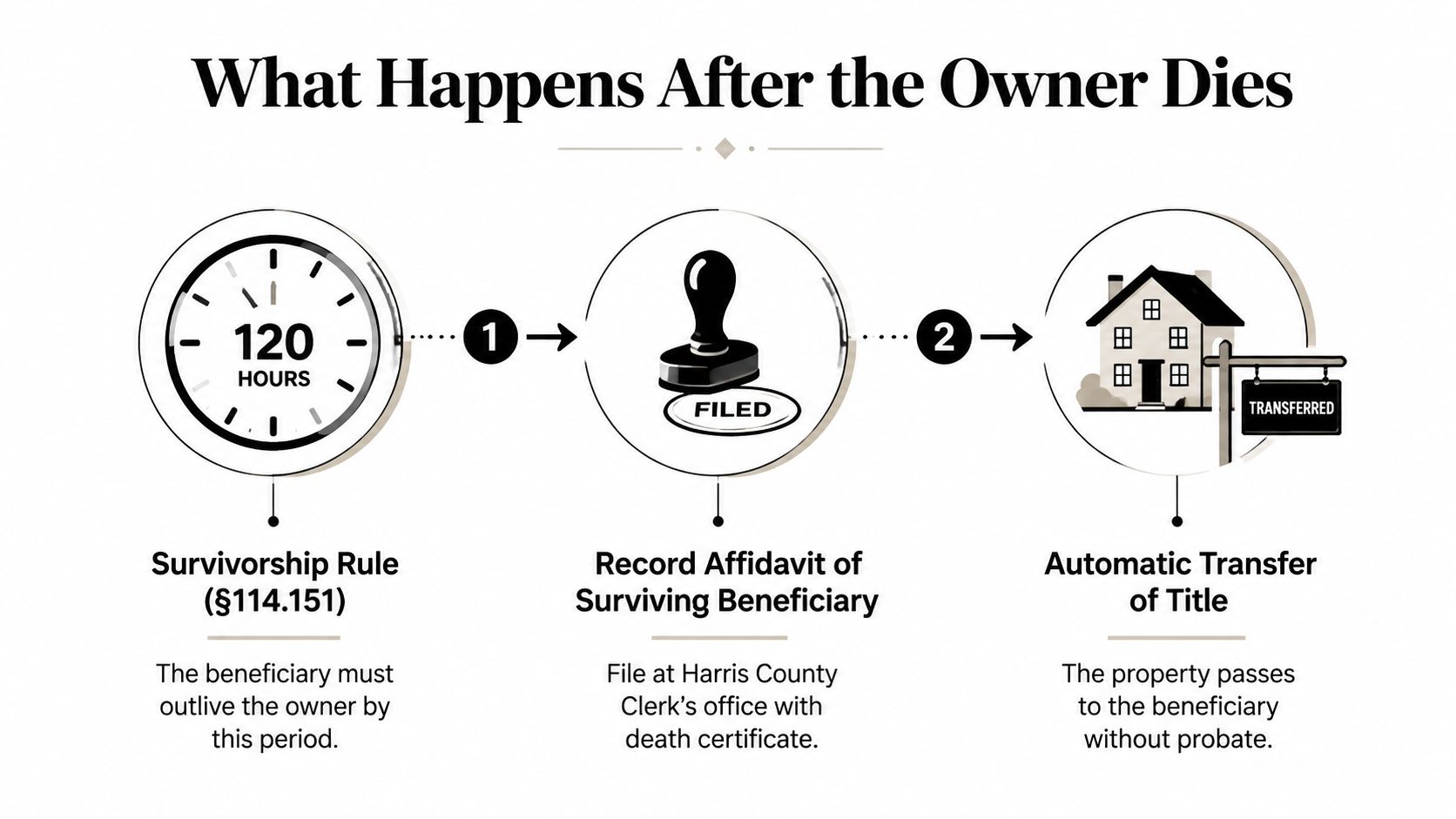
The beneficiary should obtain the death certificate and prepare the affidavit required to establish the transfer, then record those materials in the Harris County deed records. The title may pass by operation of law, but a title company, buyer, or lender will usually need recorded evidence before treating the beneficiary as the clear owner.
The house still needs management
Until title paperwork is accepted and practical authority is clear, someone must protect the home. That includes keeping insurance active, securing the property, handling utilities, addressing repairs, and paying the Atascocita MUD or other applicable property charges. Harris County ad valorem taxes continue to accrue against the property and are not canceled by the TODD.
The beneficiary takes the property subject to existing mortgages, liens, encumbrances, and other interests. A TODD does not pay off the mortgage or make a lender's security interest disappear. The beneficiary should contact the servicer promptly, review loan documents, and avoid assuming that title transfer means the debt has been forgiven.
Estate claims can still matter
If the estate is opened and secured debt exists, the personal representative must notify the creditor. The creditor then follows the statutory claims process and makes the applicable election regarding treatment of the debt. A TODD also doesn't prevent creditor claims or eliminate every reason a muniment of title or other probate proceeding may be needed.
If a primary beneficiary dies first, the deed's survivorship and anti-lapse provisions require close review. Descendant relationships can affect whether a lapsed share passes under Texas estate rules, but families shouldn't assume the result without examining the deed and the governing statute. In Harris County, coordinating the affidavit, death certificate, creditor issues, and clerk filing is often the difference between a clean title transfer and a later title defect.
Common Mistakes That Invalidate a TODD in Harris County
The most dangerous TODD errors are usually ordinary-looking paperwork mistakes. A homeowner may believe the intent is obvious, but the Harris County Clerk and a later title examiner must be able to identify a valid, recordable instrument.
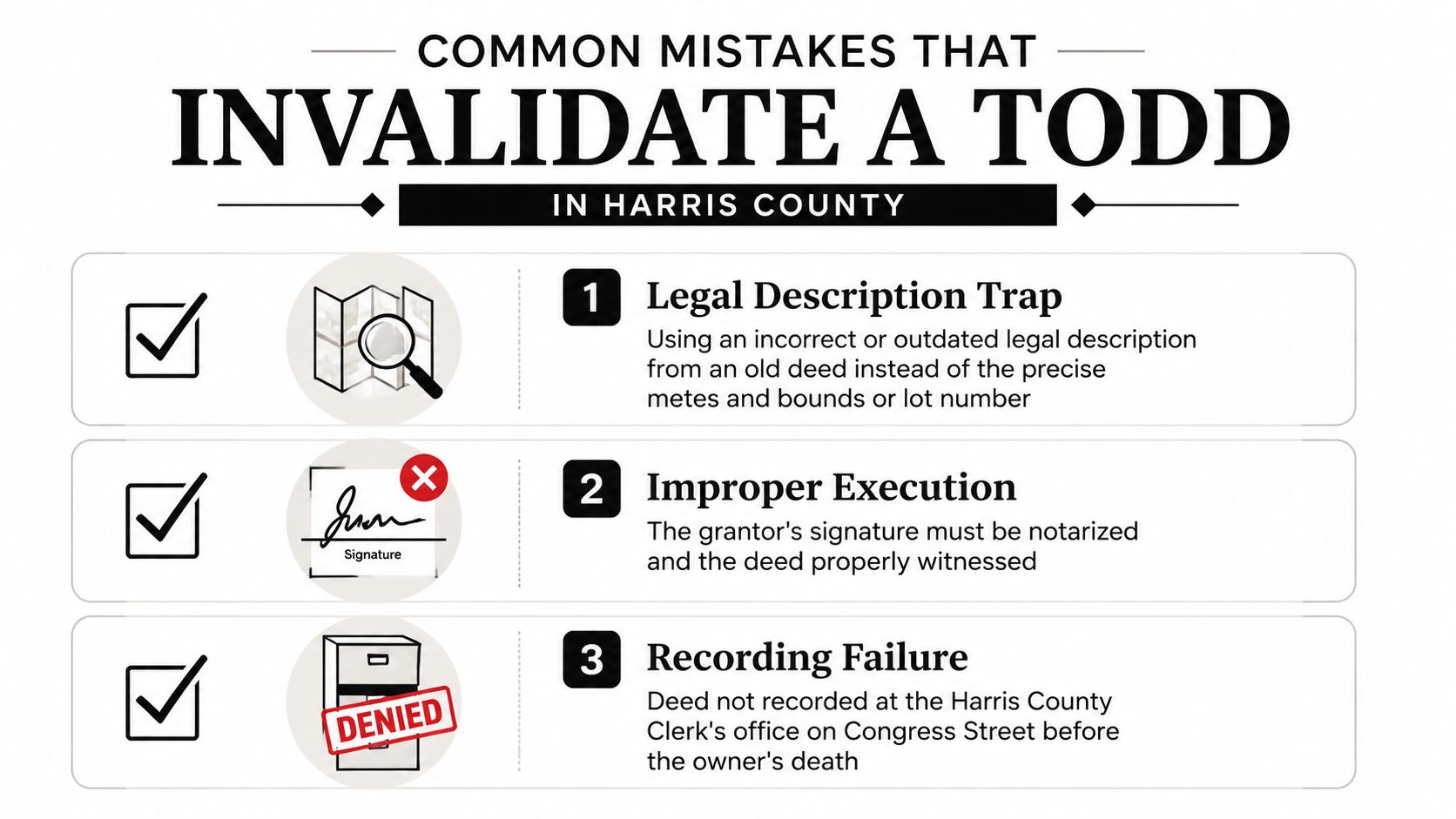
The legal description trap
A street address isn't a substitute for the legal description. Use the current recorded deed, confirm the lot and block or other controlling description, and check that the current owner and vesting match the deed being prepared.
An old deed can also create trouble if the property was replatted, conveyed, or otherwise changed. TexasLawHelp specifically cautions against relying on tax-roll descriptions because they may be wrong. If the document describes the wrong parcel, the intended transfer may fail even though everyone in the family knows which house the owner meant.
Execution and beneficiary defects
Review the notary acknowledgment, seal, signature, and dates. A missing acknowledgment, an absent seal, or a signing date that doesn't match the notarization can trigger rejection or later validity challenges.
Beneficiary language needs the same precision:
- Name people clearly: Don't rely on an undefined class of heirs.
- Add a backup plan: Identify contingent beneficiaries if a child or other primary beneficiary dies first.
- Review after divorce: Texas law can revoke a former spouse's designation in certain circumstances, but an outdated deed may still confuse a title examiner.
- Plan for multiple owners: Decide whether beneficiaries can realistically manage, sell, or refinance the property together.
Capacity, spouse, and filing problems
A credible witness and careful capacity documentation can help when an older owner may later face an undue-influence allegation. Homestead ownership also demands attention to a spouse's rights and any required joinder. Don't wait until the owner loses capacity, because a new deed may no longer be legally available.
Finally, recording must occur in Harris County before death. A document kept in a safe, given to a child, or signed but never recorded doesn't meet the statutory recording requirement.
Final review checklist: Confirm the legal description, owner names, beneficiary and contingent beneficiary designations, notary acknowledgment, spouse issues, capacity, and recording confirmation before treating the TODD as complete.
Putting TODD Planning Into a Bigger Estate Plan
A TODD is a property-transfer tool, not a complete estate plan. An Atascocita homeowner should usually review it alongside a pour-over will, durable power of attorney, medical directives, beneficiary designations, and plans for personal property. Multiple properties, minor children, business interests, or a blended family can make a trust or coordinated plan more appropriate than a stand-alone deed.
Harris County homeowners should also watch the changing transaction environment. Under HB5642, Texas real estate license holders must provide written TODD notice in residential transactions, with rulemaking due by December 1, 2025 and an effective date of January 1, 2026, according to the cited statutory material at Texas Estates Code Section 114.103. The rule is bringing TODD questions into more Atascocita and Humble property conversations, including listings and refinancing discussions.
The Law Office of Bryan Fagan, located near FM 1960 and accessible from Atascocita, Humble, and Kingwood, can review an existing deed with the rest of an estate plan and coordinate updates with Harris County records. Homeowners can also review guidance on how to avoid probate in Texas before deciding whether a TODD fits their goals.
If you own a home in Atascocita, Humble, or northeast Harris County, the Law Office of Bryan Fagan – Atascocita TX Lawyers can review your TODD, beneficiary designations, will, and related estate documents for gaps that may create problems later. Schedule a free consultation by visiting Law Office of Bryan Fagan – Atascocita TX Lawyers and bring your current deed and any recorded estate-planning documents.