Skip to content
Atascocita Forest runs on section-by-section deed restrictions that run with the land, so dividing a home there has to satisfy both the family court and the recorded covenants. The community contains approximately 1,600 homes across 21 section groupings, and the correct restrictions can change the steps needed after a divorce, sale, or inheritance.
You may be sitting at a kitchen table in Humble or northeast Harris County with a mediated settlement, a proposed divorce decree, and a house that one spouse will keep. The agreement may say who gets the property, but it may not address the recorded covenant package for that particular Atascocita Forest section. That gap can create trouble with occupancy, improvements, resale, or the paperwork needed to place the home in one spouse's name.
The practical rule is simple: a divorce order decides the spouses' rights between themselves, while deed restrictions continue to govern the property. Read the exact covenants before signing the final agreement, and get legal help when the decree, title records, lender requirements, and HOA documents don't line up.
A Real Moment When Covenants and Divorce Collide
A couple on Pin Oak Trail has finished mediation. The agreement awards the house to the husband, and both spouses are ready to move on. While sorting through the paperwork, they notice a fence that still needs staining and an architectural request for a new roofline that hasn't received a final response.
Neither issue appeared in the mediation summary. The couple assumed the divorce would close the matter. The neighbors, however, can already see the fence, and the association's compliance process doesn't stop because the owners are waiting for a final decree.
That's the point many Atascocita Forest homeowners miss. The marriage may end, but the recorded obligations attached to the lot remain in place. A decree can award the property, allocate responsibility for a repair, or order one spouse to sign a transfer document. It doesn't automatically cancel a fence rule, architectural requirement, occupancy limitation, or other covenant.
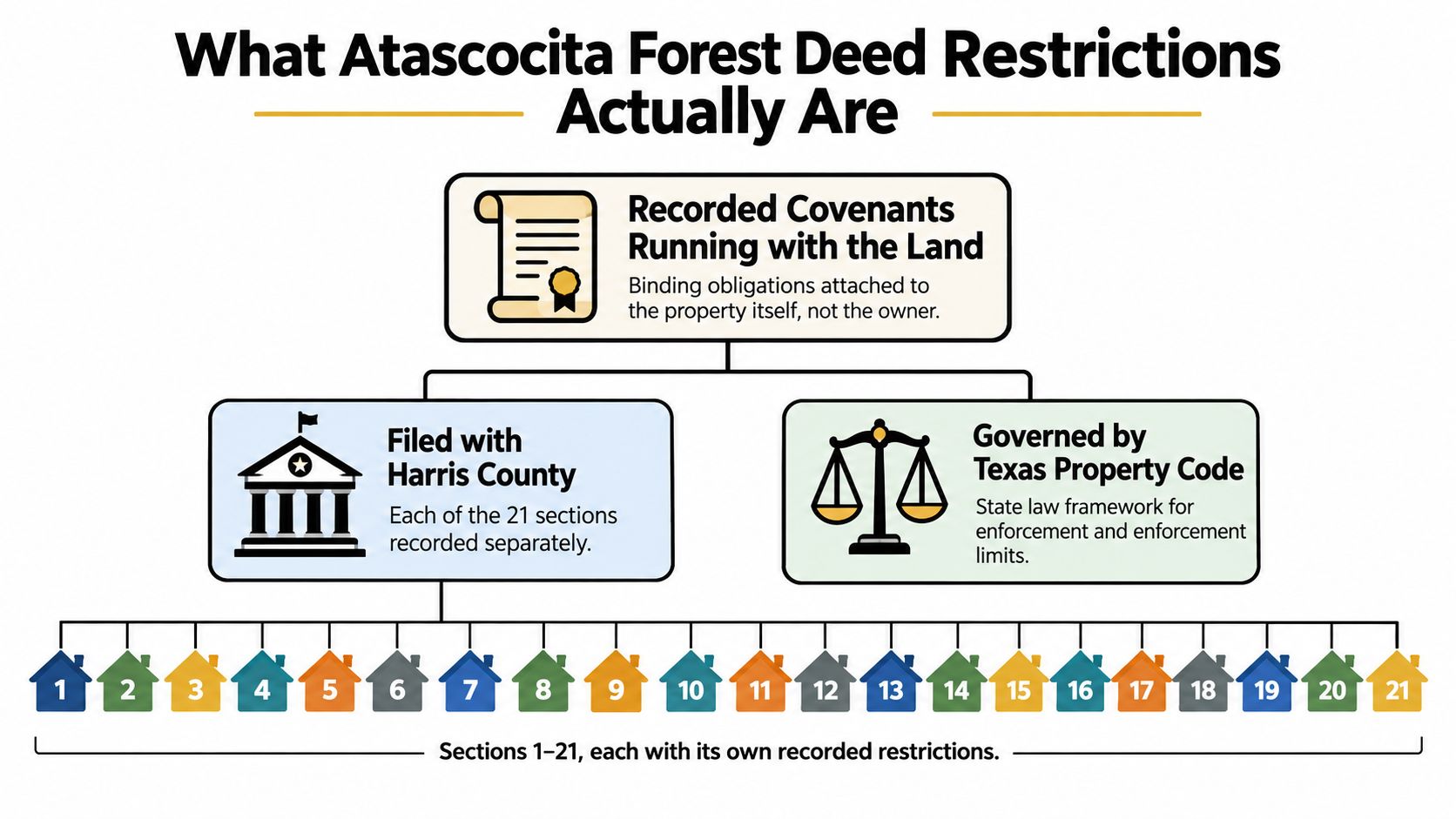
Atascocita Forest's community documents describe a deed-restricted community of approximately 1,600 homes and divide it into 21 sections, consisting of Sections 1 through 18 of Atascocita Forest and Sections 1 through 3 of The Park at Atascocita Forest. A 2018 community notice about the consolidation effort explained that the separate section structure caused confusion because each section had its own restrictions with slight variations, some not materially updated since their original filing more than 40 years earlier.
Practical rule: Don't sign a property settlement that says “the house goes to one spouse” without identifying the exact real estate and checking the restrictions recorded against it.
The same notice said consolidation would require approval from two-thirds of the homeowners in each section, meaning a supermajority vote across all 21 section groupings. Until the governing documents lawfully change, the section-specific language remains the starting point for the transfer.
What Atascocita Forest Deed Restrictions Actually Are
A deed restriction is more than an HOA preference. In Texas, these rules are generally restrictive covenants, recorded in county real property records and attached to the land. They can regulate how a lot is used, what may be built, and whether an architectural change needs review.
For Atascocita Forest, the association's published materials provide downloadable restrictions by section. That structure matters because the document controlling a home isn't necessarily identical to the document controlling a nearby home. The community is described as having 21 section groupings, with the Atascocita Forest sections and The Park at Atascocita Forest sections identified separately.
Texas property owners' association law supplies the broader enforcement framework. The Texas State Law Library's guide to restrictive covenants explains that recorded declarations can operate as binding land-use instruments and that Texas Property Code Chapter 202 addresses property owners' associations and restrictive-covenant enforcement.
Read the covenant as a property document
Start by separating the types of obligations you may find:
- Use restrictions address how the home or lot may be occupied or used.
- Architectural controls can affect fences, roofs, additions, landscaping, and other visible work.
- Assessment provisions address charges and collection procedures.
- Amendment clauses explain how owners or the association can change the document.
- Enforcement language identifies available remedies and notice procedures.
The original developer's plan may explain why the restrictions exist, but the recorded instrument controls the legal analysis. Older language may also require careful review, especially where a provision has a stated duration, renewal process, or later amendment.
The restriction follows the property, not the family relationship.
That distinction becomes important during divorce. A spouse receiving the home may become the sole owner, but the spouse doesn't receive a blank slate. The property still carries its recorded obligations, and any later sale, refinance, renovation, or occupancy change must be evaluated against the correct section documents.
Finding and Reading Your Section's Restrictions
Don't rely on a neighbor's copy, a general HOA summary, or a restriction document downloaded for a different section. Pull the records for the specific legal description of the home.
Begin with the property record and most recent deed. The legal description should identify the subdivision, section, lot, and block. Then search the Harris County Clerk's Official Records using the subdivision name, section designation, and the volume and page or recording information shown in the deed.
Use this records checklist
- Confirm the legal description. Compare the deed with the Harris County Appraisal District property record. The appraisal record helps you locate the property, but the recorded deed and covenant instruments control the legal description.
- Locate the original declaration. Search for the section-specific restrictions or declaration recorded in Harris County real property records.
- Find amendments and extensions. A later filing may change a provision, extend a term, or identify a different enforcement entity.
- Identify the enforcing association. Confirm whether the property is handled through the Atascocita Forest community association, a property owners' association, or another section-level entity.
- Read the transfer and compliance provisions. Look for rules affecting occupancy, construction, resale disclosures, approvals, assessments, and violations.
| Source | What to Search | What You'll Get |
|---|---|---|
| Most recent deed | Legal description, subdivision, section, lot, and block | The property description needed for title and court documents |
| Harris County Clerk Official Records | Atascocita Forest, exact section, recording details | Original restrictions, amendments, releases, and related filings |
| Community association platform | Exact section name and governing documents | Association-posted copies and contact information |
| Title company records | Property address and legal description | Current title information, liens, and exceptions relevant to closing |
Watch for red flags. An apparently old covenant may contain a duration clause, renewal language, later amendment, or a separate instrument that changes the result. If the document appears expired, conflicts with another filing, or doesn't match the property's legal description, stop relying on it until a title professional or attorney checks the chain of records.
The Atascocita Forest community documents reflect the section-by-section structure. Use them as a starting point, then verify the controlling documents in the county records before a divorce transfer or sale.
How Texas Property Division Treats a Deed-Restricted Home
Texas begins with classification. Property acquired during the marriage is generally community property, while separate property isn't divided as part of the community estate. A home purchased during marriage can therefore be community property even when only one spouse's name appears on the deed, unless the spouse claiming separate ownership can establish that it was acquired with separate-property funds.
Separate property includes property owned before marriage and property received during marriage by gift, devise, or descent. The Texas Family Code provision on separate property identifies those categories and makes tracing documentation important when ownership is disputed.
Texas courts divide the community estate in a manner that is “just and right,” not automatically 50/50. The Texas State Law Library's explanation of property division describes that standard. The court first needs a reliable picture of the marital estate, including the home, mortgage, liens, improvements, and any reimbursement or tracing claims.
The deed restrictions don't change whether the home is community or separate property. They can, however, affect how the parties evaluate and transfer it.
| Issue | Texas Family Law Treatment | Deed Restriction Impact on the Same Issue |
|---|---|---|
| Classification | Marriage timing and source of funds control the community or separate analysis | The covenant doesn't decide ownership classification |
| Valuation | The court considers the marital estate and relevant debts or claims | Use limits, pending compliance issues, and marketability can affect practical value |
| Award of the home | The court may award the house to one spouse as part of a just-and-right division | The receiving spouse still must comply with recorded restrictions |
| Sale or buyout | Parties may sell, refinance, or offset the home against other assets | Transfer documents and association requirements must match the covenant package |
| Improvements | Mortgage payments and improvements may support reimbursement arguments in some cases | Unapproved work may create a compliance problem that must be addressed |
The court order is only one part of the transfer
A court may award the home to one spouse, order a sale, or structure a buyout. The parties still need to address the home's actual condition and any active covenant dispute. A pending architectural issue, unresolved violation, or assessment lien can affect negotiations and closing even if the decree awards the property outright.
For a plain-language discussion of the broader question, see who gets the house in a Texas divorce. If the property will remain in the family and the spouses are also revising wills or trusts, an Estate Planning Attorney in Atascocita may help coordinate those documents.
The key distinction is this: deed restrictions shape use and transfer, but they don't themselves decide which spouse owns the home. The decree, deed, lender requirements, title records, and covenant documents must work together.
Step-by-Step Actions for Divorce, Sale, and Inheritance
Start with documents, not assumptions. Collect the current deed, the exact restrictions for the applicable Atascocita Forest section, recorded amendments, mortgage information, association correspondence, and notices about violations, assessments, or architectural requests. Each of the community's section-specific covenants may affect the practical steps, even when a divorce decree or estate plan gives clear ownership instructions.
Divorce transfer
Confirm that the final decree identifies the property by its complete legal description and clearly awards it to one spouse or orders another disposition. The Texas Law Help guide to dividing property and debt explains why the legal description should come from the most recent deed.
Then prepare and record the required transfer instrument. A decree may direct the transfer, yet a separate special warranty deed can still be necessary for title records, lender requirements, or a later sale. Set out who must sign, who pays recording charges, how the mortgage will be handled, and who addresses any unresolved covenant issue.
Have the proposed documents reviewed before signing. Compare the decree, deed, lender documents, and applicable section restrictions. A deadline agreed between spouses does not replace that review.
Inheritance
An inherited home remains subject to recorded restrictions. The estate representative may need to probate the will, establish authority, identify the heirs, and prepare the deed or other documents required by the title record. Update ownership and occupancy information with the association after the transfer.
If the owner planned ahead, a transfer-on-death deed in Atascocita, TX can simplify the handoff. Do not rely on that document or probate alone until a title professional confirms how the transfer affects the property and its covenants.
For probate administration, a Probate Lawyer in Atascocita, TX can help identify the documents needed to settle the estate.
Voluntary sale
Order a title search early. Disclose the applicable restrictions, request association information about assessments, violations, architectural matters, and transfer procedures, and address liens before they threaten financing or closing. Put any agreed cure or payment arrangement in writing.
The Texas Law Help guide to divorce and real estate explains why a decree may require follow-up recording or enforcement steps. The same rule applies to a sale or inheritance: an agreement does not complete the legal transfer. The deed, title record, lender requirements, estate documents, and section covenants must all align.
Atascocita Forest Scenarios Worth Walking Through
Consider a divorce buyout in one of the Atascocita Forest sections. The wife will keep the home, but the association has identified a violation involving an exterior improvement. The parties can assign responsibility in the decree, but the title company and buyer spouse still need a plan to cure the issue, obtain any required approval, and document compliance with the association.
The lesson is that a buyout isn't just a calculation between spouses. The home's condition, title status, mortgage, and covenant compliance all belong in the settlement discussion.
Now consider an inherited lot in Atascocita Forest Trails. Several heirs receive interests in the property and disagree about whether to keep it, occupy it, or sell it. If the section restrictions limit rental use or impose approval requirements for a proposed use, the heirs can't assume the property can support their preferred income plan.
The practical lesson is to read the restrictions before spending money on renovations or designing a rental strategy. If the use is prohibited or uncertain, the heirs may need to sell, negotiate a different arrangement, or obtain legal guidance before acting.
A third example involves a Shumard Estates home with an unresolved fencing dispute. A buyer may hesitate when the association's status letter identifies a violation, and the lender or title company may require a resolution before closing. The parties might negotiate repairs, obtain written association confirmation, or structure a documented escrow arrangement if the transaction professionals approve it.
The lesson is direct: an open covenant dispute can become a title and financing problem. A seller who orders association documents early has more options than a seller who waits until closing.
Misconceptions That Cost Atascocita Homeowners Money
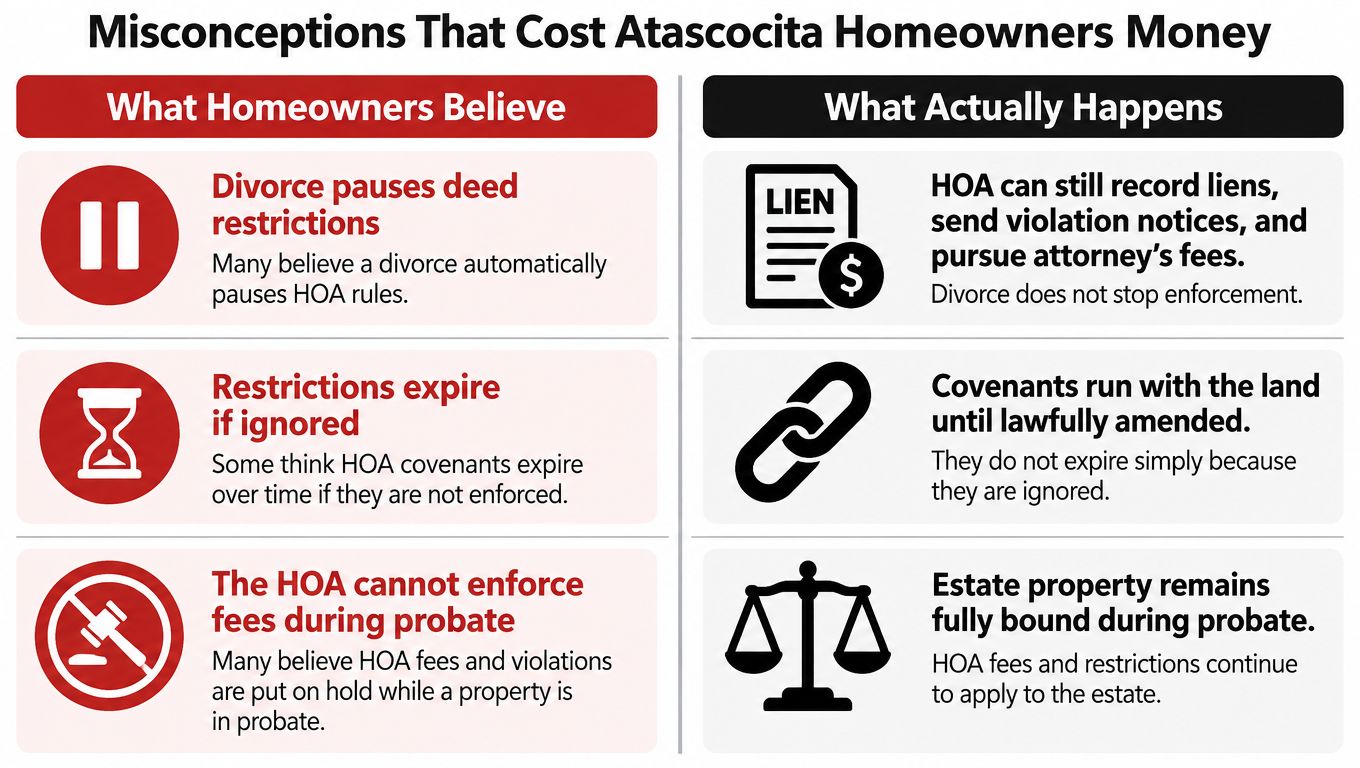
Myth: Divorce pauses the HOA's authority. It doesn't. The association can continue sending violation notices and pursuing available remedies while the spouses' case is pending. Family-court deadlines and HOA compliance deadlines are separate matters.
Myth: The final decree automatically changes the county title. A decree can order a transfer, but the parties may still need a properly prepared and recorded deed, and a lender may have its own requirements. Until the records and loan documents are handled, both spouses may remain connected to the title and mortgage.
Myth: An inheritance is exempt from restrictions. The ownership may pass through probate, but the property remains governed by the recorded covenant package. Heirs should review occupancy, construction, architectural, and resale provisions before making plans.
Myth: Paying assessments creates rights beyond the documents. Voluntary payments don't replace the recorded restrictions or expand the association's authority. Read the declaration, amendments, bylaws, and applicable law instead of relying on a payment history or verbal assurance.
Myth: A restriction can be ignored because neighbors have ignored it. Selective enforcement arguments can be fact-specific and difficult. Before relying on an apparent pattern, have counsel review the actual covenant language, enforcement history, notices, and any amendments.
Your Local Action Plan and When to Call a Lawyer
Run this checklist before you sign a divorce settlement, accept an inheritance, or list an Atascocita Forest home:
- Pull the exact covenant package. Match the restrictions and amendments to the home's legal description and section.
- Confirm title. Obtain the current Harris County records and identify owners, liens, mortgages, and unresolved transfers.
- Check compliance. Ask the association about open violations, assessments, architectural requests, and the documents required for an ownership update.
- Coordinate the legal paperwork. Make the decree, deed, probate documents, lender requirements, and association records consistent.
- Record promptly. Do not leave a signed transfer sitting in a file while the parties assume the ownership change is complete.
Call a lawyer before signing if the lender requires a partition or consent, two section documents contain conflicting easement language, foreclosure threatens a buyout, the decree has an unclear just-and-right finding, or the association threatens to place or enforce a lien. Those problems can affect the settlement value and may require court action, title work, or a negotiated compliance plan.
A property division attorney in Atascocita can review the family-law order alongside the recorded restrictions. That combined review is especially important for residents of Atascocita, Humble, and surrounding northeast Harris County communities who need the transfer to work in both systems.
The Law Office of Bryan Fagan – Atascocita TX Lawyers helps local families address divorce, property division, probate, estate planning, and related civil matters. Schedule a free consultation at the Atascocita office to review your section restrictions, title documents, proposed decree, and transfer plan before a preventable filing or HOA problem becomes more expensive.