You're sitting at the kitchen table in your Atascocita home, trying to decide whether keeping the house will give your children stability or leave you financially trapped. The mortgage statement is only part of the problem. Property taxes, insurance, HOA charges, and a Municipal Utility District assessment may all continue after the divorce, and the spouse who keeps the home may be the only person responsible for making those payments.
That's why Atascocita MUD district assessments and divorce property division require more than a quick estimate of the home's market value. The key question isn't who gets the house. It's who can sustain it after the marriage ends, while accounting for taxes, debt, refinancing, and the rest of the community estate.
Understanding Atascocita MUD Assessments in Divorce
A couple in Atascocita may believe their home has a certain amount of equity because they're looking at its estimated market value minus the mortgage balance. During divorce negotiations, that calculation often proves incomplete. The home may sit inside a Municipal Utility District, or MUD, that imposes its own property-tax charge alongside county, school, and city levies.
MUDs help fund local water, sewer, and related infrastructure through property taxes and assessments. The Texas Comptroller's county directory lists many Harris County MUDs, confirming that these districts are a routine part of property ownership in northeast Harris County. For homeowners in Atascocita, Humble, and nearby communities, the district charge is a recurring obligation attached to the property, not a one-time closing expense.
Why the monthly budget matters
Suppose one spouse wants to remain in the home with the children. That spouse may focus on the mortgage payment and assume the property is affordable because the other spouse will transfer ownership or accept other assets in exchange for equity. The budget can change once the remaining owner accounts for the complete cost of ownership.
A 2025 Harris County market snapshot reported a median Atascocita home price of $211,605, a median 2025 property-tax bill of $1,748, and an effective tax rate of 0.8% (Harris County property-tax market snapshot). The reported tax bill works out to approximately $145.67 per month, before considering mortgage payments, insurance, HOA charges, and any other property-related costs.
Practical rule: Treat the home as a continuing financial obligation, not merely as an asset awarded in the divorce decree.
A MUD assessment can affect the amount available for a buyout, the affordability of a refinance, and the proceeds available if the home is sold. It can also expose an overlooked disagreement between the spouses. The person leaving may want credit for taxes paid before the sale, while the person staying may argue that those payments are necessary household expenses.
The settlement should address those issues directly. A decree that says one spouse receives the home without accurately accounting for district taxes may transfer title, but it won't guarantee that the arrangement is financially workable.
How Texas Community Property Laws Apply to Marital Homes
Texas starts with a presumption that property acquired during the marriage is community property. The court must divide the community estate in a manner that is “just and right” under Texas Family Code Section 7.001, not automatically in equal shares (Texas State Law Library explanation of property division).
That distinction changes how you should approach the marital home. Use these steps to identify the legal and financial issues.
Step one, classify the home and related obligations
If the home was purchased during the marriage with marital earnings, it will generally be treated as community property. The same analysis can extend to the mortgage balance, property taxes, MUD charges, insurance obligations, and other debts connected to the residence.
The fact that only one spouse's name appears on the deed or loan doesn't automatically remove the home from the community estate. Texas community-property guidance identifies real estate, businesses, vehicles, money, retirement accounts, and other property acquired or earned during marriage as potentially community assets (Texas community-property overview).
A spouse who claims the home, or a portion of it, is separate property must prove that claim with clear tracing evidence. Relevant records may include a premarital deed, inheritance documents, gift records, or financial statements showing how funds moved into the purchase.
Step two, evaluate the entire estate
A judge doesn't divide the house in isolation. The court considers the community estate as a whole, including retirement accounts, vehicles, business interests, cash, and debts. Children's needs, each spouse's earning capacity, and the circumstances of the marriage may affect the outcome.
That's why the spouse who paid more toward the mortgage doesn't automatically receive a larger share of the home. The court examines the overall evidence and determines what division is just and right.
Step three, calculate net equity
Gross value can mislead both spouses. The useful figure is the property's value after subtracting the mortgage, liens, delinquent taxes, MUD charges, selling expenses where relevant, and other obligations that affect the property's real economic value.
For residents who need focused guidance on this process, a Property Division Lawyer in Atascocita handles division of community property and complex assets for Atascocita divorces. You can also review what community property means in Texas before gathering documents for mediation or court.
The True Cost of Keeping a Home with MUD Assessments
A spouse may qualify to keep the Atascocita home and still be unable to afford it after divorce. The market price is only the starting point. Harris County property taxes can include county, school, city, and district charges, while the MUD portion depends on the specific district. MUD notices express rates as a dollar amount per $100 of assessed valuation. Harris County examples include $0.84 per $100 and $0.207 per $100, as shown in this Harris County MUD tax-rate notice.
A nearby home may carry a different burden. The district, assessed value, exemptions, and current billing status all affect the amount owed. Review the actual tax records for the property instead of relying on a neighbor's bill or a listing estimate.
Net equity is the number that belongs in negotiations
An agreed market value does not complete the calculation. The spouses must identify the mortgage payoff, home-equity debt, unpaid property taxes, MUD charges, liens, and other obligations. If one spouse keeps the property, that spouse must also qualify for any required refinance and carry the recurring housing expenses alone.
MUD assessments can steadily erode the value of retaining the home. They may not reduce the appraised market value directly, but they increase ownership costs and can make the property unaffordable on one income. The settlement should account for the full carrying cost, including taxes, insurance, mortgage payments, district charges, maintenance, and likely future financing.
| Financial Metric | Estimated Annual Impact | Effect on Divorce Settlement |
|---|---|---|
| Property-tax bill | Varies according to the property's assessed value, exemptions, and applicable taxing entities | Reduces the cash available for housing and may affect whether one spouse can keep the home |
| Monthly property-tax allocation | Calculate the annual bill as part of the household budget | Shows whether post-divorce income can cover the recurring obligation |
| MUD district tax | Varies by district and assessed value | Lowers practical equity and may affect refinance or buyout feasibility |
Do not treat the home as affordable because the mortgage payment fits. Add every recurring district and tax obligation before agreeing to a buyout.
The settlement should value the home based on what it costs to own, not what it looks like on a real-estate listing.
This analysis matters in a High-Net-Worth Divorce in Atascocita, where one spouse may receive retirement accounts, business interests, or liquid investments while the other retains the residence. The exchange must reflect liquidity, tax exposure, recurring obligations, and the risk of future financing.
For guidance on the ownership decision, review who gets the house in a Texas divorce. The answer depends on the complete estate and the just-and-right standard, not on title alone.
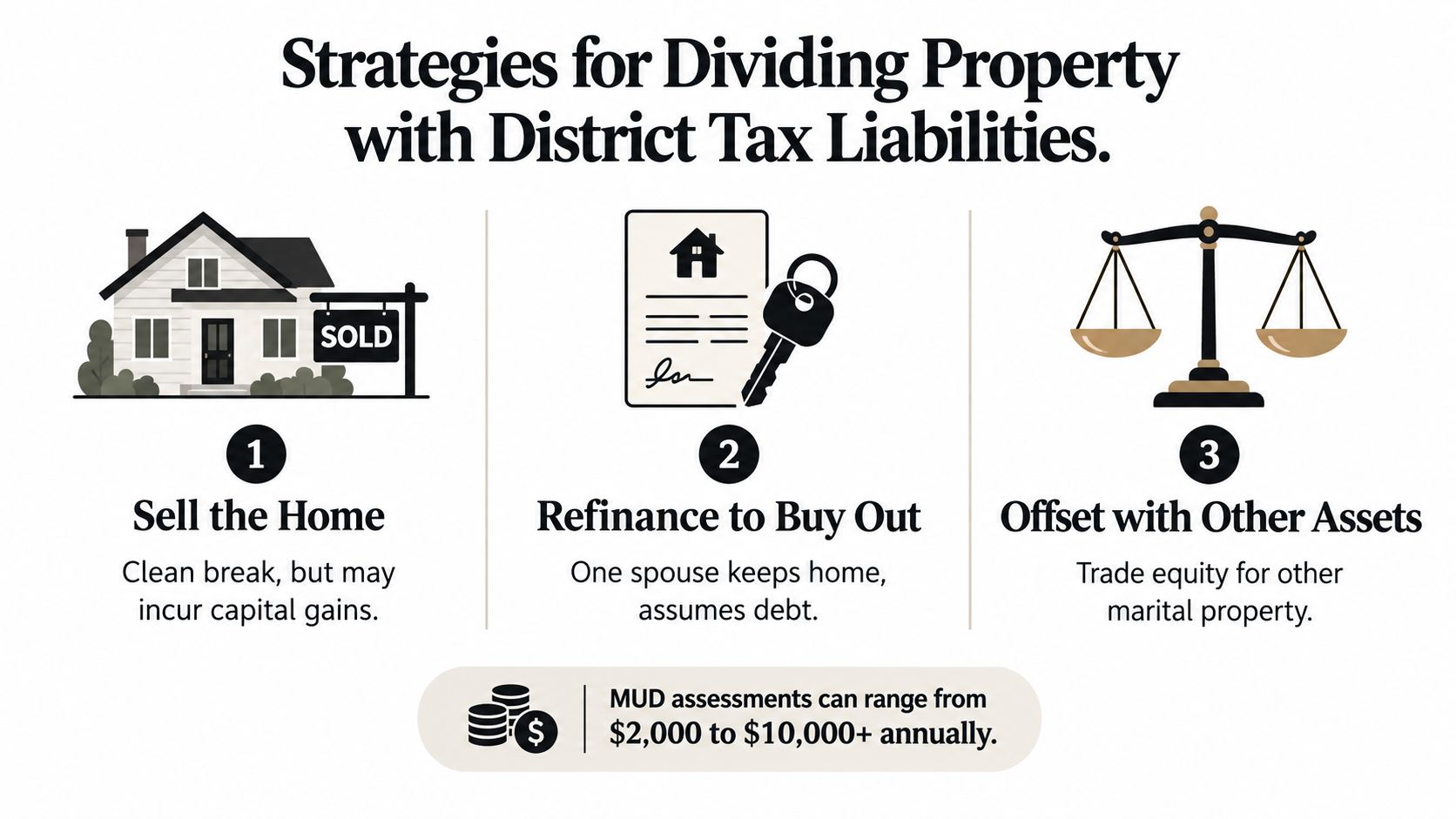
Strategies for Dividing Property with District Tax Liabilities
There are three practical ways to handle a marital home with MUD-related costs. None is automatically correct. The right option depends on equity, income, credit, tax status, debt, children's housing needs, and whether the spouse keeping the home can carry the full monthly burden.
Sell the home
Selling usually creates the cleanest financial break. The parties can pay the mortgage, liens, delinquent taxes, and other closing obligations, then divide the remaining proceeds under the settlement or court order.
The drawback is emotional and practical. Children may need to move, the sale may take time, and the spouses must agree on repairs, listing terms, access, and price. Unpaid county or district charges can also complicate the closing process. A sale makes sense when neither spouse can comfortably carry the complete housing cost or when the parties need to convert an illiquid asset into cash.
Refinance and buy out the other spouse
A refinance can allow one spouse to keep the home and pay the other spouse's share of the net equity. It can also remove the departing spouse from the mortgage, which is important because a deed transfer alone may not release someone from loan liability.
This route only works if the remaining spouse qualifies for the new loan and can handle the mortgage, insurance, HOA charges, taxes, and MUD obligations. A lender's approval is separate from the family court's property ruling. The decree should set firm deadlines and explain what happens if the refinance fails.
Offset the home with other assets
The spouses may agree that one person keeps the home while the other receives retirement funds, cash, business interests, or other community property. This can avoid an immediate sale or refinance, but the assets must be valued accurately and compared for liquidity and tax consequences.
A retirement account may not have the same practical value as cash, and home equity may be difficult to access. The agreement should also identify who handles future tax bills and what happens if the staying spouse later sells the property.
Choose the strategy that protects post-divorce solvency, not the strategy that preserves appearances.
Practical Scenarios for Atascocita Homeowners Facing Divorce
The planned buyout that becomes a sale
An Atascocita spouse wants to remain in the marital home so the children can stay in the same neighborhood. During the initial discussion, the spouse looks at the home's estimated value, subtracts the mortgage, and believes a buyout is possible.
The full budget tells a different story. Once the spouse adds the mortgage, insurance, HOA charges, property taxes, and the applicable MUD assessment, the monthly obligation exceeds what the spouse can responsibly carry on post-divorce income. A lender may also determine that the spouse doesn't qualify for the necessary refinance.
The financially responsible solution is a sale, even though it's not the preferred emotional outcome. The spouses can negotiate temporary occupancy, a marketing timeline, responsibility for taxes and repairs, and division of net proceeds. A clear plan protects both parties from a failed buyout that leaves the departing spouse tied to the mortgage or the remaining spouse facing foreclosure pressure.
The offset that accounts for recurring costs
In another Atascocita divorce, one spouse has stronger income and wants to keep the home. The other spouse prefers liquid retirement assets rather than an interest in the residence. The parties compare the home's net equity with the value and accessibility of the retirement account.
The spouse retaining the home argues that the ongoing MUD and property-tax burden reduces the home's practical value. That point doesn't automatically create a legal discount, but it is a legitimate negotiation issue because the staying spouse will assume the recurring costs and the risk of future increases or special assessments.
The final arrangement can give the staying spouse the residence while allocating a larger portion of liquid retirement property to the departing spouse, if the overall result remains supported by the community-property evidence. The agreement should identify account values, transfer procedures, tax treatment, and responsibility for the home's future expenses.
These examples don't create a formula for every family. They show why the home, debt, taxes, and other assets must be evaluated together. A settlement can look balanced on paper while leaving one spouse with an asset that is impossible to maintain.
Essential Steps to Protect Your Financial Future During Settlement
Collect the information before mediation, not after the spouses have already taken firm positions. In Atascocita and northeast Harris County, the county tax account and the applicable MUD records should form part of the property file.

Build the property file
Gather MUD documents. Collect tax bills, assessment notices, district correspondence, mortgage escrow statements, HOA records, and notices of special charges. Don't assume the escrow statement reflects every current obligation.
Confirm the county account. The Harris County tax office is the public contact for county property-tax records. The Texas Comptroller directory lists the office at 713-274-8000 and [email protected] (Harris County tax office directory). Ask for the current balance, payment status, and records connected to the property.
Identify the correct MUD. Verify which district serves the address and request the current rate, account information, delinquency status, and any assessment or operational notices. A nearby property may be in a different district with a different tax burden.
Obtain a reliable value. Use a current appraisal or another appropriate valuation method. The value should reflect condition, comparable sales, liens, and the property's local market characteristics.
List every debt. Include the mortgage, home-equity debt, credit cards, vehicle loans, tax balances, and other community obligations. Texas guidance recognizes that community debts are divided with community assets (Texas Law Help property-and-debt guidance).
Test the post-divorce budget. Prepare a realistic budget for the spouse who may keep the home. Include the full housing cost, maintenance, children's needs, support obligations, and any new debt created by a buyout.
Put the agreement in writing
The decree or settlement should address possession, refinance deadlines, payment responsibilities, sale procedures, taxes, insurance, repairs, and the consequences of noncompliance. If the home wasn't addressed in the decree, Texas law can permit a later suit for partition of undivided community property. Texas Law Help notes a two-year filing deadline under Family Code Section 9.202 for certain partition claims after denial of rights (Texas property-division guidance).
That deadline isn't a reason to postpone careful drafting. It's a warning that an unresolved asset can create a second legal dispute after the divorce.
When to Seek Local Legal Counsel for Complex Property Division
DIY property division is risky when the marital home carries MUD obligations, mortgage debt, tax balances, and competing claims about separate property. Online estimates and informal agreements won't answer whether a spouse can qualify for refinancing, whether the community estate has been fully identified, or whether the proposed exchange is just and right.
A local attorney can help you organize the evidence, identify the correct district records, calculate net equity, and negotiate a sale, buyout, or offset that reflects the home's ongoing cost. The attorney should also review title, mortgage liability, retirement accounts, business interests, debts, and any tracing claim before you sign a final agreement.
The property division attorney serving Atascocita, Texas can help evaluate these issues for residents of Atascocita, Humble, and surrounding Harris County communities. Bring your deed, mortgage statement, tax records, MUD notices, bank statements, retirement statements, and a list of debts to the consultation.
You don't have to decide between keeping the house and protecting your financial future without a clear analysis. Schedule a free consultation with the Law Office of Bryan Fagan – Atascocita TX Lawyers to review the home's net equity, MUD-related obligations, and the broader property-division strategy for your divorce.
The Law Office of Bryan Fagan – Atascocita TX Lawyers helps Atascocita, Humble, and Harris County residents address divorce, property division, custody, estate planning, criminal defense, and civil matters. Contact the office to discuss your MUD assessments, marital home, debts, and settlement options with a local legal team.