Fall Creek is unincorporated Harris County, so your divorce is filed in Harris County based on the 90-day county residency rule, and city limits do not determine divorce venue. Texas also requires at least six months of Texas residency before a divorce suit may be maintained.
You may be looking at a divorce form from a Fall Creek kitchen table, pausing at the box that asks for your city and county. Your mailing address may say Houston, your neighborhood may feel connected to Atascocita and Humble, and the paperwork may make it seem as if choosing the wrong local description could send your case to the wrong courthouse.
That concern is understandable, but the legal answer is more straightforward. For divorce venue, the important question is generally which county you or your spouse have lived in for the required period, not whether Fall Creek has its own city government. The same distinction helps with families dealing with child support, custody, or related Harris County family-law issues.
Why Your Fall Creek Address Confuses the Divorce Paperwork
A Fall Creek homeowner begins filling out a divorce petition and reaches the address section. The form asks for a city, county, and state. The homeowner knows the address uses “Houston” for mailing purposes, has heard that Fall Creek is connected to Houston's planning area, and wonders whether the case belongs in Houston municipal court, an Atascocita court, or somewhere else.
The practical answer is that Fall Creek is identified as an unincorporated community in Harris County, not as an independent city. The community's Fall Creek FAQ also describes it as being within Houston's Extra Territorial Jurisdiction, commonly called the ETJ. That affects how you understand local boundaries, but it doesn't turn Fall Creek into a separate municipality for divorce filing purposes.
The question is county, not neighborhood
Texas divorce venue works more like a county address on a package than a neighborhood label on a map. The court generally looks at whether either spouse has lived in the filing county for the required 90 days, along with the separate six-month Texas residency requirement. It doesn't ask whether your subdivision has its own mayor or city hall.
For many Fall Creek residents, that means the starting point is Harris County. A person can live outside an incorporated city limit while still living in the county where the divorce should be filed. That's why a Fall Creek address shouldn't automatically lead you to search for a “Fall Creek divorce court.”
The confusion often becomes more serious when one spouse recently moved, maintains a different mailing address, or lives outside Texas. Venue can depend on either spouse's qualifying county residence, so the address history of both spouses may matter.
What this means for a neighbor in northeast Harris County
Residents in Fall Creek, Atascocita, Humble, and nearby communities often share the same practical court system even though their municipal boundaries and local services may differ. The courthouse location, filing process, service requirements, and case assignment are county-level concerns.
You'll want to separate five questions:
- Is the property inside a city limit?
- Is the property in Harris County?
- Does either spouse meet the Texas six-month requirement?
- Has either spouse lived in Harris County for the required 90 days?
- Does a previous custody case create a different venue rule?
Once those questions are separated, the paperwork usually feels much less mysterious.
What Unincorporated Harris County Means for Fall Creek Residents
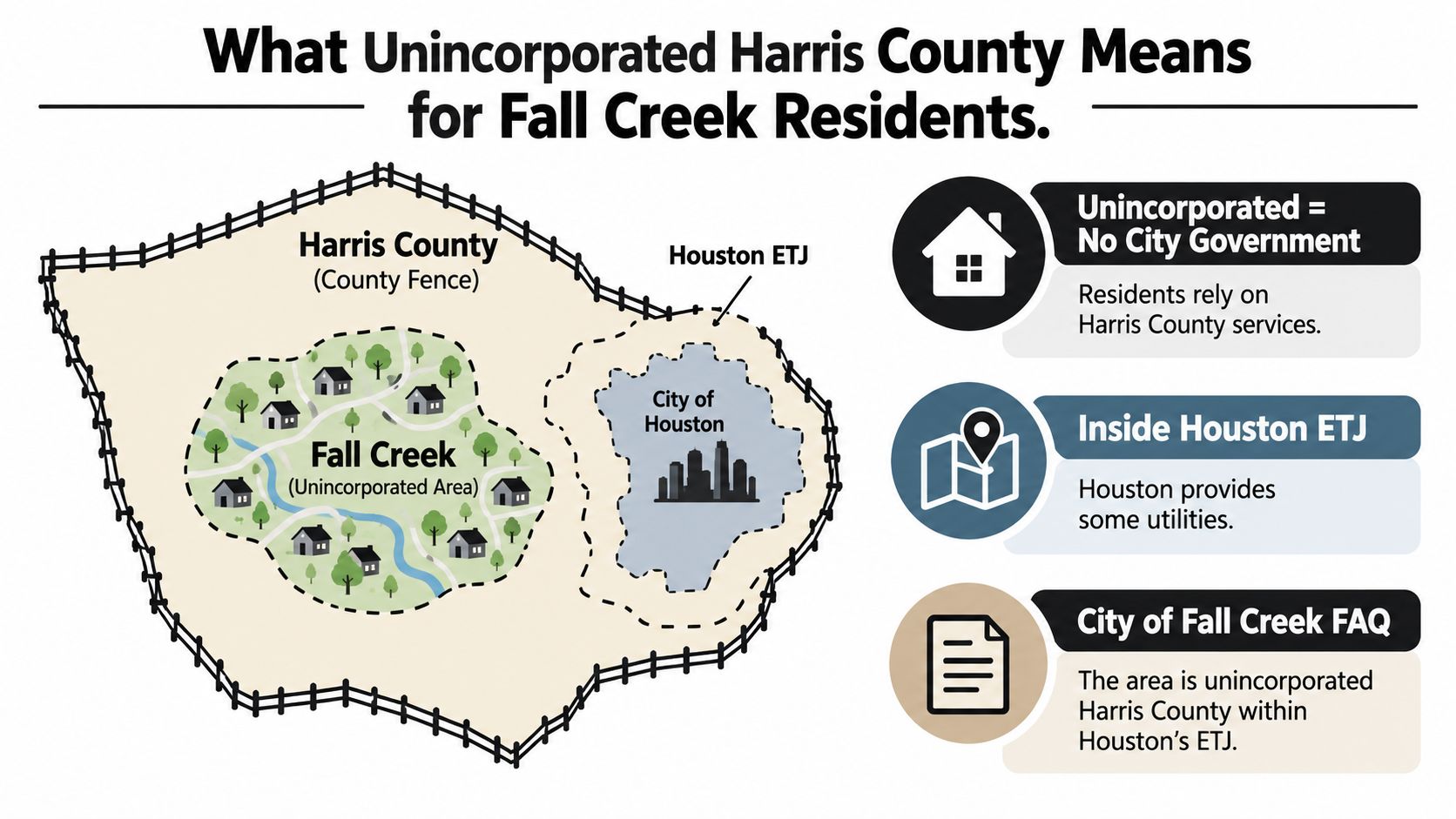
Think of Harris County as a large fence around many different communities. A city has its own smaller walls, government, and municipal services. Fall Creek sits outside an independent city's walls but inside the larger Harris County boundary. That's the everyday meaning of unincorporated Harris County.
The Fall Creek community's own FAQ describes the neighborhood's jurisdiction as unincorporated Harris County and within Houston's ETJ. The ETJ is a planning and regulatory area associated with Houston. It doesn't mean Fall Creek is inside Houston's municipal city limits, and it doesn't create a separate City of Fall Creek.
What unincorporated status can change
Unincorporated status can affect the local government responsible for services, planning, roads, permits, utilities, and property-tax arrangements. Those details can vary by address and service provider. A mailing address may use a familiar city name even when the property itself isn't inside that city's legal boundary.
The ETJ can also create confusion because Houston may have planning influence or involvement with certain development matters. That influence is different from municipal incorporation. A planning designation isn't the same thing as being a city resident.
For questions involving children, county-based legal services remain important. For example, an Atascocita Child Support Attorney may handle establishing, modifying, and enforcing child support in Harris County.
What unincorporated status does not change
It does not remove Fall Creek residents from Harris County's legal system. It does not create a separate divorce venue, and it does not move a family-law case into a municipal court just because the mailing address includes "Houston."
Divorce venue follows Texas county residency rules. The county clerk and family courts operate within the county structure, even when a resident lives in a suburban community outside incorporated city limits.
For divorce purposes, you are a Harris County resident if your qualifying residence is in Harris County. Your neighborhood's municipal status doesn't create a separate divorce venue.
That's the sentence to remember when the city-limit question starts to overwhelm the filing decision.
Texas Divorce Venue and the Residency Requirements
Texas divorce venue uses a two-part test. Both parts matter, and satisfying one doesn't automatically satisfy the other.
First, at least one spouse must have been a Texas domiciliary for the preceding six months. In ordinary language, Texas must be that spouse's home, with an intention to remain connected to the state. A temporary trip or short absence doesn't necessarily change domicile, but a genuine move can raise a more complicated question.
Second, either spouse must have been a resident of the county where the divorce is filed for the preceding 90 days. The Texas Family Code states the rule, and the Texas statutory venue provision explains that the case may be filed in the county where either party has lived for the required period, assuming the Texas residency requirement is met.
The two-part test: Texas must have been a spouse's home for at least six months, and either spouse must have lived in the filing county for at least 90 days.
How the rule works for a Fall Creek couple
Suppose one spouse has lived in Fall Creek for more than 90 days and has treated Texas as home for at least six months. The other spouse still lives in the same household, or has moved elsewhere. Harris County may be the proper venue because the Fall Creek spouse's qualifying residence connects the case to Harris County.
If both spouses live in different Texas counties, the filing spouse may have more than one possible venue. The law can allow filing in the county where either spouse meets the county-residency requirement. That doesn't mean every county is automatically acceptable. The filing must still match the facts and statutory requirements.
Why the filing county deserves careful attention
Venue is more than an administrative box. If a case is filed in the wrong county, the other spouse may raise a venue objection, and the case can face transfer issues under Texas family-law procedure. A transfer can create additional expense, delay service, and require the parties to reorganize filings or appearances.
That's especially stressful when someone is already dealing with property, children, support, or safety concerns. Before filing, gather the dates and addresses that show where each spouse lived. Keep records that help establish the relevant residence history, particularly if a move happened recently.
How Venue Differs From the 60-Day Waiting Period
Two separate clocks often get blended together during a divorce consultation.
The first clock answers where the case belongs. Venue generally points to the county where either spouse has lived for the required 90-day period, provided the Texas six-month requirement is satisfied. The second clock answers when the court can usually grant the divorce. Texas generally requires at least 60 days after filing before the court may grant the divorce, as explained by Texas Law Help's divorce guidance.
These clocks don't replace each other. Meeting the 60-day waiting period doesn't cure filing in the wrong county. Likewise, establishing Harris County venue doesn't mean the court can finalize the divorce immediately.
| Question | What it addresses | What Fall Creek residents should understand |
|---|---|---|
| Where do I file? | County venue | Qualifying residence generally points to Harris County when the facts meet the Texas rule |
| When can the court usually grant the divorce? | Waiting period | The court generally can't grant the divorce until at least 60 days after filing |
| Does unincorporated status change the venue rule? | City versus county jurisdiction | No, the divorce venue analysis remains county-based |
| What can cause avoidable delay? | Filing and procedure | An incorrect county can create transfer problems before the case moves forward |
For a Fall Creek resident, filing in the correct Harris County venue addresses the location question even though the neighborhood isn't within an independent municipal city limit. The waiting period remains a separate timing requirement.
You can review the practical distinction in this guide to the Texas waiting period for divorce. The safest planning approach is to calculate the residency dates and the waiting period independently.
How to Verify Whether Your Fall Creek Address Is Inside City Limits
The city-limit question can still matter for taxes, services, utilities, and local administration. It just shouldn't be confused with the divorce venue question. Address-specific verification is important because unincorporated Harris County is broad and fragmented, and a mailing city doesn't always identify the legal municipal boundary.
Start with the community description
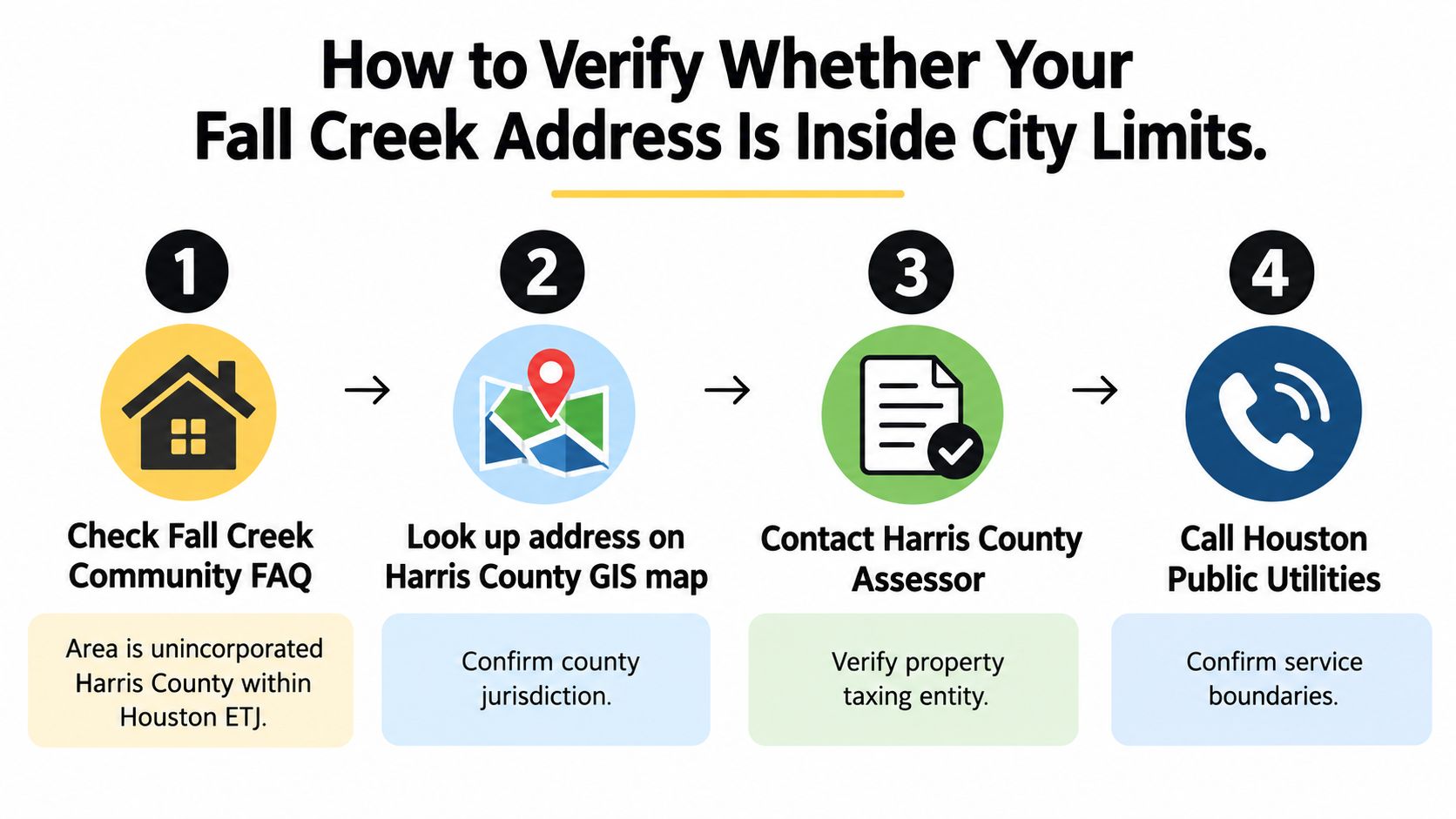
Begin with the Fall Creek community's own FAQ. It describes Fall Creek as unincorporated Harris County within Houston's ETJ. That gives you useful background, but it may not resolve every boundary question for every nearby property.
Then check the exact property address through Harris County appraisal and clerk records. County records can help identify the taxing entities and the governmental jurisdiction associated with the property.
Confirm the address through mapping and service records
If your home sits near a municipal boundary, use official county mapping tools or GIS resources. A boundary can run close to a subdivision, and nearby homes may have different municipal classifications despite sharing a mailing city.
The following checklist keeps the investigation focused:
- County: Confirm whether the property is located in Harris County.
- Municipal boundary: Check whether the legal address falls inside a city limit or an unincorporated area.
- ETJ: Determine whether the property is within Houston's ETJ.
- Taxing entity: Review the property's appraisal and tax records.
- Utilities: Confirm which provider serves the address.
- School boundaries: Verify the relevant school district separately.
The last three items can affect daily life, taxes, and services. They don't change the Texas divorce venue analysis, which turns on the spouses' qualifying residence.
Recently moved spouses need a separate review
A person's current mailing address may not tell the entire venue story. If one spouse recently moved from Fall Creek to another Texas county, the dates and location of that move may determine which county satisfies the 90-day requirement. The Texas State Law Library's filing guidance highlights the importance of the spouses' county residence and the Texas residency period.
If you're also trying to understand how ETJ status affects other legal filings, review this guide to Houston ETJ and Atascocita legal filings. For divorce, however, keep the central distinction in view: city boundaries help identify local government, while county residence usually controls venue.
Filing Divorce in Harris County From Fall Creek
A Harris County divorce from Fall Creek is legally a county case, but the physical logistics can feel very local and very real. Harris County family courts are located at 201 Caroline in downtown Houston, according to the Harris County family court information. Residents driving from Fall Creek, Atascocita, or Humble may need to plan for downtown traffic, parking, security, and time away from work.
Harris County has ten family district courts, so the assigned court and the number of appearances can affect the practical experience. Not every case requires the same number of court visits, and some matters resolve through agreements or remote procedures when permitted. Still, you should ask early how hearings, mediation, discovery, and finalization may affect your schedule.
Budget for the initial filing and case expenses
Harris County's civil filing fee schedule lists a $365.00 divorce filing fee for both divorce with children and divorce without children. The amount appears in the Harris County civil and family fee schedule. Service fees and other case-specific expenses may be added, depending on how the case proceeds.
| Item | What Applies to Fall Creek |
|---|---|
| Venue county | Harris County when the statutory residence facts support filing there |
| Texas residency | At least six months for at least one spouse to qualify under the Texas rule |
| County residency | At least 90 days in the filing county for either spouse |
| Waiting period | At least 60 days after filing before the court can usually grant the divorce |
| Divorce filing fee | $365.00 for divorce with children or without children |
| Other expenses | Service fees and other costs depend on the case |
The county procedure is the same Harris County process that Atascocita and Humble neighbors use. Unincorporated status may shape services and taxes, but it doesn't create a special Fall Creek divorce track.
For a location-focused explanation of the court question, see which court handles divorce for an Atascocita unincorporated Harris County address. The most useful preparation is practical: confirm venue, collect residence dates, identify service needs, and plan for downtown appearances before filing.
When Spouses Live in Different Counties or States
The hardest venue questions usually arise after the household has already separated. One spouse may have moved from Fall Creek to another Texas county. Another may have relocated outside Texas. A third situation may involve an existing custody case that changes the analysis for child-related proceedings.
If one spouse recently moved to another Texas county, the relevant question is whether either spouse has lived in the proposed filing county for the required 90 days. The spouse who remained in Harris County may support Harris County venue if the residence facts satisfy the rule. The spouse who moved may also create a different possible venue if the new county's timeline qualifies.

When one spouse lives outside Texas
An out-of-state spouse doesn't automatically eliminate a Texas filing option. If the Texas-resident spouse satisfies the six-month Texas requirement and the county-residency facts support Harris County, Harris County may remain the proper divorce venue.
Service becomes an important practical issue in that situation. The petition must be served correctly, and the out-of-state spouse may have separate questions about participation, jurisdiction over property, or child-related orders. Those issues should be reviewed before the petition is filed rather than after a service problem develops.
Divorce venue and custody venue may not match
A prior SAPCR, meaning a Suit Affecting the Parent-Child Relationship, can change the venue analysis for custody enforcement. In certain continuing-jurisdiction situations, Texas law may require an enforcement action to transfer to the county where the child has resided for six months or longer, as reflected in the Texas courts guidance on continuing jurisdiction.
The focus is generally the child's principal residence during the relevant period. The child doesn't necessarily need to have remained in one place without any interruption. That makes custody venue a separate question from the location of a divorce petition.
For example, a divorce may properly begin in Harris County because a spouse meets the county-residency rule, while an enforcement matter connected to a prior custody order may belong elsewhere. Filing both matters under the same assumption can create avoidable transfer problems.
This is the point where a short venue review can prevent a long procedural detour. Gather the spouses' addresses, move dates, the child's principal-residence history, and any prior SAPCR or custody orders before choosing the filing county.
Getting Trusted Help With Your Fall Creek Divorce
The city-limit question often feels bigger than it is because several different systems use overlapping geographic labels. Fall Creek can be described as unincorporated Harris County and within Houston's ETJ, while a mailing address may use Houston. Those facts can coexist without changing the county-based divorce venue rule.
Before filing, focus on the facts that matter:
- Confirm the county: Identify where each spouse lived, not just the city name used for mail.
- Count the residence periods: Check the six-month Texas requirement and the 90-day county requirement separately.
- Review recent moves: A change from Fall Creek to another county can affect the available venue.
- Check prior custody orders: A SAPCR can create a different venue analysis for child-related enforcement.
- Plan for logistics: Account for downtown Houston court access, service, fees, and possible appearances.
- Ask about the case type: An agreed matter and a contested divorce may require different preparation.
A local attorney can review these details before a petition is filed. That review is especially useful when spouses live apart, one spouse is outside Texas, the address is near a boundary, or children are covered by an earlier order.
The Law Office of Bryan Fagan – Atascocita TX Lawyers provides family-law guidance for residents of Fall Creek, Atascocita, Humble, and northeast Harris County. The firm's services include divorce representation and contested divorce services for cases where the spouses disagree about issues such as property, children, or support. You don't have to determine the correct venue by guessing from a mailing address.
Schedule a free consultation with Law Office of Bryan Fagan – Atascocita TX Lawyers to review your Fall Creek address, residency dates, prior custody orders, and Harris County filing options. The Atascocita office serves residents of Fall Creek, Atascocita, Humble, and surrounding northeast Harris County communities, so you can receive clear guidance before filing.