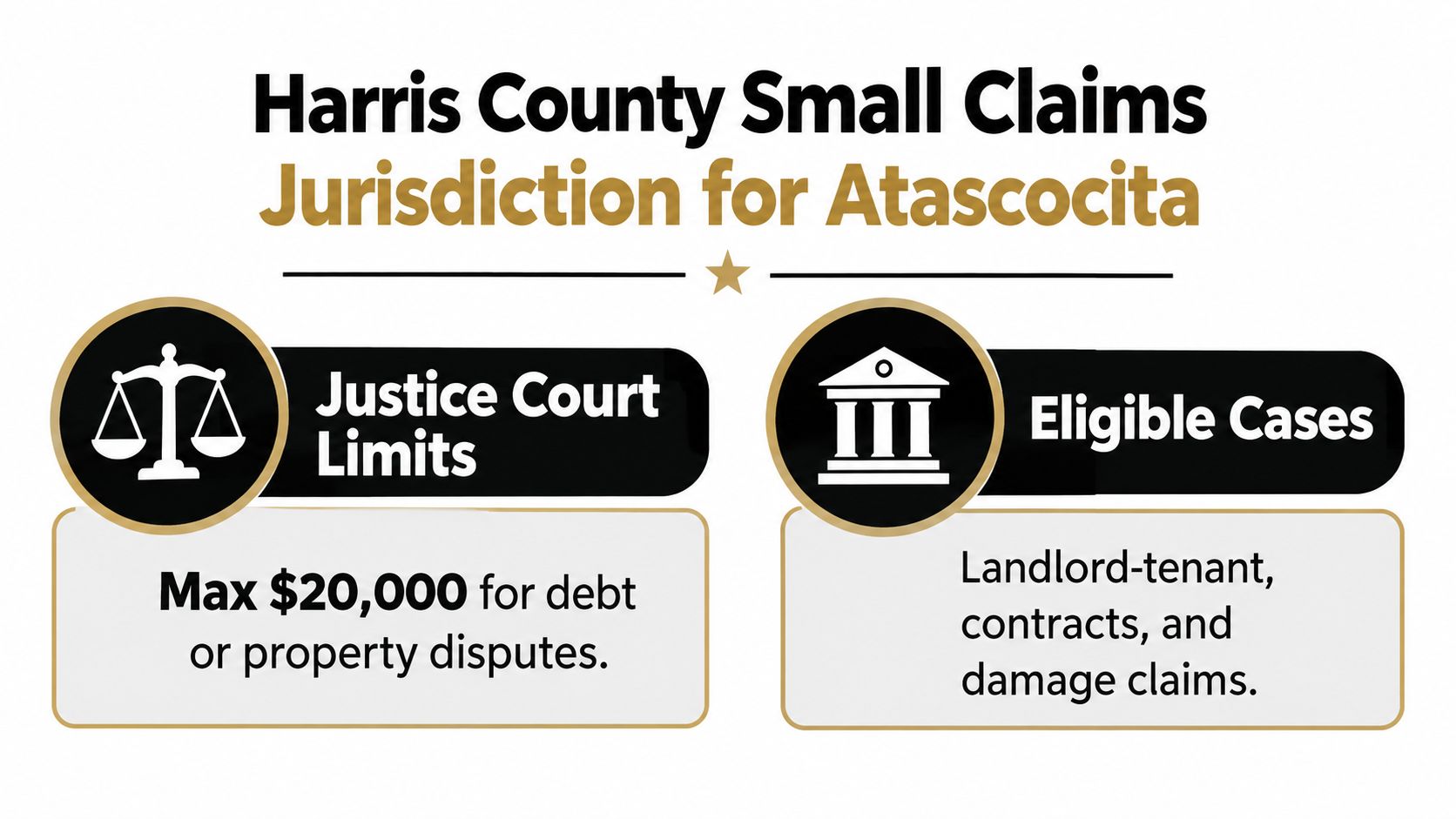
The Texas small claims limit in justice of the peace courts is $20,000, exclusive of interest and court costs. For an Atascocita resident, the correct Harris County precinct matters just as much as the amount of the dispute.
A contractor stopped responding after taking payment, a former tenant left property damage, or a customer failed to pay an invoice. You may be ready to recover the money, but filing in the wrong Harris County court can waste time and add cost before a judge ever hears the facts. The practical question is not just whether you have a valid claim. It's whether your claim belongs in a Harris County JP court, and whether you've followed the local process closely enough to move it forward.
Understanding Small Claims Jurisdiction in Harris County
An Atascocita homeowner pays a company to repair a fence. The work remains unfinished, the company denies responsibility, and the homeowner has invoices, photographs, and messages documenting the dispute. Filing at the nearest courthouse may seem practical, but a Harris County justice court must have authority over both the amount in controversy and the proper county and precinct.
Texas justice courts hear civil disputes up to $20,000, excluding interest and court costs, while attorney fees may be included when the law or contract allows them. The Texas State Law Library notes that the limit increased from $10,000 for cases filed before September 1, 2020. That change brought more consumer, debt, property, and contract disputes within the justice court process. These Texas small claims jurisdiction rules are the first reference point for deciding whether a claim fits.
Why the precinct is part of jurisdiction
An Atascocita mailing address does not, by itself, identify the justice court that should hear a case. The applicable Harris County JP precinct can depend on the defendant's residence, the location of the event, the place where a contract was to be performed, or the location of the property involved.
That detail affects common local disputes. A breach-of-contract claim against a business, property damage at an Atascocita home, and a debt claim against a former customer may point to different court assignments. A defendant who moved to another part of Harris County can also change the practical filing analysis.
The city label is only a starting point. Check the complete address and the facts connecting the dispute to the precinct before preparing the petition.
Practical rule: Treat the $20,000 limit as the first screen. Confirm the proper Harris County precinct before filing.
Small claims procedure covers civil disputes. It does not handle divorce, child custody, or criminal charges, which follow different rules and belong in different courts. For comparison, Harris County Family Courts: A Atascocita Resident's Guide explains how family law matters proceed in the Harris County courts serving Atascocita.
A changing Texas structure
Texas's current small claims structure developed relatively recently. Before August 31, 2013, justices of the peace also served as small claims court judges. After that date, small claims cases were filed in justice courts under procedural rules adopted by the Texas Supreme Court.
Harris County's justice court materials identify the current $20,000 jurisdictional ceiling. They also explain that, when a precinct has more than one JP court, a case may be brought in any small claims court within that precinct. Harris County justice court information helps clarify why the local precinct assignment remains important even when the parties live near one another.
For an Atascocita resident, the result is practical. A dispute within the monetary limit and connected to a proper Harris County venue may proceed in JP court. A claim above the limit, or one involving issues better suited to a higher court, can create dismissal, transfer, or added-cost problems if filed in justice court.
Determining the Correct Venue for Your Case
A former customer in Atascocita may owe you money, yet the nearest courthouse is not automatically the right place to file. Jurisdiction asks whether a justice court can hear the type and size of dispute. Venue identifies the county and precinct where the case should be filed. Choosing the wrong precinct can delay the case or require you to refile.
Texas generally permits a small claims case in the county and precinct where the defendant lives, where the incident occurred, where the contract was to be performed, or where the property is located. The Texas State Law Library's venue guidance for small claims cases also describes an option to file in the plaintiff's county and precinct when the defendant lives out of state or the defendant's residence is unknown.
Applying the rule to Atascocita disputes
Start with the connection that best fits the facts:
- Local defendant: If a former customer owes you money, verify the defendant's current residence and the JP precinct covering that address. Do not rely only on the address used during the transaction.
- Location-based dispute: A collision, property incident, or similar event may point to the precinct where it occurred, even when one party lives in Atascocita.
- Contract dispute: If the agreement identifies where work or payment was supposed to occur, that performance location may determine venue.
Atascocita's city label or ZIP code does not settle the question. Addresses near city-limit or extraterritorial-jurisdiction boundaries can lead to unexpected court assignments. For Atascocita addresses near those boundaries, review how the Houston ETJ affects Atascocita legal filings before confirming the precinct.
Compare the defendant's address, the event location, or the contract's performance location with the county's official court information. Then confirm the assigned JP court directly through the county portal. Harris County civil court information provides county court details for checking the appropriate court and case status.
File where Texas venue rules permit the case, not merely where the courthouse seems convenient.
That check matters in disputes involving unpaid rent, vehicle damage, unfinished contractor work, or a personal debt affecting your household budget. Family law follows a separate procedure. For comparison, The Divorce Process in Atascocita: What to Expect outlines divorce filing in Atascocita and Harris County.
Filing Your Petition and Paying the Filing Fee
An Atascocita resident can have a well-supported claim stalled by an incomplete petition or an incorrect filing package. After confirming the proper precinct and venue, prepare the paperwork so the clerk can identify the parties, understand the dispute, and route the case correctly. Harris County justice court materials identify the governing framework as Texas Rules of Civil Procedure 500 through 507. The claim must fall within the justice court limit of $20,000 or less, excluding interest and court costs but including attorney fees when applicable. Harris County filing information for small claims explains the county's procedure and filing requirements.
Prepare the claim before visiting the clerk
A petition should give the judge a direct factual path from the agreement or event to the money you contend is owed. Organize these points before you file:
- Identify every party accurately. Use the defendant's correct legal name and a service address where legal papers can be delivered.
- State the basis of the dispute. Explain whether the claim involves a debt, contract, property damage, or another civil matter within the court's authority.
- Describe the essential facts. State what happened, what the defendant was supposed to do, what went wrong, and what remains unpaid or unrepaired.
- State the amount sought. Separate the principal loss from any request for interest, court costs, or attorney fees when legally available.
- Swear to the petition. Harris County's process calls for a sworn petition, so you sign it under oath before a notary or authorized court official.
The sworn statement makes the petition a formal account of the facts, rather than an informal complaint. Keep the language concise and factual. Make sure your records support the events and amounts described, since those documents may become part of your courtroom presentation.
Budget for filing and service
Harris County states that the filing fee is $54.00, with $75 per defendant for Harris County process service. These amounts appear in the county's small claims filing instructions. Verify the current court information before submitting anything because local procedures and costs may change.
If paying upfront would create a hardship, the Texas small claims packet allows a Statement of Inability to Pay. The request can seek relief from filing, service, or appeal-bond costs. Approval is not automatic, so complete the form carefully and provide the information the court requires.
Bring the petition, the copies requested by the clerk, identification, and either payment or the completed inability-to-pay request. Filing the papers does not by itself complete every step of the case. The clerk must accept the documents, assign the case, and provide the information needed for formal service. Keep the case number and clerk's instructions with your records so you can track what happens after filing.
Serving the Defendant and Managing Costs
A defendant must receive formal legal notice before the case can properly proceed. Sending your own text message, email, or informal copy of the petition usually isn't a substitute for court-authorized service. The practical choice in Harris County is often between service through the appropriate constable's office and a private process server.
| Service option | Practical benefit | Cost consideration |
|---|---|---|
| Constable service | Uses the county process system and may be a straightforward choice when the defendant's address is reliable. | Harris County lists $75 per defendant for process service. |
| Private process server | May offer more scheduling flexibility or additional attempts when locating the defendant requires attention. | Private fees can differ, so obtain the charge before authorizing service. |
The county's stated service charge applies per defendant. If you name multiple defendants, each person requires proper service and creates another service expense. That can change the economics of a claim even when the underlying dispute appears simple.
Choose the method based on the address and urgency
Constable service may make sense when you have a current residential or business address and want to use the county's established process channel. A private process server may be useful when the defendant is difficult to reach, the address has unusual access restrictions, or you need to discuss the practical likelihood of repeated attempts.
Neither option fixes an incorrect address. Before paying for service, verify the defendant's name and location as carefully as possible. An unsuccessful attempt can delay the answer deadline and hearing process, while incorrect service can prevent the judge from moving ahead.
For Atascocita residents who need to identify the relevant constable area, which constable precinct serves Atascocita for service of process can help orient you to the local service question.
Budget insight: The cheapest service choice is not always the least expensive outcome. Paying for a method that has a realistic chance of reaching the defendant can avoid repeated attempts and avoidable delay.
After filing, monitor the case rather than assuming the defendant has been served. Ask the clerk or service office for status information, keep copies of returns, and act promptly if the court requires corrected information.
Preparing Evidence and Courtroom Strategy
A small claims hearing rewards organization. The judge needs to understand the agreement, the event, the breach or damage, and the amount requested without sorting through an unstructured phone gallery or a stack of unrelated messages.
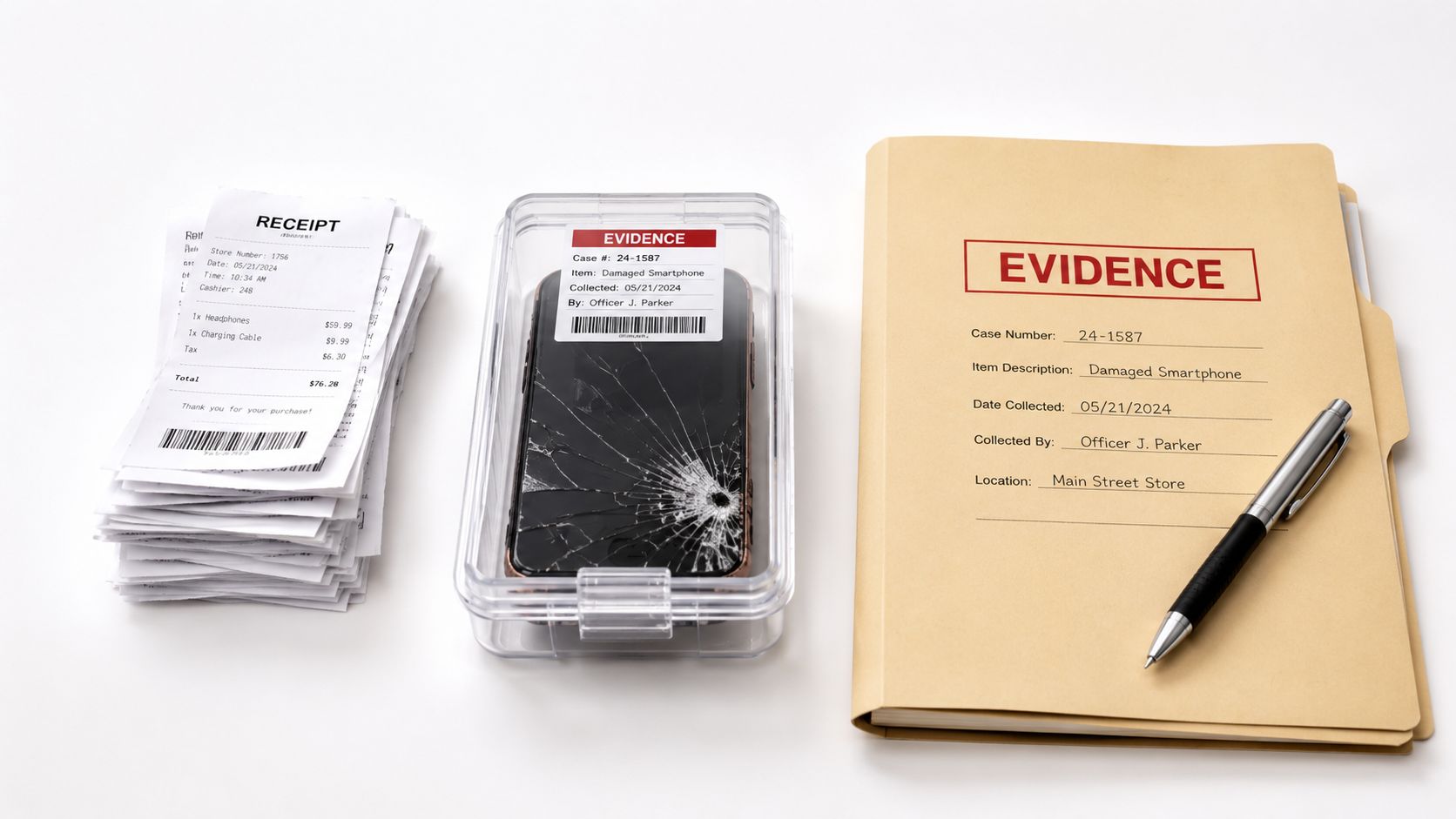
Build an evidence file that tells one story
Create a chronological file with a short index. Put the agreement or invoice first, then payment records, photographs, repair estimates, messages, and notices that show how you tried to resolve the problem. Bring the original records when available, along with organized copies for the court and the opposing party if required.
Your evidence should answer specific questions:
- What was promised? Use the contract, estimate, invoice, advertisement, or messages describing the agreement.
- What did you do? Show payment confirmations, delivery records, access provided, or other proof that you performed your part.
- What went wrong? Use dated photographs, inspection records, repair estimates, or communications acknowledging the problem.
- What do you want the court to award? Tie each requested amount to a receipt, invoice, canceled payment, or other reliable record.
Witnesses can help when they have direct knowledge, but a witness should explain what they personally saw or heard. A friend repeating what you told them may add less value than a dated message or photograph created close to the event.
The following video can provide general orientation about the small claims process. It doesn't replace the Harris County court's instructions or advice about the facts of a particular dispute.
Present the facts with discipline
Write a short outline before the hearing. Start with the result you want, then explain the events in order and identify the document that supports each important point. Avoid turning the hearing into a personal argument. A calm, direct explanation is more useful than speculation about the defendant's motives.
Arrive prepared to listen as well as speak. Address the judge respectfully, don't interrupt, and answer the question asked. If the defendant raises a new issue, take notes and respond with the document or fact that addresses it. If you don't know an answer, say so rather than guessing.
A judge can only decide from the evidence presented in the courtroom. The strongest private file has limited value if you can't locate the relevant document when the question arises.
Keep your phone silent, dress neatly, and bring your hearing notice and identification. Confirm the hearing details through the appropriate Harris County justice court because trial settings and local courtroom procedures can vary.
Understanding Outcomes and Next Steps
A hearing isn't necessarily the final practical step. The judge may rule for the claimant, rule for the defendant, or address an issue that requires a later filing or hearing. After the decision, read the judgment carefully and identify what it awards, denies, or requires.
Trial timing itself can vary. Texas small claims guidance explains that after the defendant answers, the judge has discretion over the trial setting, so docket management matters after filing as well as before the hearing. Texas small claims trial guidance also identifies the principal post-judgment options and deadlines.
If you believe the trial result is wrong
A motion for new trial must be filed within 14 days after judgment under the cited small claims guidance. That deadline is short, so don't wait while trying to decide whether the result feels unfair. Review the judgment, identify the specific error or newly relevant issue, and confirm the filing requirements with the court or a lawyer.
A motion for new trial is not merely a second opportunity to repeat the same presentation. You need a concrete procedural or factual basis and must follow the applicable filing and notice rules. Missing the deadline can eliminate an important avenue for correcting a trial-level problem.
If you obtain a judgment
A judgment establishes what the court awarded, but collecting may require additional legal steps. Texas small claims guidance identifies an application for writ of execution and a writ of garnishment as enforcement tools available to a prevailing party when appropriate.
The right tool depends on the judgment and the debtor's circumstances. Keep the signed judgment, track payments, and document any failure to comply. Don't threaten unauthorized collection measures or assume that a judgment automatically places money in your account.
For a contract dispute that continues after judgment, breach of contract remedies provides related information about possible civil remedies. A lawyer can help determine whether a writ, garnishment request, negotiation, or another lawful step fits the situation.
When to Seek Legal Advice from Local Attorneys
Small claims court permits self-representation, but some cases become difficult quickly. Consider legal advice when the defendant files a counterclaim, several people may share responsibility, important evidence is disputed, service keeps failing, or the claim raises a legal issue you can't explain confidently.
The most useful consultation happens before a preventable mistake. A local lawyer can review venue, the sworn petition, evidence organization, service choices, and the practical value of pursuing the claim. That review can be especially helpful for professionals and small business owners in Atascocita, Humble, and northeast Harris County who need to protect time as well as money.
The path is clear: confirm the $20,000 jurisdictional limit, verify the Harris County precinct, file a sworn petition, complete service, prepare focused evidence, and act promptly after judgment. If the dispute involves family law, criminal defense, estate planning, or a civil issue that no longer fits comfortably in JP court, use the court system designed for that matter rather than forcing it into small claims.
The Law Office of Bryan Fagan – Atascocita TX Lawyers provides local guidance on civil disputes, family law, criminal defense, estate planning, and related court matters for residents of Atascocita, Humble, and northeast Harris County. Schedule a free consultation by visiting Law Office of Bryan Fagan – Atascocita TX Lawyers to discuss venue, filing, service, evidence, or the next step after a JP court judgment.