A deputy has just handed you court papers at your Atascocita home. Your heart is racing, the paperwork is dense, and you may be unsure whether you can return to the house, call your children, or go to work. If you're searching for information about a protective order served by the Harris County Sheriff in Atascocita, treat the order as legally binding immediately, even if you believe the allegations are false or the paperwork is confusing.
Don't contact the applicant to argue, explain, apologize, or ask for the order to be withdrawn. Read every page, preserve the documents, and speak with a Texas attorney promptly. The safest first move is strict compliance while counsel reviews the order and develops a response.
Understanding Your Protective Order and Its Restrictions
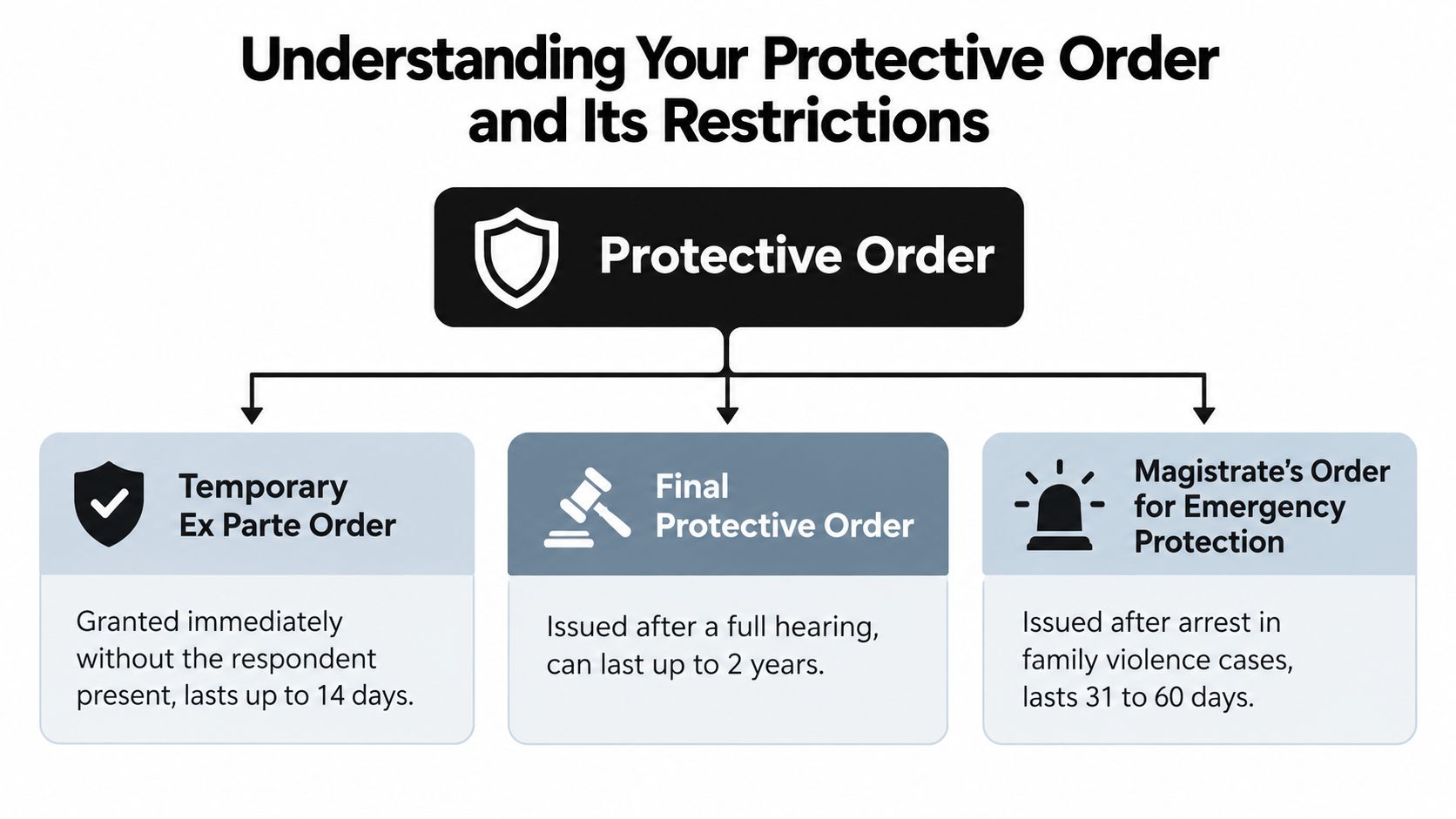
Texas uses several different protective-order procedures, and the document served on you matters. A temporary ex parte protective order can be entered before the respondent is present at a hearing. A final protective order follows a court hearing and may remain in effect for up to two years, according to Harris County protective-order guidance. A magistrate's order of emergency protection, often called a MOEP, may be issued by a criminal court after an arrest.
Those orders aren't interchangeable. Your paperwork should identify the order type, the protected people, the prohibited locations, and the specific conduct the court has restricted. Some orders prohibit direct contact, while others also prohibit contact through friends, relatives, children, social media, email, or messaging applications. The order may also prohibit harassment or coming near a protected person's home or workplace.
Read the order as an enforceable boundary
Start with these steps:
- Identify the order type. Look for language describing a temporary order, final order, or magistrate's emergency order.
- Mark every restricted person and location. Don't assume the order covers only the person who made the application.
- Read the contact provisions word for word. If it says no contact, don't send a message through a mutual friend or use a child to pass along information.
- Review hearing information. Write down the date, time, courthouse, and any instructions about responding.
- Give the complete paperwork to your attorney. Don't rely on a photograph of the first page.
For a plain-language overview of the subject, see what a protective order means in Atascocita. Residents researching domestic violence and family safety matters can also review Protective Orders in Atascocita.
A protective order doesn't decide every issue in a divorce or custody case. It does, however, create boundaries that can affect possession exchanges, communication about children, access to a shared residence, and future court proceedings. If the order conflicts with an existing custody order, don't decide for yourself which document controls. Ask counsel to address the conflict through the court.
How Harris County Manages Service and Enforcement
If a Harris County sheriff's deputy serves a protective order at your Atascocita home, identify the agency's role before you seek answers. The Harris County District Attorney's Protective Orders Section handles applications, while the court issues the order. The Sheriff's Office and constable units may serve the paperwork and respond when officers believe a violation has occurred. Constables may also assist applicants with appointments in some precincts.
For residents of Atascocita, Humble, and northeast Harris County, the process is handled through county offices rather than a separate neighborhood court. Harris County permits an application when the applicant or respondent lives in Harris County, or when the alleged violence occurred there. The central location listed for this process is the Juvenile Justice Center at 1200 Congress, 2nd Floor, Houston.
For details about how deputies handle family-violence calls locally, review the Harris County Sheriff family violence response in Atascocita. That local law-enforcement role is separate from the District Attorney's work on the application and from the court's authority over the order.
The county's victim assistance information from the Harris County Sheriff's Office lists formal support channels, including the Crime Victim Assistance Unit at 713-274-9369. County materials also list the Family Criminal Law Protective Orders line at 713-274-0212. Use these offices to determine where an application or victim-support question belongs. Contact a defense attorney for advice about your response, hearing, or possible service problem.
Service is more than a paper handoff
The respondent must receive the order directly. Giving papers to a friend, relative, or other third party does not complete formal service on the person named in the case. Harris County materials also identify the District Attorney's office as the office managing the protective-order process, so the applicant does not have to run the proceeding alone.
That distinction matters after service at an Atascocita residence. The deputy who delivered the documents may not have filed the application, prepared the case, or have authority to change its terms. Stay calm, keep the complete paperwork, and direct procedural questions to the appropriate county office or your attorney. Do not argue with the serving officer about the allegations.
Local practice point: The Sheriff, constables, District Attorney, and court have different jobs. If you send a hearing or service question to the wrong office, you can lose time when the issue requires prompt attention.
A related family case may involve The Divorce Process in Atascocita: What to Expect. Divorce filings and protective-order proceedings remain separate, even when they involve the same relationship or children.
Immediate Compliance and Safety Steps to Take Now
The first hours after service are when people make avoidable mistakes. They call the applicant, return to a restricted residence to collect belongings, post about the case, or ask a relative to negotiate. Don't do those things. Your intent won't necessarily protect you if your conduct violates the written order.
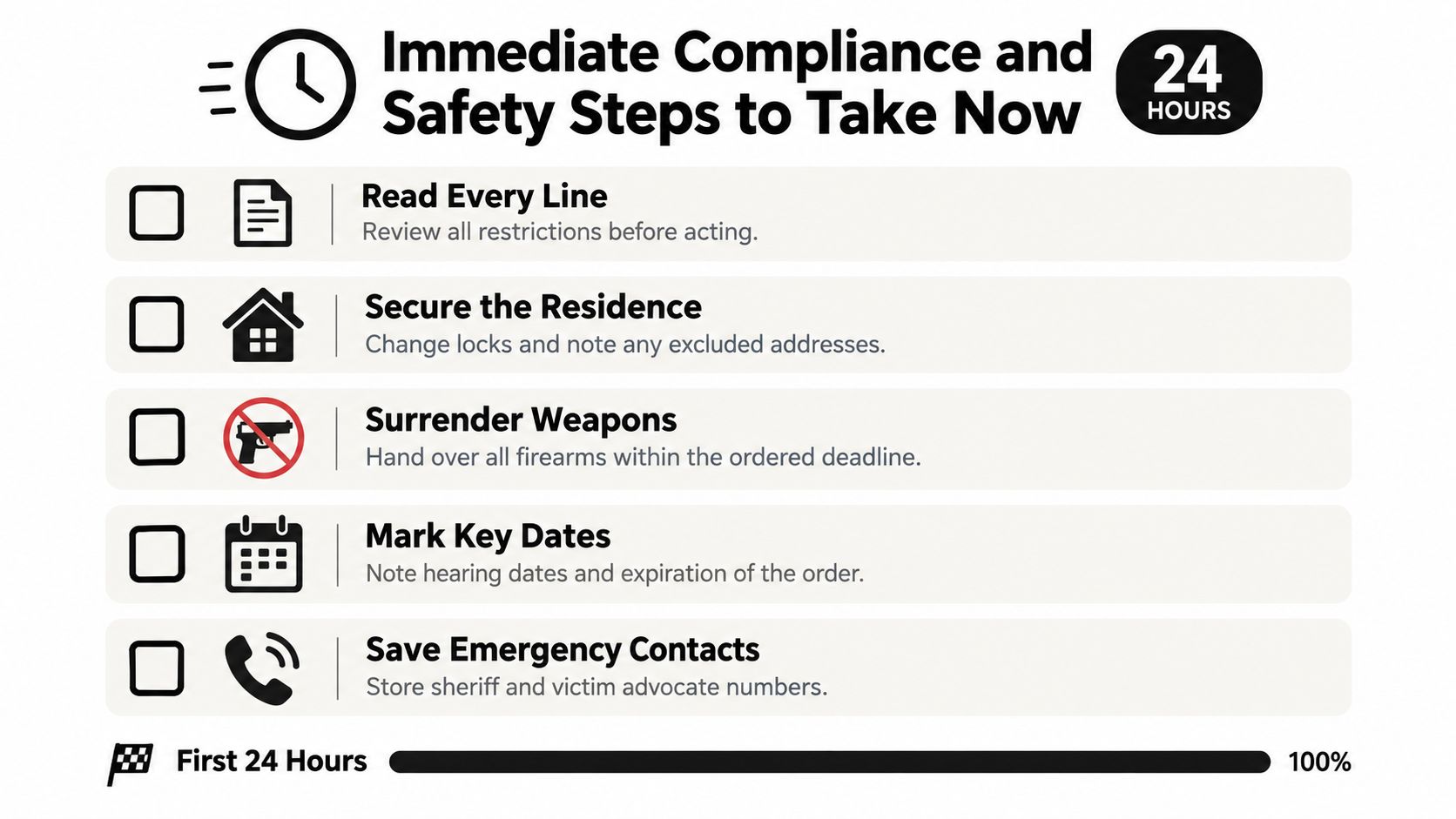
Your immediate checklist
- Secure the paperwork: Keep every page, envelope, attachment, and notice together. Photograph the documents for backup, but preserve the originals.
- Stop direct and indirect contact: Don't call, text, email, comment, send a gift, or ask another person to deliver a message. Don't use social media to communicate indirectly.
- Leave restricted locations if required: If the order excludes you from a shared Atascocita home, workplace, school, or other location, comply before trying to retrieve property.
- Arrange safe housing: Stay somewhere that doesn't require you to approach the protected person or violate a location restriction.
- Document your compliance: Record when you left, where you stored property, and the steps you took to avoid contact. Keep the record private and factual.
- Notify your employer only as necessary: If the order covers your workplace, tell the appropriate manager or security contact enough to prevent an accidental encounter. Don't distribute allegations or confidential paperwork.
- Write down deadlines: Mark the hearing date and any response deadline immediately. Bring the original documents to counsel.
If personal items, medication, identification, work equipment, or clothing remain at a restricted residence, do not just show up. Ask your attorney about a controlled retrieval process or a court-approved arrangement. A request to collect belongings does not automatically create permission to enter.
The same rule applies to child-related communication. If the order restricts contact with the other parent, don't assume that discussing visitation, school, medical care, or exchanges is automatically allowed. Your attorney can help identify whether the order provides a narrow exception or whether the court needs to clarify the arrangement.
Watch the following resource only in a safe setting and don't use general information to replace a review of your specific order.
Navigating Hearing Timelines and the 48-Hour Service Rule
Consider a common northeast Harris County situation. You receive an application at your Humble-area home, and the paperwork lists a hearing for the next morning. You've had little time to gather messages, identify witnesses, find housing records, or speak with a lawyer. Texas law gives respondents specific protections when service and hearing timing create an unfair preparation problem.
The respondent must receive formal notice of the application. Service follows the method used for citation under the Texas Rules of Civil Procedure, and publication service isn't allowed, as explained in the Texas Family Law Practice guidance on protective-order service.
What happens when service is incomplete
If the hearing is set before service is completed, you can ask the court to reschedule it. The new hearing date generally must be no later than 14 days after the request, according to that Texas practice guidance. This isn't a reason to ignore the hearing. It's a reason to act quickly and make a formal request through the court or your attorney.
A separate rule applies when service occurs within 48 hours of the hearing. Under Texas Family Code Section 84, the respondent may request a reset, and the court must reschedule the hearing for a date no later than 14 days after the original hearing date.
That timeline gives you a practical assignment. Save the exact time and date of service, keep the envelope or service paperwork, and notify counsel immediately. Don't assume the court knows when you were served. Your attorney may need to present that information and request the appropriate relief.
At the same time, prepare for the hearing rather than focusing only on delay. Preserve relevant messages, photographs, call logs, medical records, location information, and prior court orders. Don't delete unfavorable material, edit screenshots, or contact witnesses in a way that could be interpreted as pressure.
The Severe Consequences of Violating a Court Order
A protective order isn't a suggestion or a private agreement. It's a court order with enforceable restrictions. If you knowingly violate it, law enforcement may treat the conduct as a criminal matter, and the violation can create a second legal problem while the original application remains pending.
The most common mistakes look harmless to the person making them. A respondent may believe a short “I just need my tools” text is practical, or that a relative's message doesn't count as contact. If the order prohibits direct or indirect communication, those choices can create evidence against you.
The safest defense strategy begins with compliance. You can challenge the allegations, request a hearing, and seek a modification without testing the order's boundaries.
Violations can also complicate related divorce, custody, or support proceedings. A judge reviewing family-law conduct may consider whether a parent followed court instructions and respected the other household's safety. Don't assume a protective-order dispute stays isolated from a custody case in Harris County.
If you believe the order is inaccurate, too broad, or impossible to follow alongside an existing possession schedule, have counsel seek clarification or modification. Don't make a unilateral adjustment. Continue following the written terms until a court changes them.
The order may also affect firearms, residence access, workplace arrangements, and communication about children, depending on its language. Read the operative provisions carefully and ask a lawyer about any requirement you don't understand before taking action.
Securing Local Legal Representation in Atascocita
A protective-order case can sit at the intersection of civil procedure, family law, and criminal enforcement. The right attorney should review the order itself, the service details, the hearing schedule, any related arrest or criminal case, and existing custody or divorce orders. A lawyer who handles only one part of that picture may miss a conflict that matters to your safety and long-term rights.
For an Atascocita or Humble resident, the immediate legal work should be practical:
- Review the order: Identify each restriction, exception, protected person, and location.
- Protect the hearing record: Confirm the hearing date, assess service timing, and prepare a response.
- Address overlapping cases: Compare the protective order with custody, divorce, criminal, or property matters.
- Preserve evidence: Organize communications and records without contacting the applicant or witnesses improperly.
- Seek lawful changes: If the restrictions need clarification or modification, present that request through the proper court process.
The Law Office of Bryan Fagan – Atascocita TX Lawyers provides representation in family law, criminal defense, estate planning, and civil matters for individuals and families in Atascocita, Humble, and Harris County. For a related overview of local representation, visit the Atascocita restraining-order attorney resource.
You don't need to decide the entire future of your divorce, custody case, or family relationship on the day a deputy serves the paperwork. You do need to follow the order, protect the evidence, and obtain advice before responding. That disciplined approach gives your attorney room to address the allegations and protect the issues that matter beyond the immediate hearing.
The Law Office of Bryan Fagan – Atascocita TX Lawyers can review a protective order served in Atascocita, explain the restrictions, prepare for the hearing, and address related custody or criminal concerns. Visit Law Office of Bryan Fagan – Atascocita TX Lawyers to schedule a free consultation at the Atascocita office and discuss your next steps.