A parent in Atascocita may be preparing to enroll a child, sign a lease, buy a home, or negotiate a custody order. The listing says “Atascocita.” The mailing address says “Humble.” A nearby school appears to serve children in the neighborhood. Then the district asks for the exact address, and the family discovers that a community label doesn't answer the legal question.
That uncertainty can be stressful, especially when school placement affects a child's daily routine, transportation, special-education services, or a parent's proposed move. The phrase Atascocita geographic restriction to Humble ISD boundary describes a question that must be answered at the address and campus level, not by relying on a neighborhood name. This guide explains what controls, what documents to preserve, and when a school-boundary issue may require family-law advice.
Why the Atascocita Address Alone Does Not Guarantee Humble ISD Enrollment
A family moves into an Atascocita subdivision believing the school decision is settled. The children have already visited the nearby campus, and the real-estate listing describes the home as part of a Humble ISD community. During enrollment, however, the parent learns that the district needs the exact residential address and supporting proof. The parent now has to determine not only whether the home falls within Humble ISD, but also which campus serves that property.
The confusion starts with Atascocita's legal status. Atascocita is an unincorporated census-designated place in northeastern Harris County, approximately 6 miles east of Humble, rather than an incorporated city with its own municipal boundary. The Texas State Historical Association's Atascocita history records that the community was part of Humble ISD, but that historical relationship doesn't turn the word “Atascocita” into a school-attendance guarantee.

Why community labels create legal confusion
Atascocita's development began in the 1970s, and by the 1990s the community included more than 15 neighborhoods, according to the historical record linked above. Its large suburban area includes planned neighborhoods, parks, retail centers, and residential developments extending north and south of Farm Road 1960 and along Lake Houston.
Growth makes casual assumptions especially risky. A subdivision name may be used by a homeowner, a postal service, a real-estate agent, and a school district, but each may be describing a different geographic system. A mailing city identifies how mail is addressed. A subdivision name identifies a development. Neither one independently establishes school eligibility.
Practical rule: Treat “Atascocita” as a community description, not as the legal answer to a school-enrollment question.
For real-estate and family-law purposes, the controlling question is whether the specific residential address falls within the applicable Humble ISD boundary and attendance zone. A parent should verify the property's legal situs, obtain the district's current written determination, and preserve that record before relying on the school assignment in a purchase, relocation plan, or custody agreement.
How School District Boundaries Are Determined in Harris County
School eligibility and campus assignment are related, but they aren't the same decision. The district boundary answers whether a property is served by Humble Independent School District. The attendance zone answers which elementary, middle, or high school serves the child at that address.
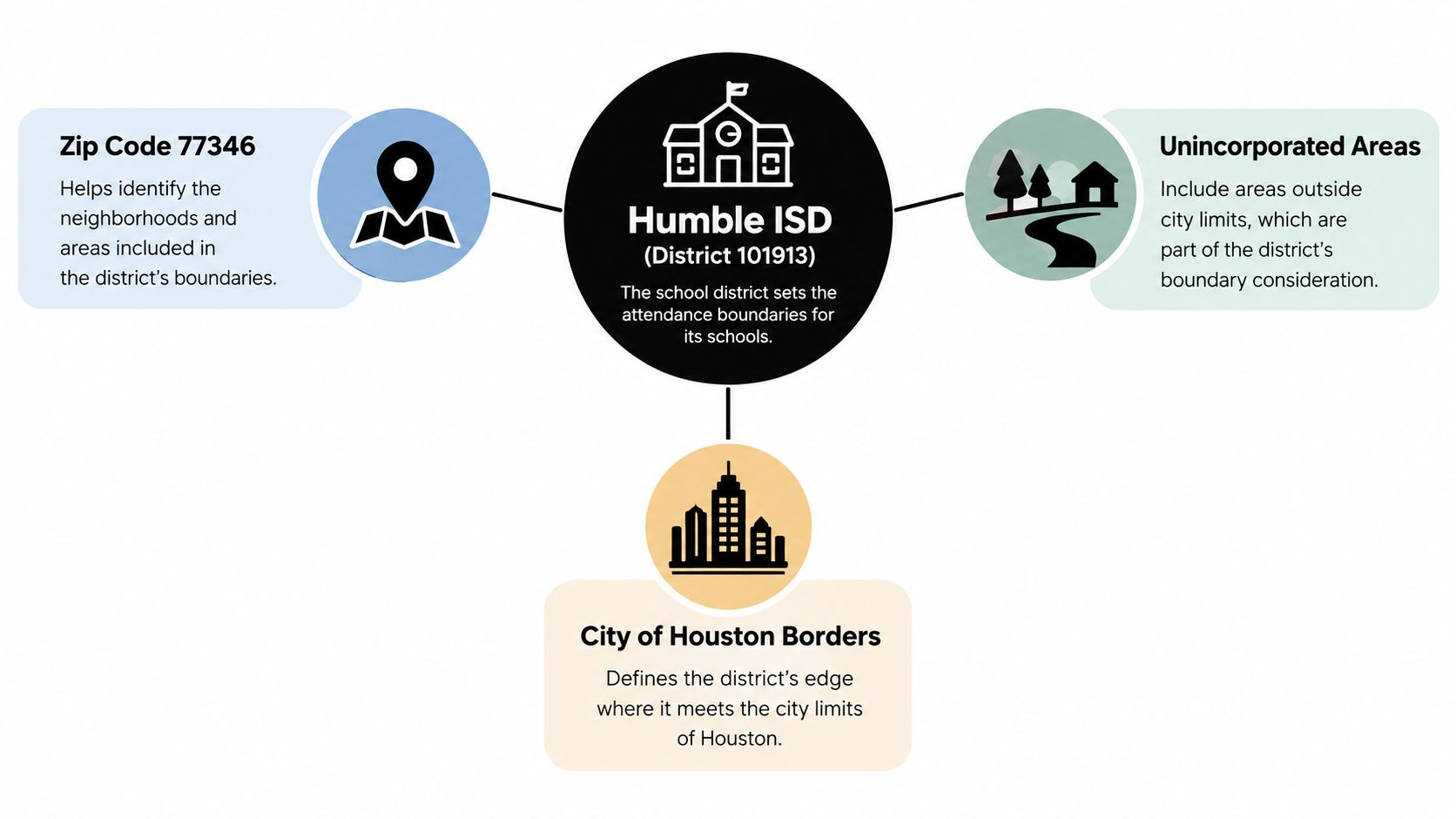
Humble ISD is identified by district number 101913 in Texas Education Agency records. Those records identify Atascocita High School as campus 101913008, confirming the institutional relationship between the Atascocita area and Humble ISD. They also identify separate Humble ISD campuses, including Atascocita Middle School and Atascocita Springs Elementary. The Texas Education Agency campus records show why the phrase “an Atascocita home” isn't enough to establish a particular campus entitlement.
The geographic systems do different jobs
Parents often place several map labels into one mental category. That's understandable, but the labels don't have equal legal effect.
| Geographic system | What it describes | Does it alone control school enrollment? |
|---|---|---|
| Census-designated place | A community identified for census purposes | No |
| Postal designation | The mailing city or address format | No |
| Municipal boundary | The limits of an incorporated city | No, not by itself |
| School-district boundary | The public-school district serving an address | Yes, for district eligibility |
| Campus attendance zone | The assigned school within the district | Yes, for the particular campus |
The important point is that attendance zones are address-based. Two properties that use Atascocita in a listing or mailing address can have different elementary, middle, or high-school assignments. Even homes that seem close to one another may be separated by a boundary line, a development section, or a later rezoning decision.
Why parcel-level verification matters
A school district doesn't assign a child based solely on what a neighbor says, what a listing promises, or what a map application displays. The district evaluates the residential address and applies the current boundary and campus rules. That's why a parent should ask for a written address lookup or enrollment determination rather than rely on a general statement that Atascocita is “served by” Humble ISD.
The distinction also matters in disputes. A parent may truthfully live in Atascocita as a community, yet still need separate proof of the district, the assigned campus, and the effective school year. Those records are more useful than a generalized neighborhood description when parents disagree about enrollment or relocation.
Step-by-Step Process to Verify Your Child's Assigned School Zone
A careful verification process begins before a move, enrollment deadline, or custody hearing. The goal isn't merely to find a school on a map. The goal is to create a dated record showing what Humble ISD determined for the exact property at the relevant time.
Start with the district's address determination
Submit the exact street address to Humble ISD's boundary resource. Include the complete address, including the unit or apartment identifier when applicable. Don't submit only the subdivision name, ZIP code, or mailing city.
Save the written result. Download or print the lookup, enrollment determination, email, or other district communication. Record the date on which the information was provided because boundaries and campus assignments can change.
Separate district eligibility from campus placement. Ask whether the property is within Humble ISD and which elementary, middle, and high-school campuses are assigned. A district answer without the campus assignment may leave an important question unanswered.
Humble ISD's attendance-zone and transportation resource states that its 2025–2026 information concerns school boundaries, not bus stops or transportation times. A parent must therefore confirm transportation eligibility separately. School assignment and bus service are related practical concerns, but one doesn't prove the other.
Match the lookup to the property
Review the deed, current lease, or other residence documents to ensure the address submitted to the district is the same property where the child will live. A real-estate listing may use a marketing name or mailing designation that differs from the property's legal situs. If parents live in different homes, preserve the address associated with each parent and identify which address the governing order or district determination uses.
Before relying on the result, recheck the assignment for the applicable school year. A simple file should contain:
- Exact address: Keep the complete street address and unit information.
- Dated district response: Preserve the lookup or written enrollment decision.
- Residence proof: Maintain the current deed, lease, or other accepted documentation.
- Campus assignment: Note the assigned elementary, middle, and high schools.
- Exceptions: Save any transfer, grandfathering, or written district determination.
This record can help a parent communicate with the district and can give an attorney a clearer factual foundation if a custody or relocation dispute develops.
Understanding the Difference Between District Membership and Campus Assignment
A child may live inside Humble ISD and still not attend the campus a parent expected. District membership establishes the public-school system connected to the address. The campus attendance zone determines the school assignment within that system.
The difference becomes clear when comparing the kinds of boundaries families encounter:
| Boundary question | Example | What it decides |
|---|---|---|
| Community identity | “This home is in Atascocita” | How residents and businesses describe the area |
| Property location | The exact home address | Which geographic records apply |
| District membership | The address falls inside Humble ISD | Whether Humble ISD is the applicable district |
| Campus zone | The current zone for that property | Which campus serves the student |
| Transportation eligibility | District transportation rules for the address | Whether bus service or other transportation applies |
Rezoning can change the answer after a family moves
In May 2025, Humble ISD trustees approved a rezoning affecting Sections 55B and 55F. For 2025–2026, incoming kindergarten students and students moving into those sections were shifted from Centennial Elementary to Summerwood Elementary. The change was scheduled to extend to students in all grades in 2026–2027. The stated reasons were anticipated overcrowding at Centennial and additional classroom capacity at Summerwood, as reported in coverage of the Centennial and Summerwood rezoning decision.
That example matters because it disproves a common assumption: Humble ISD assignment doesn't guarantee campus stability through graduation. A family may remain in the same general community while the assigned elementary school changes. The district boundary and the campus zone can remain distinct even when the child's home doesn't move.
Parents should ask whether a rezoning includes grandfathering, transition provisions, or grade-specific rules. They should also preserve written confirmation for the school year that matters to their family. If a custody order names a school, ties a parent's residence to a geographic restriction, or addresses transportation, a later rezoning may require legal review rather than an informal agreement.
A parent dealing with these questions may also need guidance on custody for parents living in the same school district, particularly when both homes remain in Humble ISD but fall into different campus zones.
How Boundary Disputes Affect Child Custody and Family-Law Cases
Consider two parents who live in the Atascocita and Humble areas. One parent believes the child should remain enrolled near the child's current home. The other parent plans to move to a different address and argues that the new home is still “in Atascocita” or close enough to the same school. Without an address-level determination, both parents may be relying on assumptions rather than evidence.

The school question can become a custody question
School placement is commonly tied to the child's residence and the district serving that location, not solely to a mailing city or real-estate label. That distinction can affect disputes about enrollment, transportation, special-education responsibility, and a proposed move between Atascocita and nearby Humble addresses.
The 2025 Humble ISD targeted monitoring report cites Texas Education Agency guidance stating that a local education agency must provide a free appropriate public education to eligible students receiving special education when the student attends an instructional setting located within the agency's geographic boundary. In practical terms, identifying the correct district can matter when parents disagree about which school system bears responsibility for services.
A parent should avoid treating the school map as the entire legal file. A technically defensible record should include:
- the child's exact residential address;
- the effective date of the district lookup;
- the assigned campus;
- proof of residence;
- any written transfer, exception, or grandfathering decision;
- communications about transportation or special-education responsibility.
The district's current address-level enrollment determination remains the practical verification. TEA records can corroborate the relationship between Humble ISD and its Atascocita campuses, but a campus list doesn't decide the assignment for every property.
A proposed move needs practical planning
A parent who wants to relocate should compare more than driving distance. The proposed address may change the campus, the school-day transportation plan, the child's access to services, and the time available for each parent's possession schedule. A parent should request the district's written answer before presenting the move as educationally neutral.
The same care applies when a parent changes residences during an active case. Keep copies of leases, deeds, enrollment records, attendance communications, and district decisions. If the issue involves a child's educational needs, modifying custody due to a child's school needs may require evidence showing how the requested change serves the child, not merely how it benefits one parent.
The central question is often practical: Can the proposed arrangement keep the child enrolled, transported, and supported without unnecessary disruption? Address verification gives the court and the parents a reliable starting point.
Exploring Transfer Options and Exceptions When You Live Outside Your Desired Zone
A parent may discover that the assigned campus isn't the preferred school. That doesn't necessarily end the discussion, but it changes the question from “What school does this neighborhood guarantee?” to “Does the district currently allow a transfer, and under what conditions?”
Humble ISD's published policy allows a parent or person standing in parental relation to request assignment to a campus other than the student's home campus. The policy treats the request as an application, not as an automatic right, and directs families who don't know their zoned campus to consult the district's attendance-zone information. The district's middle-school transfer information identifies campuses open for in-district transfers for a specified school year, including Atascocita and other Humble ISD campuses.
A transfer request should be handled as a separate process
Start with the home-campus determination. A parent needs to know the school assigned by address before asking for a different campus. Then review the current year's transfer information and confirm whether the desired campus is accepting applications.
Before relying on an approval, ask the district to clarify:
- Eligibility: Does the child and address meet the current transfer requirements?
- Timing: When must the application be submitted, and when will the decision issue?
- Duration: Does approval apply only to the specified school year?
- Transportation: Will the transfer change bus eligibility or transportation responsibility?
- Continuity: Could the child need a new request if the family's address or school year changes?
Parents in Atascocita, Eagle Springs, Summerwood, Fall Creek, and nearby Humble communities should preserve the application and written decision. A verbal understanding with another parent or a school employee may not explain the approval's limits.
Don't treat approval as a permanent geographic exception
A transfer can solve an immediate enrollment problem without permanently changing the child's home campus or the geographic restriction in a custody order. It may also depend on campus capacity and the particular school year. Those limitations matter when parents draft a parenting plan or negotiate a relocation.
If a child is already enrolled under an approved transfer, include the approval in the family's records and ask whether it survives a move, a change in grade level, or a change in custody arrangements. If the answer isn't clear, obtain written clarification before signing an agreement that assumes continued enrollment.
When to Consult an Atascocita Family Law Attorney for School-Boundary Disputes
A parent may live in an Atascocita neighborhood, use an Atascocita mailing address, and still need to prove the exact residence assigned to a Humble ISD school. Community names work like neighborhood labels, not enrollment guarantees. If a proposed move, competing addresses, custody order, or special-education question is involved, a map search may not answer the legal issue.
School attendance can add pressure. Atascocita Middle School states that students must attend classes or participate in online learning at least 90% of the days a class is offered, according to its attendance requirements. That threshold does not establish a boundary or guarantee admission. However, a possession schedule, transportation plan, or relocation that causes repeated lateness or missed instructional time may create a separate education and custody concern.
Build evidence before the disagreement grows
Treat the address file like a case file. Keep proof of residence, district communications, enrollment decisions, attendance records, and documentation for excused absences together. Prompt communication with the campus can help identify a problem before it becomes part of a modification or enforcement dispute.
A consultation may help when:
- a parent says an Atascocita mailing address guarantees a particular campus;
- the parents live in different Humble ISD attendance zones;
- a proposed move could change the child's campus or transportation;
- the district requests residence documents that are difficult to provide;
- a special-education responsibility question involves district boundaries;
- rezoning affects the child's current or expected school;
- a transfer approval may not continue into a later school year.
A custody attorney near Humble ISD in Atascocita can review how the district's address determination interacts with an existing order, possession schedule, or relocation plan. A Child Custody Lawyer in Atascocita, TX provides custody and conservatorship representation for Atascocita families.
The Law Office of Bryan Fagan, Atascocita TX Lawyers, addresses family-law concerns involving custody, divorce, and related disputes. Criminal defense, estate planning, wills, trusts, probate, and civil litigation involve different legal questions and should not be treated as part of a school-boundary analysis.
If divorce is also part of the family's situation, the Texas divorce statute summary describes separate filing and waiting-period rules. Those rules do not determine which Humble ISD school serves a particular address.
Because eligibility can turn on one address and one school year, bring the district's determination, proof of residence, school communications, attendance records, and current court orders to a consultation. The Law Office of Bryan Fagan, Atascocita TX Lawyers, offers consultations through Law Office of Bryan Fagan, Atascocita TX Lawyers.